A growing company can survive messy spreadsheets for a while, until it starts hiring across state lines, handling terminations, and answering legal questions with three different versions of the same personnel file. That's when HR decisions stop being routine and start becoming evidence. A strong HR governance framework gives leadership a way to make people decisions with consistency, accountability, and a clear record of why each choice was made.
A mid-sized business can look organized on the surface and still have HR decisions drifting in different directions. One manager approves exceptions casually, another asks for extra documentation, and a third keeps using an outdated policy after a state expansion. That kind of inconsistency turns into risk quickly, because no one can tell whether the company is following a system or just reacting in the moment.
An HR governance framework is the control system that brings order to that environment. It defines who decides, who approves, what gets documented, and how leaders review the outcome. In practice, that means HR, Legal, Finance, and business leaders follow defined accountability, approval, and oversight across hiring, workforce planning, compensation, performance management, employee data, and compliance.
For SMBs, that structure matters because growth makes informal habits harder to defend. A company cannot rely on memory when someone asks why a termination moved forward, why a promotion was approved, or why one employee record had broader access than another. The framework gives leadership a clear way to explain those choices, compare them across locations, and keep decision rights consistent when the workforce spans more than one state.
Think of HR governance as a control tower. Air traffic controllers don't fly the plane, but they keep everything coordinated so each flight follows the right path. HR governance plays the same role for people decisions, it aligns approvals, standards, and oversight so the employee lifecycle moves in a controlled way instead of depending on individual manager style.
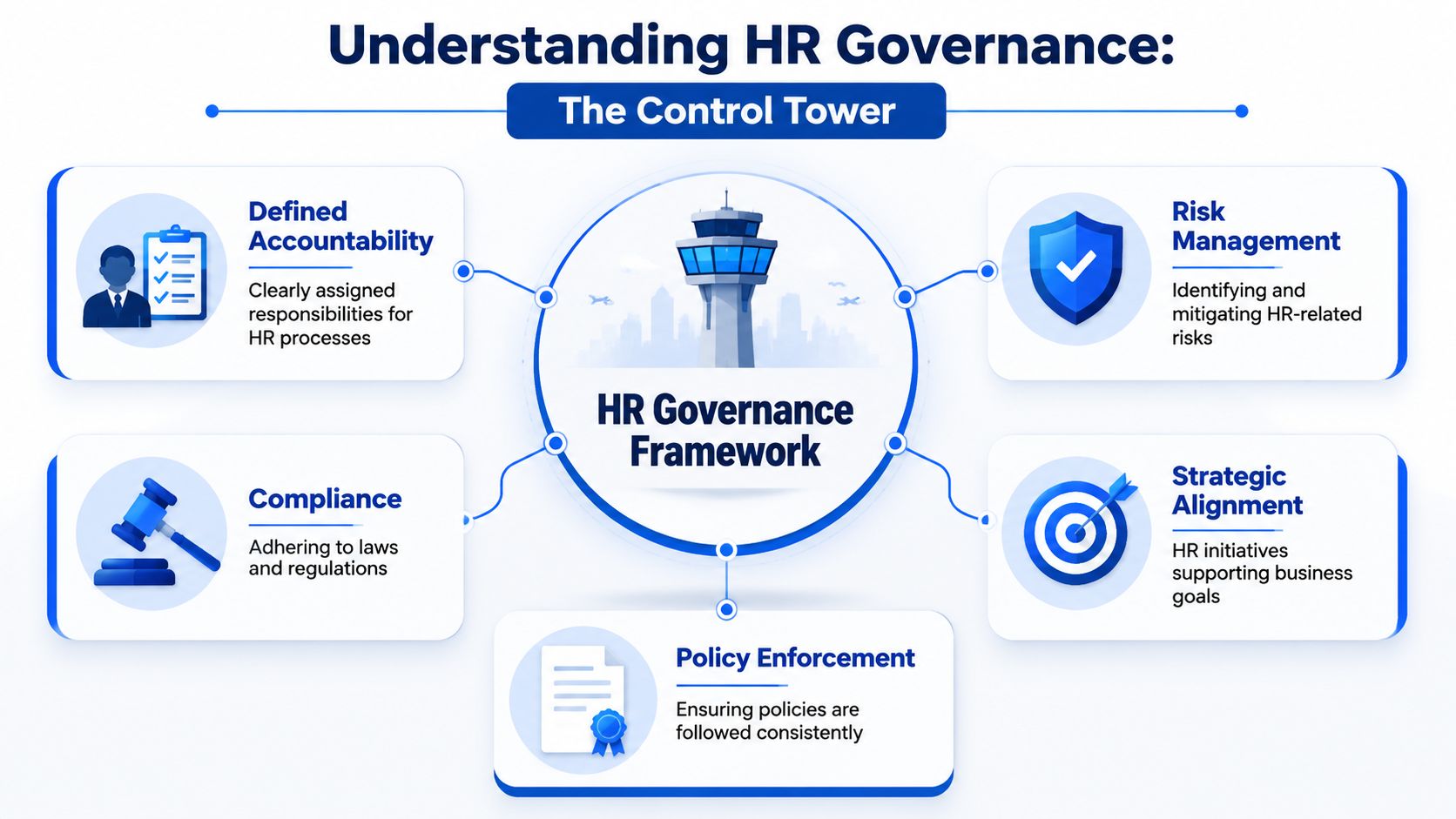
The key idea is simple. Governance exists to manage people-related decisions through defined accountability, approval, and oversight structures across hiring, workforce planning, compensation, performance management, employee data, and compliance, according to AIHR's HR governance guidance. Modern frameworks also lean on common workforce definitions, validation rules, reporting standards, retention schedules, and access controls so leaders can review governance metrics on a regular cadence and spot recurring compliance issues, slow approvals, or poor data quality.
A policy tells people what should happen. Governance makes sure the right people carry it out, and that someone can prove it happened. That distinction matters because a policy on paper doesn't stop ad hoc approvals, missing documentation, or unsupported exceptions.
Practical rule: if a people decision could later be questioned by Legal, an auditor, or an executive, it needs a governance path, not just a policy reference.
There's also a useful way to separate the layers. Process support helps HR work efficiently. Standard ownership tells the company who is responsible for the rule itself. When those two get mixed together, teams start assuming someone else owns the decision, and that's where gaps appear.
The control tower analogy also explains why governance is not just an HR issue. Compensation touches Finance, investigations touch Legal, and workforce planning affects business strategy. A strong framework gives each stakeholder a role without letting every stakeholder improvise the rules.
That's why the most mature organizations keep definitions, access rules, and reporting standards consistent. They want the same data to mean the same thing in every review meeting, not a different version depending on who exported it. For leadership teams, that consistency is the bridge between HR administration and real risk control.
An SMB can feel an HR governance gap faster than a larger company because there are fewer layers to catch mistakes. A policy update gets missed, a termination file is incomplete, or a manager in one state applies a practice that does not fit another jurisdiction. Those are not small administrative slips. They are the points where avoidable legal exposure starts, and where leaders begin to question whether a high-stakes people action can be defended.
An effective HR governance framework is a decision architecture. It defines roles, decision rights, controls, compliance monitoring, audit cadence, and performance measurement so hiring, compensation, terminations, and investigations are handled consistently and defensibly across the organization, as noted by Zalaris. For SMBs operating across multiple states, that structure reduces variation. It means fewer ad hoc manager decisions, fewer documentation gaps, and a clearer evidence trail for legal review.
In practice, the first pressure point is inconsistency. A leader may treat a decision as “minor,” but a weak approval path can make it look arbitrary later, like a turnstile with no record of who entered. The second is visibility. If HR, Legal, and Finance are not looking at the same standards, one team may believe the company is compliant while another is still cleaning up exceptions.
The third pressure point is evidence retention. If the company cannot show why an action happened, or who signed off on it, the defense becomes weaker even when the original decision was reasonable. That is why governance failures usually show up as documentation gaps, unclear thresholds, and informal approvals that never got recorded.
A good governance model does not slow the business down. It keeps the business from having to explain avoidable mistakes later.
For leaders who want to connect governance with broader risk discipline, HR risk management strategies offers a useful lens. It frames the work as reducing uncertainty, not just adding rules.
Strong governance supports three things leadership cares about. It keeps decisions consistent across jurisdictions. It creates a defensible trail for high-risk people actions. It also cuts the friction that comes from redoing work because the first approval path was not clear.
That matters especially in SMBs, where one unclear manager decision can ripple into employee relations, legal review, and operational delays. Governance is what keeps those moments from becoming organization-wide cleanup projects. A simple way to see it is this, if the company can explain who decided, who approved, and what evidence was kept, the organization is in a much stronger position than if the answer depends on memory.
For teams that need to connect governance to everyday execution, an HR operating model helps show how authority, process, and accountability fit together.
A usable HR governance framework needs more than a handbook. It needs a structure that tells people where authority sits, how decisions move, and what proof gets kept. If those pieces are vague, the company ends up with policies that sound strong but do not hold up when someone asks how a choice was made.
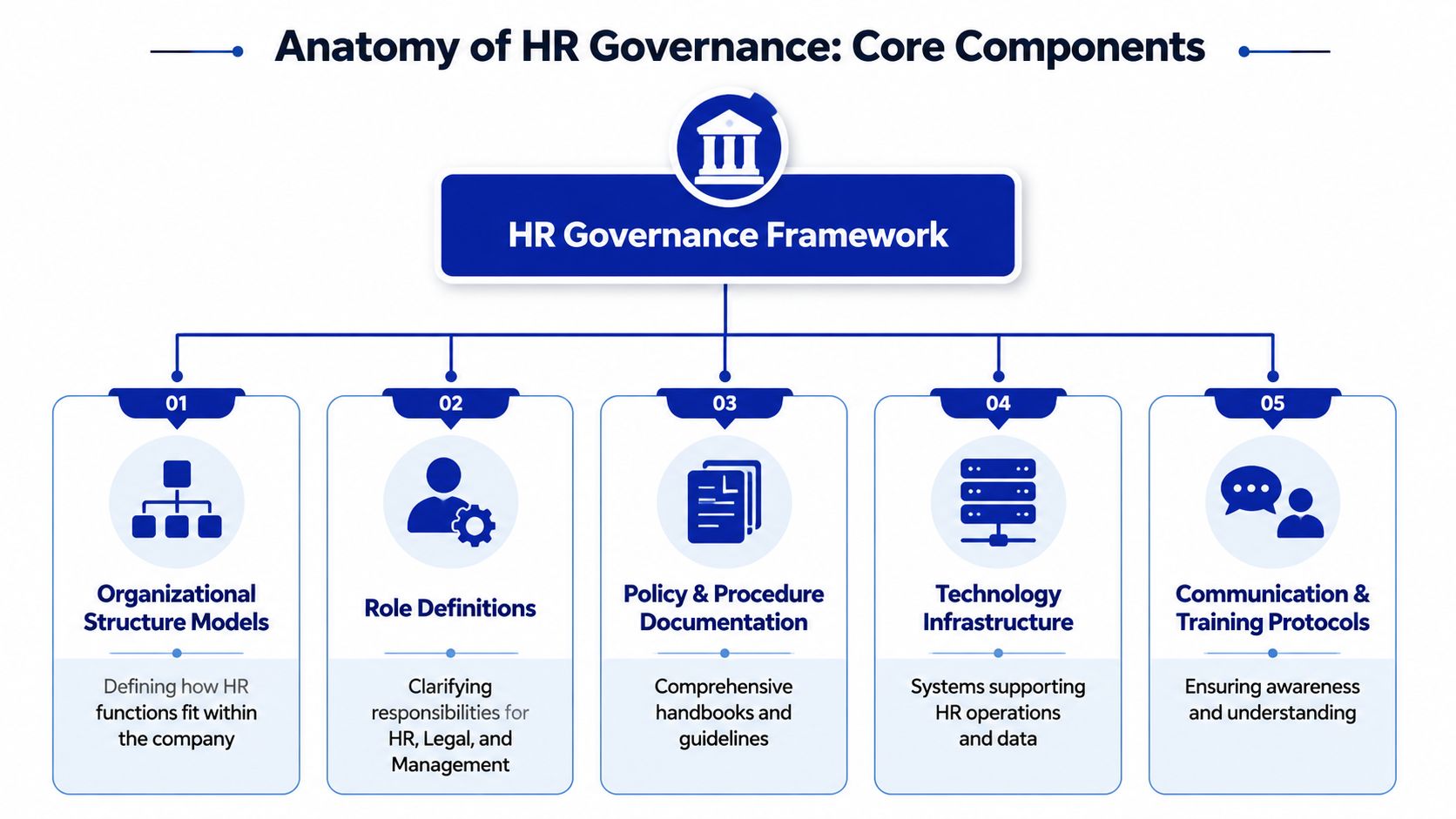
Start with organizational structure. That means deciding whether HR authority is centralized, distributed, or hybrid, and making sure the structure matches how the business operates. A company with multiple locations or states needs enough central control to keep standards consistent, while still allowing local execution where laws or workflow differences require it.
Next comes role definitions. HR, Legal, and management should not share responsibility in a fuzzy way. Someone owns the rule, someone supports the process, and someone else approves exceptions. That split matters because decision-rights confusion is one of the biggest reasons people actions become hard to defend.
Then there is policy and procedure documentation. Handbooks, playbooks, investigation guides, and manager instructions all need to point people to the same standard. If one document says one thing and an older template says another, managers will follow the version that feels easiest, not necessarily the one that is current. The same discipline also matters for the systems behind the documents, which is why many teams pair policy work with replacing compliance chaos with calm through clear workflows and records.
A frequently missed angle in existing guidance is decision-rights governance for high-risk people actions such as terminations, investigations, discipline, and manager conduct. Many public resources discuss policies, roles, audits, and data controls, but they stop short of clarifying who recommends, who approves, and what evidence must be retained for defensibility, as noted in HRM Guide's framework discussion. That gap matters because these are the decisions most likely to be questioned later.
If the company cannot show who recommended, who approved, and what evidence was retained, the decision will feel weaker even when the outcome was right.
Escalation paths solve that problem. Routine decisions should move quickly. Anything outside standard thresholds should go to a defined approver, not get handled ad hoc by the nearest manager. That is the difference between consistent governance and improvisation.
For teams building the operating layer around these rules, an HR operating model helps show how roles, service delivery, and oversight fit together. It is the operating map that connects the policy on paper to the approvals, handoffs, and accountability needed in daily work.
A mature framework usually includes:
A specialized advisory firm is one option for leadership teams that need help with employment practices, federal and state compliance issues, wage and labor issues, and employee relations, especially when the decision has real legal or reputational weight. The value is in having a partner that treats governance as a decision problem, not just an admin process.
A rollout works better when it starts with one high-risk decision and proves the process before it spreads. If a company tries to redesign every HR rule at once, the effort can stall under its own weight. A phased approach keeps the work manageable and gives leaders a chance to correct gaps before the framework reaches every team.
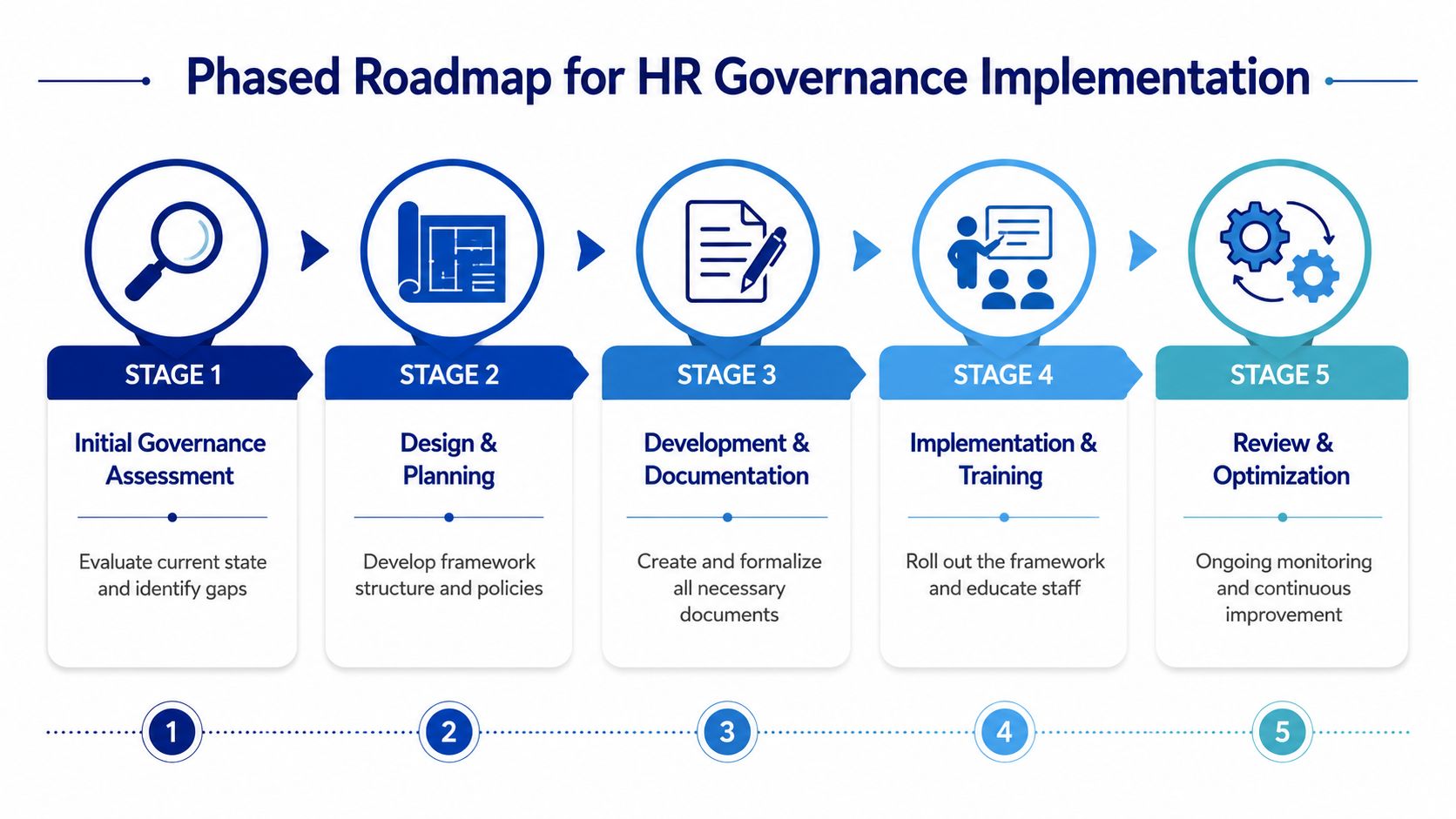
Start with a governance assessment. Map current approvals, note where policies live, and identify where managers or HR teams are making decisions without a clear standard. That gives leaders a baseline before they redesign anything.
Then move into design and planning with HR, Legal, Finance, and business stakeholders in the room. Decision rights, escalation paths, and control points should be set here. The company should also decide which people actions need the most structure, such as terminations, investigations, and discipline.
Documentation comes next. Draft or revise policies, manager guides, and workflow instructions so the standard is easy to follow. Then configure systems to support the workflow, whether that means approval routing, access controls, or evidence storage.
A practical data governance model often uses a five-step control loop, catalog, classify, control, check, change, implemented over a 90-day rollout, according to OPM's Human Capital Framework context and related governance guidance. The same source also reflects measurable operating targets such as 100% dataset ownership, 90%+ quarterly access-review completion, and audit evidence production in under 48 hours. Those targets matter because they turn governance into something leaders can track instead of something they only discuss in policy meetings.
Implementation tip: assign one owner per control, then test whether that owner can explain the process without reading the policy aloud.
A simple sequence helps teams avoid confusion:
Training should happen before full rollout, not after. Managers need to know which approvals they can make, what they must escalate, and what evidence the company will retain. Pilot the framework in one or two business units first, then expand once the process is stable.
For audit-focused execution, leaders can pair the rollout with a structured review method like an audit checklist approach so they can verify whether the framework is producing the records they will need later.
A healthcare practice with locations in several states often starts with one problem, approvals happen differently depending on the site manager. One location keeps detailed notes, another relies on email, and a third sends decisions straight to payroll without documenting the reasoning. Once the practice assigns clear approvers, standardizes termination packets, and sets an escalation rule for anything outside routine thresholds, the team stops rebuilding every case from scratch.
A retail chain usually feels the pain in performance management. District managers may run reviews differently, which makes it hard for HR to compare ratings or spot manager bias. When the company defines a common review calendar, a single documentation standard, and a clear owner for exceptions, the review process becomes easier to defend and easier to explain to store leaders.
A professional services firm often struggles with investigations and conduct issues. The challenge isn't always bad intent, it's that records live in too many places and no one knows which version is final. Once the firm separates the recommender from the approver, adds evidence retention requirements, and uses one shared investigation workflow, leadership gets a cleaner trail for later review.
These examples look different on the surface, but the fix is similar. The business needs a stable path for the decision, a named owner for the rule, and a consistent place to keep the proof. That's what governance does when it's done well.
A governance framework only matters when leaders can see how it behaves in practice. The question is not whether a policy exists on paper, it is whether managers follow the approval path, keep evidence in one place, and complete reviews on time. If decisions still sit in inboxes, records are scattered, or access checks keep slipping, the framework needs correction.
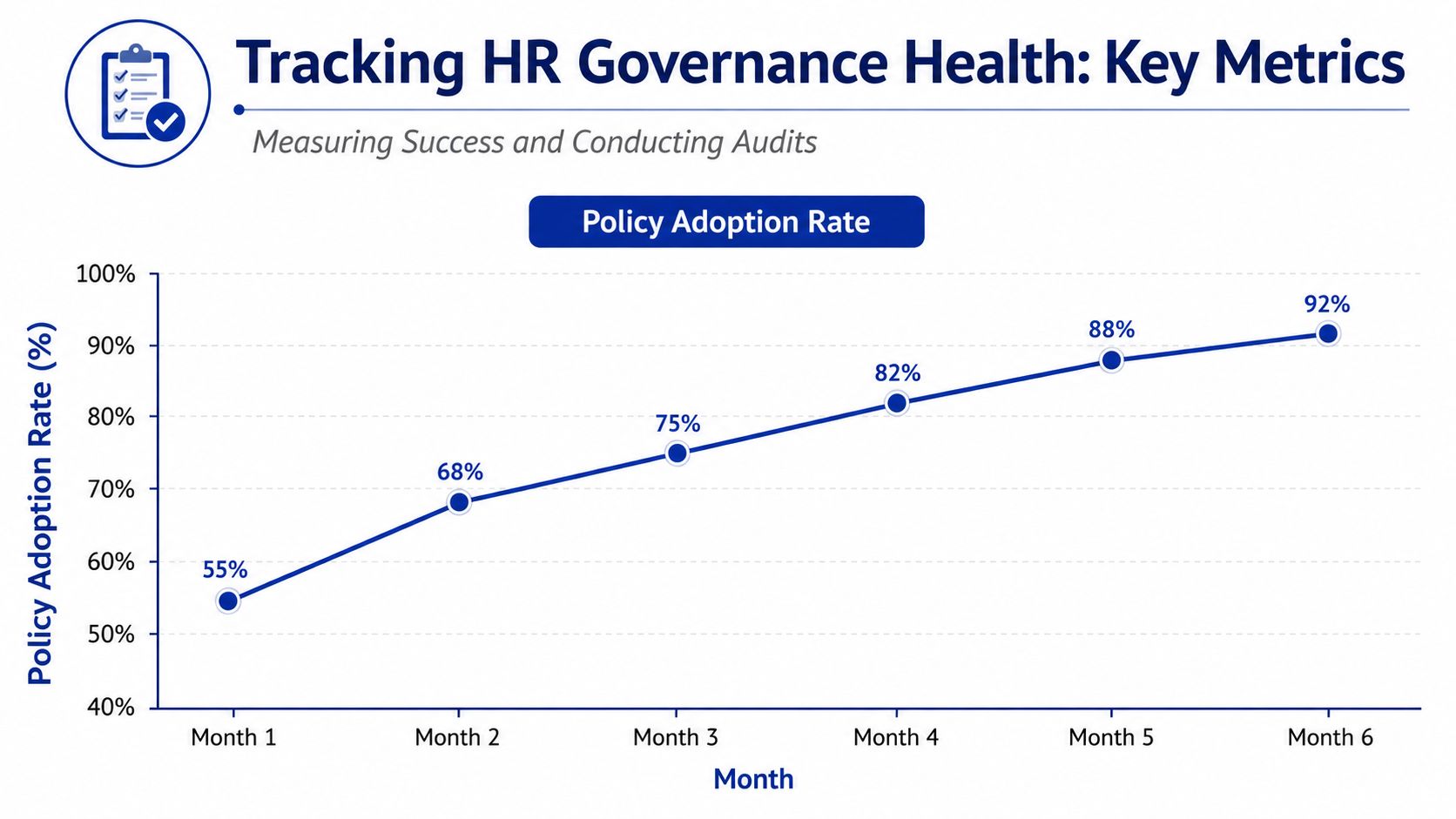
The most useful metrics show whether controls are working. Track policy adoption, approval cycle consistency, access-review completion, and the time it takes to retrieve audit evidence. If one of those measures falls behind, it usually points to the place where the process is breaking down.
A technically mature HR data governance layer should include classification, system-of-record design, access controls, retention policy, audit protocols, incident response, and metrics tied to remediation speed, according to 4Spot Consulting's HR data governance framework. The same guidance recommends data owners, stewards, and custodians, plus role-based or field-level access by workflow rather than hierarchy, with quarterly access reviews, break-glass access for emergencies, and immutable logging of high-risk actions.
For leadership teams, that structure works like a checklist before takeoff. It does not replace judgment, but it reduces the chance that a high-risk people decision is made without the right review or proof.
A quarterly review cadence works well for many SMBs because it gives leaders time to spot patterns without letting issues linger. HR, Legal, Finance, and business leaders should review governance metrics together, then decide what needs correction, escalation, or communication. When a gap appears, the audit should end with a clear next action, not just a report.
Teams that want to make metrics more usable can follow the roadmap for audit-ready KPIs, which helps connect data to day-to-day management decisions. That matters because dashboards only help when someone uses them to decide what changes next.
Audit standard: if you can't produce the evidence quickly, the control is weaker than it looks.
The audit checklist resource fits this process well because it helps teams record what was reviewed, what was missing, and what changed after the review. It also supports the kind of decision-rights governance that SMBs need for high-risk people actions, especially when multiple states or managers are involved.
A strong HR governance framework gives SMBs something they can rely on when people decisions get complicated. It creates defined accountability, clearer approvals, and a defensible trail for high-risk actions. For multi-state businesses, that structure is what keeps HR decisions consistent when local rules and manager habits pull in different directions.
The most useful documents are practical, not fancy. Start with a policy outline template, a decision-matrix spreadsheet for recommenders and approvers, an audit checklist, and a manager training deck. Keep retention schedules attached to each document, then update them as laws, roles, and workflows change.
If your team needs help turning these ideas into a defensible operating model, contact Paradigm International Inc. to talk through your current HR decision process and the documentation your leadership team needs next.