
A well-handled workplace complaint is a sign of strong leadership, but a poorly managed one can quickly become a business owner's worst nightmare. One wrong move during an HR investigation can expose your company to legal risks, damage employee morale, and tarnish your reputation. A structured, defensible investigation process isn’t just about following rules—it’s a fundamental part of building a fair and healthy workplace.
A formal HR investigation is your structured process for gathering facts to determine if company policy, ethical standards, or the law has been violated. These inquiries can be triggered by a range of issues, from harassment and discrimination claims to accusations of theft or safety breaches. The primary goal is to conduct a fair, impartial review that protects both your employees and your business.
Ignoring or mishandling a complaint is one of the fastest ways to destroy team trust. When employees see their concerns dismissed or poorly addressed, it sends a clear message that their well-being isn't a priority. This often leads to lower productivity, the loss of good employees, and a toxic environment that hinders growth.
Failing to conduct a thorough and unbiased HR investigation carries significant risks. The consequences extend far beyond a single employee issue and can leave lasting financial and cultural scars on your business.
Common mistakes often lead to serious problems:
A defensible investigation is your organization's first line of defense. It demonstrates a commitment to fairness and due process, showing your team that their concerns are taken seriously and that decisions are based on objective facts, not office politics.
Ensuring your HR investigation is legally sound often requires a solid understanding of applicable laws, making effective legal research methodologies an invaluable skill for HR leaders. The stakes are higher than ever, with recent data showing that discrimination, harassment, and retaliation claims are at an all-time high. While most investigators claim to follow required practices, only 57% of organizations consistently use a formal, documented process. Small businesses, in particular, often lag behind, increasing their exposure as they grow. You can find more details about these workplace investigation trends.
Ultimately, a well-run HR investigation is a proactive tool for protecting your company’s integrity. It provides a clear path to address misconduct, reinforce your values, and build a workplace where everyone feels safe and respected.
If you need guidance on strengthening your investigation protocols, our team is here to help. Reach out to us to ensure your processes are fair, consistent, and defensible. Connect with an expert at https://paradigmie.com/contact.
The success of any HR investigation is often determined before the first interview begins. The initial steps you take after receiving a complaint set the tone for the entire process, establishing a foundation of fairness, impartiality, and thoroughness. How you handle these first moments demonstrates your commitment to a structured and credible process.
Your first conversation with the person making the complaint is critical. At this stage, your only job is to listen actively and impartially, ensuring the employee feels heard and respected. Avoid making premature judgments, offering opinions, or guaranteeing specific outcomes. The goal is simply to gather the initial facts while reassuring the individual that their concerns are being taken seriously.
This initial conversation typically kicks off the formal investigation process.
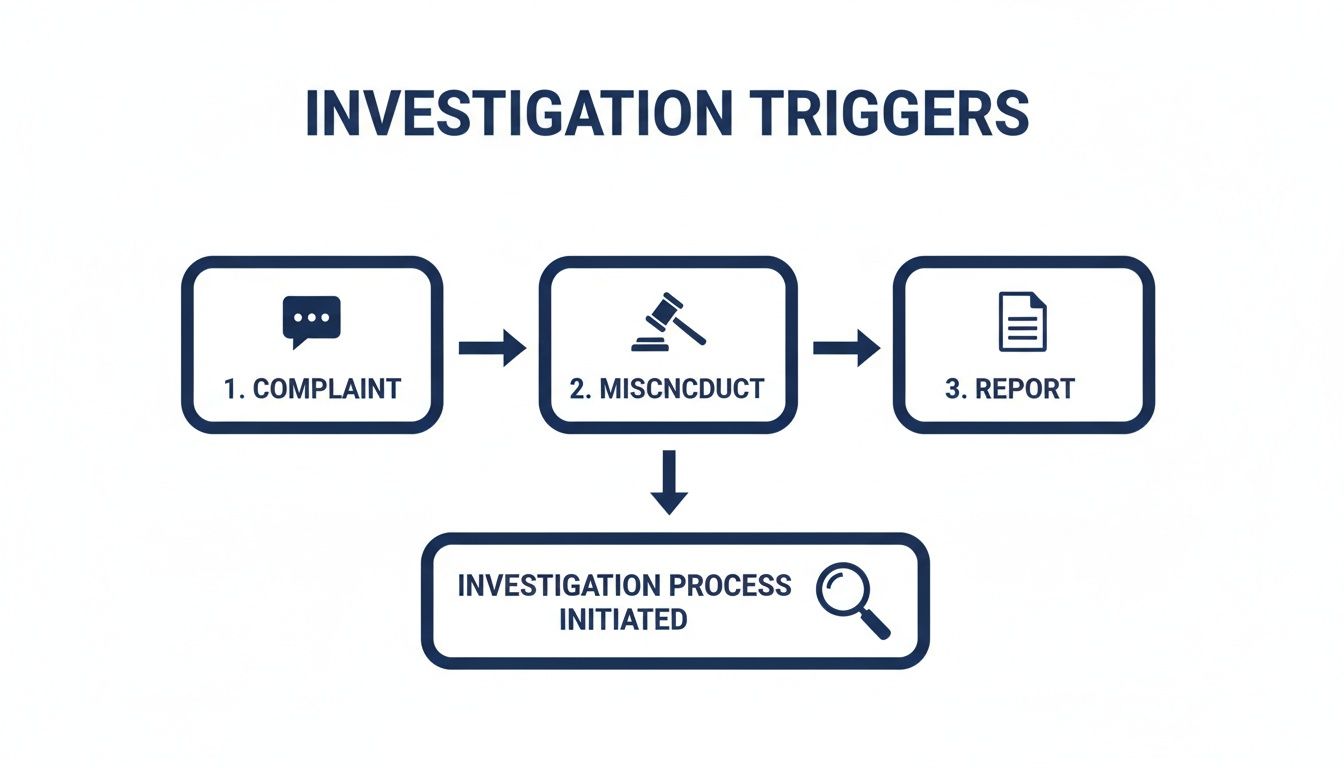
As you can see, whether an issue begins as a verbal complaint, direct observation, or a formal report, every path leads to the same destination: a structured investigation.
Once you have the initial report, you must clearly define the investigation's scope. This crucial step involves identifying the specific allegations and determining which company policies or codes of conduct may have been violated. Without a clear scope, investigations can easily lose focus and become prolonged.
Create a simple list of the core issues that require examination. For instance, if an employee alleges harassment, your scope would be to investigate the specific incidents, dates, and individuals mentioned in the complaint. This clarity ensures your fact-finding mission is targeted and relevant from the start.
In today's digital world, evidence can be easily lost. One of the most urgent first steps is to preserve all potentially relevant information to prevent it from being altered or deleted, whether intentionally or accidentally. A failure at this stage can completely undermine the integrity of your investigation.
Take immediate action to secure key evidence; this cannot wait.
This is a non-negotiable part of a defensible process. It ensures you have a complete and untampered set of facts to work with.
An investigation is only as strong as the evidence it rests upon. Preserving data from the outset is non-negotiable for a credible and defensible inquiry. It demonstrates procedural fairness and protects the organization against claims of concealing or destroying information.
In some situations, you may need to implement temporary or "interim" measures to protect employees and maintain a stable work environment while the investigation is ongoing. It is important to remember these are not disciplinary actions. They are temporary adjustments intended to reduce risk and prevent retaliation or further incidents.
The decision to use interim measures depends on the severity and nature of the allegations. It is a balancing act—you must protect all parties without appearing to have already decided someone is guilty. It is also vital to understand the complexities from the employee's perspective. You can learn more about employee rights during an HR investigation in our detailed guide.
Common interim actions include:
These preliminary steps—intake, scoping, preserving evidence, and considering interim measures—form the bedrock of a fair and effective investigation. Handling them with care and precision builds a structured process that can withstand scrutiny and lead to a well-reasoned conclusion.
Witness interviews are at the heart of any solid HR investigation. This is where you transition from allegations to facts, requiring a careful blend of skill, strict neutrality, and thorough preparation.
When these conversations are conducted correctly, you will uncover the information needed to make a sound decision. If they are handled poorly, you risk introducing bias, destroying trust, and undermining the entire investigation—potentially exposing your company to serious legal risk.
The goal of every interview is to gather objective facts. You are not there to confirm assumptions or lead someone to a specific answer. This requires a structured approach, ensuring every person involved is treated fairly and consistently. A well-planned interview process is not just good practice; it demonstrates fairness and makes your findings far more defensible.
Productive interviews are the result of meticulous planning, not chance. Before you sit down with anyone, you need a clear strategy. This planning phase sets the stage for a fact-based, professional discussion.
Here is what your preparation should cover:
Once the interview begins, your role is to be a neutral fact-finder. Start by introducing yourself and anyone else present (such as a dedicated note-taker) and clearly state the purpose of the meeting. It is crucial to emphasize that you are there to gather information and that no conclusions have been reached.
A major focus in any modern HR investigation is preventing retaliation, which is a significant source of employment claims. Increased regulatory scrutiny in areas like I-9 audits and fraud investigations has placed HR teams under immense pressure, making it even more critical to handle every interview with precision. Retaliation claims can easily spin out of the investigation process itself.
During the conversation, your primary role is to listen. Let the witness do most of the talking while you take detailed notes and ask clarifying follow-up questions. Avoid inserting your own opinions or reacting to their story. A calm, professional demeanor is essential for building rapport and encouraging honesty.
The best interview questions are simple and non-leading. Ask "Can you describe what happened?" instead of "Did you see them acting aggressively?" The first question invites a fact-based narrative; the second suggests a conclusion before you've heard their story.
While your neutrality must remain constant, your specific goals and questioning strategies will shift depending on who you are interviewing. Understanding these nuances is key to gathering the most relevant information from each person.
The key is to tailor your approach for each participant. Here is a brief breakdown of how to approach interviewing each person involved.
By fine-tuning your strategy for each interview, you can methodically piece together a clearer picture of what actually happened. Each conversation serves as a critical building block, helping you form a conclusion based on credible, well-documented evidence rather than hearsay.
Need help refining your interview techniques or structuring your overall investigation process? Our experienced advisors can provide the expert guidance you need to handle these sensitive situations with confidence. Contact us to learn more about how we can support your team.
Once the interviews are complete, the investigation enters its most critical phase. This is where you shift from gathering facts to making a sound, evidence-based judgment. The objective is to analyze all collected information and determine what most likely occurred.
This is not a courtroom trial; you are not seeking a verdict of "guilty" or "innocent." Your role is to determine whether a company policy was violated based on the available facts. This requires a structured and impartial approach to weighing the evidence fairly.
The first step is to synthesize all your information—interview notes, emails, direct messages, documents, and more. A core component of any defensible HR investigation is applying the principles of effective document analysis to connect the pieces of the puzzle.
Lay everything out and look for patterns of consistency or contradiction. Do multiple witness accounts align? Does the digital evidence support or refute what people told you? Answering these questions helps paint a clearer picture of the events.
Assessing credibility is a crucial part of this process, but it is not about deciding who you "like" or "believe" more. It is about objectively evaluating the reliability of each person's account.
Consider these factors when assessing credibility:
This methodical evaluation helps you move beyond "he said, she said" and focus on what the combined evidence actually suggests.
In a workplace investigation, you do not need to prove anything "beyond a reasonable doubt," which is the standard for criminal court. Instead, we use a more practical standard: preponderance of the evidence.
This simply means determining if it is more likely than not that the alleged conduct occurred.
Think of it as a scale. If the evidence supporting the allegation outweighs the evidence against it—even slightly—then the preponderance standard has been met. This civil standard is appropriate for making workplace decisions.
This standard allows you to reach a reasoned finding based on the available facts, even when absolute certainty is impossible. It is about arriving at a logical conclusion supported by the balance of the evidence you have collected.
Your final investigation report is the official, permanent record of the entire process. It must be clear, concise, and, above all, defensible. The report should guide the reader through the investigation from start to finish, outlining the steps taken, the evidence reviewed, and the conclusion reached.
A well-written report is your primary defense if your decision is ever challenged. It can be your best protection against costly legal claims.
Your final report needs several key components to be considered complete. For detailed guidance, our workplace investigation report template can be a great resource for structuring your document.
This report creates the official record of the investigation and justifies any subsequent actions taken. However, the work is not over once the report is signed. Closing out the investigation and communicating the outcome requires careful planning to ensure fairness and minimize further disruption.
Reaching a conclusion in your investigation is a significant milestone, but the process is not yet complete. The final phase is where your findings are translated into action. It is where you resolve the issue, communicate with those involved, and help your workplace move forward.
This stage is about careful communication, decisive action, and diligent follow-up. Your actions send a powerful message to your entire team about the company’s values and its commitment to upholding policies. An inconsistent or weak response can undermine even the most thorough investigation.
Once you have concluded that a policy was violated, the next step is to determine the appropriate corrective or disciplinary action. Consistency is critical here. Your response must align with your company policies and with how you have handled similar situations in the past.
There is no one-size-fits-all answer. The right action depends on several key factors:
Outcomes can range from a formal coaching session to immediate termination. A minor policy infraction might only require mandatory retraining, while serious misconduct like harassment or theft will warrant much stronger consequences, potentially including termination.
The goal of corrective action is not just punishment; it is about preventing recurrence. Whatever action you take, document it thoroughly and ensure it is clearly justified by your investigation's findings. This creates a defensible record.
This is one of the most delicate parts of the entire process. Communication must be professional, discreet, and confidential. You will need to inform both the person who made the complaint and the person who was the subject of it, but the level of detail shared will differ.
When meeting with the complainant, inform them that the investigation is complete and that appropriate action has been taken based on the findings. You are not obligated—and generally should not—share specific disciplinary details. Your goal is to reassure them that they were heard and that the company is committed to preventing retaliation.
For the respondent, the conversation will be more direct, especially if discipline is involved. Clearly explain the findings, which policies were violated, and what the consequences will be. This conversation must be documented in detail.
Your work is not finished once you have delivered the news. The final, crucial step is the post-investigation follow-up. This ensures that the resolution is effective and that new problems do not arise.
First and foremost, you must actively monitor for any signs of retaliation. Retaliation claims can pose a significant legal risk, sometimes even more damaging than the original complaint. Plan to check in with the complainant periodically—perhaps after a month, and again at three months—to ensure they feel safe and have not experienced any negative repercussions.
Use the investigation as a learning opportunity. Did the incident reveal a gap in your policies? Is additional training needed on a certain topic? Is there a systemic issue in a particular department? Addressing these root causes is how you build a healthier, more resilient culture for the long term.
Handling these final steps with care is what makes an investigation truly defensible. If you need support navigating corrective actions or strengthening your post-investigation protocols, our team can provide the expert guidance needed to close the loop effectively. Reach out to us to learn more.
Even with a solid plan, every HR investigation presents unique challenges. As a business owner or HR leader, you will inevitably encounter situations that feel like uncharted territory. Let's address some of the most common questions that arise.
Understanding the answers to these questions reinforces the core principles that should guide every investigation: fairness, consistency, and defensibility.
Knowing when to bring in an outside expert is a critical judgment call. While it is a significant step, it is sometimes the only sensible option.
An external investigator is almost always the right choice when allegations involve senior leadership. This approach is the clearest way to avoid any conflict of interest—or even the perception of one. Their involvement adds a crucial layer of impartiality that protects the integrity of the process from the start.
You should also consider an external investigator if a case is unusually complex, involves sensitive legal issues, or if your internal team lacks the bandwidth or specialized skills to handle it properly. In high-stakes situations, an objective, third-party perspective dramatically strengthens the defensibility of your investigation.
A few common missteps can completely derail an otherwise solid investigation. One of the most frequent—and damaging—is delaying the start of the process. Waiting sends a message that the issue is not a priority and allows evidence to become stale and memories to fade.
Another major pitfall is failing to remain neutral. Allowing personal biases or preconceived notions to influence the process is a sure way to undermine the outcome.
Other significant errors to avoid include:
The single biggest mistake? Failing to actively prevent retaliation against the person who came forward or any witnesses. Your process and your documentation are the best tools you have to guard against all these common errors.
Conducting an investigation with remote employees does not change the core principles—fairness, thoroughness, and confidentiality remain paramount. What changes are the tools and methods you use.
Video conferencing is your most valuable tool in this scenario. Use a secure, high-quality platform for all interviews, and ensure the remote employee has a private, quiet space where they can speak freely without being overheard.
Evidence gathering will rely more heavily on digital communications. This means you must coordinate with your IT team immediately to preserve emails, chat logs, and other relevant electronic data. Always remember to confirm that all company policies apply equally to your entire workforce, whether they are in the office or working from home.
A defensible HR investigation process is a cornerstone of responsible leadership and a healthy organization. While this guide provides a solid framework, every situation has its own nuances and can benefit from expert guidance. The team at Paradigm International Inc. acts as a decision partner for SMB leadership, helping you navigate high-stakes people decisions with confidence.
If you need support strengthening your investigation protocols or managing a complex employee relations issue, contact us to learn how we can help.