A lot of teams realize they need an HR operating model right after growth exposes the cracks. A company expands into a third state, a manager handles a termination differently than another location would, and suddenly there's no clear process, no decision owner, and no clean documentation trail. What used to feel manageable now feels risky.
That's usually the moment HR stops being an administrative function and becomes an operating question. If your business is scaling, especially across states or in a regulated setting, you need a system that tells people who does what, how decisions get made, and how those decisions hold up under scrutiny.
For a growing SMB, an HR operating model is the blueprint for how people, process, technology, and accountability work together. It's not corporate jargon. It's the practical design behind hiring, leave decisions, investigations, terminations, documentation standards, and manager support.
Without that design, growth creates inconsistency. Managers improvise. HR responds case by case. Leadership assumes everyone is following the same playbook when they're not. That gap becomes expensive when a high-stakes employee decision needs to be explained months later.
A sound model gives leaders a repeatable way to run HR with structure and judgment. It also helps separate culture-building from compliance risk, which matters when you're trying to create a strong employee experience without weakening your documentation standards. For leaders thinking about retention at the same time, ISU Insurance Services' California playbook is a useful companion read because it shows how people strategy and practical risk awareness often need to sit side by side.
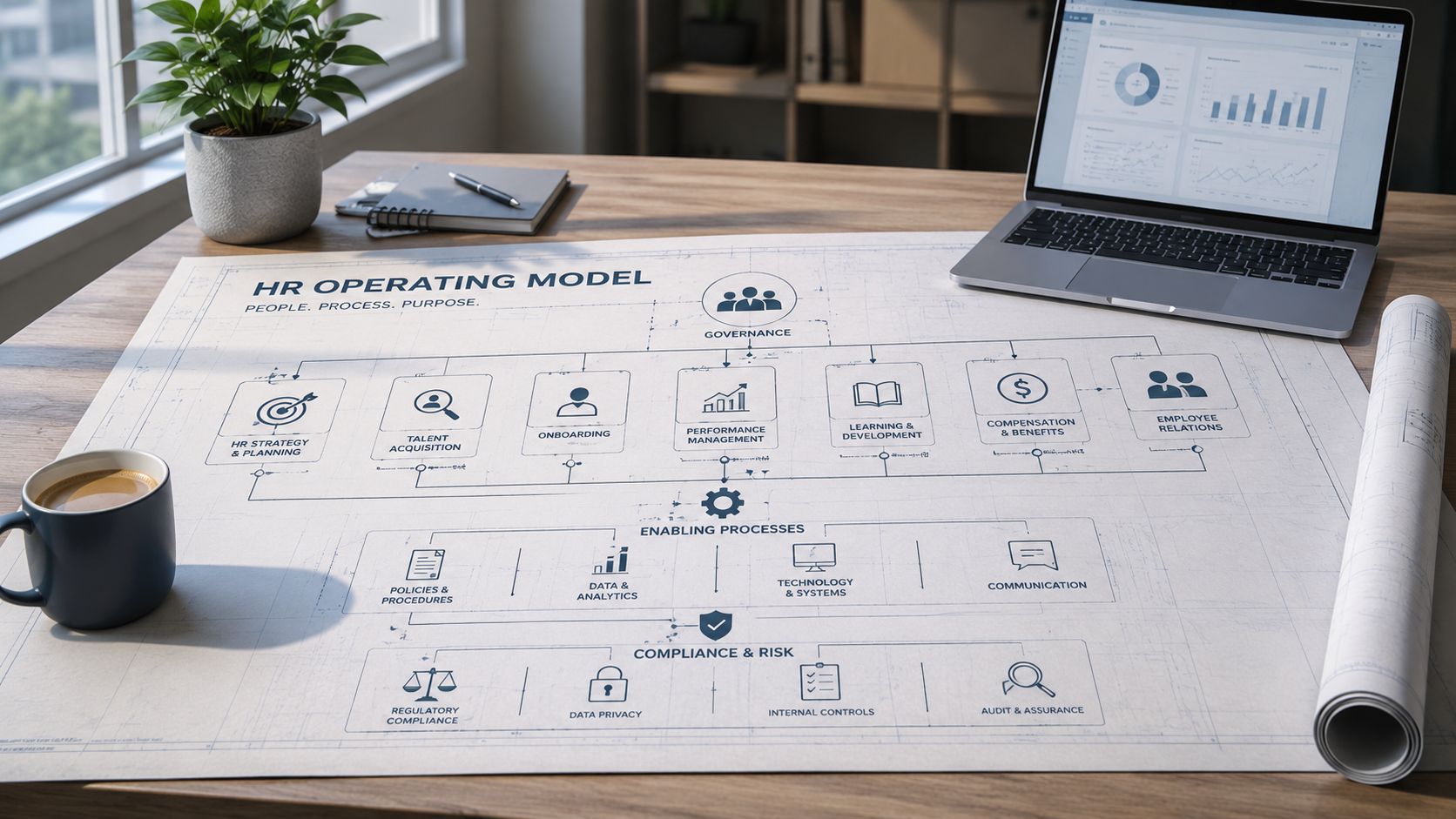
An HR operating model is the design for how HR delivers work across the business. It's analogous to a house blueprint. The blueprint doesn't just show where the rooms go. It shows how the structure, wiring, plumbing, and load-bearing elements work together so the building is usable and safe.
HR works the same way. Policies alone don't create consistency. A good model connects strategy, roles, workflows, systems, and oversight so HR can support the business and protect it at the same time.
When leaders say HR feels reactive, the issue is often operating design, not effort. People may be working hard, but they're working without a clear model for decision rights, escalation paths, and service delivery.
That matters because the most common HR work isn't just transactional. It includes judgment calls. Leave requests. Performance concerns. Accommodation discussions. Investigations. Final-stage disciplinary action. Those decisions need a structure behind them.
Practical rule: If a manager can't explain who owns the decision, what standard applies, and where the documentation sits, you don't have an operating model. You have good intentions.
Here's the simplest way to break it down:
Strategy and vision
This is the reason the HR function exists in its current form. It should reflect business priorities such as scaling across states, reducing inconsistency, supporting managers, or tightening compliance in regulated settings.
Organizational design
This defines how HR is arranged. It includes who handles advisory work, who owns specialized expertise, and where administrative support sits.
Technology and tools
Systems like your HRIS, case management platform, workflow tools, and reporting stack should support the model. If the tech doesn't match the process, teams usually create workarounds that weaken consistency.
Processes and policies
These are the repeatable steps for hiring, onboarding, leave, discipline, investigations, and exits. Process is where defensibility starts because it creates consistency before a dispute exists.
People and capabilities
The model only works if the team has the skill to execute it. That includes HR judgment, manager coaching, documentation discipline, and the ability to distinguish routine issues from high-risk ones.
Governance and accountability
This is how decisions get made and monitored. It includes approval rules, escalation standards, and who signs off when a situation carries legal or operational risk.
Service delivery
Employees and managers need to know how to get support. If one issue goes to a business partner, another to payroll, and another to a local manager with no shared protocol, the model breaks down in practice.
For a multi-state or regulated SMB, an HR operating model isn't a nice organizational exercise. It's a risk control. It reduces the chance that one manager in one location creates a problem the rest of the company has to defend.
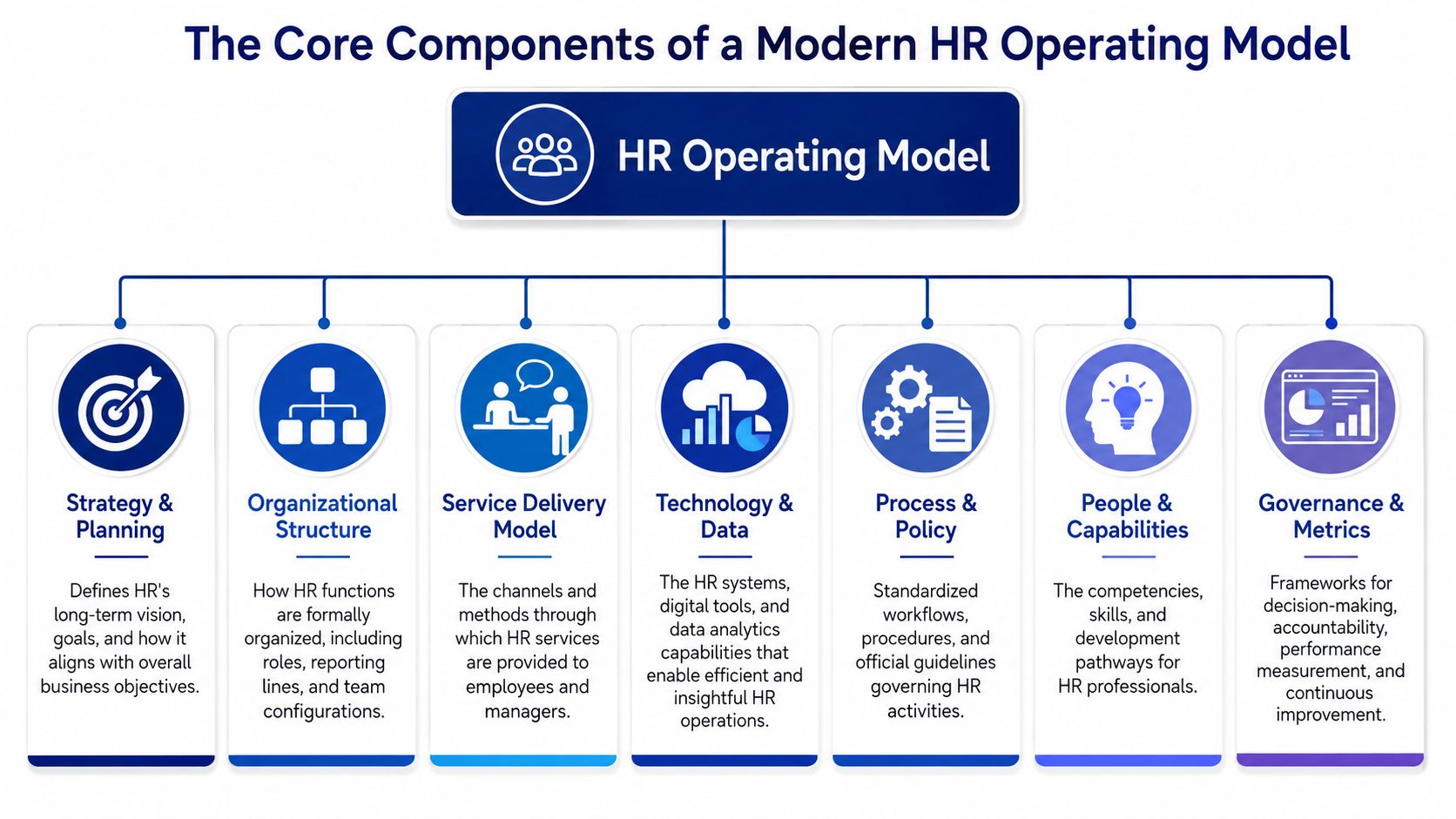
A modern model needs seven parts working together. If one is missing, the others have to compensate, and that usually shows up as delay, inconsistency, or weak documentation.
Structure
This is the formal layout of HR. In practice, that may include HR business partners, subject matter experts, and shared support. The structure should match business complexity, not mimic a larger company just because the chart looks impressive.
Roles and RACI
Role clarity is where many models succeed or fail. An effective HR operating model requires a Responsibility Assignment Matrix that defines who is Responsible, Accountable, Consulted, and Informed for each workflow step, as outlined in Wowledge's guidance on updating the HR operating model. Without that, teams fall into the familiar pattern of “I thought someone else owned it.”
Governance and decision rights
This is the control layer. It determines when a manager can act alone, when HR must be consulted, when legal review is required, and who approves final action in sensitive cases.
Governance sounds abstract until a termination, investigation, or accommodation request lands on the wrong desk.
End-to-end processes
Good process design follows the entire lifecycle, not isolated tasks. Hiring connects to onboarding, onboarding connects to manager accountability, and manager accountability affects performance management and exits later on.
HR technology stack
Your systems should support documentation, approvals, visibility, and reporting. A platform that stores data but doesn't support case history or workflow discipline often gives leaders a false sense of control.
Some leaders invest in tools first and hope the process will sort itself out. It usually goes the other way. Process has to define what the tool is there to support.
That's especially true in hiring. If your recruiting process doesn't define verification standards, escalation points, and decision ownership, a polished ATS won't solve the underlying issue. Teams that want a stronger front-end control environment may find value in Sentry Private Investigators Ltd's piece on an investigative approach to hiring, because it highlights how disciplined screening supports a more defensible workforce strategy.
| Component | Why it matters |
|---|---|
| Service delivery channels | Employees and managers need clear entry points for HR support. Confusion at intake leads to delays, inconsistent advice, and fragmented records. |
| Performance metrics | Metrics should track whether the model is working, not just whether tasks are getting completed. Useful measures focus on consistency, escalation quality, and execution discipline. |
An HR operating model becomes much more important when your business spans states or sits in a regulated environment. Rules change. Documentation expectations change. Manager habits vary by location. If you don't standardize the way HR decisions are made, you get uneven treatment and uneven risk.
That's where many employee experience efforts run into trouble. 87% of HR leaders prioritize employee experience in new operating models, but only 12% of SMBs integrate multi-state compliance risk into their workflows, and 68% of multi-state SMBs report increased regulatory scrutiny according to McKinsey's analysis of HR's new operating model. The gap is straightforward. Teams design for empathy and convenience, then discover they didn't design for defensibility.
A leave request in one state may require a different response, timeline, or documentation path than the same request in another. A final pay issue may be routine in one location and high-risk in another. An investigation can become harder to defend if witness handling, documentation practices, or decision approvals vary by manager.
That's why multi-state operators need one operating standard with controlled local application. Not one policy binder in a shared folder. A true model that defines process ownership, escalation rules, and documentation expectations.
For leaders reviewing related exposure, a focused look at wage and hour compliance is often a useful place to pressure-test where inconsistency is already creating risk.
Here's how the main approaches tend to perform for SMBs:
Business partner model
This works well when leaders need close support embedded near the business. It helps align HR advice with operations, but it can drift if business-facing HR staff act too independently from enterprise standards.
Leader-led model
This gives managers more ownership. It can move quickly, but it only works when managers are trained, disciplined, and clear on when to escalate. In weak management environments, it creates uneven decisions fast.
Agile or squad-based model
This suits fast-changing businesses with strong cross-functional habits. It can improve responsiveness, but some SMBs struggle to maintain documentation rigor if squads move faster than governance does.
The right model for a multi-state SMB is usually the one that creates the least ambiguity in high-stakes decisions, not the one that sounds the most modern.
Most leaders don't need the perfect framework. They need the right starting point for their size, complexity, and risk profile. The useful question isn't “Which HR model is best?” It's “Which model helps us scale without losing control?”
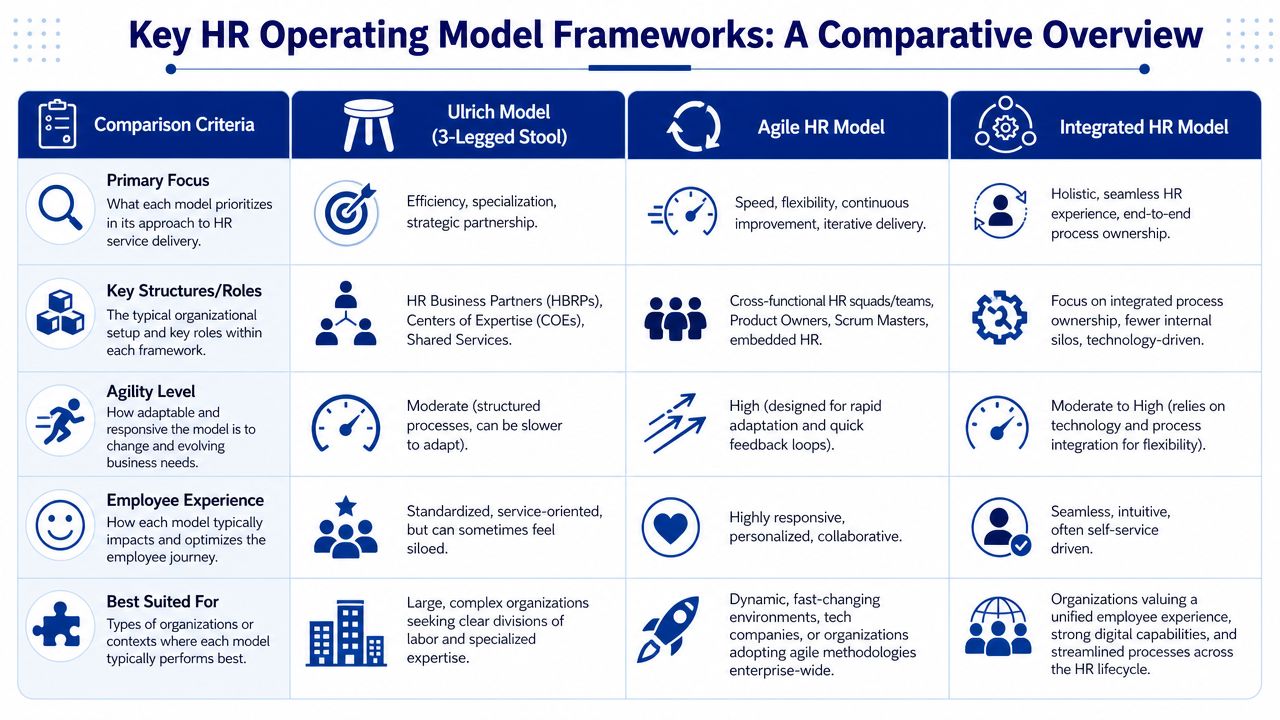
One framework still dominates for a reason. The business partner model is used by approximately 75% of companies in North America, according to AIHR's overview of HR operating model types. Its appeal is clear. It embeds HR advisors close to business leaders while separating specialized and administrative work where appropriate.
| Framework | Where it works | Where it struggles |
|---|---|---|
| Ulrich or business partner model | Strong for growing organizations that need specialization and clear advisory roles | Can create silos if handoffs between partners, experts, and shared services aren't tightly designed |
| Agile HR model | Useful in fast-moving environments where priorities shift often | Can become messy if governance and decision documentation lag behind team speed |
| Integrated HR model | Good for organizations that want end-to-end ownership and a smoother employee journey | Requires process discipline and technology alignment to avoid becoming vague |
McKinsey-related thinking summarized by CIPD identifies five emerging HR operating model archetypes: Ulrich+, agile, employee experience-driven, leader-led, and machine-powered, as noted in CIPD's insight on future models. That's useful because it reminds leaders they're choosing a delivery mechanism, not a slogan.
Use these filters:
Business complexity
If you're operating in several states, handling sensitive employee matters regularly, or managing regulated teams, choose a model with strong governance and clean escalation.
Leadership capability
If managers are strong decision-makers and document well, a more leader-led approach can work. If they vary widely, keep more control in structured HR channels.
Growth pattern
Rapid hiring, acquisitions, and geographic expansion usually require more defined roles and process ownership than founder-led companies expect.
Employment footprint
If you're also evaluating cross-border hiring or outsourced employment structures, LatHire's EOR founder's guide is a practical reference because operating model choices often intersect with where employment responsibility formally sits.
A lot of SMBs also benefit from reviewing whether they need an internal build, external guidance, or a hybrid approach such as fractional HR leadership, especially when the business has more complexity than its current HR bench can absorb.
Don't start with an org chart. Start with decision flows, risk points, and service expectations. Once those are clear, the structure becomes easier to justify and easier to defend.
Most HR operating model projects don't fail because the team lacked ideas. They fail because leaders assume design and documentation are secondary details that can be handled after rollout. In practice, that's backward. If the model isn't documented clearly enough for managers to follow and leaders to audit, it won't hold under pressure.
The safer approach is a pre-mortem. Before you invest time, ask where this effort is most likely to break. Usually the answer is in handoffs, inconsistent approvals, missing records, or a model that asks managers to do more than they can reliably execute.
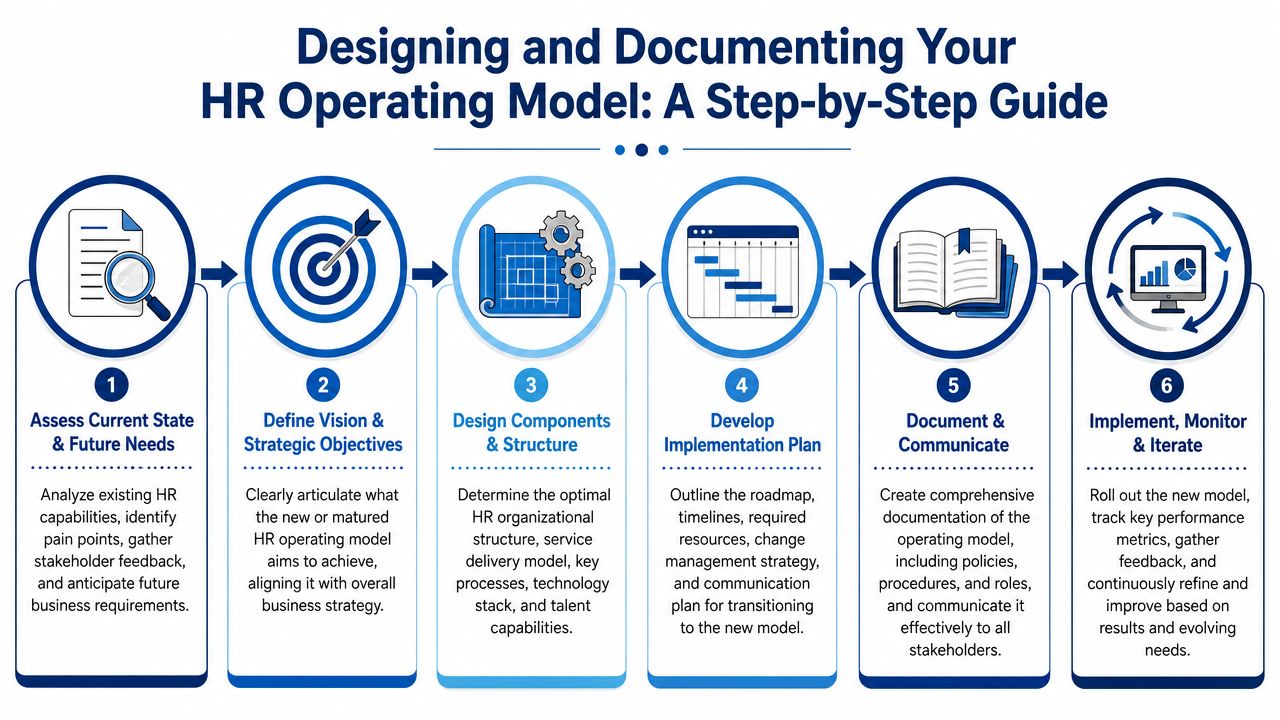
Assess the current state
Review how work gets done, not how people think it gets done. Look for inconsistent manager behavior, unclear approval paths, duplicate effort, and missing documentation in employee cases.
Define the future-state standard
Decide what the model must support. That may include multi-state consistency, cleaner investigations, stronger manager escalation, or better visibility into high-risk decisions.
Map core processes end to end
Focus on hiring, onboarding, leave, accommodations, discipline, investigations, and exits. Document where each process begins, who touches it, what approvals are required, and what records must be retained.
Build the process around the riskiest moments first. Routine tasks can usually tolerate imperfection. Terminations and investigations usually can't.
Documentation should answer five questions:
That's why structure and documentation should be built together. If managers are responsible for first-line performance conversations but HR is accountable for case oversight, both responsibilities need to be visible and enforceable. A well-designed model often aligns with broader work on designing organizational structure, because unclear reporting and unclear process ownership usually show up together.
If the documentation is too theoretical, managers won't use it. If it's too thin, it won't protect the business. The right standard is practical, teachable, and specific enough to survive review later.
The most common mistake is treating an HR operating model as a technology project. It isn't. Technology can support the model, but it can't define ownership, fix weak judgment, or create consistency where leaders haven't agreed on standards.
That matters even more as automation expands. Two-thirds of current HR tasks can be automated, and one of the biggest implementation failures is adding technology without redesigning the work so HR can shift toward the 20% of strategic activities that matter most, according to McKinsey's perspective on a new operating model for people management. If teams automate old chaos, they just produce faster chaos.
Weak executive sponsorship
If leadership treats the model as an HR-side initiative, managers won't change behavior. The COO and business leaders have to reinforce decision rights and escalation standards.
Too much complexity for the company's size Some SMBs borrow a large-enterprise structure they can't staff or manage. The better move is a simpler model with clear controls.
Process second, software first
Buying tools before defining workflows usually creates confusion. Teams end up fitting critical decisions into generic system steps that don't reflect legal or operational reality.
Good implementation starts with fewer assumptions and more operating discipline.
A model may look clean on paper and still fail because managers don't know their role. This happens often when leaders say managers own people decisions but never define what that means in practice.
Manager enablement should include:
A working model doesn't just launch well. It survives turnover, new locations, and business stress. That happens when the model is simple enough to use, strong enough to govern risk, and reviewed often enough to stay aligned with how the business operates.
A COO usually sees whether the HR operating model works during a messy moment, not a planning meeting. A manager wants to terminate an underperformer in one state, retain a similar employee in another, and move fast because the team is already strained. If decision rights, documentation standards, and escalation rules are unclear, culture suffers first and liability follows close behind.
A strong HR operating model creates three outcomes. Clear ownership. Consistent people decisions. A record the company can defend when an employee, agency, auditor, or plaintiff's counsel asks how and why a decision was made.
That is why this work belongs in operating reviews, not just HR discussions. For multi-state and regulated SMBs, the model has to support a good employee experience while also holding up under wage and hour scrutiny, leave administration errors, accommodations questions, investigations, and exits. Teams that get this right do not make the process cold or bureaucratic. They make it predictable, fair, and easier for managers to follow under pressure.
Technology can improve execution if the operating rules are already defined. HiBob's discussion of the HR operating model points to better decision support and tighter links between HR activity and business outcomes. That can help with retention, hiring, and workforce planning. It does not replace judgment, and it does not solve weak governance. Software helps after the business decides who approves what, what must be documented, and when a local issue becomes a legal or compliance issue.
An HR operating model is not a slide deck or a policy folder.
It is the system the business uses when people decisions carry legal, financial, and reputational consequences. If leaders want that system to hold up during growth, audits, manager turnover, or a difficult employee case, it has to be used in daily operations and tested against real scenarios.
If your leadership team needs a decision partner to design a more defensible HR operating model, pressure-test current practices, or strengthen execution in high-stakes people matters, our firm offers advisory support built for complex employment environments. Readers who want a more structured path forward can learn more by starting a conversation there.