
The handbook still reads well, but the company has hired in another state, managers are using old complaint and leave procedures, and the owner is handling HR alongside running the business. Payroll has one version of the rules, supervisors have another, and nobody is certain which handbook employees received. An HR policy review should resolve those operating gaps, not just produce a cleaner document.
Start with the policies that govern difficult decisions. A formatting inconsistency can wait. A manager who doesn't know where to send a complaint, recognize a possible leave request, or coordinate a departing employee's pay needs a usable procedure now.
In fiscal year 2020, the EEOC received 67,448 workplace-discrimination charges, including retaliation in 37,632 charges (55.8%), disability in 24,324 (36.1%), race in 22,064 (32.7%), and sex in 21,398 (31.7%). One charge can allege more than one basis. Those categories make complaint intake and anti-retaliation the right starting point, rather than another general statement about company values.
| Review order | Policy area | Federal baseline | Where states diverge | Review trigger |
|---|---|---|---|---|
| 1 | Complaint intake and anti-retaliation | Title VII of the Civil Rights Act of 1964, enforced by the EEOC; review current coverage for 2026 | Check additional protected classes, reporting obligations, and investigation requirements in each work state | A complaint, investigation, or termination after a complaint |
| 2 | Wage, overtime, and final pay | FLSA, administered by DOL; review applicable wage-and-hour requirements for 2026 | Check California and Texas separately for final-pay timing and deduction restrictions | A termination, layoff, or new nonexempt role |
| 3 | Leave, including FMLA overlap | FMLA employer coverage and employee eligibility require separate tests | Check California, New York, and Washington leave programs separately from federal eligibility | A leave request, pregnancy, or disability overlap |
| 4 | Pay transparency and work location | Check federal compensation obligations separately from state posting requirements | Check Colorado, California, New York, and Washington for posting coverage, transfers, and remote-worker rules | A job posting, offer, or first hire in a new state |
| 5 | AI, confidentiality, and monitoring | Connect AI-assisted employment decisions to applicable discrimination and employment rules | Check state privacy and monitoring requirements before approving employee-data uses | Employees entering company or client data into generative tools |
| 6 | Handbook ownership and acknowledgments | Maintain a policy register mapped to applicable DOL and EEOC requirements | Identify state addenda and local requirements for each location | Annual review, acquisition, or first employee in a new state |
The DOL's FLSA history records that the law was signed on June 25, 1938, and took effect on October 24, 1938, establishing federal standards addressing minimum wage, overtime, child labor, and the 40-hour workweek. That federal foundation isn't a substitute for a current state review. For final pay especially, payroll should receive a location-specific instruction, not a generic instruction to process payment normally.
The practical question is whether a manager can apply the rule without inventing an answer. For AI, that means identifying approved uses, prohibited data inputs, approval authority, and responsibility for checking outputs. For handbook ownership, it means naming the person who can approve changes and withdraw obsolete copies.
A mandatory employee policies checklist can help identify missing documents, but document completeness isn't the finish line. Choose the highest-risk gaps for the current quarter. Rewriting every policy at once can delay the fixes managers need most.
Priority rule: Fix the missing decision path before polishing the policy language.
A busy owner needs a bounded procedure, a controlled set of documents, and evidence that corrections work. A shared spreadsheet and a restricted document folder are enough to start. Buying another system won't resolve unclear authority or conflicting instructions.
The EEOC's harassment-prevention guidance recommends thorough policies, multiple reporting avenues, regular training, and periodic testing of reporting systems. That supports treating the review as a control test, not a proofreading assignment. The reviewer should be able to trace a workplace event from the employee's first message through the manager's response and the final record.
The location list should reflect where employees work. A headquarters address or payroll mailing address isn't enough to scope the review. Require managers to identify unapproved moves and temporary work arrangements that need further assessment.
Inventory every document employees and managers use. Include the handbook, addenda, separate policies, posting templates, offer letters, onboarding attachments, leave forms, and manager scripts. Map each item to a jurisdiction, employee group, document owner, approval authority, and operating workflow.
Record the current version and where it appears. A policy in a shared folder may be current while the onboarding email still distributes an obsolete attachment. The inventory should expose that mismatch before anyone starts drafting.
Interview the people who apply the rules. Speak with the owner, the payroll administrator, and a manager from each work state. Ask where an employee reports a concern, who approves leave, and how payroll receives final-pay instructions. Skip a broad employee survey at this stage; concrete process questions reveal more useful gaps.
Ask each person to show the form, inbox, or checklist used to complete the task. An answer such as “the office handles it” should remain an open issue until someone identifies a responsible person and a backup. Record disagreements without trying to resolve them through memory.
Test completeness before testing individual cases. Check protected-class coverage, alternative reporting channels, investigation authority, anti-retaliation language, manager responsibilities, retention instructions, and state addenda. Verify employee access, including whether a remote employee can find the correct policy without asking a supervisor.
Separate employee-facing language from manager operating instructions. Employees need a clear explanation of rights, expectations, and reporting options. Managers need the routing steps, approval boundaries, and escalation contacts that make those promises usable.
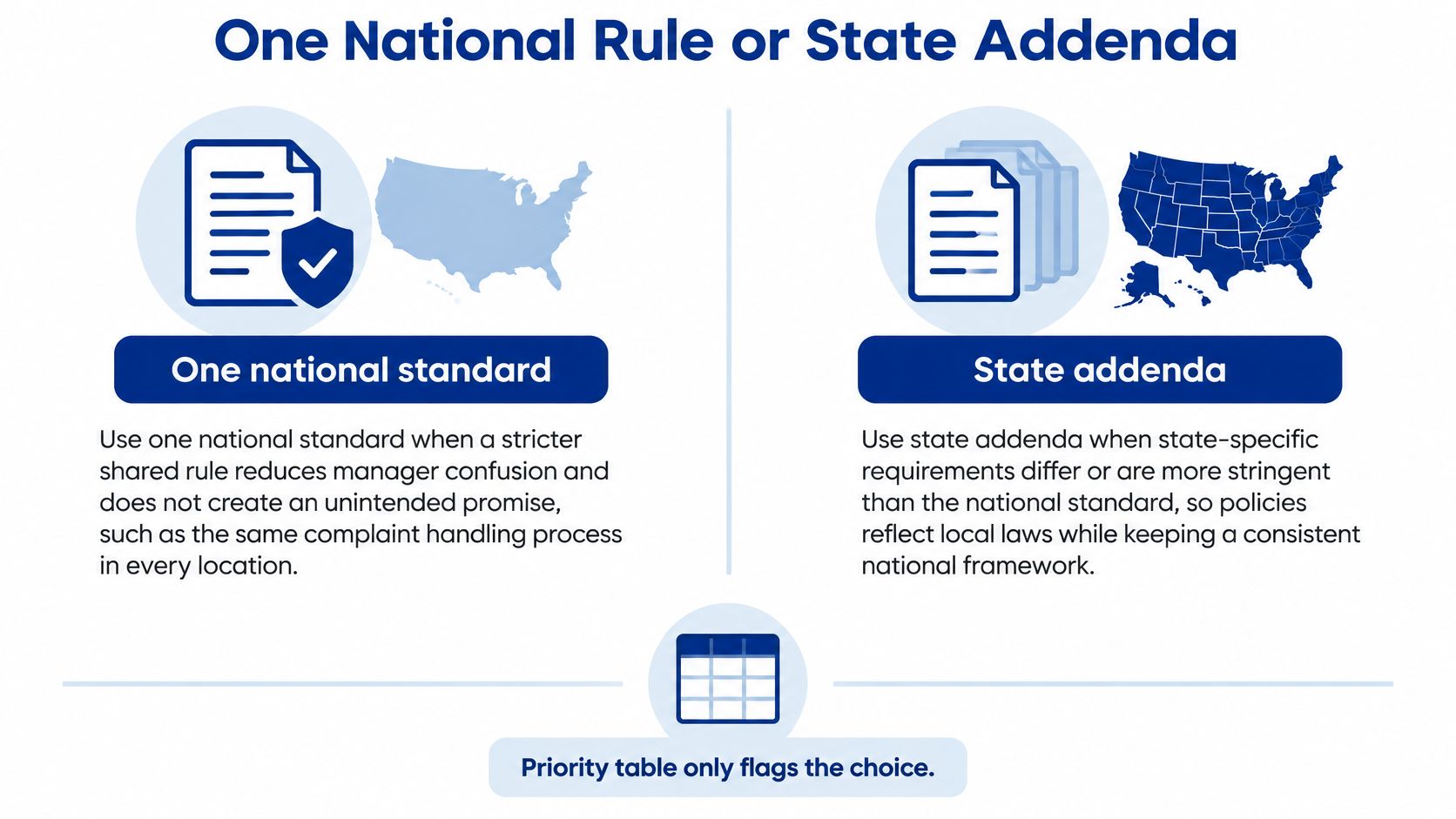
The format decision should also be recorded during the review, rather than left to whoever edits the handbook.
Don't delete the history just because a new edition has launched. The company may need to establish which instructions applied when an earlier decision occurred. Keep unresolved legal questions visible in the issue log instead of burying them in editing comments.
Keep the file that proves the procedure ran. Store signed acknowledgments with personnel records and retain each issued addendum with its issue date. Keep Form I-9 files separate from general personnel files as a records-management practice. Restrict access to complaint materials and sensitive leave records.
Sample a complaint file from intake through closure, and inspect leave requests, eligibility communications, and designation records. Confirm that the record identifies who acted, when the action occurred, and what information supported it. The HR documentation practices guide provides a useful framework for organizing those records.
Assign remediation and verify completion. Rate each gap by legal exposure, likelihood, affected population, and effort to correct it. Name an owner, deadline, interim safeguard, and verification test. A revised reporting policy, for example, isn't complete until the listed contacts receive a test message and can explain the next action.
Schedule a formal review annually, with additional reviews after legal changes, acquisitions, reorganizations, new-state hiring, or serious incidents. Keep high-stakes decisions outside routine editing work. A termination following a complaint or leave warrants expert help before action, as do sensitive investigations and leave-disability overlap.
A closed task needs evidence of a working correction, not just an uploaded replacement document.
International Inc. reviews HR practices and recommends actions that achieve compliance and cost control. Its audits and reviews integrate with ongoing compliance programs so findings become governance changes rather than isolated corrections. That work can include updating an existing handbook, adding multi-state policies, or creating a first handbook.
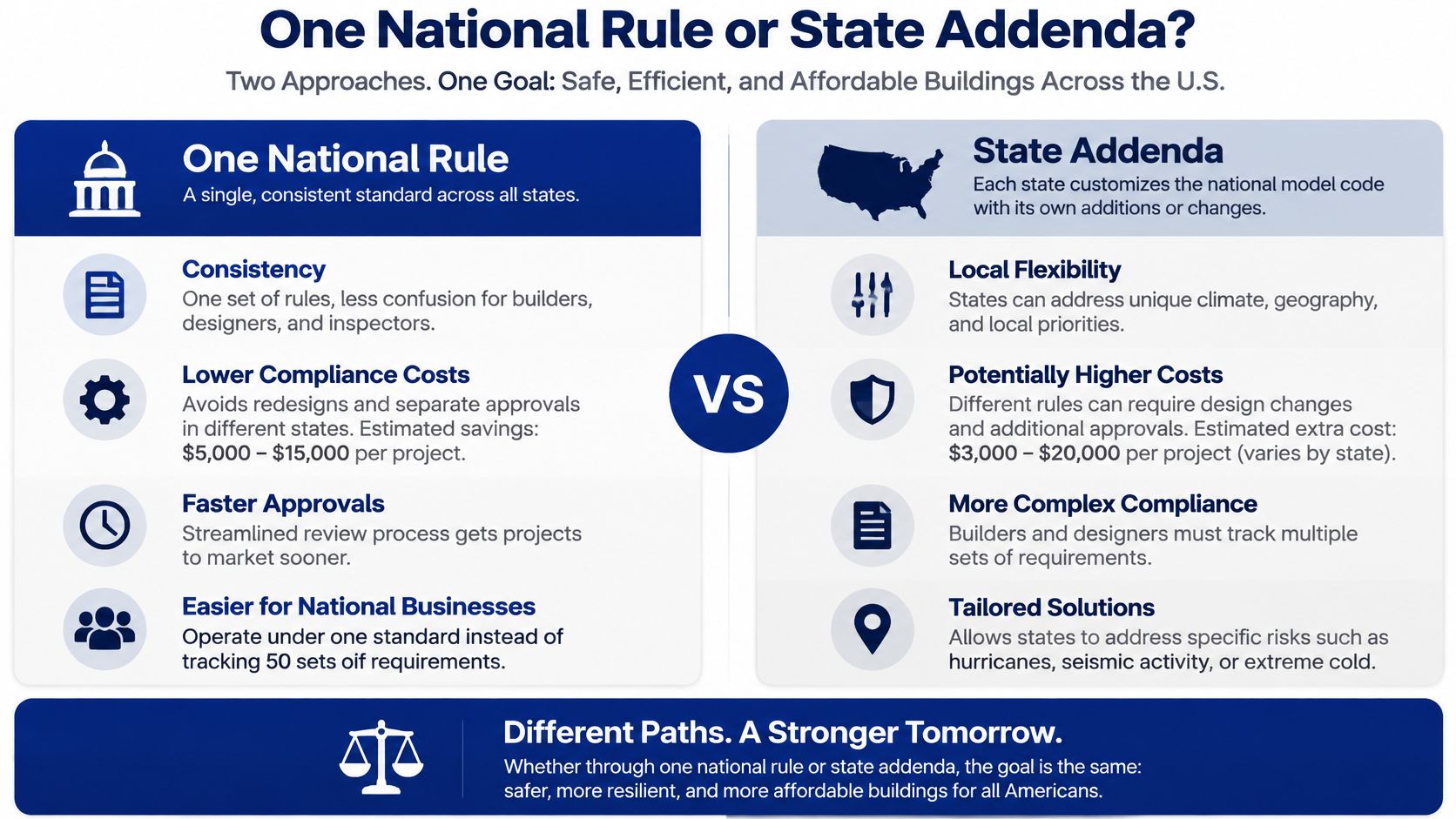
Use a national standard when common instructions improve execution without creating an unintended promise. Complaint channels, anti-retaliation expectations, investigation routing, and confidentiality limits usually benefit from shared procedures. Use a core policy with a state addendum when a location-specific deadline, benefit, or posting obligation needs separate treatment.
A stricter company-wide rule isn't automatically the better choice. Extending a benefit nationally can create an expense or commitment leadership didn't intend. A multi-state employee handbook should make those choices deliberate.
| Topic | Better format | Why | Example to verify |
|---|---|---|---|
| Complaint channels and anti-retaliation | One national standard | Managers need common intake and escalation instructions | Alternative reporting paths named and accessible |
| Investigation steps and documentation | One national standard | Consistent procedures support reliable fact-finding | Investigator authority, saved records, closure communications |
| Wage calculation and overtime eligibility | Core rule plus state addendum | Federal and state requirements need coordinated review | Classification and actual work state |
| Final paycheck timing and deductions | State addendum | A single payroll instruction may not fit every jurisdiction | Texas requirements against the departing employee's work state |
| Paid family or medical leave | State addendum | State programs require separate eligibility and benefit analysis | California and New York programs checked independently of FMLA |
| Pay range on job posts | State addendum or deliberately higher national standard | Posting coverage and remote-work reach need location review | Colorado, California, New York, and Washington requirements |
| Remote work location | Core rule plus location addendum | A move can require changes beyond manager approval | Approved work locations and exception authority |
Under the FMLA and DOL regulations applicable in 2026, the DOL's FMLA guidance states that private-employer coverage generally requires at least 50 employees during 20 or more workweeks in the current or preceding calendar year; employee eligibility generally requires 12 months of service, 1,250 hours during the prior 12 months, and a worksite with 50 employees within 75 miles. The same guidance describes up to 12 workweeks of unpaid, job-protected leave during a 12-month period, with group health coverage continued on the same terms. Remote-worksite treatment needs verification rather than an assumption based on the employee's home address.
Under the FMLA rules applicable in 2026, DOL Fact Sheet 28 explains that employees needn't say “FMLA,” foreseeable leave generally requires 30 days' notice, and otherwise notice is due as soon as practicable; written designation is generally due within five business days after sufficient information establishes qualification, absent extenuating circumstances. Assign intake, eligibility and rights notices, certification follow-up, the designation clock, and payroll communications to named people.
For California, New York, and Washington, keep wage-replacement programs separate from job-protected leave in the addendum. Record the applicable program, benefit, eligibility, reinstatement provisions, and update owner after state-specific verification. Leave involving disability, pregnancy accommodation, or possible termination deserves expert review before action.
A finished review should leave a calendar that shows recurring work is happening. A policy owner and a task owner aren't always the same person. Payroll may execute a requirement while the owner remains responsible for checking that the process works.
| Checkpoint | Law or agency | Frequency | Owner |
|---|---|---|---|
| Minimum wage, overtime, and pay statements | FLSA and DOL for federal wage requirements; applicable state pay-statement rules, 2026 review | Every pay period | Payroll |
| Discrimination, retaliation, and complaint handling | Title VII and EEOC; current 2026 applicability review | Continuous, with annual control testing | Owner or HR lead |
| Leave eligibility, rights, and designation notices | FMLA and DOL, 2026 | Each potentially qualifying request; track the applicable notice deadlines | Leave administrator |
| EEO-1 workforce report | EEOC reporting requirements; verify current filing-year coverage | Annual when covered | Owner |
| Injury and illness summary posting | OSHA Form 300A requirements; verify 2026 coverage and posting window | Applicable annual posting period | Safety or facilities lead |
| Federal and state workplace posters | DOL, EEOC, and applicable state agencies; 2026 review | Check at onboarding, new locations, and required updates | Office manager |
| Harassment-prevention training | Applicable California and New York requirements; verify current 2026 scope and cycle | State-required cycle | Location manager |
| Pay range on job postings | Applicable Colorado, California, New York, and Washington rules; 2026 review | Every covered requisition | Recruiter or hiring manager |
| Handbook acknowledgment and state addenda | Company governance practice mapped to applicable obligations | Annual company review and new-state entry | Handbook owner |
The calendar should distinguish legal requirements from company-selected controls. An annual handbook acknowledgment can be a useful internal practice without being described as a universal federal mandate. Reporting, posting, and training entries should record coverage decisions and the current agency instruction used to set the deadline.
An employment-law compliance calendar planning resource can help organize the next planning cycle, but future-year planning doesn't replace verification of current obligations. For an additional implementation perspective, leaders can browse risk governance implementation steps from Acheloa Wellness, Inc., while keeping employment-law determinations with qualified advisers.
Accountability check: A checkpoint without a named owner, deadline, and completion record is a wish, not an operating control.
A completed training roster doesn't establish that managers respond correctly. A published handbook doesn't establish that employees trust the reporting process. The EEOC's Select Task Force report on workplace harassment identified shortcomings in the evidence on training effectiveness and explained that training alone may improve knowledge without reliably changing behavior.
Test the policy-training-response chain. The rule should describe unacceptable conduct in plain language and use examples relevant to the workplace. Employees and witnesses need accessible reporting options, and managers need a clear escalation duty rather than discretion to handle sensitive concerns without escalation.
Select recent complaint and discipline files across locations. Compare what managers did with the approved procedure. A supervisor's explanation shouldn't substitute for a dated record.
Consider a supervisor who receives a complaint about a favored team lead. The policy may require escalation, but the supervisor instead asks the employee to settle the matter privately. A training certificate won't reveal that failure; a scenario exercise or file review can.
The company should also test the backup reporting route. If every alternative contact redirects employees to the same supervisor, the apparent choice isn't meaningful. Confidentiality language should explain limits rather than promise secrecy that an investigation cannot maintain.
Retaliation review shouldn't stop when the original concern closes. Examine later schedule changes, assignments, discipline, access to opportunities, and manager communications. The reviewer should distinguish documented business reasons from unexplained changes after an employee raised a concern.
Useful operating signals include:
A low complaint count isn't proof of a healthy reporting system. Employees may remain silent because the route is unclear or because they don't trust the response. Leadership should assess accessibility and follow-through, not reward managers merely for having few reports.
Investigations deserve expert help when authority, impartiality, or evidence handling is uncertain. When a complaint, leave, and possible termination overlap, pause the employment action and obtain qualified support before proceeding.
The owner's decision is which fixes happen now, which need interim controls, and which require counsel before implementation. A short leadership brief is more useful than a large redline attachment. It should make priorities, approvals, and changed manager responsibilities easy to see.
The brief should include:
An HR governance framework helps connect those assignments to leadership oversight. The owner shouldn't approve a vague instruction to improve documentation. The assignment should identify the form, review point, and person responsible for checking completion.
Employees need a short notice explaining what changed, where the approved version is stored, and how to acknowledge receipt. Managers need practical scripts for receiving complaints, routing leave requests, and coordinating separation details with payroll. Those scripts should identify the next action and prohibit improvisation outside the manager's authority.
For distributed teams, recorded explanations can supplement live briefings. Moonb's corporate video production services offer a production option for organizations choosing that format. Any recording should carry a version date and point employees to the controlled policy, since a polished video can become outdated too.
International Inc. offers optional policy guidance that addresses root causes, updates policy wording, and trains managers to prevent recurrence. The firm is an HR consulting firm, not a law firm; legal interpretation and sensitive legal decisions belong with qualified employment counsel. Its free HR Risk Review is a 30-minute confidential call, followed by a short written summary of risks and recommended next steps.
International Inc. offers HR policy reviews, handbook support, and multi-state policy alignment for leaders handling HR alongside operating the business. Further information about that support is available at Paradigm International Inc..
A second look can help leadership sort the policy gaps identified and decide which deserve attention first.
This article is general information, not legal advice. Employment laws change and vary by state; consult qualified employment counsel about your situation.