
It's Friday afternoon, and a manager wants an employee dismissed before the weekend. The COO is reviewing the request when a complaint arrives from the same employee, who recently asked about medical leave. There's no senior HR leader, and the payroll provider can process a separation but can't decide whether it should happen. The immediate problem isn't paperwork. It's knowing who has authority to act and when the decision needs outside review.
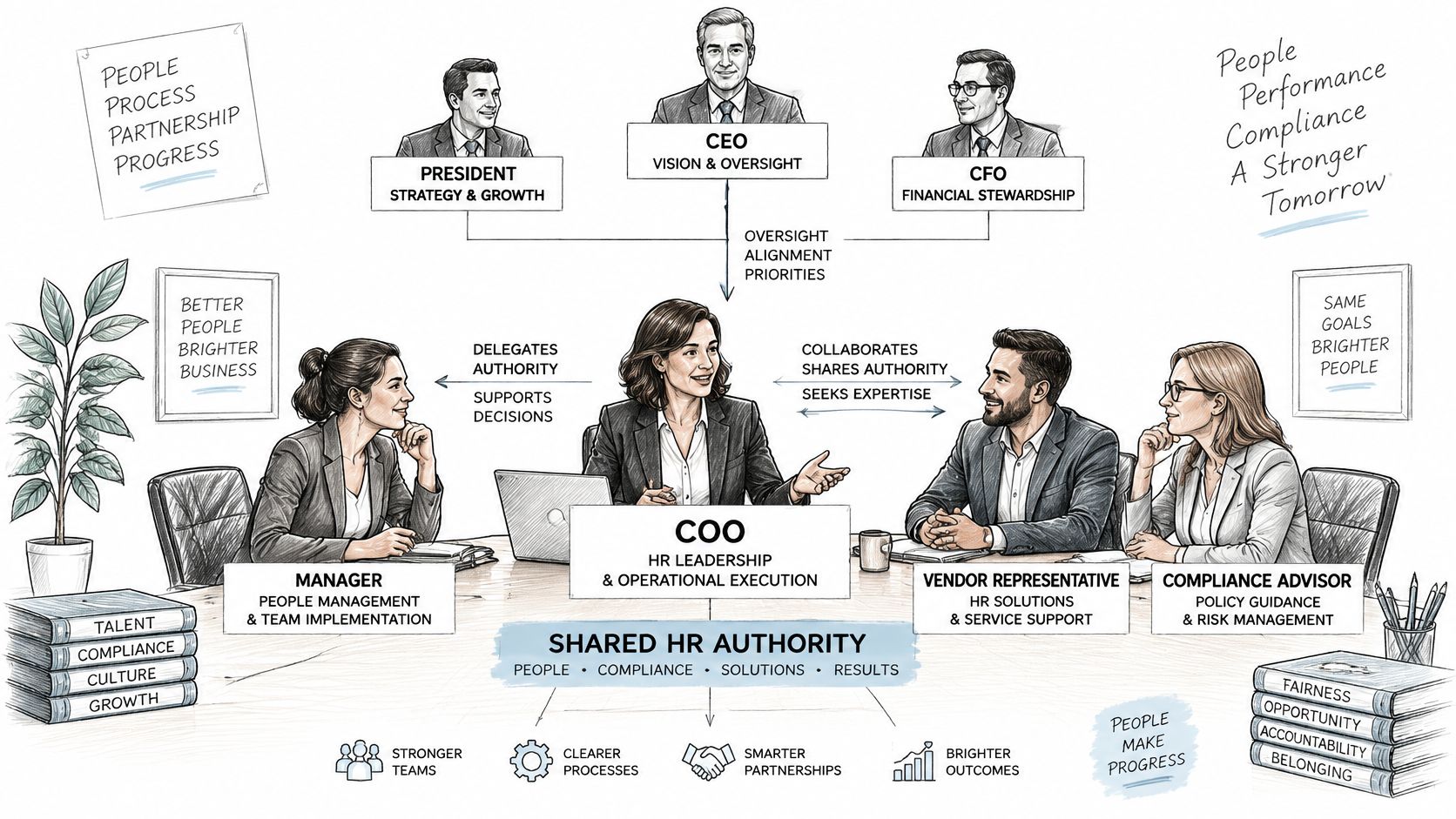
A COO responsible for HR should control execution, not make every sensitive people decision alone. In a growing, multi-state company, the COO needs authority to keep hiring, performance management, onboarding, and employee support moving. The owner should retain accountability for enterprise-level people risk, with an outside adviser supporting decisions that exceed the COO's expertise.
Without a senior HR leader, the shared-review role belongs to the owner or an outside adviser. It shouldn't become an imaginary HR department that appears on a responsibility chart but has no time, authority, or qualifications. Each review needs a named person and a clear reason for involving that person.
| HR area | COO runs day to day | Shared with owner or adviser | Escalate before acting |
|---|---|---|---|
| Hiring and offers | Approves the hiring process and offer letters | Reviews job-related criteria and forms | Offers with pay or policy exceptions |
| Performance and discipline | Runs documented corrective steps | Reviews consistency across managers | Discipline tied to a complaint, leave, or disability |
| Terminations | Makes the final call on routine separations | Checks documentation and timing | Senior leaders, leave, complaints, or disability issues |
| Complaints and investigations | Receives intake and assigns the investigator | Separates fact-finding from the decision | Harassment, retaliation, or discrimination allegations |
| Leave administration | Tracks eligibility and notices | Applies FMLA and state leave rules | Any overlap with disability accommodation |
| Handbook and policy | Approves updates and rollout | Aligns state addenda with counsel | Changes affecting pay, leave, or protected activity |
| Payroll and benefits | Oversees the PEO or payroll vendor | Confirms deductions and final pay | State-specific final pay or wage disputes |
| Recordkeeping and Form I-9 | Owns deadlines and audit evidence | Reviews files on a set schedule | Missed deadlines or errors found in an audit |
The distinction is routine execution versus exceptions requiring judgment. Approving an offer within established terms isn't the same as promising an exception to company policy. Receiving a complaint isn't the same as deciding whether the allegation is substantiated.
For longer-term workforce planning, Turn On Work's 2026 guide to strategic HR planning offers a planning resource alongside this decision map. Staffing priorities and workforce needs deserve deliberate planning rather than a series of urgent approvals. That planning doesn't replace case-specific review when a manager proposes a sensitive action.
Escalation test: If a decision could be challenged and the file can't show who decided, why, and under which policy, the decision needs review before action.
The same principle applies to a missed verification deadline or an unresolved safety-record error. A manager shouldn't improvise a correction or replace the original record. For investigations, terminations after complaints or leave, and disability-related decisions, expert help is worth obtaining before acting.
HR reporting to the COO is a legitimate structure, but it isn't the dominant one. A SHRM examination of U.S. employers in 2021 found that, among 417 employers, 10% of HR leaders reported to the COO and 13% to the CFO; the largest share reported to the CEO, president, or owner. In that sample, 67% of organizations had fewer than 250 employees, making the findings relevant to growing businesses.
SHRM also reported that its earlier analysis found no financial difference across the HR-investment metrics examined based on reporting line. Owners shouldn't treat a reporting arrangement as proof that HR is properly supported. The more useful questions concern authority, access to advice, staffing capacity, and documented review.
The COO is the operating owner. That means ensuring managers follow approved processes, employees know where to raise concerns, and administrators complete assigned work. The COO should also have authority to pause an action when the information is incomplete.
The owner retains enterprise accountability for matters such as executive conduct, major policy exceptions, and decisions with substantial organizational consequences. An outside adviser contributes experienced HR judgment, while employment counsel addresses legal questions. The HR business partner role is useful for understanding how ongoing advisory support differs from administrative processing.
A PEO or payroll provider can handle payroll and administrative tasks without owning the employer's internal decisions. The COO still needs to confirm who receives incident information, who checks its accuracy, and who follows unresolved issues through to closure. A completed vendor ticket isn't evidence that leadership made a sound decision.
International Inc. handles ongoing HR and compliance work and judgment calls, while the client's PEO, payroll provider, or HR app handles payroll and administration. That division should be explicit in the working agreement, not assumed from the vendor's service descriptions. Managers need a short approval list they can use:
Does a particular leave request trigger federal FMLA rights? The answer requires separate checks for employer coverage and employee eligibility. For a 2026 review, the governing federal framework is the Family and Medical Leave Act, administered by the U.S. Department of Labor under 29 U.S.C. § 2601 and 29 C.F.R. Part 825.
The DOL's FMLA guidance sets the general thresholds at 50 employees during 20 or more calendar workweeks for private-employer coverage, plus employee eligibility requirements of 12 months of service, 1,250 hours worked, and 50 employees within 75 miles of the worksite.
| Test | Threshold | How to measure it |
|---|---|---|
| Employer coverage | 50 or more employees in 20 or more workweeks in the current or preceding year | Count payroll headcount, including part-time, temporary, and seasonal staff |
| Employee tenure | At least 12 months with the employer | Measure as of the scheduled leave start; service need not be consecutive |
| Hours worked | At least 1,250 hours in the 12 months before leave starts | Count actual hours worked; paid or unpaid leave hours generally don't count |
| Worksite count | 50 or more employees within 75 miles of the worksite | Measure by the shortest public surface route; remote workers are tied to their reporting location or home base |
Under the DOL's employee-eligibility guidance, the worksite employee-count test is measured when the employee gives notice, while tenure is measured when leave is scheduled to begin. Those dates shouldn't be collapsed into a single payroll snapshot. The leave file should preserve the notice date, scheduled start, assigned worksite, hire history, and hours calculation.
The service period need not be continuous, but a break exceeding seven years generally doesn't count toward prior service under the federal framework. A returning employee's original hire date therefore isn't enough to establish eligibility. The administrator needs the employment history before reaching a conclusion.
Say a remote account manager works from California and receives assignments from an office in New York. The COO should examine the reporting location rather than assume the employee's home is the relevant federal worksite. Total company headcount alone doesn't resolve the employee's eligibility.
California and New York also operate state paid family leave programs with different eligibility and benefit structures. For the 2026 review, the administrator should check California Paid Family Leave through California's Employment Development Department and New York Paid Family Leave through the New York Workers' Compensation Board. Passing or failing the federal test isn't the complete state-law analysis.
A consistent FMLA eligibility checklist helps keep the calculation and supporting records together. Medical leave can also overlap with accommodation duties under the Americans with Disabilities Act, enforced by the EEOC. That overlap deserves expert help before a denial, return-to-work demand, or termination.
Payroll onboarding can be complete while Form I-9 remains unfinished. The COO needs a deadline register that identifies the task owner, evidence of completion, and escalation contact. For a 2026 compliance review, the team should confirm current agency instructions rather than rely on old onboarding templates.
For employment verification administered by USCIS and the Department of Homeland Security, Form I-9 guidance hosted by DOL requires employee Section 1 completion by the first day of employment and employer Section 2 completion within three business days. The register should also track DOL FMLA notices, OSHA records, and state wage-payment requirements.
| Requirement | Deadline or trigger | Owner |
|---|---|---|
| Form I-9 Section 1 | Employee completes by the first day of work | Onboarding owner |
| Form I-9 Section 2 | Employer completes within three business days of the first day | Named authorized representative |
| FMLA eligibility notice | Generally within five business days after the employer knows leave may qualify, absent extenuating circumstances | Leave administrator |
| OSHA injury and illness records, Forms 300, 300A, 301 | Most employers with more than 10 employees, subject to industry exemptions | COO with safety lead |
| Final pay | State-specific deadline established before separation | Payroll owner with counsel |
The onboarding owner should track the employee's task separately from the employer representative's task. Remote hiring needs a written document-review procedure consistent with current USCIS rules and a named representative, not a method invented by each manager. Errors should enter a correction log rather than disappear through undocumented edits.
The leave administrator should retain evidence that required notices were sent, not merely that a leave request entered the system. A request received by a supervisor needs a defined route to that administrator. An employee shouldn't lose time because the supervisor didn't recognize a potential leave issue.
Under the Occupational Safety and Health Act recordkeeping framework, OSHA's employer-responsibility guidance states that many employers with more than 10 employees must maintain Forms 300, 300A, and 301, subject to industry exemptions. For the 2026 review, the safety lead should confirm applicable recording, posting, access, and submission requirements. Incident reports, workers' compensation notices, leave records, and medical restrictions should be reconciled rather than managed in isolation.
A quarterly sample should test missing fields, late entries, classification inconsistencies, and unresolved corrective actions. The employment records retention requirements guide provides a useful starting point for organizing the file inventory. Final-pay rules require separate state review, including California, New York, and Florida wherever employees work; counsel should confirm the applicable wage-payment rule and timing before a separation is scheduled.
A payroll processing date isn't a substitute for a confirmed final-pay deadline.
A late timesheet can usually follow a manager's established workflow. A late timesheet followed by discipline against someone who recently complained needs a different level of review. The COO should distinguish routine administration from retaliation, harassment, disability, leave, executive involvement, or inconsistent treatment before anyone commits to an outcome.
The EEOC's fiscal year 2024 performance announcement reported 88,531 new discrimination charges, a 9.2% increase over the prior year, with 52,080 charges pending at year-end. Those figures don't predict an individual employer's exposure. They reinforce the practical importance of documented intake and deliberate decisions under federal anti-discrimination laws enforced by the EEOC.
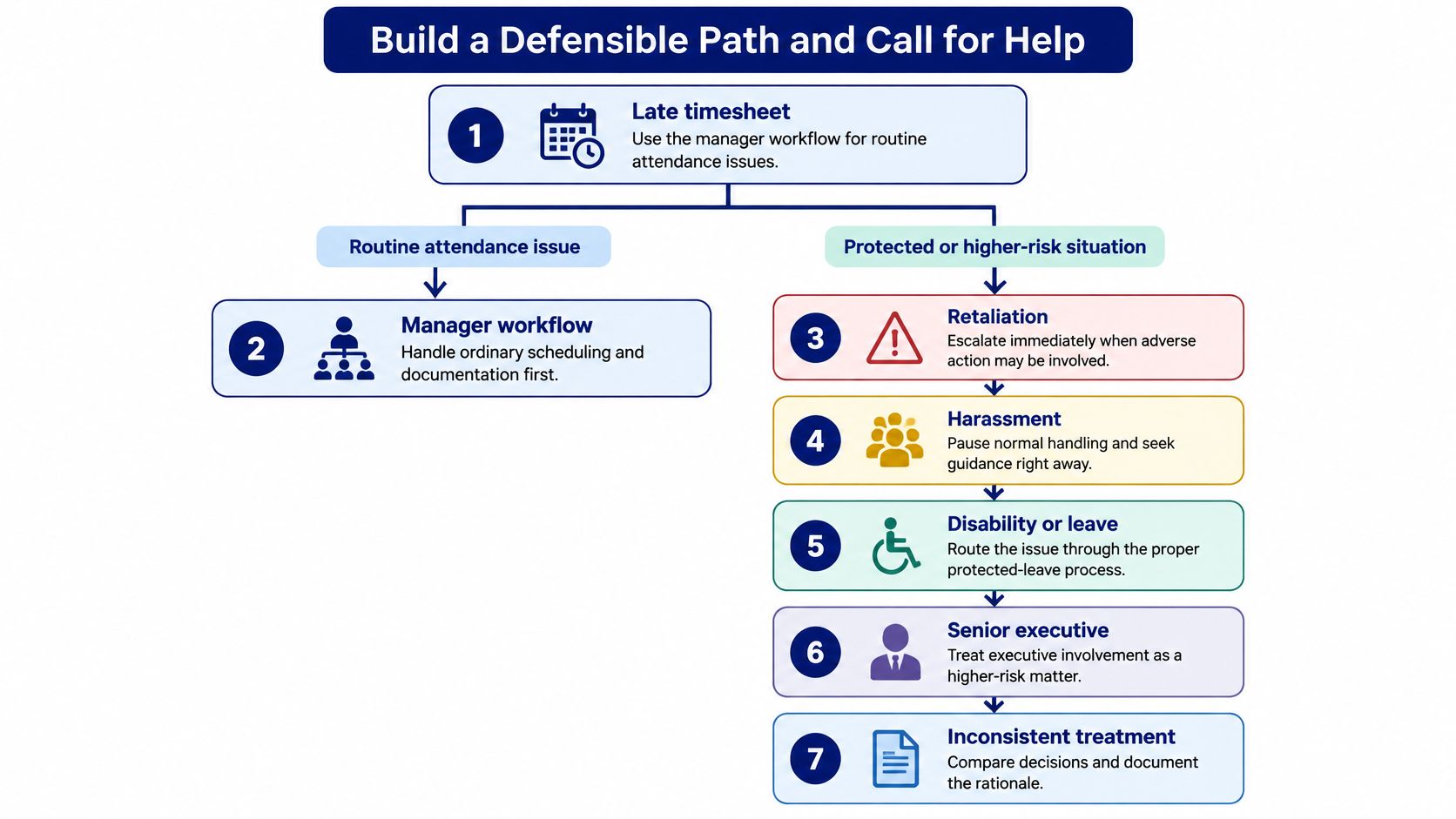
Name the decision owner before action. Record who can authorize the outcome and who must review it. If the COO is implicated, the owner needs an independent route rather than allowing the COO to control the case.
Log intake the same day. Record dates, people involved, the concern raised, and any policy cited. Separate the employee's account from the recipient's interpretation, and preserve the original message.
Choose an impartial investigator. The investigator shouldn't have supervised the employee or be responsible for the final decision. Reporting to the accused leader, participating in the disputed events, or having a personal stake should trigger a different assignment.
Collect facts before discussing outcomes. Preserve relevant communications, interview witnesses, and identify conflicting accounts. A manager's preferred result shouldn't become the investigation's starting assumption.
Check policy and jurisdiction. Compare the proposed action with company rules, prior treatment, applicable federal requirements, and the employee's state. For a 2026 decision, counsel should resolve legal questions involving the relevant law, including FMLA, ADA, or state wage and leave requirements.
Record the rationale and approval. Identify the evidence relied upon, unresolved gaps, policy basis, approving person, and follow-up date. The explanation should connect the facts to the decision without overstating what the investigation established.
Review what happened afterward. Check for changed assignments, exclusion, schedule changes, hostility, or other adverse treatment after the concern was raised. Follow-up should include actual contact and record review, not merely marking the case closed.
These controls stop a manager from turning an emotional conversation into an immediate employment decision. They also keep an investigator from becoming the person who gathers evidence, evaluates personal conduct, and approves the result. A practical human resource risk management approach makes those boundaries visible before the next urgent call.
An adviser can structure the HR process, identify missing information, and coordinate the review. Legal questions belong with qualified employment counsel. The following situations merit a pause before leadership announces a decision:
International Inc. works with operator-led companies, including those led by a COO, president, or CFO, that don't have a senior HR leader. That operating context matters because the adviser must help a busy executive make deliberate decisions without pretending the company has a fully staffed internal HR function. The process should clarify authority rather than add another undefined reviewer.
The COO's dashboard should show leading indicators, not just completed cases or legal expenses. Useful measures include:
Each high-risk case should connect to its owner, evidence set, policy basis, jurisdiction, action date, and follow-up. Access should be limited to people with a legitimate role. Leadership needs enough visibility to supervise the process without circulating sensitive details unnecessarily.
The owner and COO should finish the initial responsibility map this week. An afternoon is enough to draft the map, identify gaps, and assign unresolved questions, though legal review and remediation may take longer. The result should be a working document the COO opens when the next complaint arrives.
The HR governance framework should support this document rather than become a separate policy nobody uses. The map belongs alongside the case register, escalation contacts, and approval records. A missing reviewer should be treated as an open issue, not automatically assigned to whoever answers first.
Owner's check: Every sensitive decision needs an authorized decision-maker, an identified reviewer, and a record that explains the action.
Owners seeking an outside assessment can learn more about how International Inc. approaches HR decision support. International Inc. is an HR consulting firm, not a law firm, and its advisory role doesn't replace employment counsel.
International Inc. offers a free, 30-minute confidential HR Risk Review, followed by a short written summary of risks and recommended next steps. Owners and COOs can visit Paradigm International Inc. to learn about support for decision ownership, escalation practices, and multi-state HR oversight.
This article is general information, not legal advice. Employment laws change and vary by state; consult qualified employment counsel about your situation.