
A lot of leaders reach for HR help only after something has already gone sideways. A manager handled a complaint poorly. A termination felt rushed. A business expanded into another state and suddenly discovered that “standard practice” wasn’t standard at all.
That’s usually the point where the difference between basic HR support and strategic human resource management consulting becomes obvious. One keeps the machinery running. The other helps leadership make sound decisions when facts are incomplete and the cost of getting it wrong can follow the business for years.
Strategic human resource management consulting is not the same as outsourced administration. That distinction matters most for SMBs that are growing, operating across states, or working inside regulated environments where employment decisions carry legal and reputational consequences.
A useful comparison is finance. A bookkeeper records transactions and keeps the records current. A financial advisor helps a CEO decide whether a move is wise, what the downside looks like, and how to document the reasoning. Strategic HR consulting plays that advisory role for people decisions.
Administrative HR support usually focuses on execution:
Strategic consulting focuses on judgment:
Practical rule: If the issue could end in a claim, agency response, executive dispute, or reputational damage, it belongs in the strategic category.
This is one reason the market has expanded. The global human resources consulting market reached US$49.4 billion in 2022 and is projected to exceed US$82 billion by 2032, reflecting stronger demand for strategic HR advisory as companies manage employment risk and compliance complexity, according to Fact.MR’s human resources consulting market analysis.
HR software is useful. A PEO can also solve real operational problems. Neither automatically serves as a decision partner during a sensitive investigation or a disputed termination.
A simple comparison helps:
| Support model | Primary value | Limitation in high-stakes moments |
|---|---|---|
| HR software | Standardization and workflow efficiency | It doesn’t apply judgment to a messy employee relations issue |
| PEO or admin outsourcing | Process support and infrastructure | It may not guide executive decision-making with a risk-first lens |
| Strategic HR consultant | Advisory counsel, documentation standards, risk mitigation | Requires leadership engagement and clear scope |
If your team is also modernizing systems, it helps to understand how process design and technology fit together. This overview of digital transformation in HR is useful because strong tools only work when the operating model behind them is sound.
The value shows up when leadership faces questions that don’t have a simple policy answer.
Examples include:
A strategic consultant doesn’t just answer, “What does the policy say?” The better question is, “What is the defensible path from here?”
That usually includes reviewing facts, identifying gaps, sequencing next steps, and helping leaders avoid emotional or inconsistent responses. For companies trying to build that capability more intentionally, a structured strategic HR plan often matters more than adding a...com/post/strategic-plan-hr) often matters more than adding a...com/post/strategic-plan-hr) often matters more than adding another tool or template library.
The strongest HR advisory work is usually quiet. It prevents rushed decisions, cleans up inconsistent practices, and gives executives a record they can stand behind later.
Basic support keeps HR moving. Strategic consulting keeps leadership from stepping into preventable exposure.
When an HR firm leads with advisory work, the service list looks different. The work is less about handling volume and more about reducing uncertainty for leadership.
The core services usually sit under one idea: helping the business make people decisions that are consistent, lawful, and well documented.
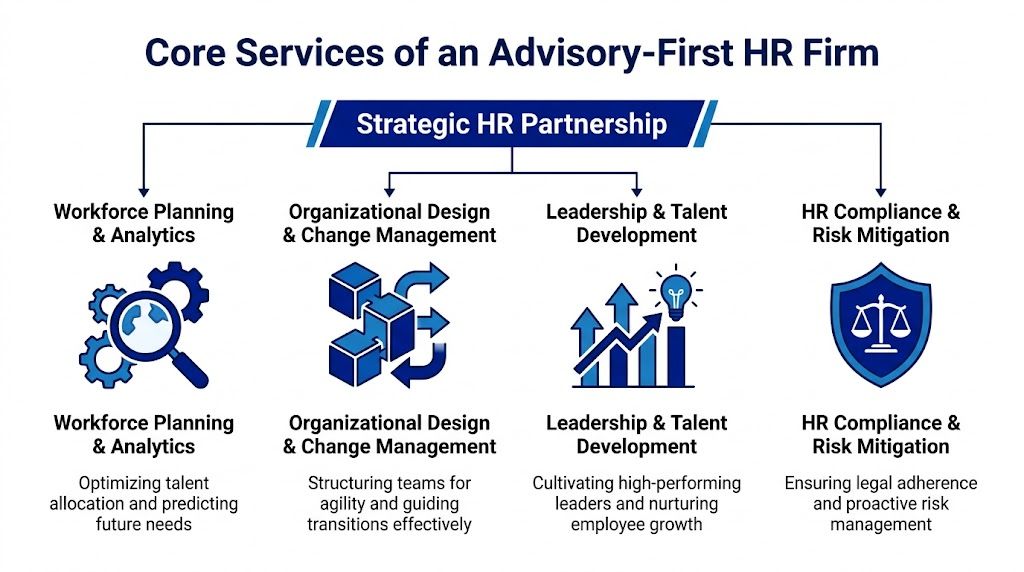
This work goes beyond headcount reporting. It asks whether the company has the right structure, where manager strain is increasing, and which employee patterns deserve attention before they become expensive problems.
An advisory-first firm may help with:
The practical point is simple. Leaders need more than dashboards. They need help interpreting what the data means and what action makes sense.
A surprising amount of HR risk starts with unclear structure. Reporting lines become fuzzy. Decision rights overlap. Managers carry responsibility they were never prepared to handle.
In growth stages, advisory firms often help leaders answer questions such as:
Poorly managed change creates confusion first, then inconsistency, then exposure. Good consulting slows that sequence down.
Most employment risk doesn’t begin with a bad intent. It begins with a manager improvising.
That’s why leadership support is a core service, not an add-on. A sound advisory firm helps managers learn how to:
A manager who says, “This employee just isn’t a fit,” usually needs coaching before the company acts on that statement.
Many firms also support training, coaching, and role-based playbooks. Some providers, including outsourced HR services designed for growing companies, combine recurring advisory...com/post/outsourced-hr-services), combine recurring advisory...com/post/outsourced-hr-services), combine recurring advisory access with manager guidance so leaders aren’t making isolated judgment calls under pressure.
This is the area CEOs usually care about most once a problem appears. It includes the work that keeps a business from relying on assumptions, old templates, or uneven manager practices.
Common services include:
The trade-off is worth stating clearly. Administrative providers often move faster because they process repeatable tasks. Advisory-first firms move more deliberately because they are protecting the decision itself.
That slower, more structured pace is often exactly what a leadership team needs during high-stakes moments.
A business rarely needs outside HR advice for every issue. It does need it when the issue is complex enough that ordinary internal handling could create larger problems.
That point often arrives earlier than leaders expect.

Some moments should prompt a serious look at outside support.
The service gap is real for SMBs in these situations. Many businesses in multi-state or regulated operations are underserved because traditional providers emphasize administration over strategic risk mitigation, as noted in this rival analysis of HR consulting gaps.
This isn’t an argument against internal HR people. Good internal staff are essential. It is an argument against asking them to solve specialized risk problems without support.
An HR generalist may be excellent at onboarding, employee support, and routine policy administration. That same person may not have the depth needed to guide a contested investigation, a multi-state termination, or a manager misconduct issue involving legal exposure.
A line manager is even less equipped. Managers often know the employee and the business pressure. They usually don’t know how to create a record that will stand up later.
The worst time to discover a capability gap is in the middle of a complaint review or just before a termination meeting.
Ask three questions:
| Question | If the answer is yes |
|---|---|
| Could this issue lead to a claim or formal complaint? | Bring in advisory support |
| Are leaders disagreeing about what to do next? | Bring in advisory support |
| Is the current documentation incomplete, inconsistent, or emotional? | Bring in advisory support |
If a company keeps running into these moments, waiting rarely helps. Exposure tends to accumulate through inconsistent notes, outdated practices, and manager habits that no one has corrected.
For SMB leaders deciding whether the timing is right, this guide on when to hire an HR consultant for a small business is a practical s...com/post/hire-hr-consultant-small-business) is a practical s...com/post/hire-hr-consultant-small-business) is a practical starting point.
The best time to hire a consultant is usually before the issue becomes adversarial. Once positions harden and facts are poorly documented, the options narrow.
Not every HR consultant is built for risk-heavy work. Some are excellent operators. Some are trainers. Some are compliance checklists with a retainer attached. A CEO looking for a decision partner needs a narrower filter.
The right evaluation process has less to do with personality and more to do with method.

A low-cost provider can become expensive if they miss key issues. The better question is whether the consultant regularly works in the kinds of situations your business faces.
Look for evidence in these areas:
A consultant who mainly sells templates may still be useful. They just aren’t the same thing as an advisory-first partner.
Weak providers are quickly revealed. Ask direct questions and listen for specifics.
“How do you approach a termination when documentation is incomplete?”
A strong answer should mention fact review, risk assessment, remediation options, and decision sequencing.
“What do you do when a manager’s conduct may be part of the problem?”
You want to hear about neutral review, witness process, consistency, and separating performance issues from misconduct issues.
“How do you support companies operating in more than one state?”
Look for a practical answer about policy harmonization, local variation, and consistent operating standards.
“What does a completed investigation look like from your perspective?”
A serious consultant should describe scope, interviews, records, findings, and recommended action steps.
“How do you help leaders make decisions they can defend later?”
This is the central question. If the answer stays vague, the methodology probably is too.
What to listen for: clear process, careful language, and an emphasis on facts over instinct.
Some warning signs show up fast:
The best consultants tend to ask sharp questions back. They want to know who makes decisions, where the company operates, how managers are trained, what documentation looks like today, and where prior issues have surfaced.
That curiosity is a good sign. It means they understand that risk doesn’t live in one policy. It lives in the interaction between leadership habits, process design, and evidence.
A strong buyer looks for a consultant who can step into that reality without turning every issue into a generic HR project.
Leaders sometimes struggle to measure the value of human resource management consulting because the return doesn’t always appear as new revenue. It often appears as avoided damage, cleaner execution, and better decisions under pressure.
That doesn’t make the ROI vague. It just means the measurement model is different.
A credible advisory engagement should produce more than conversations. Deliverables vary by scope, but they often include tangible working tools that leadership can use after the engagement ends.
Examples include:
Some firms also support analytics and operating dashboards. That’s useful when it helps leaders act, not just monitor.
One of the clearest examples is turnover analysis. HR consultants increasingly use predictive methods to flag flight risk earlier. In turnover prediction models, machine learning is used in 75.9% of models, and identifying at-risk employees can reduce voluntary attrition by up to 30%, according to this research review on predictive analytics in HRM.
That matters because the ROI isn’t only in reporting. It’s in changing management action before a preventable loss occurs.
A practical measurement lens looks like this:
| Area | What to measure |
|---|---|
| Risk reduction | Fewer repeat employee relations issues, cleaner case handling, more consistent documentation |
| Manager effectiveness | Better escalation habits, stronger written records, fewer improvised responses |
| Operational stability | Smoother onboarding of new managers, cleaner role clarity, fewer policy contradictions |
| Workforce retention | Earlier identification of pressure points affecting turnover or morale |
Good ROI in HR advisory often looks like a problem that never matures into a formal dispute.
Many leaders often misjudge the investment. They compare advisory work to a lower-cost admin option and assume the savings are obvious. They usually aren’t, because the comparison ignores what the consultant is trying to prevent.
The avoided costs can include:
This is also where tools matter. A thoughtful consultant may work through an HRIS, pull payroll and performance data together, or help leadership interpret 9-box, engagement, and retention patterns. The point isn’t to create more reporting. The point is to turn a messy people issue into an evidence-based decision.
That’s the category where certain firms operate, combining risk review, documentation standards, and... operate, combining risk review, documentation standards, and leadership guidance for businesses that need more than administrative support.
A few approaches consistently disappoint:
The strongest ROI comes when leaders use advisory support to build routines. Better intake. Better notes. Better escalation. Better judgment.
That’s how companies scale without carrying hidden HR debt.
Defensible HR practices aren’t abstract. They show up in how a company hires, promotes, investigates, documents, and exits employees when the facts are messy and emotions are high.
The details change by industry. The principle doesn’t. Leaders need decisions grounded in evidence, not manager instinct.
A growing tech company often looks low risk from the outside. The actual risk shows up in dispersed teams, uneven manager habits, and assumptions that one policy set fits every employee.
A typical pattern looks like this:
A company hires remote employees across several states. Managers use different standards for attendance, corrective feedback, and role flexibility. One team documents performance concerns carefully. Another relies on Slack messages and verbal feedback. A termination decision then lands on leadership’s desk with inconsistent records and different treatment across teams.
A defensible response usually includes:
Tools such as the 9-box grid become useful when applied carefully. They help map employees against quantifiable performance and potential measures so promotion and termination decisions are tied to evidence rather than subjective impressions, as described in Visier’s overview of data-driven HR and the 9-box grid.
A remote workforce doesn’t reduce HR risk. It often hides inconsistency until a challenged decision forces the company to explain itself.
Healthcare creates a different type of pressure. Patient-facing work, credentialing, conduct expectations, scheduling realities, and documentation standards all intersect. A weak people process can become an operational problem quickly.
Consider a practice dealing with a clinician or staff member whose conduct has raised repeated concerns. The team may know there is a problem, but the file is often fragmented. One supervisor wrote detailed notes. Another didn’t. Some concerns relate to communication. Others touch compliance-sensitive behavior. The business wants speed, but the record needs discipline first.
A defensible path usually involves:
Healthcare leaders often need an advisor who can slow the process down without stalling the business. That balance matters. Moving too fast creates exposure. Moving too slowly can undermine operations and morale.
Different industries need different operating details, but the strongest HR consulting always drives the same outcomes:
That’s what strategic HR support is for. Not more paperwork. Better judgment, applied in a way the company can defend later.
If your leadership team is dealing with growth, multi-state complexity, investigations, or high-stakes employment decisions, a specialized HR consulting firm is one option for building a more structured, defensibl...com) is one option for building a more structured, defensibl...com) is one option for building a more structured, defensible HR approach. The goal isn’t to replace your internal team. It’s to help decision-makers move carefully, document correctly, and reduce preventable risk as the business grows.