
A manager in one state reports a complaint about retaliation. The employee works in another state, the manager supervises people across three jurisdictions, and the termination decision is already scheduled for Friday. The COO now has to determine which rules apply, who should investigate, what evidence must be preserved, and whether the existing documentation can support the decision.
That's the operating reality for a growing business. Human resource risk management is no longer a file-storage exercise or a collection of annual training sessions. It's a governance discipline that helps leaders identify people-related exposure, make consistent decisions, document the reasoning, and escalate matters before they become legal, financial, or reputational problems.
Traditional HR support works for routine decisions in one jurisdiction. It breaks down as a company crosses state lines, adds management layers, adopts new technology, or receives a complaint involving retaliation, discrimination, harassment, pay, leave, or manager conduct.
In the complaint described earlier, a weak process collects the manager's statement, files it, and proceeds with the scheduled termination. A defensible process pauses the decision, preserves messages and performance records, maps the jurisdictions involved, appoints an investigator, and separates factual findings from legal advice and the final employment decision.
That discipline is the foundation of effective human resource risk management. The goal is not to prevent every difficult employee situation. It is to show how the organization identified the risk, who assessed it, what controls it applied, and why the final decision was reasonable.
Compliance maturity should be treated as an operating control, not an HR preference. A 2024 HR.com research summary on legal and employment compliance reported that only 31% of organizations had a fully mature compliance function. The same research indicated that just 32% take a proactive approach to compliance, while 34% faced an enforcement action in the past year.
Those findings matter for multi-state small and midsize businesses because informal judgment does not scale. A manager may apply one state's leave rule to an employee working elsewhere, or an investigation may involve witnesses, records, and decision-makers across several jurisdictions. Without a defined owner, jurisdiction review, evidence trail, and escalation trigger, the company cannot reliably explain why it acted as it did.
Headcount changes raise the stakes. Crossing a statutory threshold can activate new posting, leave, reporting, benefits, or anti-discrimination duties. Maintain a current headcount and jurisdiction register, link each threshold to an accountable owner, and require review before a hiring, transfer, restructuring, or termination decision is finalized.
Practical rule: Treat every high-stakes people decision as a business control. Assign an owner, define the evidence required, record the jurisdictions reviewed, and establish the escalation point before the decision is finalized.
Employment risk deserves the same executive attention as a material vendor dispute, security incident, or financial-control failure. The cost doesn't arise only from a court judgment. It can include back pay, settlement costs, management time, investigation expenses, employee disruption, insurance implications, and reputational damage.
U.S. labor enforcement data cited in 2026 showed that the Department of Labor recovered $259 million in back wages in FY2025 for nearly 177,000 workers, the highest amount since 2019. The same 2026 HR compliance checklist cited EEOC results showing nearly $660 million recovered for workers in FY2025, including $528 million secured through pre-litigation enforcement.
The litigation environment has also become more demanding. A 2026 employee-risk summary reported 26,635 federal employment lawsuits filed in 2025, a record high and 10% above 2024, while discrimination, harassment, and retaliation allegations reached 15.5 claims per 1,000 employees, as reported in the same employment compliance analysis.
A complaint doesn't become expensive only when a claimant files suit. It becomes expensive when the company loses control of the facts, allows relevant evidence to disappear, permits the decision-maker to shape the record, or treats a potential retaliation issue as a routine performance matter.
The EEOC's public reporting illustrates the value of earlier resolution. In FY2023, the agency resolved 98 merits lawsuits in federal district court for nearly $22.6 million and filed 143 lawsuits on behalf of alleged victims of workplace discrimination, more than 50% above FY2022, according to the EEOC 2023 Annual Performance Report. By FY2025, the EEOC reported $660 million recovered for 17,680 victims, including $528 million through pre-litigation enforcement processes.
That makes complaint intake and investigation design financial controls. Your process should answer four questions immediately:
For broader insurance context, leaders can review this employment liability coverage guide to understand how employment practices liability insurance fits into a wider risk program.
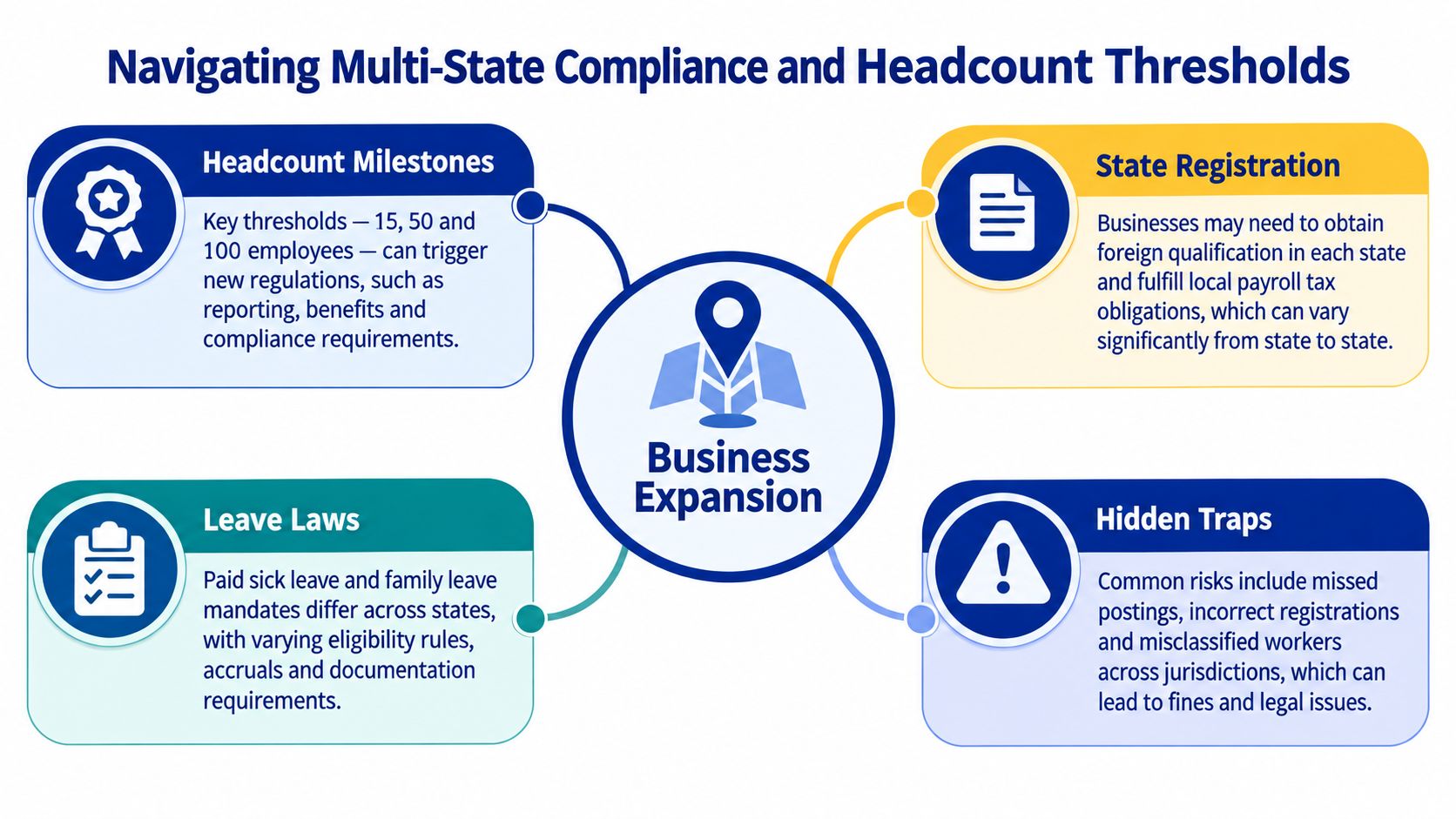
A company doesn't become a multi-state employer merely by opening a second office. It becomes one when employees work, report, travel, get paid, take leave, or raise complaints under different legal regimes. That distinction matters because the same policy, investigation sequence, or retention rule may not work everywhere.
State whistleblower laws can differ in who receives protection, what activity qualifies, what the employer must document, and how long records must be retained. A complaint made by an employee in one state may involve a manager in another state, a payroll team in a third jurisdiction, and a termination decision made at headquarters. A single paper trail designed for the headquarters state may leave gaps elsewhere.
Headcount is a control variable. It can trigger representation rules, consultation duties, reporting requirements, leave obligations, posting requirements, or other employment-law responsibilities. A comparative employment-law guide notes that employers with 100 or more employees must organize social elections for a Works Council in certain jurisdictions, and that 10% employee support can be enough to trigger representation rules in some jurisdictions for companies with 100 to 300 employees, as described in this global employee headcount thresholds guide.
Don't track headcount as a payroll report that someone checks after the fact. Maintain a threshold register owned jointly by HR, finance, and operations. Review it whenever the business hires, acquires, reorganizes, uses contractors, or changes where employees perform work.
A useful register identifies:
Companies with employees in more than five states spend 3.6 times more time on compliance than others, while in-house HR teams averaged 562 hours per year on compliance work, according to HR.com's compliance research coverage. That burden makes informal tracking especially dangerous.
For hiring teams, hiring compliance insights from GENTY recruitment can provide useful context on building controls into recruitment rather than trying to repair compliance after a hire.
Use a state-specific handbook review as another control. The Paradigm International employee handbook guide can help leadership teams identify where a single national policy needs state supplements or a more careful review.
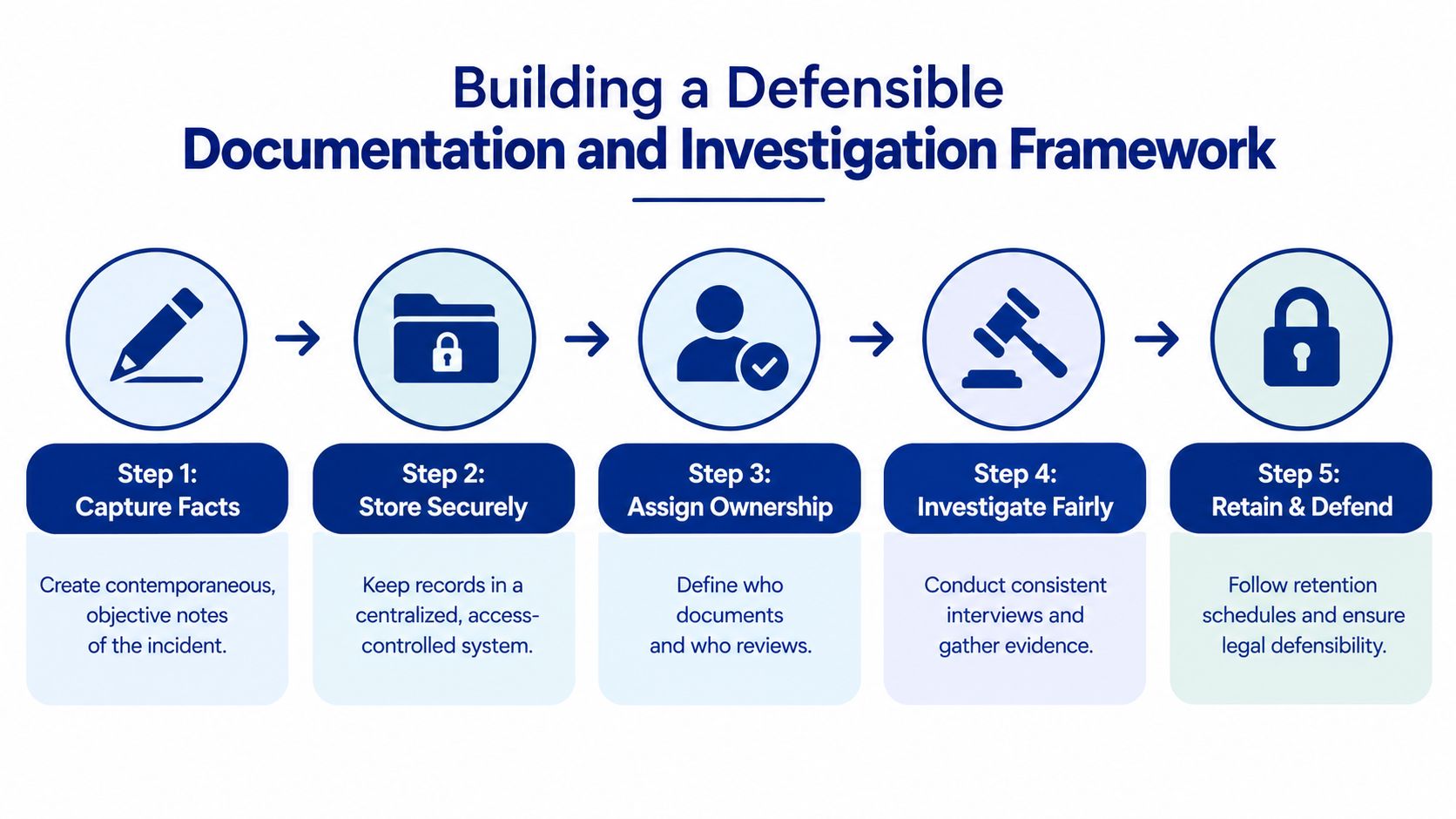
“Document everything” is weak advice unless the organization defines what to document, who documents it, when the record is created, and where it is stored. A defensible file doesn't contain every thought anyone had. It contains a clear sequence of facts, actions, decisions, and approvals.
Start with a controlled intake record. Capture the date, reporter, people involved, allegation, location, relevant policy, and immediate safety or retaliation concern. Don't ask the manager accused of misconduct to control the initial record, and don't let the business continue a termination decision without reviewing whether the complaint changes the risk.
Capture facts contemporaneously. Record what the witness or employee said, what the company observed, and what remains unknown. Avoid conclusions such as “the manager is retaliating” until the evidence supports that finding.
Store records securely. Keep investigation materials in a restricted location with access limited to people who need the information for the investigation or decision. Separate sensitive investigation records from ordinary personnel files when appropriate.
Assign ownership clearly. Name the investigator, the HR process owner, the legal reviewer if needed, and the business decision-maker. The person who decides the employment action shouldn't rewrite the factual record to justify the outcome.
Investigate consistently. Identify witnesses, collect documents, ask comparable questions, and give the subject a fair opportunity to respond. Adapt the process to the jurisdictions involved rather than forcing every matter into one rigid template.
Retain and defend the record. Apply the appropriate retention schedule, preserve records when litigation or an agency inquiry is reasonably anticipated, and document why the organization selected the remedy.
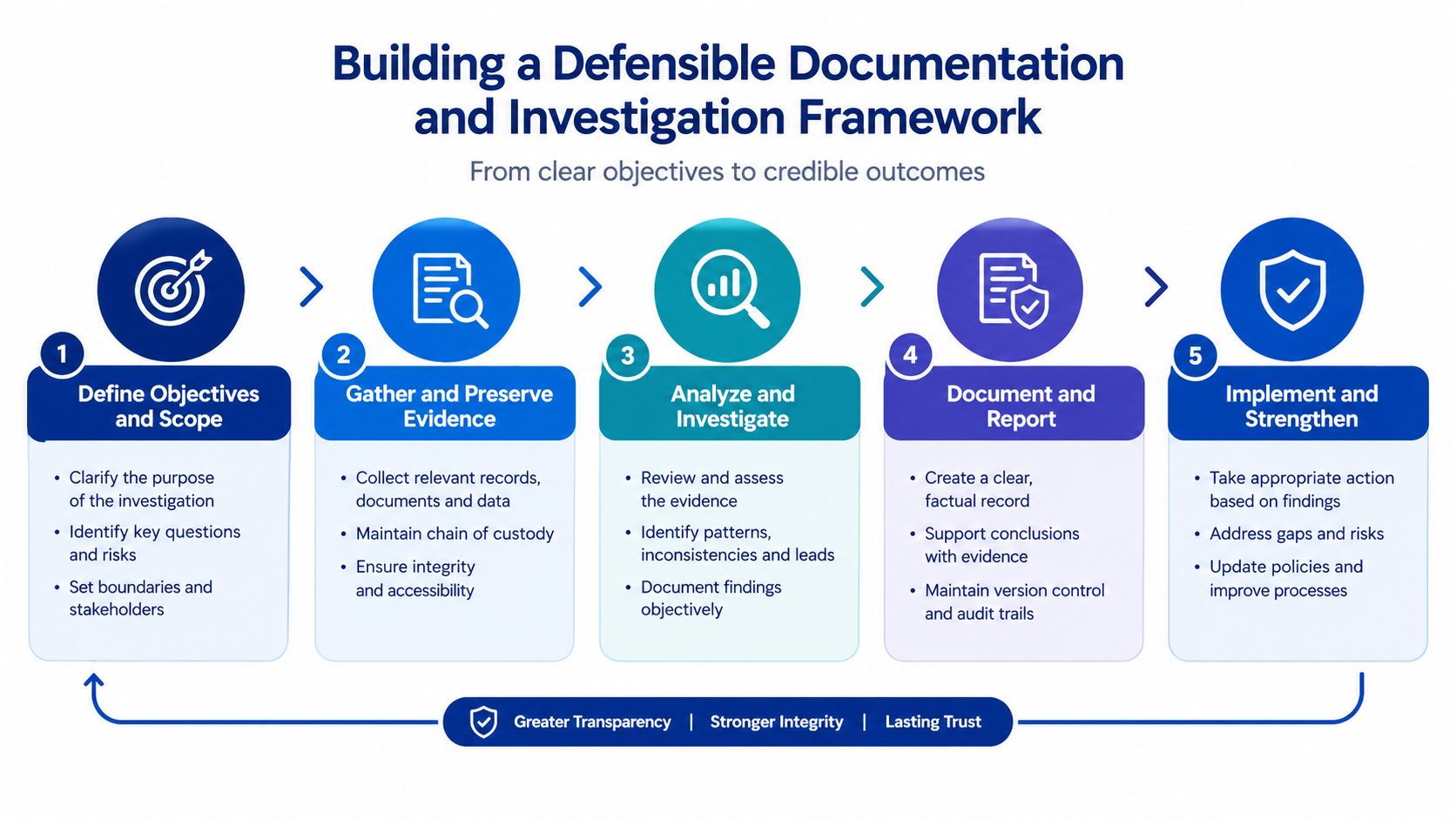
Independent legal guidance emphasizes that investigators must identify the law applicable to the investigative step itself, not only the law governing the underlying allegation. It also recommends separating factual findings, legal advice, and remedial decisions so the record can withstand scrutiny across jurisdictions, as explained in this workplace investigations guidance from ACC.
A sound investigation file should allow a reviewer to distinguish three layers:
That separation prevents a common failure. Leaders often begin with a desired employment outcome and then ask HR to assemble supporting paperwork. The defensible approach works in the opposite direction. Establish the facts, assess the legal and operational exposure, then make and record the business decision.
For practical implementation, use this SMB HR documentation advice to strengthen manager notes, performance records, complaint files, and decision memoranda.
A compliance checklist can tell you whether a policy exists. It can't tell you whether employees understand it, whether managers apply it consistently, or whether a new business decision creates an unrecognized people risk.
The risk surface now includes technology, employee data, workforce resilience, compensation transparency, health costs, geopolitical disruption, and changes in how work is organized. Mercer's 2026 People Risk Report and Aon's 2026 Human Capital Outlook flag AI, cyber, geopolitics, pay transparency, and trade volatility as major forces shaping workforce risk, according to Mercer's people risk management coverage.
The executive question isn't whether AI or geopolitics appears on a risk register. The question is what a manager must do differently on Monday.
If the company uses AI to screen candidates, draft performance language, analyze workforce data, or support scheduling, define who reviews the output and what evidence remains. If pay transparency requirements affect recruiting, decide who approves salary ranges, how exceptions are documented, and how managers explain differences. If a cyber incident exposes employee information, establish who controls notification, evidence preservation, and employee communications.
A practical people-risk register should connect each broad risk to a decision rule:
| People risk | Local decision rule | Evidence to retain |
|---|---|---|
| AI-assisted employment decisions | A qualified person reviews material outputs before action | Input, output, reviewer, and final rationale |
| Pay transparency | Compensation ranges and exceptions receive documented approval | Role level, range, approval, and explanation |
| Cyber exposure | Access and incident ownership are defined before an event | Access record, incident timeline, and response |
| Geopolitical or trade disruption | Workforce changes use a documented escalation path | Business rationale, affected roles, and review |
| Employee resilience | Managers escalate sustained conduct or workload concerns | Report, response, and follow-up decision |
More tools don't automatically create more control. A new HR platform can multiply inconsistent data, duplicate records, and unclear ownership if leaders haven't defined the process first.
Leadership test: If nobody can explain who reviews the data, who approves the decision, and where the evidence lives, the organization hasn't implemented a control. It has added activity.
Ad hoc HR administration asks, “What form do we need?” Formal governance asks, “What risk are we managing, who owns the response, and how will leadership know it worked?”
Canada's federal audit framework defines HR risk mitigation as a sequence of identifying risks, assessing likelihood and impact, ranking priorities, and monitoring the response, as set out in the Canadian federal HR risk audit framework. That sequence gives an SMB a workable operating model without requiring a large risk department.
Identify. Build a live inventory covering complaints, terminations, investigations, manager conduct, pay practices, leave administration, data handling, hiring, and geographic expansion. Record the trigger, affected people, jurisdiction, current control, and owner.
Assess. Rate the potential impact and likelihood using language leadership understands. A complaint involving protected activity and a pending termination deserves a different response from a minor handbook inconsistency. Include legal, financial, operational, employee, and reputational consequences.
Respond. Select a control that matches the exposure. The response may involve an investigation, decision pause, legal review, manager restriction, policy correction, payroll audit, training, or a change in approval authority. Assign a deadline and make the responsible person visible.
Monitor. Confirm that the response occurred and reduced the risk. Review repeat complaints, delayed investigations, unresolved corrective actions, inconsistent manager decisions, and threshold changes. A closed ticket isn't proof that the control worked.
The UK government's people standard distinguishes lower-level risks managed inside the organization from higher-level risks escalated through broader management bodies, according to the UK government people standard. An SMB can apply the same logic with a simple authority map.
Local HR or an assigned manager may handle routine policy questions. Executive leadership should receive matters involving protected complaints, retaliation concerns, senior leaders, repeated conduct, multiple states, substantial workforce impact, or a proposed action that could materially affect the business.
Document the escalation itself. Record when the issue was raised, who reviewed it, what information was available, what advice was requested, and why the organization selected its response. This evidence shows that leaders didn't ignore the warning or allow one manager to make an enterprise-level decision alone.
Most organizations don't fail because they lack a handbook. They fail because the handbook doesn't control the decision in front of the manager.
A 2025 HR compliance study found that only 33% of organizations have highly mature legal compliance processes that employees fully understand, and fewer than 40% use up-to-date technologies for HR compliance processes, according to HR compliance best-practice research. Those gaps become visible during terminations, investigations, audits, and employee complaints, when leaders need reliable evidence rather than general assurances.
A mature partner should help leadership answer difficult questions:
Technology can support secure records, workflow approvals, reporting, and threshold tracking. It can't decide whether the facts support a termination or whether a manager's explanation creates retaliation risk. Leaders need a process that combines tools with experienced judgment.
The financial question also deserves discipline. Compare the cost of structured advice with the cost of delay, rework, inconsistent decisions, and external disputes. A review of 2026 rates for HR advisors can help owners and COOs frame that comparison before a high-stakes matter arrives.
Paradigm International Inc. provides HR risk and decision advisory for SMB leadership teams dealing with terminations, investigations, manager conduct, documentation standards, and multi-state employment decisions. The firm's advisory-first approach is designed to give executives a clear process, appropriate escalation, and a defensible record when people decisions carry legal, financial, or reputational exposure.
Paradigm International Inc. helps owners, COOs, and HR leaders build practical controls for complaints, investigations, terminations, documentation, and multi-state compliance. Visit Paradigm International Inc. to discuss the people-risk decisions your organization needs to handle with greater precision and defensibility.