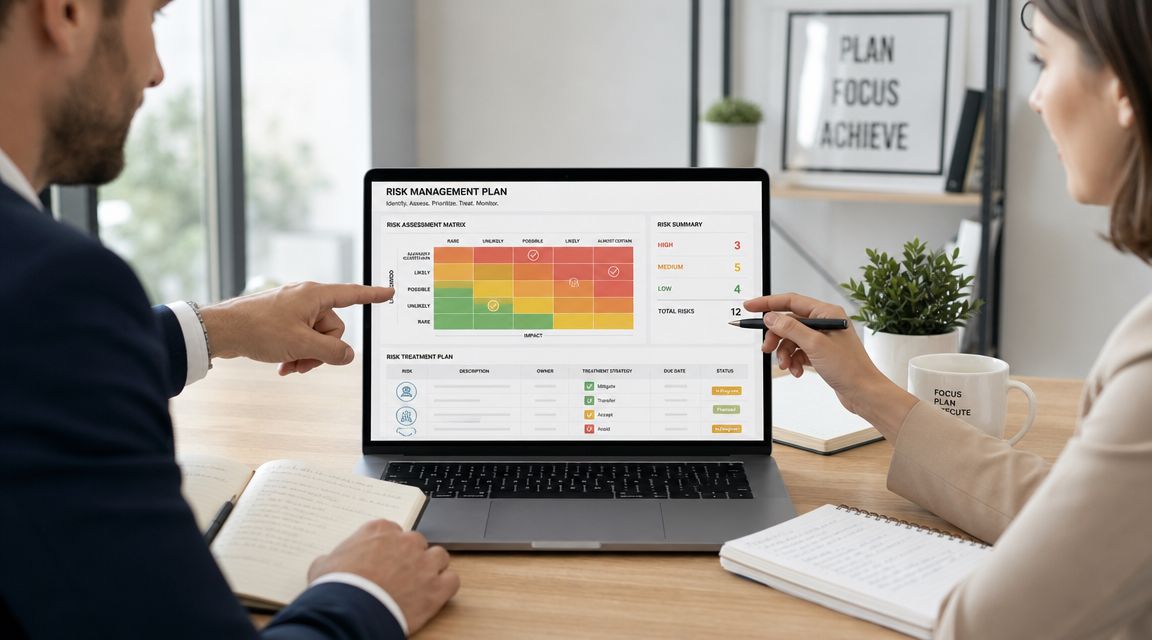
A lot of business owners first look for a human resources risk management template when something has already gone sideways. A manager handled discipline inconsistently. A resignation exposed that nobody had a backup plan. A termination raised questions about documentation, timing, and who approved what. In that moment, a generic spreadsheet doesn't help much.
What helps is a working system. The right template gives your team a way to spot people risks early, assign ownership, define trigger points, and document decisions in a way that holds up under pressure.
A generic checklist feels productive because it creates the appearance of coverage. You tick boxes for hiring, wage and hour, leave, discipline, investigations, and terminations. Then the file sits in a shared drive until a real issue forces someone to open it again.
That's the core problem. People risk isn't static. It changes when you add a new state, promote a first-time manager, revise compensation, move to remote work, or start documenting performance more aggressively. A checklist usually lists topics. It rarely tells your team when to act, who decides, what evidence to collect, and how to escalate.
A business owner might have “wrongful termination risk” on a checklist and still be exposed. Why? Because the checklist doesn't answer practical questions:
Without those details, teams improvise. Improvisation is where inconsistency starts.
Practical rule: If your template can't guide a manager through a high-risk decision on a stressful day, it isn't a management tool. It's a filing exercise.
SMBs feel this problem faster than large enterprises because roles overlap. The same person may oversee operations, approve terminations, handle employee complaints, and manage vendor relationships. When ownership is blurred, risks stay “known” but unmanaged.
This is also why process design matters. If you're standardizing workflows across hiring, onboarding, documentation, and approvals, a useful resource on B2B HR process improvement can help clarify where automation supports consistency and where human review still needs to stay in place.
Three patterns show up repeatedly in weak HR risk management:
A real human resources risk management template fixes those gaps by operating like a control register. It doesn't just say “watch for manager misconduct.” It names the trigger, assigns the owner, sets the deadline, and records the next review.
Think of your template as the control panel for people operations. It should let leadership see where exposure sits, how serious it is, what controls exist, and who is accountable for movement. If it only captures a risk name and a vague note, it won't support defensible decisions.
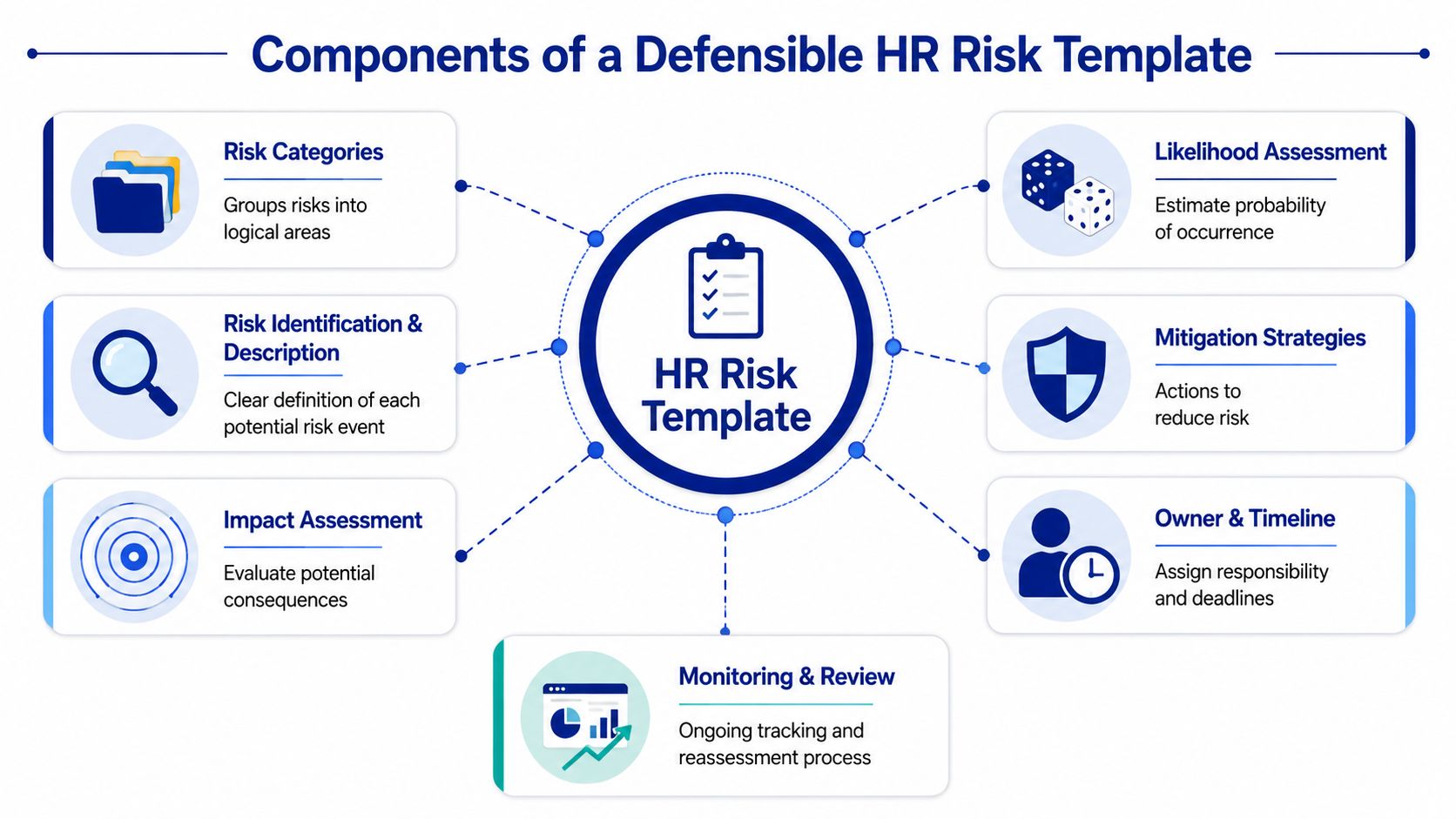
A strong template is built around a risk register, probability-and-impact scoring, assigned owners, deadlines, and review cycles. That structure matters because organizations that combine incident-response planning with tested response plans can save an average of $2.66 million, according to Canada Safety Training's workplace risk management summary.
At minimum, each row in your register should answer a specific management question.
| Template field | What it should capture | Why it matters |
|---|---|---|
| Risk category | Hiring, pay practices, leave, employee relations, termination, data privacy, manager conduct | Helps leadership sort exposure by operational area |
| Risk description | A clear event statement, not a vague label | Makes the issue specific enough to assess and act on |
| Likelihood score | How likely the risk is to occur | Supports prioritization |
| Severity score | How serious the impact would be | Forces attention to legal, financial, and operational consequences |
| Treatment strategy | Avoid, accept, modify, or transfer/share | Moves the discussion from awareness to response |
| Owner | Named person, not a department | Creates accountability |
| Deadline and review cadence | Next action date and future review schedule | Keeps the register live |
A risk owner is the person responsible for monitoring the issue and driving the response. That doesn't always mean they personally solve it. It means they make sure the right people act, the right documentation exists, and the issue doesn't disappear between meetings.
A mitigation control is the action or safeguard you put in place to reduce exposure. In HR, that might be manager training, approval gates before termination, a compensation audit process, or a standardized investigation intake form.
A review cadence is the rhythm that keeps the register active. Some risks should be reviewed on a fixed schedule. Others should be reviewed when a trigger occurs, such as an expansion into a new state, a complaint against a manager, or a pattern of turnover in one function.
A defensible template doesn't try to predict every possible problem. It creates a reliable method for identifying, scoring, assigning, and revisiting people risks before they become expensive surprises.
The most cluttered templates often fail first. Avoid adding columns that look impressive but don't improve decisions. If a field doesn't help someone prioritize, assign, escalate, or document, it's probably noise.
Keep the template clear enough that an owner or COO can review it quickly and understand:
That's the difference between a generic sheet and a usable human resources risk management template.
Most downloadable templates fail for the same reason most checklists fail. They give you a place to record concerns, but not a structure that supports action. A business needs more than rows and color coding. It needs a repeatable operating tool.
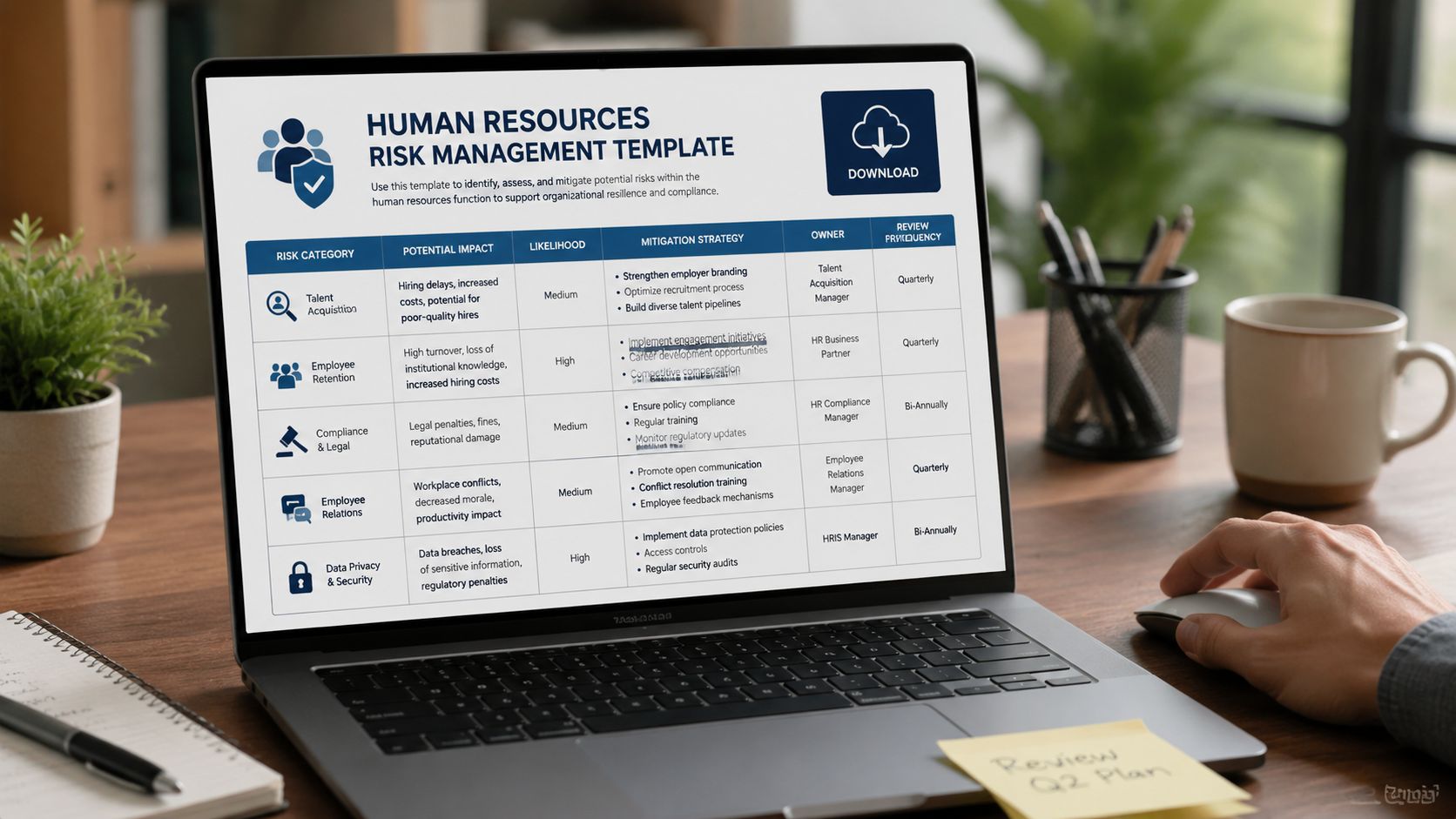
A useful download should already be organized around the fields that matter in real decisions:
The layout itself drives better judgment. When a row requires a named owner, a due date, and a trigger point, weak entries become obvious. “Manager conduct issue” isn't enough. “Regional manager has repeated documentation gaps in discipline decisions” is something leadership can address.
That's also why the template should be treated as the center of the process, not an attachment to it. If your team fills it out after decisions are made, it won't improve consistency. If they use it before high-risk actions, it becomes a control.
The simplest way to start is to use one shared version and make it the source of truth for HR risk reviews. If multiple leaders maintain separate lists, your process will drift.
If you want help building or tailoring a decision-ready version for your organization, contact Paradigm International Inc.. Keep the first version simple, usable, and tied to actual leadership decisions. That's what gets a template adopted.
A blank template can feel abstract until you start putting real scenarios into it. The easiest way to build your register is to work through your employee lifecycle and your highest-risk manager actions. Don't begin with policy titles. Begin with situations that create exposure.
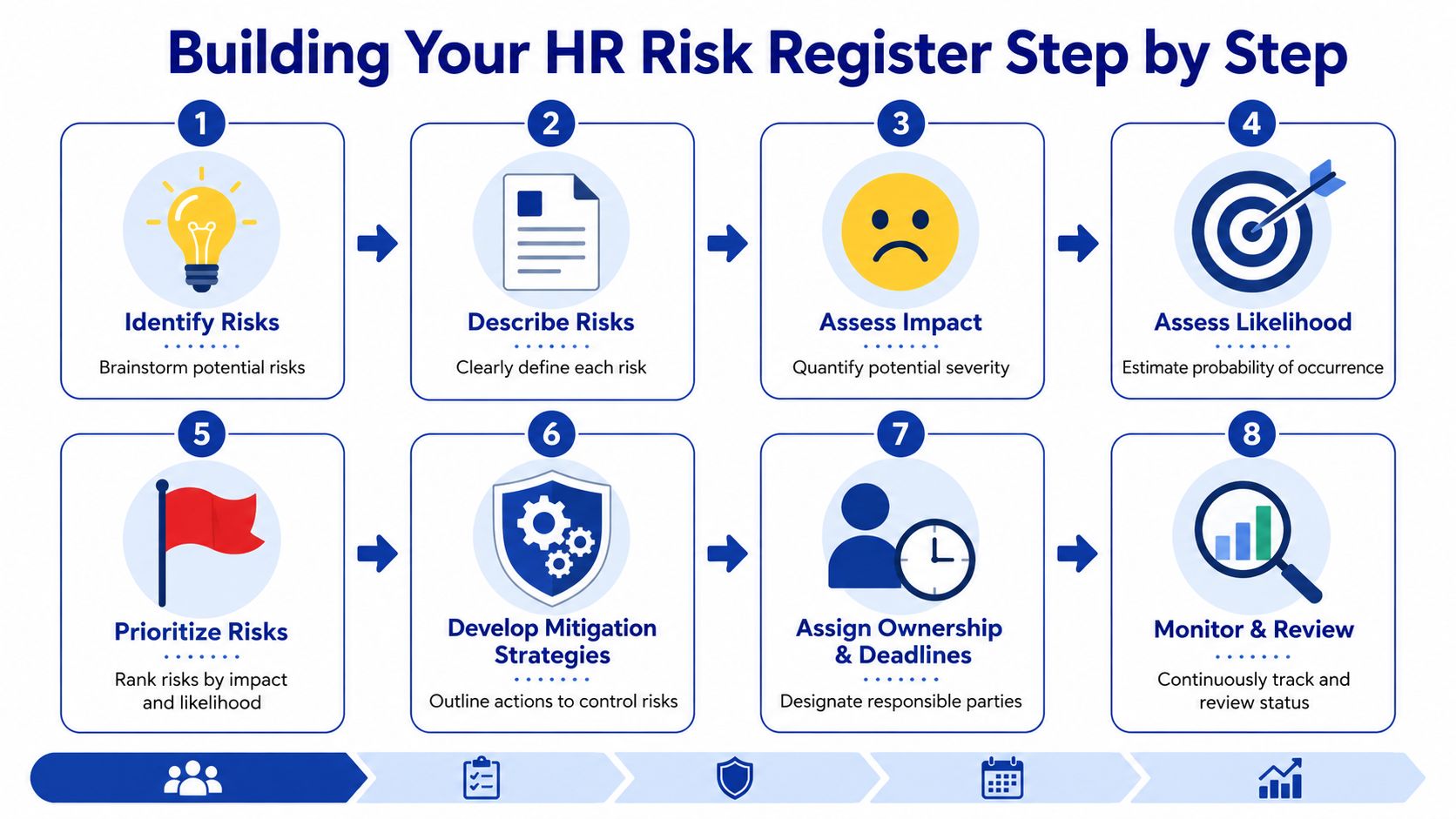
The control cycle should be straightforward: identify risks, score them by likelihood and severity, choose a treatment strategy, assign owners and deadlines, then communicate and review. The Canadian CCHRSC guidance on HR risk management planning emphasizes that sequence and warns against skipping ownership and recurring reassessment.
Start by listing events that could reasonably happen in your business. For most SMBs, the first pass should cover recruitment, manager conduct, compensation, leave administration, employee relations, investigations, terminations, and multi-state compliance.
Write each risk as a plain-language event. Good examples include:
Then score each item. Keep your scoring system simple enough that leaders will use it. The goal isn't mathematical precision. The goal is consistent prioritization.
Once the risk is scored, pick a treatment response. Some risks can be avoided by changing the process. Others need modification through added controls, training, approvals, or documentation standards. Some may be accepted if the impact is manageable and the burden of additional control is too high.
Many teams stall at this point. They identify the risk, then stop short of defining action.
A stronger entry includes the control itself. For example:
| Risk entry | Weak version | Strong version |
|---|---|---|
| Inconsistent manager discipline | “Train managers” | “Require HR review before final written warnings and maintain discipline comparison log by department” |
| Misclassification in California | “Check classifications” | “Review role duties at job change, route flagged positions to HR and payroll before status update” |
| Poor termination documentation | “Document better” | “Use termination packet checklist, second-level review, and pre-approval for protected-category concerns” |
The best mitigation steps are specific enough that someone can verify whether they happened.
Assign an owner by name. “HR” is not enough. Name the HR director, COO, operations lead, or practice administrator responsible for monitoring the issue and moving next actions forward.
Then set a deadline and review cadence. Some items need a date tied to implementation. Others need a recurring review, such as monthly for active employee relations risks or quarterly for broader policy and manager-conduct issues.
A practical way to pressure-test your register is to compare it with your actual management pain points. If your company is struggling with team dynamics, event management, or leadership conduct during growth, these MyCulture.ai risk assessment insights offer a useful lens on how risk can build around people interactions, not just compliance language.
If you're building the register for the first time, start with no more than your most material risks. Depth matters more than volume. You can also compare your categories against the guidance on manager-focused HR risk assessment to make sure your register reflects how risk enters through day-to-day supervision.
Use realistic wording. Name triggers. Name owners. Name deadlines. That's how a human resources risk management template becomes usable on day one.
Finishing the template isn't the win. The win is getting leaders to use it before they approve a sensitive action, not after the issue becomes legal exposure.
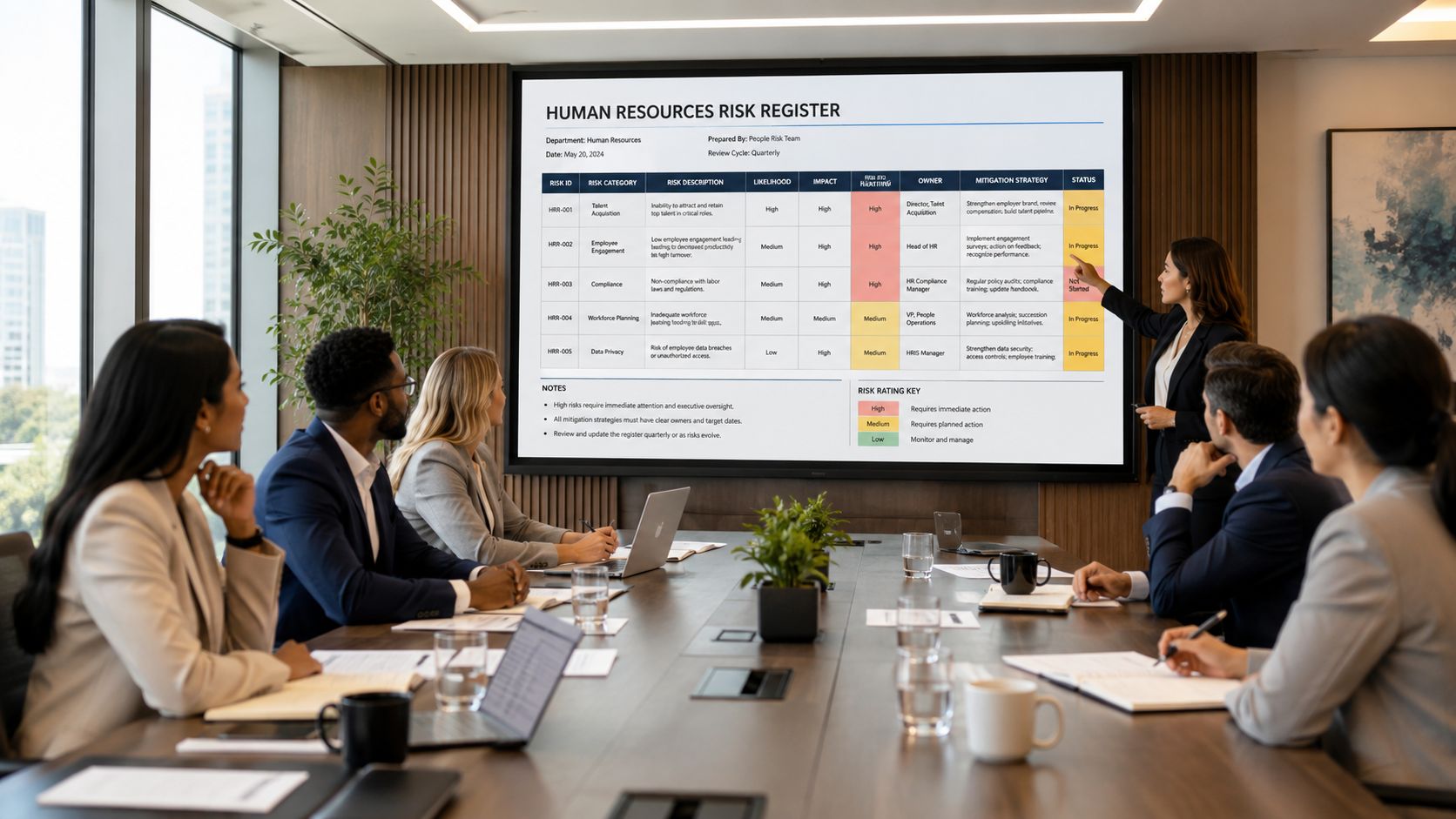
Most public template content stops at the matrix stage, but risk management only works when risks are monitored, assigned, and reviewed on a defined cadence. The World Health Organization template guidance makes the essential question clear in its risk management plan framework: leaders need to know when to act, who decides, and what documentation makes the decision defensible.
The cleanest way to do this is to build a recurring leadership review around the top active HR risks. Keep it focused. Review only what needs decision, escalation, or follow-up.
A workable meeting agenda might include:
Trigger points prevent delay and inconsistency. They tell managers and HR when routine supervision becomes a higher-risk matter.
Examples of useful trigger points include:
When a trigger is met, the next step should already be written down. That's what makes the system reliable under stress.
A simple escalation path often works better than a complicated one:
This structure turns the template into a governance tool. It also creates a visible record of who reviewed what and when. That record matters when a people issue later gets challenged.
Multi-state employment is where weak templates break down fast. A single entry like “leave compliance” might feel tidy, but it hides the underlying work. Different states create different obligations, timelines, notices, pay rules, and documentation expectations. If your register doesn't separate them, leadership can't manage them.
One recent HR survey found 42% of employees feel their needs at work are not being met, up from 19% previously, according to HR Brain's HR risk assessment discussion. For multi-state SMBs, that matters because employee dissatisfaction often surfaces through local issues such as scheduling, leave handling, pay practices, manager behavior, and policy inconsistency.
Treat each state-specific requirement as its own tracked risk where meaningful differences exist. That way, ownership and mitigation can match the actual compliance burden.
A practical register might include entries like:
This approach feels more detailed because it is. But it also gives your team somewhere precise to record controls, such as payroll review steps, handbook addenda, supervisor instructions, or state-specific onboarding notices.
A side-by-side view helps leadership see where a common process can remain centralized and where local variation is required.
| Risk area | Centralized element | State-specific element |
|---|---|---|
| Leave administration | Core intake process | Eligibility, notices, contribution rules, documentation timing |
| Final pay | Offboarding workflow | State timing rules and payout requirements |
| Break compliance | Timekeeping standard | Local meal and rest break requirements |
| Hiring documents | Offer letter approval | Required notices and policy addenda by state |
That structure prevents two common errors. The first is over-standardizing a process that should vary by state. The second is letting every location invent its own approach without oversight.
Not every state-specific risk needs to sit with HR alone. Ownership may belong to payroll, operations, a practice administrator, or a regional leader, depending on the issue. HR should still oversee consistency, but your template should reflect who controls the process in reality.
For businesses trying to map location-specific compliance exposure, the article on employment law breaks is a useful example of how one operational topic can vary significantly by jurisdiction.
Multi-state compliance gets manageable when you stop treating it as one policy problem and start treating it as a set of owned, reviewable risk entries.
A good human resources risk management template doesn't remove uncertainty. It gives your leadership team a disciplined way to make better decisions when uncertainty shows up.
That's why the advantage isn't the document itself. It's the operating habits behind it: clear ownership, visible triggers, documented controls, and recurring review. Businesses that use those habits consistently are better positioned to handle terminations, investigations, policy changes, manager issues, and expansion without making reactive mistakes.
Responsible growth in HR risk terms usually means a few things are true at the same time:
If you want a broader planning lens, a guide on HR risk management strategies expands on how organizations can align risk controls with growth and governance.
The businesses that handle HR risk well are rarely the ones with the thickest manuals. They're the ones with a workable system that people use. That's the foundation that supports stability, credibility, and cleaner decisions as the company grows.
If your team is dealing with complex terminations, manager conduct issues, investigations, or multi-state compliance questions, Paradigm International Inc. works with SMB leaders to build defensible HR decision processes and stronger risk controls. You can contact Paradigm International Inc. to discuss how to operationalize your HR risk framework in a way that fits your organization.