
You're probably already dealing with the messy version of this problem, not the clean one. A new hire starts Monday, a manager is in another state, a remote approver is waiting on document copies, and someone in HR is trying to decide whether the I-9 got handled “well enough.” That's the wrong standard. The I-9 verification process is a federal risk-control system, and if your company expands across states or faces an audit, “well enough” is exactly where exposure starts.
The first mistake employers make is treating Form I-9 like an HR formality. It isn't. Federal law requires every employer that recruits, refers for a fee, or hires an individual for work in the United States to complete Form I-9, and USCIS administers the process nationally. That obligation has been in place since Congress standardized the form in 1986, which makes it one of the longest-running hiring compliance duties in the country, not a nice-to-have onboarding step. The core business question is simple: can you prove you verified identity and work authorization correctly, on time, and in a way an auditor can defend?
For a COO, the risk is operational, legal, and reputational at the same time. The I-9 is the primary federal record used in audits to test whether the hiring process was legally defensible, which means a weak file can undermine an otherwise strong hiring decision. If you want a useful comparator, review solid employment background check tips alongside your I-9 controls, because both processes depend on disciplined documentation and consistent review.
Practical rule: If your team cannot produce a clean I-9 file on demand, you do not have a compliance process. You have a filing habit.
The financial exposure is not theoretical. Compliance guidance citing DHS penalty ranges places civil fines at $288 to $28,619 per violation (symmetry.com). That range alone should change how leadership views onboarding errors, because a missing signature, a late section, or a bad document entry is not “admin noise” once ICE or HSI is involved. The process has to be designed for defensibility from day one.
The I-9 works when each person does their part at the correct time. Section 1 belongs to the employee and must be finished no later than the first day of work. Section 2 belongs to the employer or authorized representative and must be completed within three business days of the start date, with a same-day completion requirement when the hire lasts three days or fewer (USCIS). That timing is nonnegotiable because late completion is one of the clearest markers of a weak file.
Section 1 is the employee's attestation. The employee provides their name, address, date of birth, citizenship or immigration status, and signature, and the form must be complete on or before the first day of work. Section 2 is the employer's review and certification. The employer records the document title, issuing authority, document number, and expiration date when applicable, then signs the certification after examining the documents.
The employer's role is bounded. USCIS requires the reviewer to judge whether the documents reasonably appear genuine and relate to the person presenting them, not to run a deeper identity investigation (USCIS Handbook for Employers M-274). That distinction matters. If managers start “investigating” documents instead of verifying them, they create inconsistency, delay, and discrimination risk.
Keep the review narrow. The job is to verify, not to second-guess identity beyond the form's legal standard.
A clean workflow also needs a standard intake sequence. The employee completes Section 1, the reviewer inspects the documents, the reviewer records the required details, and the company stores the form according to the federal retention rule. If you need a broader view of HR record execution, an internal process should fit your digital signing stack too, which is why many teams pair I-9 controls with their electronic form strategy, including electronic signatures for HR forms.

The safest model is to make each step visible in your workflow system. That way, a missing signature or delayed review is obvious before it becomes an audit finding.
The document rule is strict, and that's a good thing. The employee must present either one List A document or one List B plus one List C document. That's the whole decision tree. Anything outside that structure creates over-documentation, inconsistent review, and avoidable audit exposure.
List A documents establish both identity and work authorization. If the employee presents one acceptable List A document, the employer records the required data from that document and stops there. List B documents establish identity, and List C documents establish work authorization, so the combination route requires one of each. The review should never drift into “extra proof” territory, because that's where discrimination concerns begin.
The operational weakness I see most often is managers treating the I-9 review like a general HR intake step. They ask for too much, they record too little, or they accept something that isn't valid because they're rushing to finish onboarding. The better model is a fixed checklist at the point of hire, because the required data elements are the same whether the employer uses paper or a digital system. Microsoft's guidance on employment verification fields follows that same logic by separating identity-number capture, document type selection, and I-9 record creation into discrete fields (Dynamics 365 employment verification guidance).
Auditors are not impressed by intent. They look for complete fields, the correct document combination, and document data that matches the form. The common failure points are straightforward:
A disciplined checklist prevents most of those errors before they happen. It also keeps the review narrow, which is the best way to reduce both paperwork mistakes and bias claims.
Remote verification is where many multi-state employers get themselves in trouble. The alternative procedure exists, but it is not a free-for-all. It applies to E-Verify enrolled employers in good standing, and the employer has to inspect document copies, conduct a live video review with the employee, check the alternative-procedure box, and retain the document copies reviewed (DeWitt LLP). That is a real process with real controls, not a shortcut.
The most common mistake is assuming any remote hire can go through the alternative procedure. That assumption is wrong. Eligibility has to be established before the review begins, and the employer has to know who is authorized to act on its behalf. Distributed teams create edge cases fast, especially when one location handles hiring, another handles HR records, and a third manager is the one meeting the employee on video.
A second mistake is inconsistency. If one manager uses the alternative procedure and another insists on an in-person inspection for a similar role, the process stops looking like a compliance control and starts looking arbitrary. That creates risk on both sides of the law, because the I-9 and E-Verify framework is also a civil-rights-sensitive process. The DOJ/IER guidance is clear that employers must not demand more or different documents than required and must complete the process consistently (DOJ/IER guidance).
Remote review only works when the workflow is prebuilt. The employee sends document copies, the reviewer compares them during live video, the reviewer marks the alternative-procedure box, and the company stores the copies with the record. If the employer uses agents, the agent needs the same standards and the same documentation trail as the internal team.
If you want a close analog for how to think about identity checks in a broader hiring context, Matil identity verification is a useful read because it shows why structured, repeatable verification beats informal judgment every time. The lesson carries straight into I-9 operations: if the process can't be repeated consistently across states and managers, it isn't defensible.
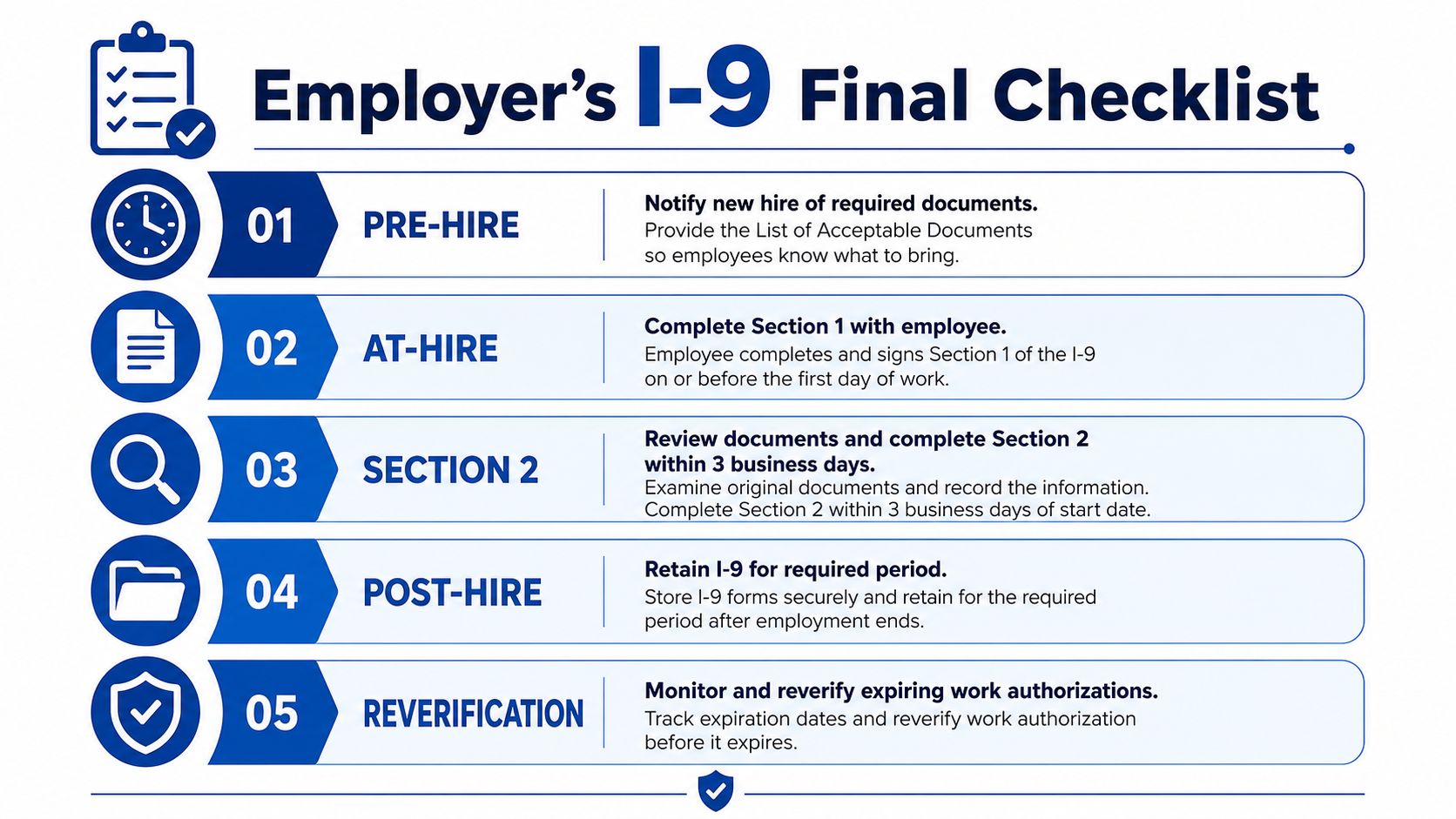
The initial hire is only part of the obligation. Employers also have to track when reverification is required and when it is not. If a work-authorization document expires, the employer has to revisit the file before the authorization lapses, but reverification is not required for U.S. citizens and permanent residents who presented identity documents that do not expire. The key is to focus on the document type and the employment authorization status, not the person's nationality assumptions.
Federal retention is clear. The employer must keep Form I-9 for three years after the date of hire or one year after the date employment ends, whichever is later (USCIS). That means one employee may have a longer retention period than another, depending on tenure. Once that later date has passed, the form should be destroyed safely, not left in a pile of old personnel files indefinitely.
The retention rule is not just about storage. It is about knowing exactly when a file can leave your system without creating a new problem.
The mistake many employers make is holding records longer than necessary because nobody owns destruction. That bloats file storage, complicates retrieval, and increases the number of stale forms sitting in circulation. On the other hand, destroying too early is a serious error because the I-9 is the primary federal record in an audit. For a broader records policy lens, it helps to align the I-9 schedule with your employment records retention requirements.
Track expiring work authorization with the same seriousness you use for payroll deadlines. If the underlying document expires and the employee still needs continued work authorization, you need a timely reverification process. If you do not have a clean trigger, the expiration gets missed, and the file becomes vulnerable. That is why the process should live in one system with one owner, not in scattered calendars and manager memory.
Safe destruction comes last. Once the later of the two retention dates has passed, destroy the form in a way that protects confidentiality and preserves the fact that the retention obligation was honored. That is the clean end of the record lifecycle.
Audit readiness is the test of the I-9 verification process. If ICE or HSI serves a notice, the employer must produce the requested forms within three business days (symmetry.com). That deadline is short on purpose. The government wants to see whether your records are organized enough to be trusted under pressure.
The same mistakes keep appearing because the same process gaps keep going unaddressed. The most common ones are missing signatures, unchecked boxes, late Section 2 completion, expired documents, and incorrect document combinations. Civil fines tied to these kinds of violations can range from $288 to $28,619 per violation (symmetry.com). Separate compliance commentary also notes that ICE has broadened what it treats as substantive errors in recent enforcement guidance, which raises the stakes for basic paperwork discipline (Ogletree Deakins).
A practical corrective-action framework looks like this:
Discrimination risk is not separate from process risk. If one manager asks for extra documents and another doesn't, the company has a consistency problem, not just a paperwork problem. DOJ guidance makes clear that employers can seek support through USCIS and DOJ hotlines when discrimination concerns arise, but the better move is to prevent the inconsistency in the first place (DOJ/IER guidance).
If you want a practical internal benchmark, review your audit posture with the same rigor you'd use for any HR compliance review. A structured HR audit checklist is only useful if it includes I-9 ownership, deadline tracking, and manager-level accountability. The point is not to collect forms. The point is to show that your process can survive inspection without improvisation.

A defensible I-9 process is built on repetition, not heroics. If you run a multi-state company, the checklist has to be the same in every location, because inconsistency is where bias claims and audit findings start to overlap. The same rule applies whether the hire is onsite, hybrid, or remote.

E-Verify adds one more deadline that managers often miss. If the system issues a Tentative Non-Confirmation, the worker has 8 business days to challenge it before final non-confirmation notices can follow (symmetry.com). That window needs to be tracked with the same urgency as any other federal compliance deadline.
The leadership takeaway is simple. A strong I-9 program is not about paperwork volume, it's about consistent control. If you want a process that holds up before expansion, a regulatory change, or an ICE inquiry, get the structure right now, not after the first notice arrives.
Paradigm International Inc. helps leadership teams build defensible HR practices before problems become findings. If your expansion plans or current I-9 workflow need a sharper compliance lens, visit Paradigm International Inc. to start a conversation about a stronger, more audit-ready process.