
You may be looking at a team that seems busy all day and still misses deadlines, repeats work, or depends too heavily on a few people to keep operations moving. That's the point where many owners and HR leaders start pushing harder. More check-ins. More tracking. More pressure.
That approach usually creates more motion, not more output. Improving staff productivity is rarely about asking people to work longer. It's about removing the conditions that waste time, create inconsistency, and expose the business to avoidable HR risk.
A lot of productivity advice assumes the main problem is employee effort. In practice, that's often the wrong diagnosis. The actual blockers tend to be unclear expectations, overloaded managers, fragmented information, weak workflow design, and poor capacity balance.
That distinction matters because leaders can damage performance when they treat a systems problem like a motivation problem. If employees are already navigating unclear priorities or broken handoffs, adding pressure just increases rework, frustration, and turnover risk.
The broader labor picture supports that view. In Q2 2025, U.S. labor productivity rose 3.3% on an annualized basis because output increased 4.4% while hours worked only increased 1.1%, which shows that meaningful gains come from producing more with roughly the same labor time, not by expanding work hours, according to High5's productivity data summary.
Before launching a productivity initiative, ask a blunt question: What is slowing work down that management can fix?
Usually, the answer sits in one of these areas:
Productivity improves fastest when leaders reduce friction that employees cannot remove on their own.
Leadership discipline matters more than motivational language in these situations. If a business wants sustainable gains, it needs a framework that connects productivity to output, manager behavior, and risk control.
A defensible model for improving staff productivity should do three things at the same time:
That's also why people-first leadership matters in operational terms, not just cultural terms. Better manager clarity, better communication, and better decision-making reduce drag across the system. The company has written about that directly in its piece on people-first leadership.
If you miss the system, you'll blame the individual. If you fix the system, the individual often performs better without added pressure.
Most productivity problems stay hidden because leaders measure what they can easily see. Attendance in meetings. Response speed. Inbox activity. Status updates. None of those tells you much about whether work is moving.
A better starting point is to inspect where time disappears, where decisions stall, and where managers create different rules for similar work.

One of the clearest signals is performative work, which Deloitte describes as work that creates the appearance of productivity without adding real value. Employees spend, on average, 32% of their time on performative work, and while 60% of executives say they track activities like hours and emails, only 15% of employees believe this tracking improves their efficiency, according to Deloitte's analysis of productivity measurement.
That gap should change how leaders investigate low output. If your managers are rewarding visible activity instead of outcomes, employees adapt. They protect appearances. They send more updates, attend more meetings, and keep work in motion without moving it forward.
Start with role-level evidence, not company-wide assumptions.
Map the core output of each role
Define what the role exists to produce. Closed tickets, accurate claims, completed client deliverables, clean reconciliations, filled shifts, signed documentation, resolved exceptions. If you can't name the output, you can't diagnose the drag on it.
Trace the workflow around that output
Review how work enters, moves, pauses, and closes. Many productivity losses come from waiting, approvals, missing information, or duplicate review layers.
Interview managers on exceptions
Ask where work gets stuck, which tasks require repeated clarification, and which employees are carrying hidden coordination work. Managers usually know this, but they often describe it informally rather than documenting it.
Separate skill issues from system issues
If several capable employees struggle in the same part of the process, the process is usually the problem. If one person struggles while peers succeed under the same conditions, then you may be dealing with a performance issue.
Diagnostic rule: If the same failure appears across multiple people, teams, or locations, investigate the design of the work before you investigate attitude.
A short diagnostic period can be enough if you gather the right evidence. Focus on facts managers can observe and explain.
| Diagnostic area | What to review |
|---|---|
| Work clarity | Job expectations, handoff rules, approval paths |
| Time loss | Search time, duplicate entry, repeated questions, meeting load |
| Manager practice | How different supervisors assign work, coach, and escalate issues |
| Risk points | Overtime patterns, missed breaks, inconsistent standards, undocumented corrections |
This process does two things. It gives you a clearer picture of what's blocking output, and it prevents the common mistake of launching a broad “productivity push” with no real diagnosis behind it.
Once the blockers are clear, the strongest lever is usually the frontline manager. Not because managers can force productivity, but because they control the conditions around expectations, prioritization, follow-up, and escalation.
That matters more than most leadership teams admit. McKinsey estimates that employee disengagement and attrition can cost a median-size S&P 500 company between $228 million and $355 million annually in lost productivity, and it emphasizes that the most effective interventions are manager-led and focused on specific, actionable indicators, as outlined in McKinsey's analysis of value creation and employee performance.

Strong managers don't just watch activity. They define success in a way employees can act on.
A practical manager-led intervention usually includes:
Managers also need authority to remove obstacles. If every workflow change requires executive approval, the business teaches managers to observe problems instead of solving them.
Large productivity programs often fail because leaders standardize too early. They roll out scorecards, software, or reporting rules across the whole business before proving that the underlying change works.
A safer method is to test on one team, one process, or one recurring problem. For example:
Don't ask managers to “improve productivity.” Ask them to improve one workflow, one metric, or one recurring failure pattern at a time.
A sound intervention should meet four tests:
| Test | What it means |
|---|---|
| Observable | A manager can see whether the change is happening |
| Relevant | It affects output, quality, capacity, or consistency |
| Repeatable | Another manager could apply it the same way |
| Defensible | You can explain why the standard is job-related and fair |
This is also the one place where structured outside support can help. For businesses operating across states or in regulated settings, firms like Paradigm International Inc. can support leaders in aligning manager actions, documentation standards, and performance expectations so productivity changes don't create preventable employee-relations or compliance problems.
A manager sits down for a performance review with clean attendance records, strong effort, and a frustrated employee. The problem is the standard itself. The team has been judged on speed, inbox volume, or visible activity, while rework, quality failures, and approval delays were left out of the score.
That is how weak metrics create both performance problems and HR risk.
A defensible productivity measure ties output to the actual job, includes the quality standard, and accounts for factors employees do not control. If a metric cannot survive that test, it should not drive coaching, compensation, or discipline.
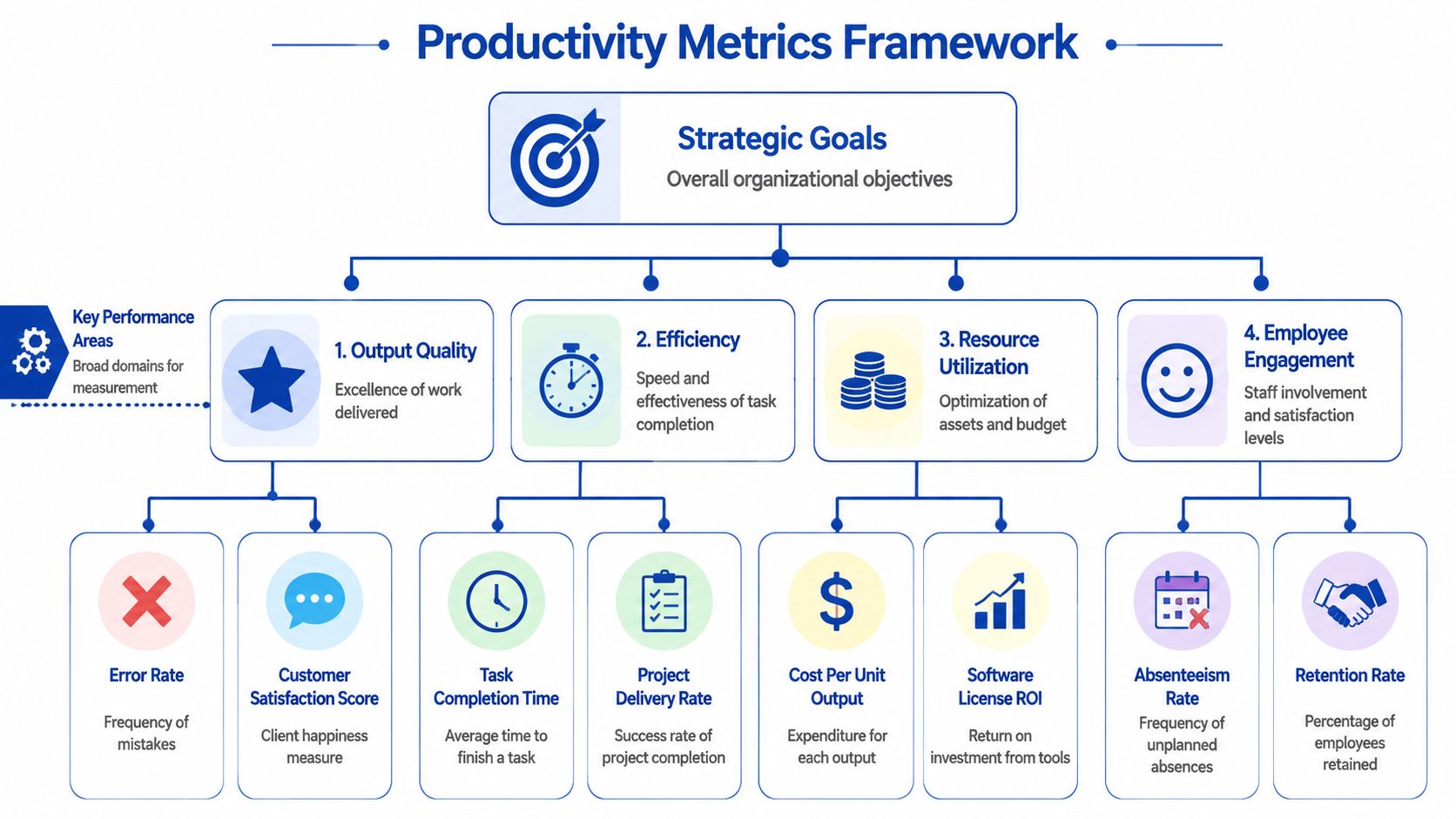
Hours, email count, and online presence are easy to track. They are often poor indicators of value.
In practice, the strongest metrics answer three questions at once:
That third question gets missed. A dispatcher cannot control a software outage. A clinic coordinator cannot force a physician signoff. A plant supervisor cannot hit the same throughput target during a staffing gap and call the comparison fair. If leaders ignore those conditions, they do not get a cleaner performance system. They get arguments, inconsistency, and weak documentation.
Use a simple screen before adopting any productivity measure.
Job-related
The measure reflects a real duty of the role, not a proxy that happens to be easy to count.
Within reasonable employee control
The employee can influence the result through their own work, without depending excessively on broken systems, missing staff, or delayed approvals.
Consistently applied
Managers use the same definition, review period, and threshold across comparable roles and locations.
Balanced with quality
Speed without an accuracy check usually shifts the problem downstream.
Clear enough to document
If the company had to explain the metric later to counsel, an agency, or an employee, the definition would hold up.
The last point matters more than many owners expect. Vague standards such as "shows urgency" or "stays on top of work" are hard to coach and harder to defend.
The right metric depends on the work. Applying one style of measurement across very different functions usually produces noise, not accountability.
| Role type | Better metric direction | Poor metric direction |
|---|---|---|
| Customer support | Resolved cases, quality of resolution, re-open patterns | Raw message count |
| Operations | Cycle completion, error reduction, exception handling | Time at desk |
| Sales support or admin | Accurate processing, turnaround reliability, handoff quality | Volume of internal emails |
| Clinical or regulated functions | Complete documentation, compliant process execution, timely follow-through | Generic “activity” score |
Good metrics help managers coach specific behaviors. Bad metrics train employees to protect the number.
Productivity should not be measured in a vacuum. A team can still hit output targets while attendance slips, turnover risk rises, or manager inconsistency spreads across locations.
The fix is not to replace performance metrics with sentiment data. The fix is to pair hard output measures with a small set of workforce indicators that explain whether results are sustainable and fairly managed. Leaders who need a practical model can use this guide on how to measure employee engagement in a way that connects to retention and performance.
Used properly, those signals help leaders spot whether a productivity issue belongs to the employee, the manager, or the operating system around them.
The number itself is only part of the control. The threshold matters just as much.
A quota set too low tells you nothing. A quota set too high invites shortcuts, inflated exceptions, and uneven enforcement by manager. In regulated settings, it can also push employees toward documentation errors, missed breaks, off-the-clock work, or other conduct the business will later have to explain.
Set initial thresholds from observed workflow data, then test them against actual conditions. Review performance across shifts, locations, tenure levels, and known operational constraints. If one group can only succeed by working around the process, the standard is not ready.
A good metric can still fail if managers apply it loosely or employees hear three different versions of the rule. The rollout should be disciplined.
Define the metric in writing
State what is counted, what is excluded, and what quality standard applies.
Calibrate managers
Review sample cases so supervisors interpret results the same way.
Use a test period Confirm the measure reflects the actual job before attaching consequences to it.
Record known exceptions
Note outages, unusual volume spikes, staffing disruptions, or other conditions that distort normal output.
Review the measure regularly
Jobs change. Metrics should change with them.
For multi-state employers, this is risk control, not paperwork for its own sake. If a productivity metric later supports a warning, bonus decision, promotion, or termination, the business should be able to show that the standard was job-related, communicated, and applied consistently.
A productivity initiative can fail even when the diagnosis is sound and the metrics are sensible. The failure usually happens during implementation. Leaders move too fast, managers apply standards unevenly, or nobody keeps a clear record of what changed and why.
That's where productivity and compliance intersect. If a business changes expectations without documenting them, later performance action becomes harder to defend.
A business does not improve output by ignoring workload balance. ADP notes that effective capacity planning is a key productivity lever, and poor workload balancing can lead to burnout and overtime, creating wage-and-hour compliance issues and retention problems. ADP also notes that autonomy over work hours is linked to reduced stress and higher performance, as discussed in ADP's guidance on increasing employee productivity.
That has a direct operational implication. Before raising output expectations, review whether the team has the staffing pattern, schedule structure, and handoff design to absorb the change lawfully and sustainably.
Leaders should assume that any productivity-related decision could later be questioned by an employee, a regulator, counsel, or a factfinder. That doesn't mean operating defensively in a negative sense. It means building a clean record.
At minimum, document:
If a manager can't explain a performance standard in writing, that standard isn't ready for enforcement.
Many businesses underestimate the role of documentation systems. Productivity doesn't scale if every manager explains standards from memory. It doesn't scale if SOPs live in personal folders, old email threads, or location-specific habits.
Centralized knowledge turns implementation into something repeatable. It gives managers the same playbook, shortens ramp-up time, and reduces the number of “exceptions” that are really just undocumented local practices.
That's especially important when performance concerns arise. If your team is revising standards, manager follow-up should connect back to written expectations. Guidance on documenting employee discipline is relevant here because productivity conversations often become discipline issues when expectations were unclear, inconsistently applied, or poorly recorded.
One of the most expensive productivity drains in a growing business is the time people spend trying to find answers they should be able to access immediately. Policies. SOPs. Prior decisions. Training notes. Client-specific rules. If employees have to stop and ask for these repeatedly, output slows and manager time gets consumed by avoidable interruptions.
This is why centralized knowledge should be treated as a productivity system, not an IT cleanup project.

A concrete example helps. A global company improved productivity for 2,000 users by centralizing knowledge, which reduced search time by 1.4 hours per person per week and cut duplicate effort by 2.4 hours, according to Bloomfire's example of knowledge centralization and productivity gains.
The larger lesson isn't just the time saved. It's that information access changes how consistently teams operate. When employees can locate the right answer quickly, they make fewer avoidable errors, interrupt managers less often, and duplicate less work.
A usable knowledge base should include the materials employees and managers need to make routine decisions correctly.
This isn't about storing more files. It's about making the right information findable, current, and usable at the moment work is happening.
Centralized knowledge protects speed and consistency at the same time.
The strongest productivity gains usually come from a chain of management decisions, not a single initiative. Leaders diagnose friction. Managers test practical changes. The business measures outputs instead of appearances. Expectations are documented. Knowledge is centralized so good practices hold across locations and supervisors.
That's the version of improving staff productivity that lasts. It creates more reliable output without turning the workplace into a pressure system that burns people out or increases legal exposure.
If your leadership team is trying to improve productivity while also protecting consistency, documentation quality, and multi-state compliance, Paradigm International Inc. can help you evaluate the people risks behind operational changes and build a more defensible path forward.