
A founder discovers the problem during an unemployment claim. The designer who started as a short-term contractor has spent two years in daily standups, works on a company laptop, uses the company's systems, and is now the only person handling product design. The contract still says “independent contractor,” but the working relationship looks much closer to employment.
That situation is common among growing businesses. Independent contractor misclassification usually begins with a reasonable onboarding decision and becomes risky through operational drift. The company changes the person's schedule, responsibilities, tools, reporting line, and level of integration without revisiting classification. When an audit, tax review, wage claim, or unemployment filing arrives, regulators examine what happened, not just what the agreement says.
The founder in this example probably didn't act recklessly. The business needed design help, the contractor had specialized skills, and a signed agreement created a sense of order. Over time, however, the contractor became part of the operating team. Managers assigned recurring work, invited the designer to internal meetings, set priorities, and expected availability during company hours.
That progression creates the central risk. Classification is often treated as an onboarding form, while the relationship itself keeps changing. A contractor who once delivered a defined project may later become a continuing individual contributor with no meaningful ability to control how the work gets done.
Practical rule: Review the relationship whenever the work changes, not only when the contract is signed.
Regulators and courts look at actual practices. The federal Department of Labor's guidance says the economic reality of the relationship matters, and the six factors must be considered together rather than reduced to one contract label. The DOL's worker classification guidance also makes clear that no single factor determines status.
Watch for changes such as:
The risk isn't limited to large employers. The GAO reported that an IRS estimate based on tax year 1984 found about 15% of employers misclassified 3.4 million workers, with estimated tax losses of $1.6 billion across Social Security, unemployment, and income taxes. The GAO later expressed that loss as roughly $2.72 billion in 2006 dollars. This historical benchmark remains part of modern U.S. policy discussions because it shows how classification errors can affect tax systems at scale. (GAO discussion of the IRS estimate)
For an SMB, the practical question is narrower and more urgent: Does the person's current job resemble an independent business, or does the business manage the person like an employee? The rest of the review should answer that question with evidence.
No single classification test controls every situation. An SMB may need to assess the relationship under the IRS common-law test, the federal economic reality test, and one or more state tests. Payroll, wage and hour, unemployment, workers' compensation, and tax agencies may apply different standards.
The IRS groups its analysis into three broad areas:
A company that needs a formal determination can use the IRS Form SS-8 process, which asks the agency to decide whether a worker is an employee or independent contractor based on the facts. The IRS also warns that, without a reasonable basis for contractor treatment, an employer may become liable for employment taxes and may not qualify for relief provisions. Its independent contractor classification guidance should be part of every audit file.
The DOL's 2024 final rule was published on January 10, 2024 and became effective on March 11, 2024, replacing the 2021 contractor rule with the long-standing economic reality approach. The framework evaluates:
The DOL says the factors are weighed under the totality of the circumstances, with no predetermined weight assigned to any one factor. A worker's ability to increase profit through initiative, manage investment, or serve an independent customer base can support contractor status. Close supervision, indefinite continuity, and work central to the company's business point in the opposite direction.
State tests can be stricter. Under an ABC-style framework, employment is generally presumed unless the business can establish that the worker is free from control, performs work outside the usual course of the business, and operates an independently established trade or business.
California, Massachusetts, New Jersey, and other jurisdictions use ABC or modified ABC approaches in selected employment contexts. A software company should be cautious about treating a developer as a contractor when development is its core service. A delivery business faces a similar problem when the contractor performs the company's central delivery operation.
| Test | Core Question | Key Factors | Where It Applies | Burden of Proof |
|---|---|---|---|---|
| IRS common-law test | Who controls the work and the business relationship? | Behavioral control, financial control, relationship type | Federal tax administration | Employer must support its treatment with facts and records |
| Federal economic reality test | Is the worker economically in business for themself? | Profit or loss, investment, permanence, control, integral work, skill and initiative | Federal wage and hour analysis under the FLSA | Totality of circumstances, with no single controlling factor |
| State ABC test | Can the business prove the worker is genuinely independent? | Freedom from control, work outside the usual course, independent trade | States using ABC or modified ABC rules | Presumption favors employment unless the business satisfies the test |
For a practical explanation of how the facts fit together, review this guide to classifying workers in HR. For multi-state employers, build the workflow around the strictest applicable rule, then confirm the result under federal and tax standards.
A self-audit should resemble an operational review, not a paperwork exercise. Start with every person paid outside payroll, then reconstruct how each relationship functions in practice.
Export the contractor population from accounts payable, procurement, and payroll. Include workers paid through agencies or vendor entities when one identifiable individual performs the work. For each engagement, collect:
The actual engagement record matters more than a clean contract file. A generic agreement can't overcome evidence that a manager controlled the daily job.
Use a role-by-role worksheet. Record the fact, the source, the factor it affects, and who verified it. Examples include company email domains, required schedules, approval rights, substitution rights, ownership of tools, pricing authority, customer access, and the worker's ability to serve other clients.
Don't score a worker by instinct. Ask what evidence would persuade an auditor who has never met the manager. If the file says “independent,” but the calendar shows mandatory daily meetings and the manager approves each task, the file needs to address that conflict.
Start with long-term individual contributors, sole-source vendors, and workers integrated into internal systems. The GAO discussed a U.S. Department of Labor-commissioned audit finding in which 10% to 30% of firms in nine selected states had misclassified workers in 2000. The same report noted that if only 1% of employees were misclassified nationally, unemployment insurance revenue losses alone could approach nearly $200 million annually. (GAO report on worker misclassification)
Document the reasoning for every classification, including low-risk cases. The file should identify the decision-maker, evidence reviewed, applicable jurisdictions, unresolved questions, and the next review date.
Set a re-review trigger for annual compliance work and for any material change in scope, location, reporting structure, schedule, or control. Borderline cases should go to employment counsel before the company issues another contractor payment.
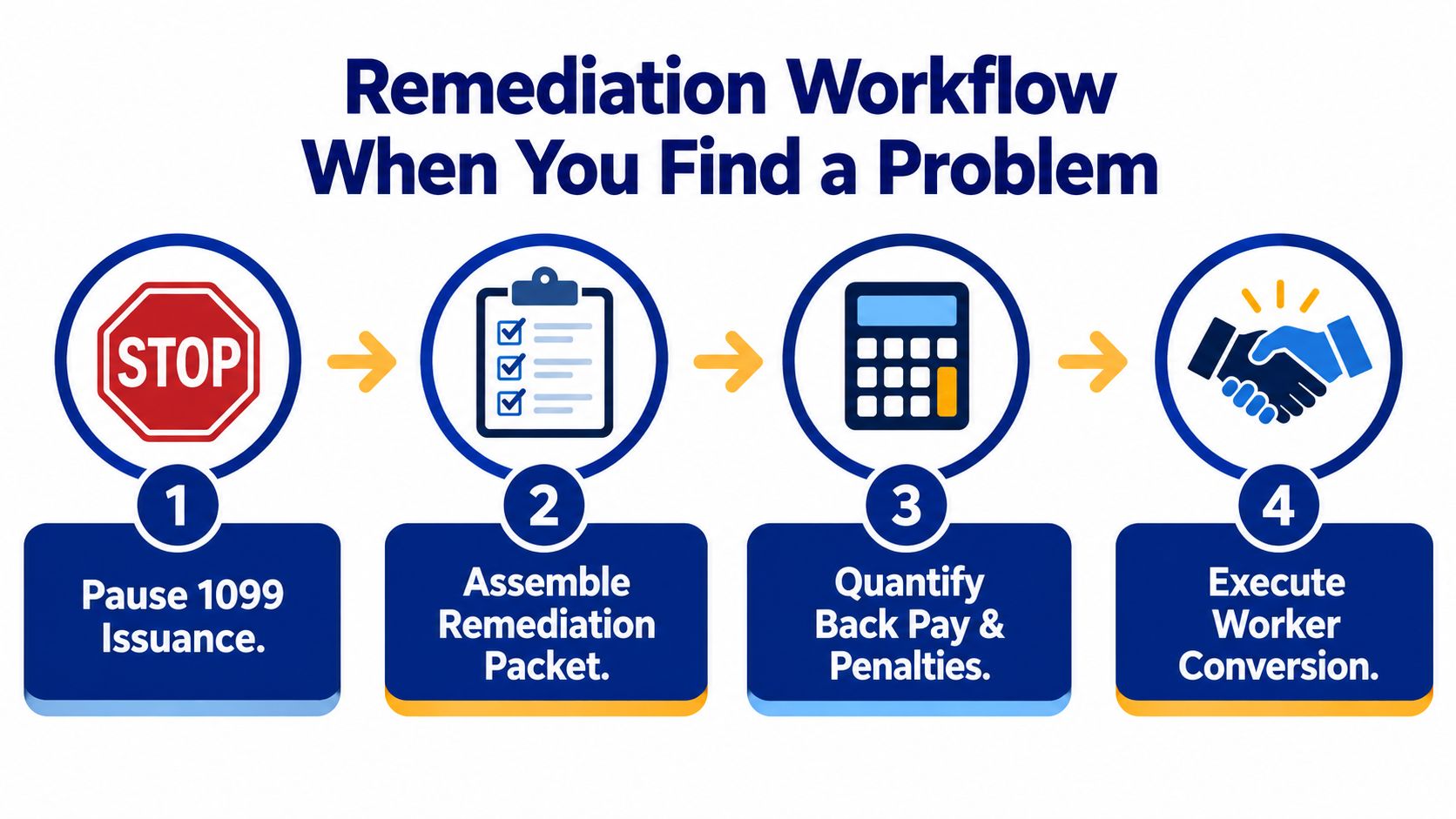
Finding a questionable classification is not the same as proving liability. It does mean the business should stop creating new evidence while leadership evaluates the relationship.
Pause new 1099 issuance for the affected role while counsel, HR, and finance review the facts. Don't abruptly change duties or destroy informal records. Preserve the agreement, invoices, messages, calendars, time records, expense information, and manager instructions.
Then prepare a remediation packet that identifies:
Finance should model unpaid minimum wages, overtime, unreimbursed business expenses, payroll taxes, unemployment contributions, workers' compensation implications, and benefits-related corrections. The DOL's small entity guidance states that an employer may owe unpaid FLSA wages, liquidated damages equal to back wages, civil money penalties, and attorneys' fees when an employee is incorrectly treated as a contractor. (DOL small entity compliance guide)
Tax corrections may involve payroll tax calculations, amended filings such as Form 941-X, corrected wage reporting such as Form W-2c, and state equivalents. Form SS-8 may help obtain an IRS determination, but it isn't a substitute for a complete remediation plan.
If the facts support employee status, make the conversion orderly. Issue an offer letter, complete W-2 onboarding, establish payroll treatment, assess benefits eligibility, and give the worker a clear written explanation of the effective date and expectations.
A conversion doesn't require the company to pretend the prior relationship never existed. It requires the company to separate past exposure from future compliance and preserve a decision memo explaining why the status changed. If the business is ending the contractor relationship instead, document the reason and write a contractor termination letter that matches the agreement and actual facts.
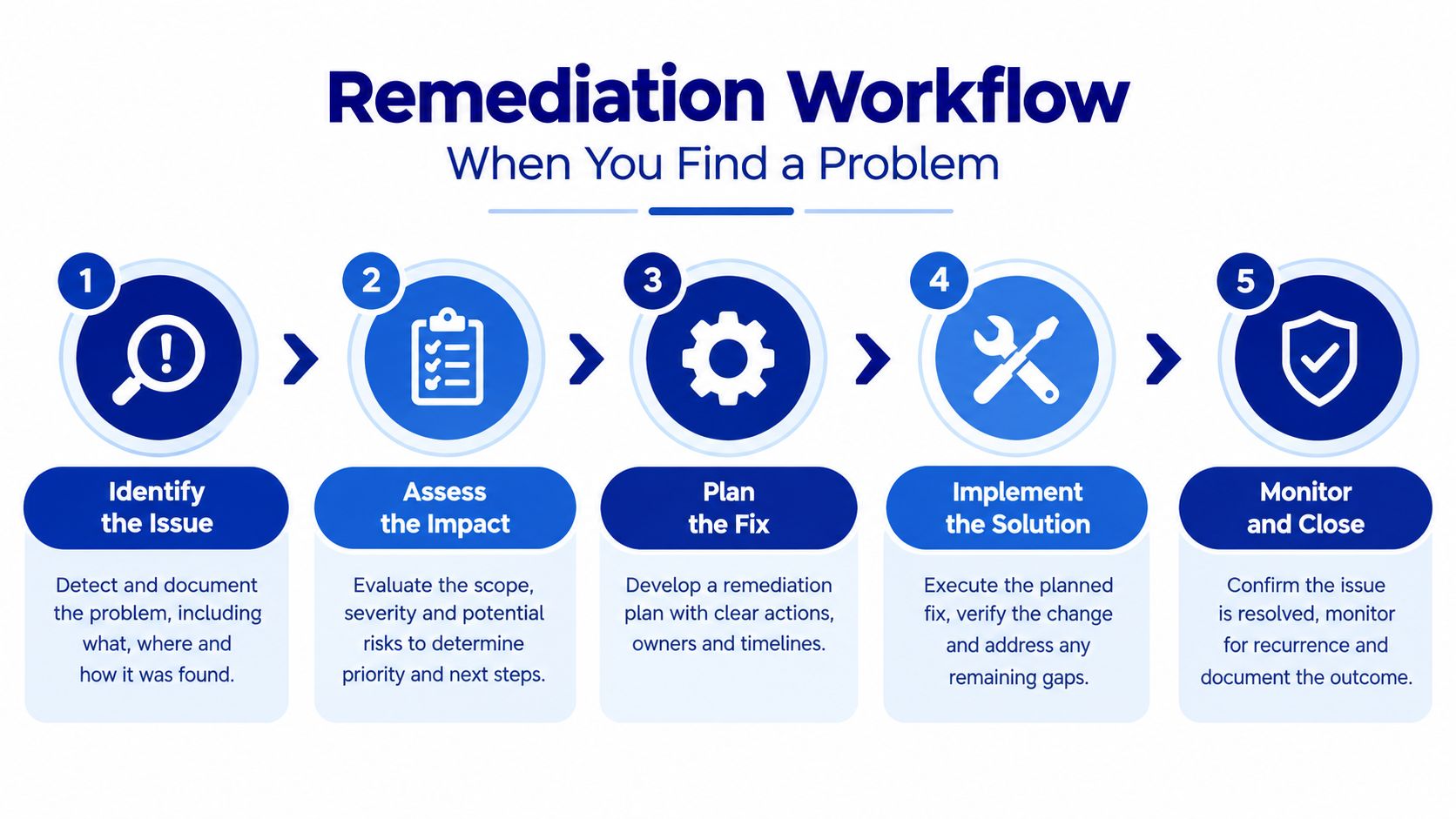
Voluntary settlement programs, negotiated resolutions, and statute-of-limitations analysis should be handled with counsel. The final file should contain the decision memo, calculations, approvals, worker communications, tax filings, and updated controls. A well-documented correction won't erase exposure, but it can demonstrate that leadership identified the issue and acted deliberately.
The cost is rarely just the difference between an invoice and a salary. A misclassified worker may create wage, tax, unemployment, workers' compensation, recordkeeping, and litigation exposure at the same time.
The DOL's small business guidance identifies unpaid wages, liquidated damages, civil money penalties, and attorneys' fees as possible consequences under the FLSA. The IRS separately warns that an employer without a reasonable basis for contractor treatment may owe employment taxes. Those liabilities can affect the same worker through different enforcement channels.
Congressional testimony in 2026 gave an example of $5,774 annually for housekeeping cleaners as a cost of misclassification in that occupation. (Congressional testimony on misclassification costs) That example matters because exposure varies by role, pay structure, hours, overtime, location, and duration. Leadership should model the actual role instead of relying on a generic penalty estimate.
| Cost Category | Per-Worker Range | Trigger |
|---|---|---|
| Back wages | Role-specific and fact-dependent | Unpaid minimum wage, overtime, or compensable working time |
| Liquidated damages | May equal back wages under the FLSA | Successful wage claim or agency finding |
| Payroll taxes | Depends on compensation and tax treatment | Employee status without proper withholding and employer contributions |
| Unemployment and workers' compensation | Varies by state and payroll history | Missed contributions, denied coverage, or a claim after injury or separation |
| Professional and legal fees | Fact-dependent | Audit response, settlement, litigation, or amended filings |
A UI tax audit result discussed by the Economic Policy Institute found an average of 1.35 worker misclassifications per audit, while broader state and federal evidence suggests 10% to 30% of employers misclassify at least one worker. The source also warns that audit-selection methods influence observed rates, because targeted audits identify more violations than random reviews. (Economic Policy Institute audit analysis)
Budgeting principle: Calculate exposure by role, hours, jurisdiction, and engagement period. Don't use an industry headline as your reserve.
Indirect costs can include lost management time, employee morale problems, damaged records, and class or collective claims. Businesses working with trades should also understand local coverage obligations, including resources on workers compensation for trades in Australia when their operations or workforce extend into that market.
Multi-state compliance becomes manageable when the company stops treating each worker as a one-off exception. Create one classification process, then attach a jurisdiction map to every worker and role.
The operating rule should be simple: apply the strictest applicable state requirement, then test the result against federal and IRS standards. If a worker passes a federal analysis but fails a state ABC requirement, the business should not rely on the federal result. A classification memo should record that conflict and explain the decision.
Every memo should answer these questions:
The memo should state the conclusion and the facts that could change it. Avoid conclusory language such as “the worker is a contractor because the contract says so.”
An independent contractor agreement should define a genuine business-to-business arrangement. Check that it addresses:
The agreement must match manager behavior. A carefully drafted document becomes weak evidence when managers require employee-style schedules, approve routine methods, or place the contractor inside every internal process.
HR should own the classification register. Finance should verify payment and tax treatment. Legal should review exceptions and high-risk jurisdictions. Operations leaders must certify that daily practices still match the memo.
Reopen the file when the worker changes location, takes on broader scope, works more hours, receives a new title, begins supervising others, becomes the only provider of a core function, or moves from project work to ongoing operations. This approach turns classification into a controlled business process rather than a forgotten procurement decision.
No. The DOL proposed in 2026 to rescind the 2024 rule and return to a economic-reality analysis centered on two core factors, while emphasizing that actual practices matter more than contract language. The proposal doesn't eliminate state rules, IRS analysis, or existing wage and hour obligations. (DOL 2026 rulemaking)
Leadership should preserve the six-factor review already used in its files, then monitor the federal rulemaking with counsel. A shifting federal standard is a reason to improve documentation, not postpone it.
Not by itself. Contract language helps establish the parties' intended arrangement, but it can't override daily control, economic dependence, integration, or the absence of an independent business. If the manager treats the worker like an employee, the company should fix the operating model or convert the person.
Use the stricter applicable state test for the affected work, then document the federal and IRS analysis separately. Don't average the tests or choose the result that produces the lower payroll cost. Record the worker's location, where services occur, the laws involved, and the decision-maker's reasoning.
Follow the agreement first, then review the actual relationship and applicable law. A contractor may have contractual termination rights, notice requirements, payment obligations, intellectual property provisions, or other protections that don't appear in an employee handbook. If the relationship may already be employment, counsel should review the separation before the company acts.
The answer depends on the claim, agency, jurisdiction, records, and applicable limitations rules. Don't assume that converting someone today resolves earlier wage, tax, unemployment, or workers' compensation issues. Preserve records and obtain a role-specific limitations analysis.
Reopen classification when a contractor becomes long-term, works inside company systems, attends mandatory meetings, follows a manager's schedule, performs core business work, loses the ability to set prices, or stops serving an independent customer base. A title change, location change, expanded scope, or increased hours should also trigger review.
Treat conversion as a status change, not a new personal relationship. Keep the business context and legitimate continuity of work, but issue an employee offer, complete W-2 onboarding, establish payroll, evaluate benefits, communicate the effective date, and separately assess prior exposure. Put the rationale and approvals in the classification file before the first employee paycheck.
Paradigm International Inc. helps owners, COOs, and HR leaders review worker classification, document defensible decisions, and manage sensitive employment changes across states. If your contractor relationships have drifted into employee-style operations, visit Paradigm International Inc. to discuss a structured review and practical next steps.