
If you're running a business across multiple states, you already know how fast a simple announcement can turn into an operational problem. One manager explains a policy change one way, another softens it, a third skips key details, and by the end of the day employees are working from three different versions of the same message. That isn't just frustrating. In the wrong situation, it's a documentation problem, a morale problem, and a compliance problem.
A strong internal communications plan helps leadership control that risk. It gives people a clear process for what gets communicated, to whom, through which channel, on what timetable, and with what record of follow-through. For multi-state SMBs, that structure matters because consistency isn't a branding exercise. It's part of sound operations.
An internal communications plan isn't an email calendar. It's a management tool.
The reason the discipline formalized in the first place was simple. Organizations needed a repeatable way to align employees around business change, not just send updates. Current guidance still reflects that standard structure, with planning built around audience, messages, channels, cadence, and measurement, and often organized into seven core components: current-state analysis, goals, target audience, channels, message strategy, frequency, and metrics, as described in Dovetail's internal communication plan overview.
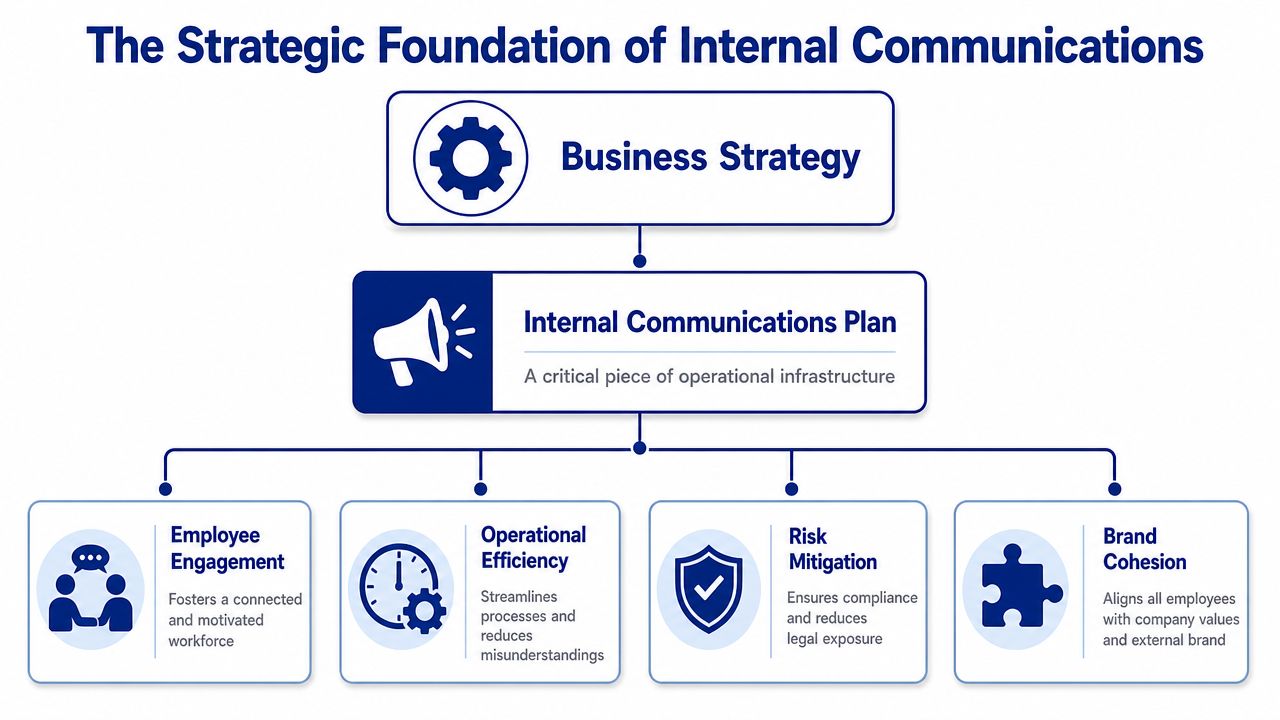
That structure matters more in complex operating environments. A single-site company can sometimes correct confusion informally. A multi-location employer can't rely on that. When teams work across states, shifts, or business units, leaders need communication that is documented, scheduled, and reviewed.
A practical internal communications plan should answer a small set of operating questions.
Practical rule: If a communication affects policy, pay, scheduling, reporting lines, safety expectations, or employee relations, it needs a documented path, not an improvised one.
Many leadership teams underestimate the strategic value of this work because internal communication gets filed under culture rather than control. That's a mistake. In regulated or distributed organizations, internal communication functions much like any other operating system. It reduces variation, supports execution, and creates a record of what the company intended employees to know.
The best plans don't live apart from the business. They support the operating model, the leadership style, and the standards the company claims to uphold.
If your organization says accountability, clarity, or respect are core values, the communication plan should make those values visible in daily practice. A company that wants consistency can't leave sensitive messages to manager improvisation. A company that says transparency matters needs a clear standard for what gets shared, when, and through whom. That's one reason it helps to define communication standards alongside broader culture work such as company core values.
For teams building from scratch, our guide to internal communications is a useful companion because it shows how a plan moves from broad intent into an operational framework.
A strong plan isn't glamorous. It does something better. It gives leaders a reliable way to communicate change without creating avoidable risk.
Most communication plans fail before the first message goes out. The failure happens when leaders design the future state without understanding the current one.
A rigorous plan starts with a communication audit. According to Workvivo's guidance on internal communications, the audit should map current channels, audience segments, and message types, then use that picture to define a better "to-be" state tied to business goals. That sounds simple, but it forces leadership to confront the actual condition of communication inside the company.
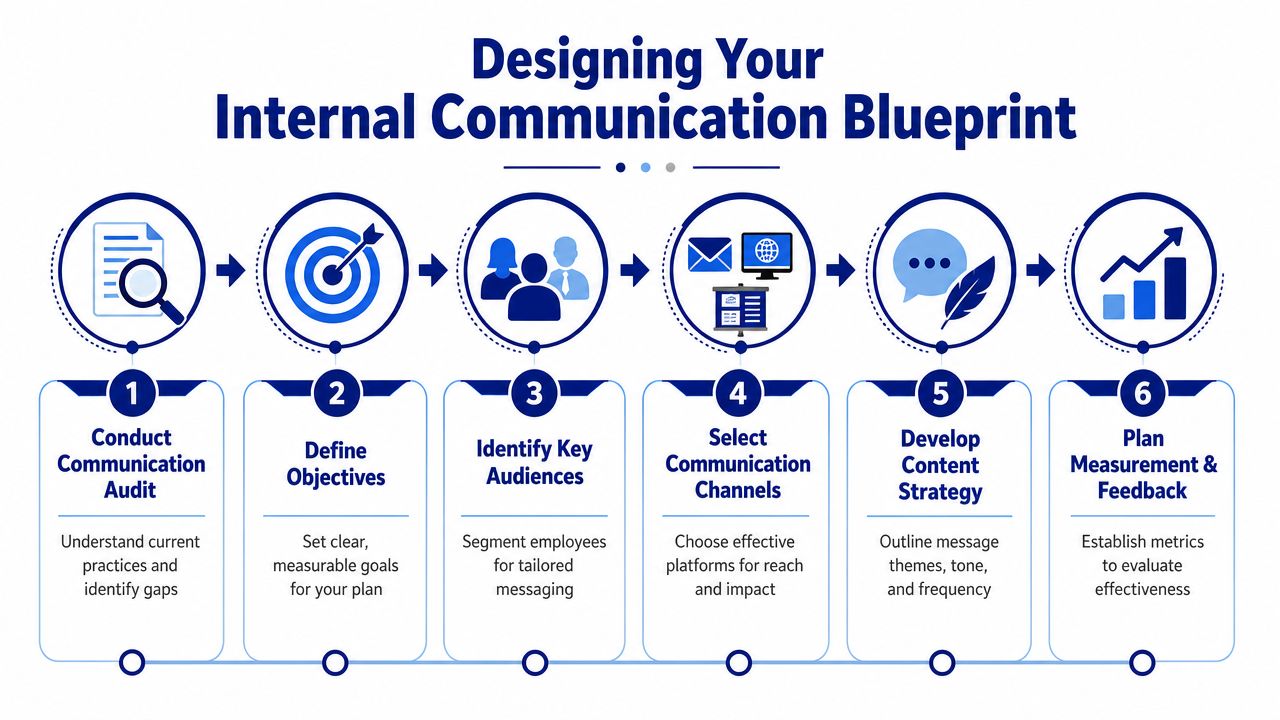
In practice, the audit should show where messages originate, how they move, where they stall, and where employees stop paying attention. It should also reveal whether different employee groups are receiving the same information in very different ways.
The most useful audit isn't theoretical. It is operational.
Look at the last few months of real communications and ask:
A good audit also identifies message ownership. If no one can say who approves a policy-related communication, you've found a risk point.
One of the most common mistakes is treating all employees as one audience. They aren't.
Employee segmentation should reflect how people experience work inside your business. For many SMBs, that means dividing groups by role, department, region, language needs, and management level. In a healthcare environment, for example, a secure intranet page may be appropriate for formal policy resources, while manager-led team huddles may work better for operational workflow changes that staff need to apply immediately. In a distributed service business, leadership may brief managers on video first, then have local supervisors explain the change with role-specific examples.
A simple planning table can help:
| Audience group | Best use case | Primary channel | Support channel |
|---|---|---|---|
| Managers | Cascade messages, answer questions, reinforce expectations | Manager briefing | Written talking points |
| Frontline employees | Immediate operational changes | Team huddle | Posted summary or text alert |
| Office staff | Detailed policy or process changes | Intranet reference page | |
| Multi-state leadership | Sensitive changes requiring alignment | Live meeting | Follow-up memo |
The right channel depends on what employees need to do next, not on what leadership finds most convenient.
Once you've mapped the current state and segmented the workforce, the blueprint should become specific. Each recurring communication type needs a defined route.
That route should include:
Generic templates are no longer sufficient. Multi-state employers need a blueprint that reflects their actual reporting lines, actual risks, and actual workforce mix. Otherwise, the plan looks complete on paper and falls apart in execution.
Even a well-built communication structure can fail if the message itself is vague, inconsistent, or legally careless. Delivery matters, but wording matters just as much.
Leadership teams often create exposure without realizing it. A rushed message about attendance, leave, performance expectations, restructuring, or compensation can create confusion at best. At worst, it can become evidence that the company communicated carelessly, inconsistently, or without adequate review.

The cost of poor communication is not abstract. Axios HQ reports that ineffective communication costs organizations $54,860 annually for every senior employee earning over $200,000, and that senior employees lose 63 work days per year because of ineffective communication. The same research notes that 37% of employees want a more consistent cadence, 36% want the opportunity to provide feedback, and 35% want more timely information. It also cites survey data showing 44% of internal communications teams had to resend or correct an internal email one to two times in the past year, while 27% did so three to five times.
Those figures point to a practical truth. Leaders don't need more message volume. They need message discipline.
Every important message should answer a few basic questions before it goes out.
This isn't just a writing exercise. It's risk control. Messages about policy enforcement, corrective action trends, accommodations, reporting obligations, or organizational changes should be reviewed for consistency with your actual practices. If operations says one thing, HR says another, and managers paraphrase both, the company creates its own ambiguity.
Not every message needs legal review. Many do need a disciplined approval process.
A workable standard looks like this:
| Message type | Review level | Why it matters |
|---|---|---|
| Routine operational update | Department owner and manager | Keeps day-to-day communication moving |
| Policy clarification | HR and operational leader | Prevents inconsistent interpretation |
| Sensitive employee issue trend | HR with leadership input | Reduces misstatement risk |
| Reorganization or legally risky topic | HR and legal as needed | Protects consistency and defensibility |
Clear communication is not the same as casual communication. The higher the sensitivity, the less room there is for improvisation.
Pre-approved templates help. They are especially useful for recurring situations such as handbook rollouts, schedule changes, benefits reminders, investigation-related confidentiality reminders, and manager talking points after leadership announcements. Templates don't replace judgment, but they reduce the chance that a local leader will fill in the gaps with language that creates new problems.
Strong messaging also depends on speaker capability. If you want managers and leaders to communicate with authority, especially in visible or difficult settings, resources on executive presence and message delivery can help. One useful example is this guide on training for women leaders to command rooms, which addresses how leaders can deliver messages with clarity and confidence under pressure.
Most communication plans overinvest in channels and underinvest in managers.
That's backward. Employees may receive a company-wide email, but they usually decide what it means after they talk with their manager. That is especially true when the topic involves policy enforcement, role changes, scheduling, safety, performance expectations, or anything that feels personal.
Public guidance often covers segmentation, channels, and calendar planning well. What it tends to underweight is manager capability and local execution. ContactMonkey's discussion of internal communications planning highlights that gap directly, noting that many guides don't provide a defensible manager workflow or accountability model, even though the manager layer is the primary control point for message delivery, especially on sensitive or legally risky topics.
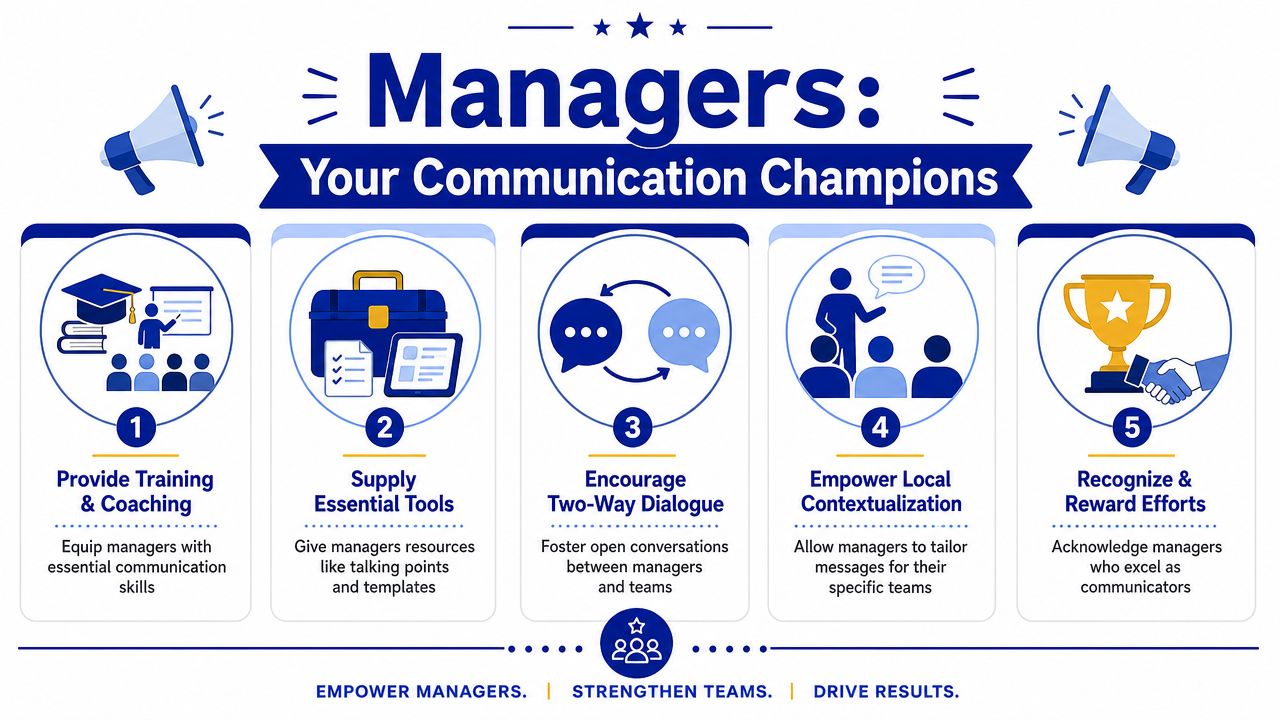
A communication cascade only works when managers receive more than a forwarded memo. They need tools, timing, and clear limits.
The strongest manager briefings usually include:
That last point matters. One common failure mode is releasing a company-wide message before managers are briefed. Employees then ask immediate questions, managers don't have answers, and trust erodes in real time.
Managers shouldn't read every script word for word. They also shouldn't invent explanations.
The right balance is controlled flexibility. Leadership should define the core principles, then allow managers to localize examples, explain team impact, and surface practical concerns. That model respects operational reality without sacrificing consistency.
A simple decision model helps:
| Manager can do | Manager cannot do |
|---|---|
| Explain local workflow impact | Change company policy in conversation |
| Clarify timing for the team | Speculate about legal or HR intent |
| Gather questions and concerns | Promise exceptions without approval |
| Reinforce required actions | Add personal theories or side commitments |
Managers are not just messengers. They are interpreters, stabilizers, and early warning sensors for misunderstanding.
Telling managers to communicate well isn't enough. The plan should assign responsibility in a way leaders can verify.
That may include manager acknowledgment of briefing materials, required team huddles after major announcements, documented escalation of unanswered questions, and feedback loops into HR or operations. For organizations trying to improve manager listening, structured prompts can be useful. Thoughtful check-ins supported by resources like these best feedback questions help managers surface confusion before it becomes resistance or rumor.
The operational test is straightforward. If one manager handles a sensitive announcement well but another causes confusion, leadership should be able to identify what support, instruction, or accountability was missing. When the manager layer is strong, the rest of the internal communications plan becomes far more reliable.
An internal communications plan shouldn't be judged by how much content the company produced. It should be judged by whether employees received the right message, understood it, and acted on it correctly.
That requires a measurement system, not an after-the-fact summary. Poppulo's guidance on internal communications strategy recommends tracking reach, awareness, engagement, and feedback rates against SMART goals. It also warns against a common failure: information overload. The benchmark isn't maximum distribution. It's measurable comprehension and actionability. If employees can't recall or act on the message, the plan hasn't worked.
That standard is especially important for multi-state SMBs. In a complex employment environment, leaders don't need vanity metrics. They need evidence that communication is landing consistently enough to support operations and reduce avoidable risk.
Many teams collect too much data and learn too little from it. The better approach is to track a small set of indicators that connect directly to execution.
| KPI | What it tells you | Useful questions |
|---|---|---|
| Reach | Whether the intended audience received the message | Did the right people get it through the intended channel? |
| Awareness | Whether employees remember the core point | Can employees describe what changed and why? |
| Engagement | Whether employees interacted with the communication | Did they attend, open, acknowledge, ask, or respond? |
| Feedback rate | Whether employees and managers surfaced questions or confusion | Are people telling you what still isn't clear? |
Reach is the easiest metric to overvalue. A message can be delivered broadly and still fail operationally. An all-staff email that everyone receives but few understand is not a success.
Awareness is harder and more useful. If employees can't accurately state the new expectation, the company still has a communication problem, even if distribution looked clean.
For high-impact messages, the most important test is comprehension. That means checking what employees understood, not what leadership intended.
A practical review process often includes:
This is also where message format matters. A policy change may need a written reference document, but initial understanding may depend on a manager conversation. A benefits reminder may work well in email. A restructuring message usually requires live communication first, written follow-up second.
The point of measurement isn't to prove the message was sent. It's to verify that employees can use it.
Many organizations respond to communication gaps by sending more. That usually makes the problem worse.
When employees receive the same topic through too many channels, or too many unrelated updates in a short period, they stop distinguishing critical information from background noise. Important messages get buried inside routine volume. Managers also become less reliable because they are asked to reinforce too many priorities at once.
Signs of overload include:
A disciplined internal communications plan doesn't try to occupy every channel all the time. It reduces clutter so the right messages stand out.
Measurement only matters if the company uses it to revise the plan. Review should happen on a fixed cadence, with additional checks after major changes or sensitive announcements.
For many SMBs, a practical review rhythm includes monthly operational checks and deeper quarterly reviews. The monthly check can focus on communication failures, manager feedback, and any message that produced confusion or rework. The quarterly review can examine trends by audience, channel, and message type.
That review should lead to decisions such as:
Organizations also benefit from comparing communication outcomes to broader employee listening patterns. Engagement data can surface whether employees trust leaders, feel informed, and know where to raise questions. When those insights are paired with communication metrics, leadership gets a clearer picture of what is working. Resources on how to measure employee engagement can then complement the communications review process.
For higher-risk employers, measurement should include recordkeeping. Not every communication needs a formal archive, but important ones should leave a trace.
That includes final approved language, audience lists, release timing, manager briefing materials, FAQs, and any follow-up clarifications. If a dispute later turns on what employees were told, leadership should not have to reconstruct the message from memory.
Documentation also helps identify repeat failures. If the same type of update repeatedly requires correction, the company can inspect the workflow rather than blaming individual senders.
A mature internal communications plan gets quieter, not louder. It becomes easier for employees to know where to look, easier for managers to know what to say, and easier for leadership to tell whether a message worked.
That maturity shows up in practical ways. Fewer corrections. Fewer conflicting explanations. Better manager consistency. Faster escalation of confusion. Stronger alignment between policy, practice, and communication.
For multi-state SMBs, that isn't cosmetic improvement. It's operational discipline. And in a complex employment setting, operational discipline is one of the strongest forms of risk control a leadership team can build.
If your leadership team needs help building a more defensible internal communications plan, especially for manager execution, documentation standards, and multi-state risk, Paradigm International Inc. works with SMB leaders who need structure and sound judgment in high-stakes people decisions. You can learn more by starting a conversation through their contact page.