


If you run a business in more than one state, Maine can disrupt your standard playbook fast. A handbook that works in one location, a scheduling practice that seems routine, or a layoff plan built around federal rules can all create risk once Maine employees are involved. The practical issue isn't just knowing the rules. It's knowing where Maine expects more from employers, and building controls that managers can follow.
For busy owners, COOs, and HR leaders, the right approach is simple. Treat Maine as a state where payroll, scheduling, leave handling, and termination decisions need tighter review before they go live. That mindset prevents most avoidable mistakes.
A five-location company rolls out one scheduling policy, one leave process, and one separation checklist across New England. It works everywhere until a Maine manager applies it without any state review. The risk usually does not show up in the policy file. It shows up in payroll corrections, a leave dispute, or a layoff timeline that should have been reviewed much earlier.
Maine deserves its own operating rules. Federal law is only the starting point. Maine adds state requirements that can change how an SMB staffs shifts, classifies pay practices, plans a reduction in force, and assigns decision authority between managers, payroll, and HR.
State guidance from the Maine Department of Labor covers several of the rules that tend to affect executive decisions first, including wage and hour requirements, overtime limits in certain situations, severance and notice obligations in covered closings or layoffs, and the state paid family and medical leave program, as reflected across Maine labor standards materials from the Maine Department of Labor. For employers operating across state lines, that matters because a policy that is lawful in another state can still create avoidable exposure once Maine employees are in the mix.
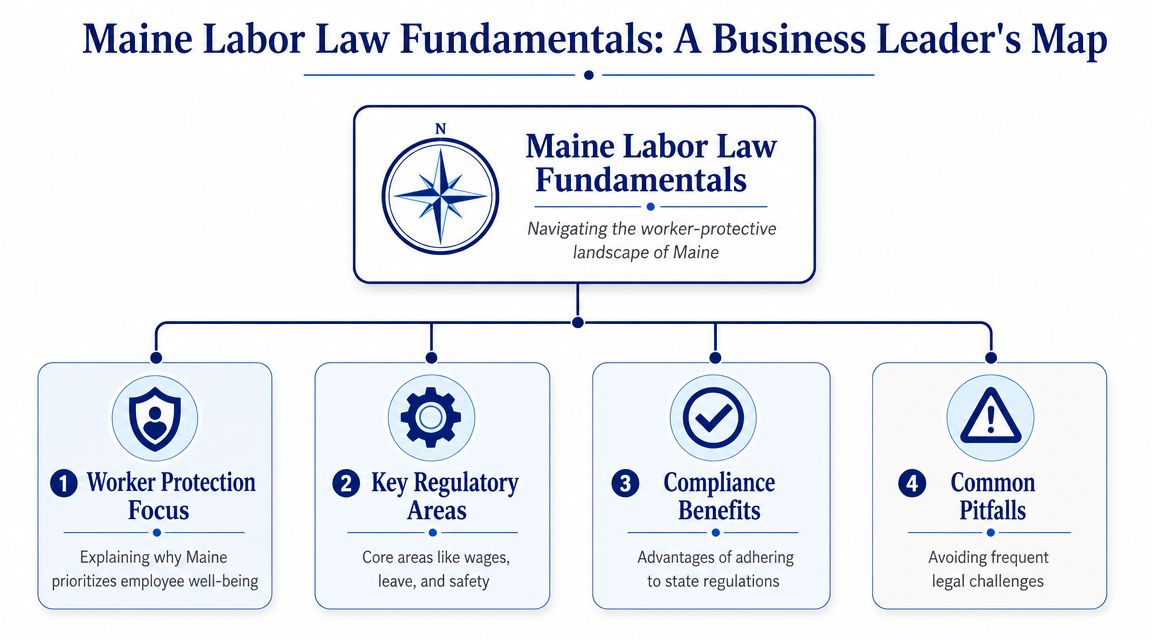
The cleanest approach is to sort Maine obligations by operating risk, not by legal topic alone. That helps leadership teams decide what needs manager training, what belongs in payroll controls, and what requires HR or counsel review before action is taken.
This structure works because Maine compliance failures are usually operational failures first. A frontline manager extends hours to solve a staffing gap. A payroll team applies a default multistate rule. An owner uses the same reduction plan in every location and reviews Maine notice obligations too late.
For multistate employers, the decision framework is straightforward. Identify where Maine sets a higher bar, then decide whether to build one national policy that meets that bar or keep a Maine-specific exception. A single national rule is easier to administer. A state-specific exception may lower labor cost or preserve flexibility elsewhere. The right answer depends on manager discipline, system capability, and how much variation your team can execute without mistakes.
A centralized handbook can still work, but Maine needs local controls attached to it. Payroll needs current state settings. Managers need clear approval limits. HR needs a review step for leave, discipline, and separation decisions that could trigger state-specific obligations.
What fails most often is assuming an issue can be fixed after the fact. Payroll can correct a rate error. It cannot reverse a poorly timed termination, an informal leave denial, or a layoff process that started before the company checked Maine requirements.
If your team needs a baseline before tightening state-specific controls, this overview of employment law basics for employers is a useful starting point. For wage-floor context across jurisdictions, this guide for employers on minimum wage is also a helpful reference.
A Maine location opens at 7:00 a.m. Payroll is set up from last year, a store manager trims shifts on the fly, and no one confirms whether the tipped rate in the system still matches state requirements. That is how routine operating decisions turn into wage claims.
For Maine employers, wage and hour compliance starts with rate control, but it does not end there. Significant exposure sits in the handoff between payroll, scheduling, and front-line managers. Multistate employers feel this most sharply because a process that works in another state can still fail in Maine if the wage floor, tip rules, or reporting-pay obligations are higher.
Maine's minimum wage is indexed, so the number changes over time. That is the reason readers often see different figures depending on the year cited. As of January 1, 2024, Maine's minimum wage was $14.15 per hour and the service employee minimum direct wage was $7.08 per hour, according to the Maine Department of Labor minimum wage guidance. If your team is using $15.10 per hour from current guidance elsewhere in this article, treat that as a later rate, not a contradiction. The compliance risk is simple. Payroll has to use the rate in effect for the pay period at issue.
Executives usually ask for the current wage number. The more useful question is who owns updates when Maine changes the number.
A practical review should cover four items:
This is less about legal theory and more about failure points. A bad rate table creates underpayment. A bad manager practice creates exceptions payroll may never catch. A multistate employer should decide whether to apply one higher national wage rule where practical or maintain a Maine-specific configuration with tighter controls.
For broader context on how wage compliance failures can escalate into larger worker-protection issues, this guide for employers on minimum wage is worth reading alongside your own legal and payroll review.
| Requirement | Threshold / Rate |
|---|---|
| State minimum wage in current Maine guidance | $15.10 per hour |
| State minimum wage as of January 1, 2024 | $14.15 per hour |
| Service employee minimum direct wage as of January 1, 2024 | $7.08 per hour |
| Report to Work law employer coverage | 10 or more employees |
| Report to Work law effective date | September 24, 2025 |
| Report to Work penalty range | $100 to $500 per violation |
Maine's new Report to Work law is easy for an SMB to miss because it sits between scheduling and payroll. Effective September 24, 2025, the law applies to employers with 10 or more covered employees working more than 120 days per calendar year. If an employee reports to work and is then sent home because the shift is canceled or cut short, the employer must pay the lesser of 2 hours of pay at the regular hourly rate or the amount the employee would have earned for the scheduled shift, according to Vorys on Maine's new Report to Work law.
If someone has already shown up, the scheduling error has become a wage obligation.
The operational answer is documented notice discipline. Set a cutoff time for cancellations. Decide who has authority to make that call. Use a consistent text, app, or call process, and keep records showing the employee was told not to report. Informal relays through a shift lead are cheap in the moment and expensive later.
If you're reviewing your process end to end, this checklist on wage and hour compliance for employers helps translate payroll rules into operating controls.
Overtime in Maine isn't just a pay calculation issue. It's a scheduling-control issue. That distinction matters because many employers pay time-and-a-half correctly and still create exposure through how managers assign hours.
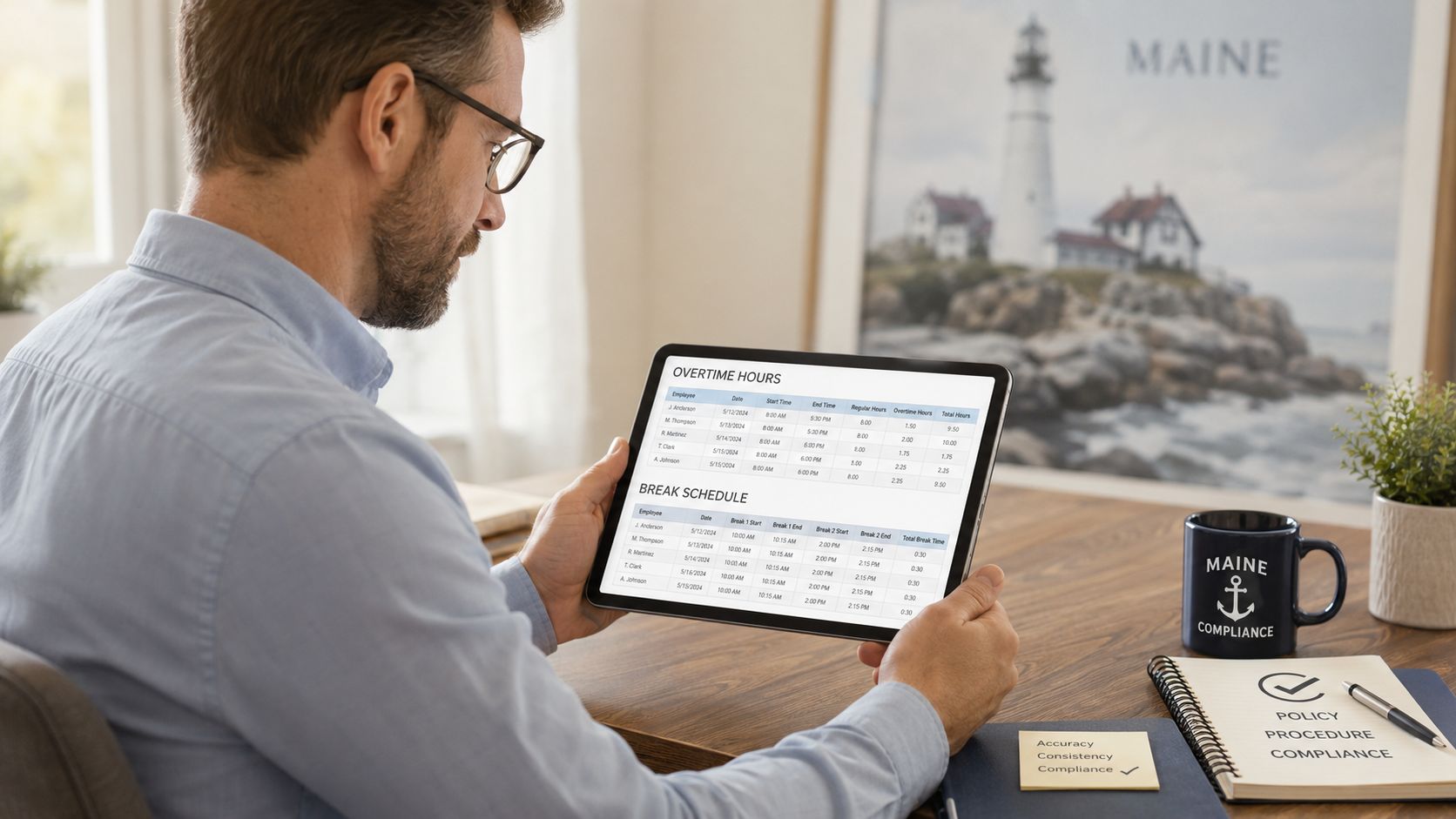
Maine guidance explains that nonexempt employees generally must receive 1.5x their regular rate for hours over 40 in a week, and employers generally may not require more than 80 overtime hours in any consecutive two-week period. It also notes that the regular rate can include bonuses, commissions, and other compensation unless excluded under the federal definition, which can increase overtime cost beyond a simple hourly multiplier, according to Baker Donelson's Maine overtime guide.
A common failure pattern looks like this. A location is short-staffed. The manager keeps assigning long shifts over a two-week period, payroll pays overtime correctly, and leadership assumes the company is compliant.
That assumption is risky in Maine. The schedule itself can be the problem.
Operational insight: Payroll can calculate overtime correctly and the company can still have a labor-law issue if managers required hours that should not have been assigned.
The strongest overtime controls are practical, not theoretical.
If your managers need a plain-English refresher on wage claims tied to unpaid or mishandled overtime, this summary of Kons Law overtime advice can help frame why documentation and calculations both matter.
Break compliance is where employers often rely on habit instead of policy. The safest approach is to document when meal periods are offered, how employees record their time, and what supervisors should do if work interrupts a break. If your timekeeping process assumes breaks occurred without confirming what happened, you create a recordkeeping problem and a wage problem at the same time.
A Maine supervisor gets a text at 6:15 a.m. An employee says her father was admitted to the hospital overnight and she needs time off. In a single-state business, that request is already sensitive. In a company with employees in multiple states, the risk rises fast because the same manager may be applying the wrong rule set from habit.
Maine employers need a leave process that sorts requests early and sends them to the right reviewer. Maine has both earned paid leave requirements and a separate family and medical leave framework. The Maine Department of Labor's family and medical leave guidance is a better operational reference point than a general 50-state summary because it focuses on who is covered, how leave is triggered, and what job protections apply.
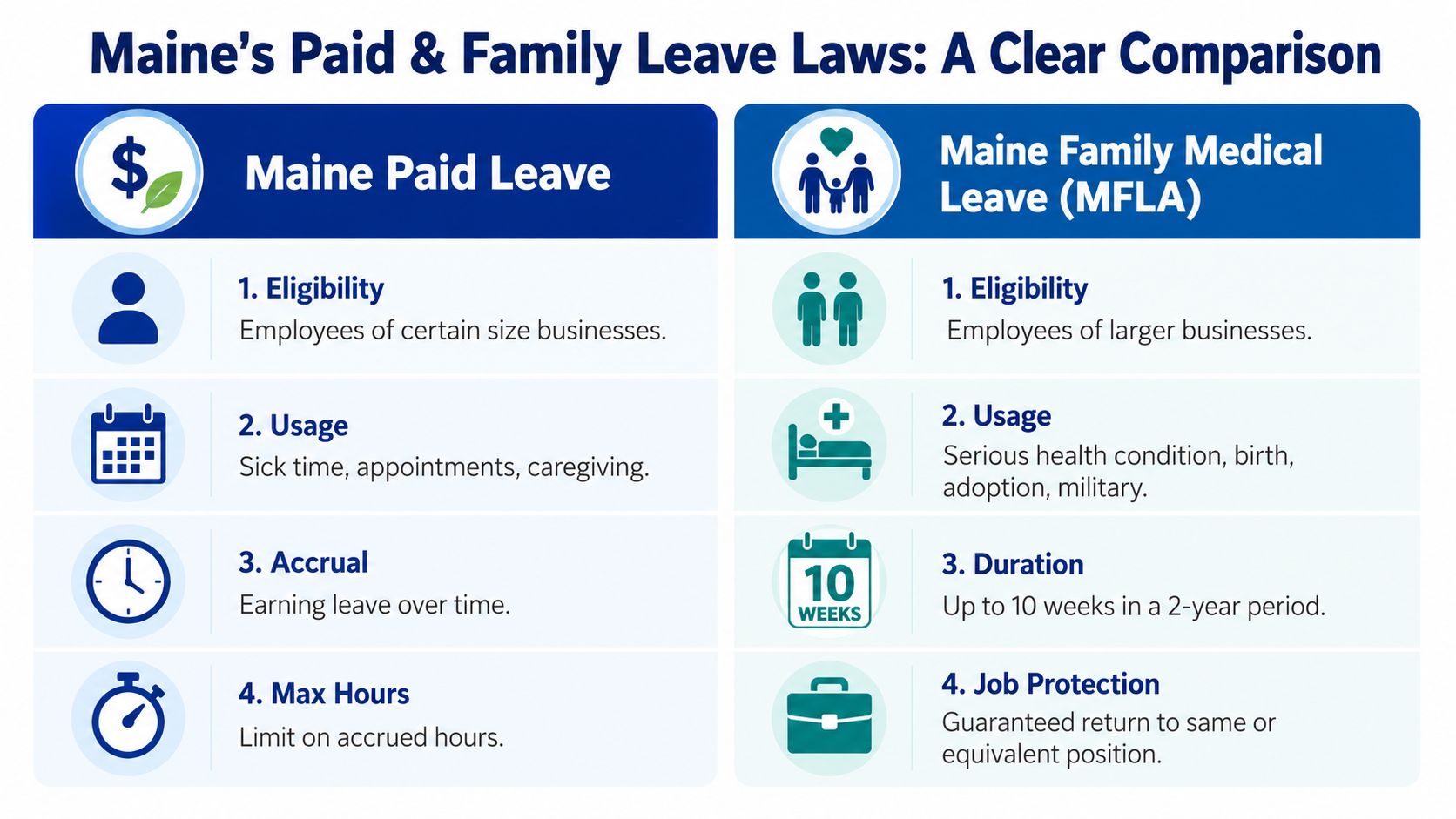
The first decision is classification.
Do not let front-line supervisors decide, in real time, whether an employee is asking for ordinary PTO or raising a protected leave issue. That is where inconsistent handling starts. It is also where multi-state employers create avoidable problems, because a manager trained on another state's rules may approve, deny, or comment in a way that conflicts with Maine requirements.
A workable framework usually has three lanes:
This approach gives managers a simple job. Receive the request, document what was said, and send it to HR or the designated leave reviewer.
Many handbooks list leave categories. Fewer say who decides what applies.
That gap creates operational risk. A manager trying to be helpful may promise job protection that the company has not reviewed. Another manager may deny the same type of request because staffing is tight. The legal problem is inconsistency. The business problem is that employees compare notes across locations, and those comparisons often become claims.
A cleaner workflow is short and specific:
Employees do not need legal terms to trigger this review. A comment about a surgery, pregnancy complication, parent care, or treatment schedule is usually enough to move the request out of ordinary attendance handling.
Small and mid-sized employers often run into trouble when they try to standardize leave administration for efficiency, only to discover that state rules do not line up cleanly. Maine may not match the eligibility rules, notice standards, accrual rules, or job-protection framework used in another state where the company operates.
The practical fix is a two-part system. Use one intake method across the company, then apply state-specific review rules after the request is submitted. That keeps the employee experience consistent without forcing Maine decisions into another state's template.
For executives, the trade-off is straightforward. Local manager discretion feels faster. Centralized review slows the first response a little, but it cuts the chance of interference, retaliation, and reinstatement disputes later.
Policy language matters. Manager language matters more in the first few minutes.
Review these items now:
A good leave policy reduces confusion. A good intake process reduces claims. For Maine employers, especially those operating across state lines, the second one usually matters more.
A Maine location manager ends a weak employee on Friday, using the same process the company uses in another state. By Monday, HR learns the employee recently raised a complaint, had a pending leave issue, and worked at a site affected by a larger headcount reduction. That is how a routine separation turns into a retaliation review, a documentation problem, and sometimes a notice issue.
For Maine employers, these cases carry more operational risk than day-to-day policy administration because the mistake is usually not the final meeting itself. The mistake is the decision path that led there. Multi-state employers see this often. A manager follows the company norm instead of the Maine-specific rule, or treats a high-risk call as a simple performance matter.
A clean termination meeting does not fix a weak record. If the reason for discharge shifted over time, if prior coaching is missing, or if similar conduct drew a lighter response for someone else, the employer has a harder case to defend.
The risk gets higher in workforce reductions. Maine's severance notice law can apply to covered closings and mass layoffs, and the Maine Department of Labor's severance pay guidance is the right place to confirm whether timing, notice recipients, and establishment-level headcount trigger extra obligations. For an executive team, the real decision is not just whether to cut roles. It is whether the company has paused long enough to review notice exposure before managers start communicating.
Use a simple review standard before approving a separation:
That review slows some exits. It also prevents expensive reversals.
In my experience, discrimination cases are often built from small inconsistencies that look harmless in isolation. One supervisor allows schedule flexibility. Another denies it without explanation. One complaint gets a same-day response. Another sits in a manager inbox for a week. Then the employee who raised the issue is disciplined or terminated.
That fact pattern creates risk even if leadership believes the underlying decision was justified. The practical fix is tighter control over who can make sensitive calls and what must be documented before action is taken.
For Maine operations, especially inside a multi-state structure, use a higher review tier for these decisions:
This is not about centralizing every employee issue. It is about identifying the points where local discretion creates outsized legal and reputational exposure.
Child labor problems usually show up after onboarding. A minor is hired correctly, age is verified, and then the scheduling team treats that employee like any other hourly worker. In retail, hospitality, food service, and seasonal businesses, that is where violations start.
Maine employers should use the state's youth employment rules as a scheduling control, not just a hiring checklist. The Maine Department of Labor summary on hours restrictions for minors outlines the state limits, including restrictions tied to age and school attendance. If your scheduling tool cannot flag minors automatically, the process depends on manager memory. That is not a reliable control.
A workable system includes:
Across all three areas, the pattern is the same. Maine law creates the rule set, but the primary exposure comes from how the business makes decisions under time pressure. SMBs that operate across state lines need a framework that separates routine employee relations from high-risk events and routes the second category to trained review before the damage is done.
A good Maine audit should be short enough to use and specific enough to catch weak points. If your team can't review it in one meeting, it's probably too abstract to help.
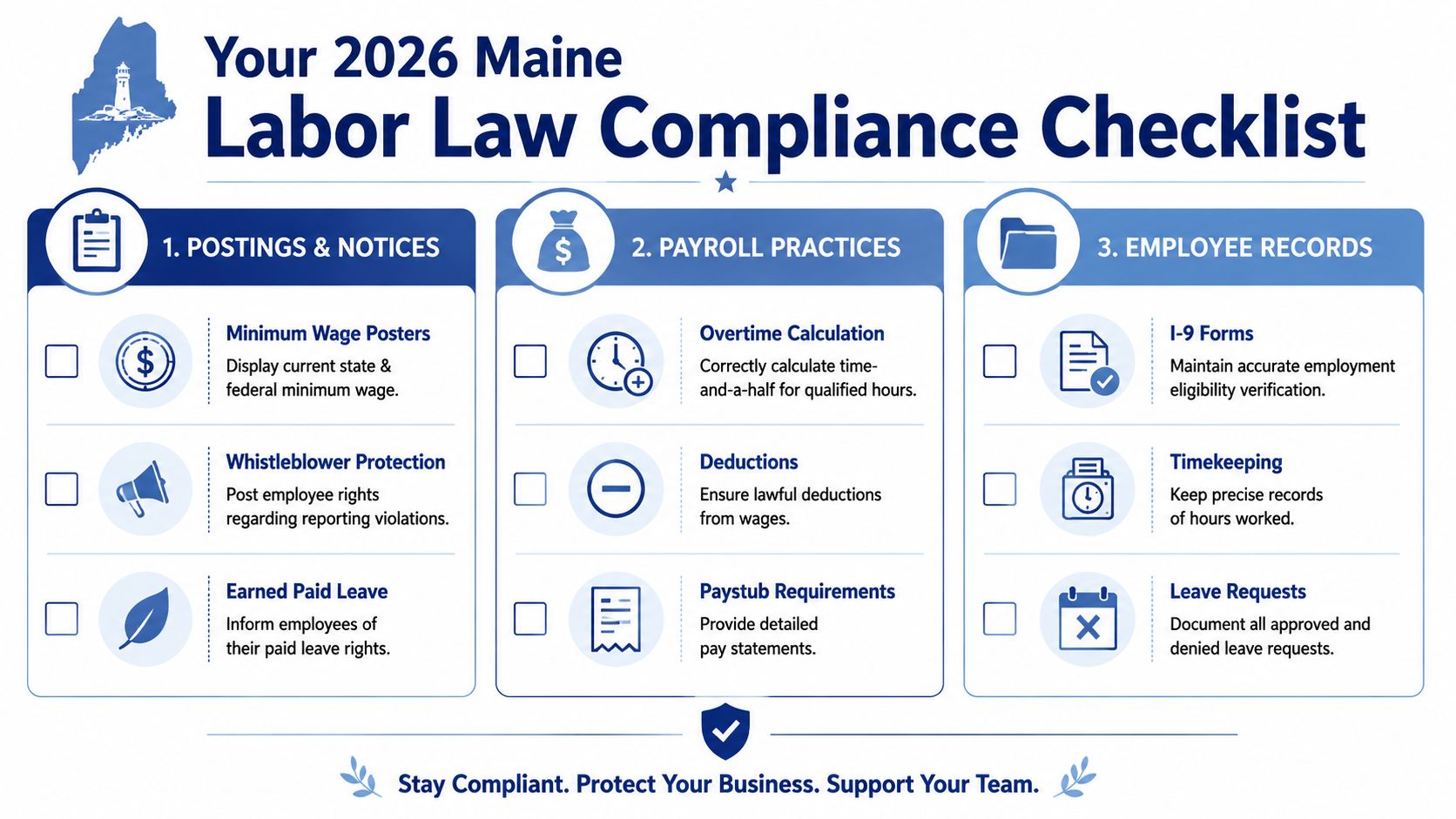
Don't treat this as a one-time legal cleanup. Use it to identify where your company is relying on memory, manager judgment, or outdated forms. Those are the areas most likely to create repeat exposure.
There's a point where DIY compliance stops being efficient and starts becoming expensive. That point usually arrives when the issue is no longer about policy administration, but about judgment under pressure.
If you're expanding into Maine, running a multi-state workforce, planning a reduction in force, dealing with a wage complaint, responding to an agency inquiry, or investigating manager conduct, it helps to bring in a specialist who focuses on defensibility. In those situations, leaders need someone who can pressure-test documentation, decision timing, communication steps, and cross-state consistency before the problem grows.
One option is working with a firm such as Paradigm's labor law compliance and HR advisory team, which supports SMB leadership teams on higher-risk employment decisions. The value in that kind of support isn't routine administration. It's having a structured decision partner when a misstep could create legal, financial, or reputational exposure.
The practical rule is simple. If the decision could lead to a claim, an audit, a breakdown in manager consistency, or a preventable public issue, don't rely on instinct alone.
If your team is dealing with Maine labor laws, especially across multiple states or during a sensitive workforce decision, Paradigm International Inc. can help you assess risk, tighten your process, and build a more defensible approach before small compliance gaps turn into larger problems.


