
A 360-degree review is a multi-source feedback process that gathers anonymous input from 8-12 raters, and it’s designed to surface the blind spots that traditional manager-only reviews often miss. It matters because 85% of Fortune 500 companies use 360-degree feedback as a core leadership development tool, and when it’s implemented correctly, it can strengthen leadership decisions while reducing avoidable people risk.
If you're leading a growing business, you've probably felt the limits of a standard performance review. A manager may know whether someone hits targets, but that doesn't tell you how that person leads a team, handles conflict, or creates risk through inconsistent behavior. Those are the issues that often become expensive later, especially for multi-state employers.
For executive teams, what is a 360 degree review is not just a definitional question. It's a governance question. Used well, it gives you a fuller picture of leadership behavior, documents patterns that matter, and helps you address concerns before they turn into turnover, complaints, or litigation.
A traditional review is a single photograph. A 360-degree review is a panoramic view.
Instead of relying on one manager's perspective, a 360-degree review collects feedback from the people who experience a leader's behavior from different angles. That usually includes the manager, peers, direct reports, and sometimes external stakeholders. The review also includes a self-assessment, which is where some of the most useful gaps appear.
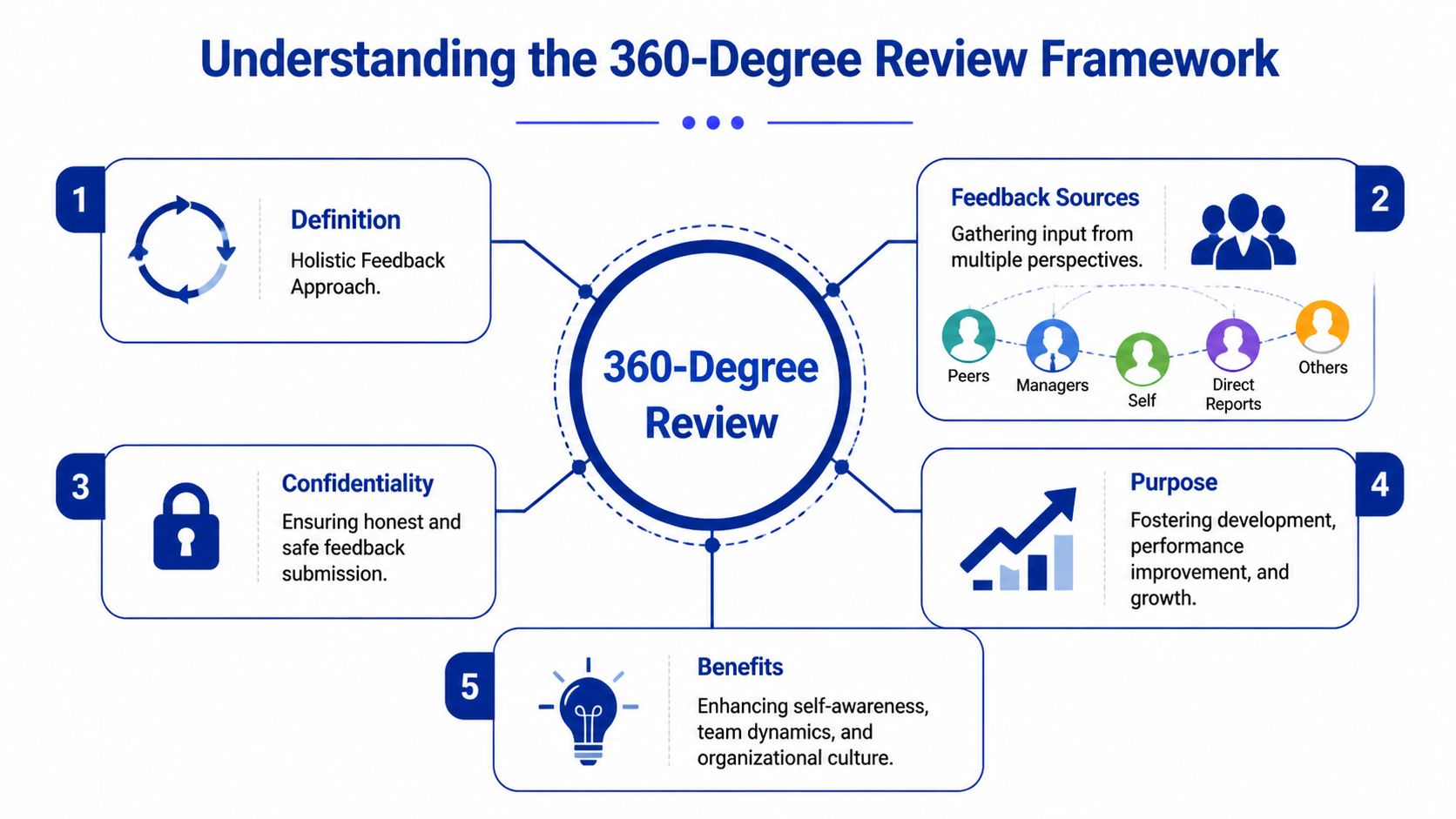
The framework has a few standard parts:
The practical value comes from comparison. In a 360 review process overview from AIHR, a 360-degree review is described as multi-rater feedback based on anonymous evaluations from 8-12 raters, and the same source notes that self-ratings are typically 10-15% higher than peer ratings. That gap is exactly why the process exists. It helps leaders see where their intent and their impact don't match.
The best use of a 360 isn't to produce a scorecard for filing cabinets. It's to identify behavior patterns.
A strong review looks at observable competencies such as communication, delegation, accountability, judgment, or collaboration. If a manager rates themselves highly on delegation but direct reports consistently describe bottlenecks or unclear direction, that signals a development need that a top-down review may never catch.
Practical rule: If a question can't be tied to an observable workplace behavior, it probably doesn't belong in a 360 review.
That is why question design matters. Generic prompts invite vague comments and personal bias. Competency-based prompts create cleaner data and better follow-up conversations. If you're refining survey design, the guide to best feedback questions for employee reviews is a useful starting point.
A 360 also works best when it's part of a broader leadership system rather than a one-off HR event. Teams that want to pair feedback with coaching, manager training, and speaker-led development can also look at examples of innovative leadership development programs to see how organizations turn insight into visible behavior change.
For a small or mid-sized business, leadership errors are rarely isolated. One poor manager can drive resignations, create inconsistent documentation, escalate employee relations issues, and weaken execution across multiple teams. A 360-degree review gives leadership teams an earlier view of those patterns.

Many leaders assume 360s are mainly developmental tools for large enterprises. They are developmental tools, but that understates their value. They also help executive teams make better decisions about leadership readiness, manager oversight, and organizational stability.
According to People Element's 360-degree feedback statistics, 85% of Fortune 500 companies use 360-degree feedback as a core leadership development tool. That level of adoption matters because it shows how widely the process is relied on in high-stakes environments where leadership blind spots carry real business consequences.
SMB leaders usually don't need more data. They need better judgment signals.
A well-run 360 can help you:
A 360 review becomes strategic when leaders treat it as an early-warning system, not an annual HR ritual.
This is especially important in multi-state businesses. As organizations expand, senior leaders can no longer rely on informal visibility. They need a repeatable way to understand how managers are operating across locations, functions, and reporting lines. Done well, a 360 creates that structure.
A 360-degree review can be one of the most useful leadership tools in your HR system. It can also create confusion, anxiety, and bad data if you force it into the wrong environment. Executive teams should look at both sides before launching one.
The biggest advantage is range. A manager sees one version of an employee. Peers, direct reports, and partners see something different.
That wider view often improves the quality of development conversations because recurring patterns are harder to dismiss. It also gives organizations a stronger basis for targeted coaching, especially in areas like communication style, delegation, collaboration, and decision-making.
Other practical advantages include:
For companies trying to connect feedback with broader culture indicators, it also helps to understand how employee engagement is measured, because engagement and leadership behavior often move together.
The disadvantages usually come from misuse, not from the concept itself.
If participants don't trust anonymity, they'll soften feedback or avoid the truth. If the survey questions are vague, you'll get personality judgments instead of usable information. If there is no coaching or follow-up, the process becomes a data dump that creates stress without producing change.
A few common downside risks show up repeatedly:
| Risk area | What it looks like in practice | Why it matters |
|---|---|---|
| Low trust | Raters hold back or give inflated scores | The report looks clean but tells you very little |
| Poor question design | Feedback becomes vague, personal, or inconsistent | Leaders can't act on the results confidently |
| Political scoring | Employees use the tool to settle frustrations | The process damages credibility |
| No action plan | Reports are delivered and forgotten | Employees view the review as performative |
| Wrong use case | The company treats it as a pay-ranking device | Candor drops and defensibility weakens |
The fastest way to ruin a 360 is to ask employees for candor and then give them no reason to believe the process is fair.
That doesn't mean the tool should be avoided. It means the organization has to be ready for it. A 360 is useful when the company has enough trust, discipline, and leadership follow-through to handle honest feedback responsibly.
Most 360 failures start before the survey opens. They begin when leadership launches the process without deciding what the process is for.
The first decision is whether the 360 is for development, evaluation, or some combination of both. In practice, the cleaner choice is development. Once employees believe their feedback will directly affect compensation or promotion decisions, candor often drops.
Leadership should also define the competencies being measured. Keep them practical. If the business is dealing with scaling issues, focus on behaviors like delegation, role clarity, cross-functional communication, accountability, and manager judgment.
People don't resist feedback tools because they dislike improvement. They resist tools that feel opaque.
Before rollout, communicate:
This is also the moment to train raters. Good raters comment on behaviors, patterns, and work impact. Poor raters comment on personality, style preferences, or isolated incidents.
Leadership advice: If your communication plan is two emails and a survey link, you are not implementing a 360. You are creating avoidable noise.
If your broader goal is to improve your performance review process, it's worth aligning your 360 with the rest of your review architecture so managers aren't receiving mixed signals from separate systems.
Companies choose a platform, finalize rater groups, and open the feedback window. The mechanics are simple. The design choices are not.
Choose raters who have enough exposure to the employee's work to provide credible observations. Avoid loading the process with people who barely interact with the subject. Also avoid letting the employee fully control the list without review, because that can skew the feedback toward friendly voices.
A practical rollout usually includes:
For businesses that need more structured guidance around review documentation and manager evaluation flow, a practical reference point is this annual performance review template.
The report is not the outcome. The action plan is.
The employee should leave the debrief with a small number of specific behavior changes, not a broad instruction to "communicate better." That may involve coaching, manager follow-up, or support from an advisory partner such as Apex HR Consultants, which works with SMB leadership teams on defensible people processes and high-stakes HR decisions.
Without follow-through, a 360 becomes one more corporate exercise that employees endure and then ignore.
Many articles explain the developmental benefits of a 360 review. Far fewer explain how easily a poorly designed process can create legal exposure. For multi-state SMBs, that omission is a problem.

A 360 generates sensitive information about employee behavior, leadership conduct, and workplace relationships. If your company uses that information carelessly, it can contribute to retaliation claims, discrimination allegations, privacy concerns, or disputes over fairness in promotion and termination decisions.
In a 2025 SHRM survey summarized in the referenced compliance discussion, 28% of HR leaders reported legal challenges from multi-rater feedback misuse, while only 12% of online resources addressed mitigation steps such as rater training or legal review of questions. That gap reflects what many executive teams learn too late. A 360 is not legally neutral just because it is common.
The highest-risk mistakes usually involve one of these issues:
A legally safer 360 is built around behavior, consistency, and documentation discipline.
Use questions that focus on observable conduct. "Provides clear direction" is safer and more useful than "is intimidating." "Follows documentation procedures" is stronger than "doesn't seem organized." Behavior-based feedback can be evaluated; character judgments usually cannot.
A defensible process also includes these controls:
Anonymous feedback can inform a management decision. It should not replace an investigation, documented performance evidence, or legal review.
A company operating in one state can still make serious mistakes. A company operating in several states adds privacy, retention, and procedural complexity.
California employers, for example, may have data privacy concerns that require closer review of what is collected, how it is stored, and who can access it. Other states may create different risk points around personnel records, manager notes, or retaliation claims. The answer isn't to avoid 360s. The answer is to align the process with your broader HR governance model before rollout.
For executive teams, the standard should be simple. If a 360 produces information that could later appear in a promotion dispute, termination review, or internal investigation, the process must be designed as if counsel may eventually examine it.
A 360-degree review often fails for reasons that have little to do with survey software. The primary failures usually sit with leadership assumptions.
Some executive teams assume the process itself will create candor. It won't. Others assume anonymity alone will produce useful data. It won't do that either. A 360 only works when the culture and the controls support honest, specific feedback.
The most common failure is launching in a workplace where employees already fear retaliation. In that setting, people protect themselves. They inflate ratings, avoid difficult comments, or disengage completely.
According to TeamGPS on 360-review readiness, failure rates exceed 60% in low-trust cultures, while high-readiness firms with psychological safety can achieve a 25-40% uplift in leadership competency. That contrast is the clearest warning sign for leadership teams considering a rollout.
A 360 can also break down when leaders treat it as a project to delegate away.
Common pitfalls include:
If leadership wants honesty, leadership has to show that honest feedback will be handled professionally.
The stronger pattern is deliberate and visible.
Start with leaders. If executives are unwilling to be reviewed, employees won't believe the process is meant for growth. Keep the first round focused and manageable. Build in facilitated debriefs, written action plans, and manager check-ins so the review leads somewhere concrete.
A disciplined executive team also knows when not to launch. If the business is in the middle of a restructuring, active employee relations disputes, or major trust breakdowns, fix those conditions first. A 360 is not a trust repair tool. It is a feedback tool that depends on trust already being present.
In most cases, it shouldn't be the primary tool for compensation or promotion decisions.
A 360 works best as a development mechanism because it depends on candor. Once employees believe their anonymous comments could directly change someone's pay, bonus, or advancement, they often become more cautious. The result is less useful feedback and a weaker process.
That doesn't mean the information has no role in talent decisions. It can still help identify leadership readiness, development priorities, and coaching needs. But high-stakes decisions should rely on a broader record that includes documented performance expectations, observable results, conduct history, and manager accountability.
A practical rule is to treat 360 feedback as one input, not the deciding input.
Constructive feedback doesn't happen automatically. Companies have to design for it.
Start with the questions. Ask about specific behaviors, not personality traits. Reviewers can usually describe whether someone gives clear direction, follows through, or listens in meetings. They are far less reliable when asked to judge broad personal qualities.
Then train raters before the survey opens. Ask them to focus on patterns, examples, and work impact. Discourage labels, speculation, and emotionally loaded language.
This kind of guidance helps:
The quality of the debrief matters just as much as the survey itself. A well-facilitated conversation turns criticism into a development plan. A poorly facilitated one can make the entire process feel punitive.
They can be useful, but they should not be trusted without oversight.
Some platforms now promise automated analysis, sentiment scoring, and pattern detection. Those features can help with efficiency, especially when organizations are handling large volumes of comments. The risk is that leaders may assume the technology is objective because it is automated.
A HiBob discussion of 360-degree review trends cites a 2026 Deloitte report finding that 35% of AI-driven systems in regulated SMBs generated biased scores, leading to an 18% higher litigation risk. For executive teams, that is the core caution. AI can accelerate a process, but it can also scale flawed judgments.
If you're evaluating an AI-supported platform, ask these questions:
For most SMBs, the safer route is a hybrid model. Let technology organize data, but keep human judgment in the loop for interpretation, coaching, and any employment decision that could create legal exposure.
If your leadership team is considering a 360-degree review and wants to design it with stronger documentation, cleaner decision-making, and better multi-state compliance controls, Paradigm International Inc. can help you evaluate the process before it creates avoidable risk.