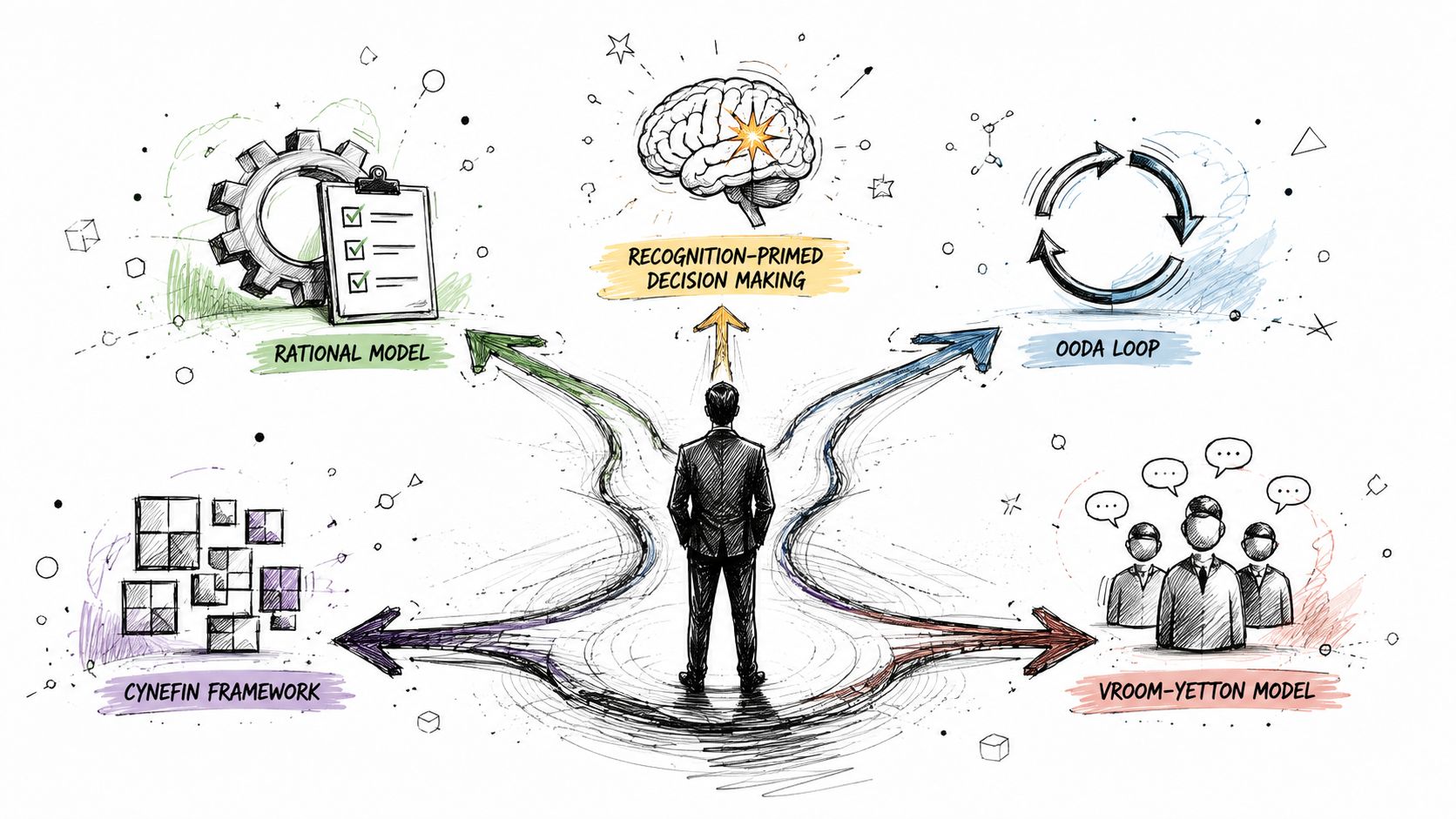
You're in the middle of a hard people call, and everyone is looking at you for the answer. A complaint has landed, the manager wants speed, HR wants more facts, and the COO wants to know whether this can be handled discreetly across two or three states without creating a bigger problem later. That is exactly where leadership decision making models earn their keep, because judgment alone is not enough when the decision has to survive scrutiny.
A lot of owners and COOs think their problem is indecision. It usually isn't. The actual problem is inconsistency: one leader decides fast, another wants more meetings, and a third changes course when the conversation gets uncomfortable.
That inconsistency becomes expensive when the decision involves a complaint, a termination, or a cross-state policy issue. One manager says the employee has to go today, another wants another investigation, and no one can explain why the process changed halfway through. If your team is still documenting these moments in loose notes and chat threads, it's worth tightening the process before the next hard call with a structured tool like document processes with GitDocAI.
The point of a model is not to replace judgment. It is to reduce variance in how judgment gets applied, so the right decisions move quickly and the wrong ones get slowed down.
That matters especially for SMBs with real employment exposure, because one rushed call can turn into a documentation problem, a manager inconsistency problem, and a credibility problem all at once. A model helps you separate what needs immediate action from what needs a fact-based pause. It also gives leaders a common language when the CEO, HR director, and operations lead are not seeing the situation the same way.
If you want a deeper look at how accountability fits into this, the framework at manager accountability is a useful companion piece.
The cleanest way to think about decision models is simple. Some are built for structured, high-stakes choices, some are built for speed, and some are built for uncertainty. The mistake most leaders make is using the wrong tool for the wrong kind of problem.
| Model | Core Mechanic | Best Fit | Watch Out For |
|---|---|---|---|
| Rational | Define the problem, set criteria, compare options, choose deliberately | Clear, high-stakes decisions that need defensibility | Can get slow if leaders pretend more data will solve a judgment call |
| Recognition-Primed | Match the situation to a known pattern and act | Experienced leaders facing familiar pressure | Fails when the leader's pattern recognition is weak or the situation is new |
| OODA | Observe, orient, decide, act in a fast loop | Rapidly changing situations | Can become endless re-orientation if no one commits |
| Cynefin | Sort the issue by domain, simple, complicated, complex, chaotic | Ambiguous problems where the response should match the uncertainty | People use it as a label instead of a decision aid |
| Vroom-Yetton-Jago | Answer diagnostic questions to decide how much team involvement is needed | Leadership choices where buy-in, time, and decision quality all matter | Can be misused if leaders want a formula instead of thinking |
The rational model is the one I reach for when a decision could be challenged later and the team needs to show its work. The recognition-primed model belongs in the hands of leaders who've seen the pattern before and know which facts matter first. OODA is useful when the situation is moving too fast for a long committee process, but it only works if someone is willing to act.
Cynefin is a good sorting tool when the problem itself is unclear. Leaders often skip that step and jump straight to solutions, which is how they treat a messy people issue like a simple operations issue. The Vroom-Yetton-Jago framework, first introduced in 1973 and refined in 1988, shifted leadership decision making from a one-size-fits-all style to a contingency model, and it remains useful because it asks when the leader should decide alone, consult selectively, or bring the team in more. That kind of calibration matters more than a rigid “always consensus” culture.
Practical rule: if the decision has legal, financial, or reputational weight, start with the model that makes your reasoning visible, then move faster only after the logic is clear.
For teams that are trying to improve how they reach agreement without making every issue political, the discussion at applying coaching models effectively is a helpful reference point.
The rational decision-making model is the one leaders say they use, then skip the parts that make it work. That is usually where bias enters. The model only holds up if you force the criteria into the open before anyone starts arguing for their favorite outcome.
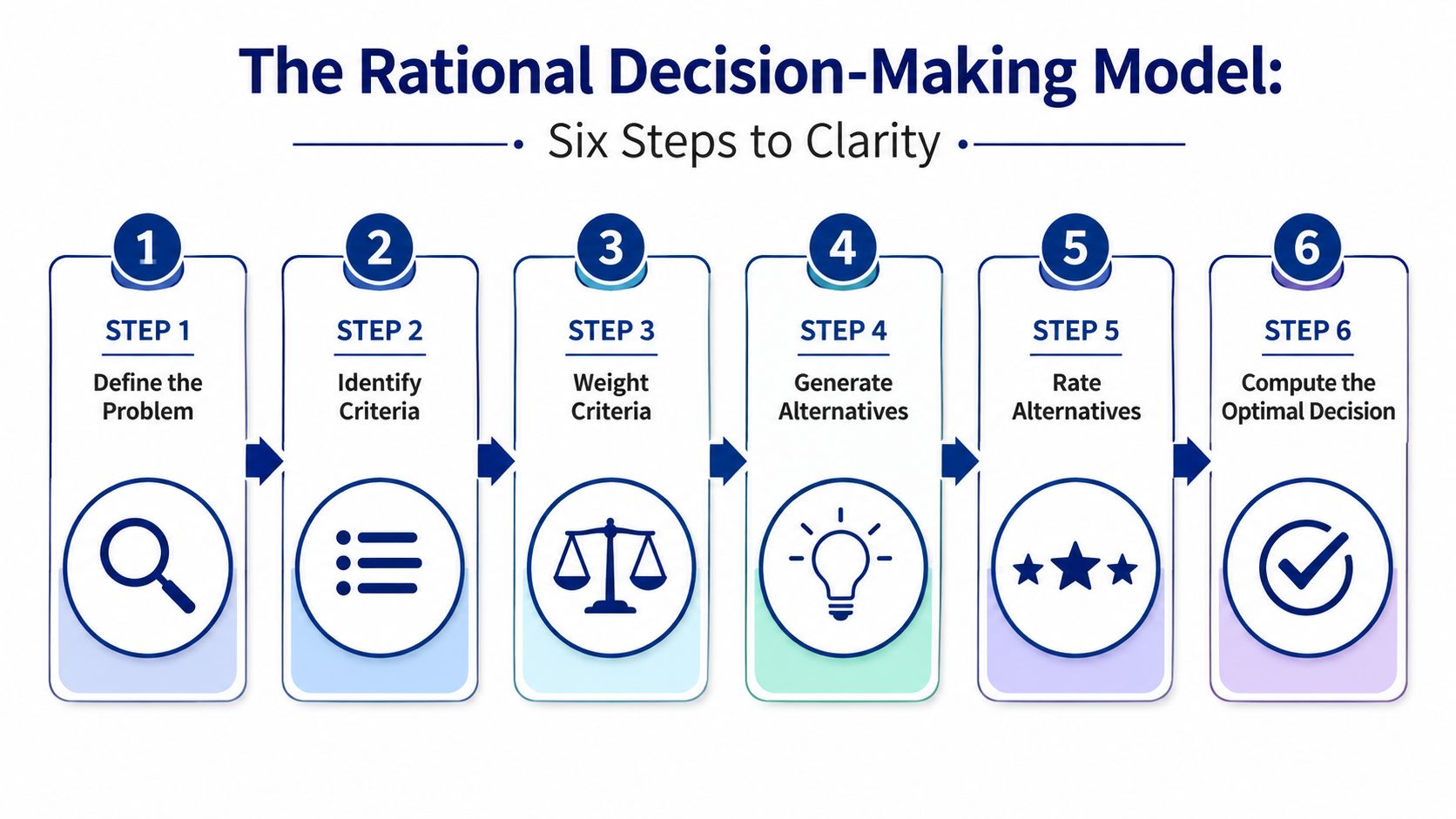
The sequence is straightforward: define the problem, identify decision criteria, weight those criteria, generate alternatives, evaluate each option, and select the best one. In a real HR or operations setting, that means you are not asking, “What does everyone feel?” You are asking, “What are we solving, what matters most, and what can we defend later?”
Here is how that looks in plain language:
A more technical version of this is the Analytic Hierarchy Process, or AHP, which turns judgment into pairwise comparisons across goals, criteria, and alternatives. Used well, that helps leaders think through competing factors like risk, cost, and strategic impact without pretending every factor has the same importance. It is especially useful when people are debating in vague terms and need a disciplined way to convert opinions into a decision structure.
If the criteria step is missing, the decision is already sloppy.
A paste-ready prompt for a decision memo works well here. Use this structure: Problem, Criteria, Options, Risks, Recommendation, Review Date. If a leader can't fill that in clearly, the issue is not ready for sign-off.
For business owners and HR teams, the value of the rational model is not theory. It is that the model forces you to name the tradeoffs before someone tries to rewrite them after the fact.
The wrong question is, “Which model is best?” The better question is, “What kind of problem is this?” If the issue is clear, high stakes, and likely to be reviewed later, a rational pass is the right starting point. If the issue is moving fast and the leader has real experience in that exact pattern, a recognition-primed or OODA approach may be enough to get moving.
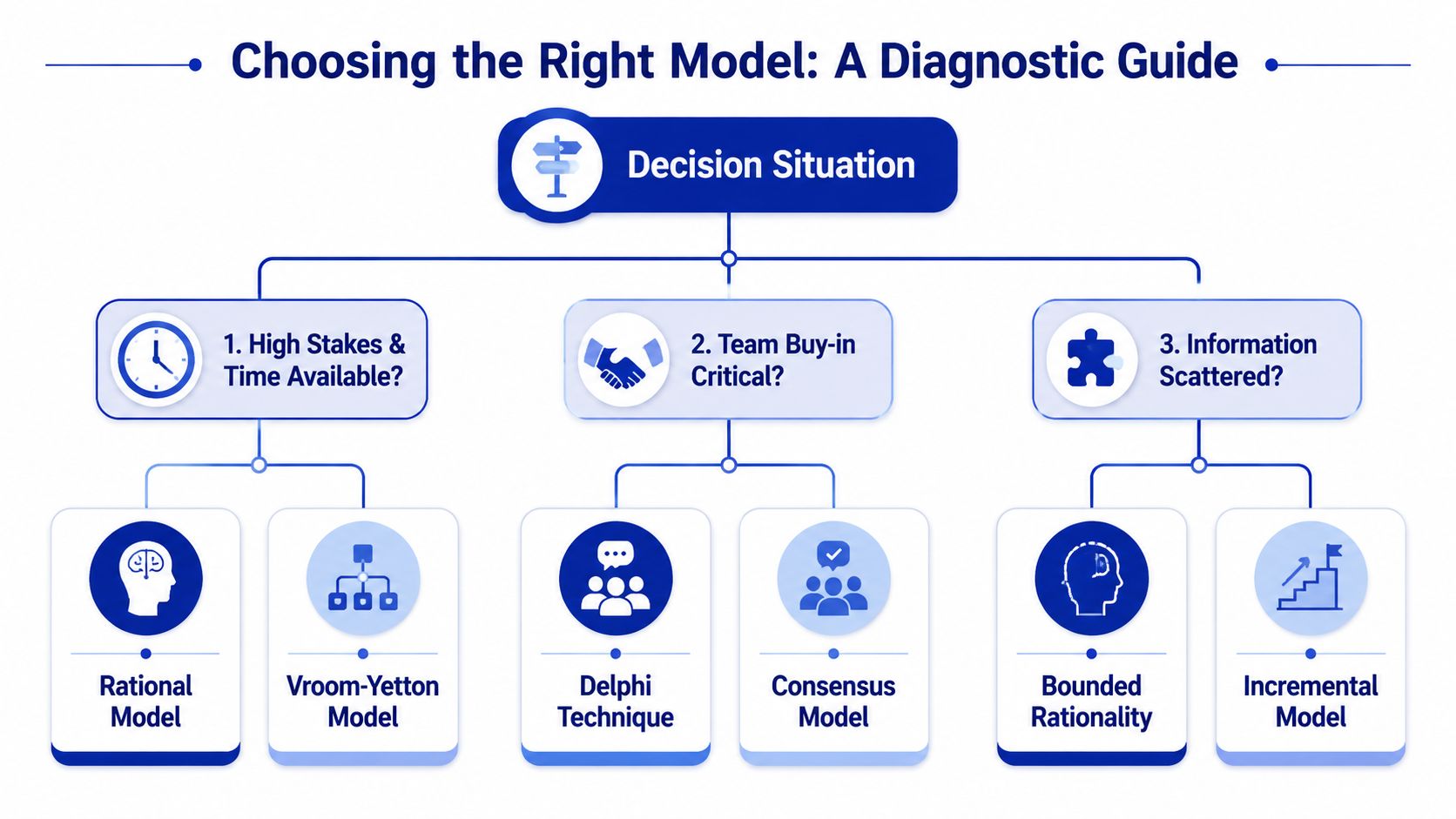
Start with five questions.
That creates a practical rule. Well-defined problem plus high stakes plus defensibility required equals rational with weighted criteria. Familiar pattern plus experienced leader plus time pressure equals recognition-primed. Fast-changing situation plus need for rapid adjustment equals OODA. Ambiguous situation plus unclear domain equals Cynefin. Need to calibrate team involvement equals Vroom-Yetton-Jago.
The point is not to memorize labels. The point is to stop defaulting to one leadership style for every issue. A good COO does not make a termination decision the same way they make a vendor choice, and they should not. The cost of getting that wrong is too high.
A manager brings you a termination recommendation after an internal investigation. The employee works in a multi-state environment, the complaint has already created tension, and someone has raised the possibility of EEOC scrutiny. This is the kind of decision where leaders often rush to the outcome before the file is ready.
The rational model forces discipline first. You define the problem, list the criteria, review the evidence, compare alternatives, and then decide. That matters because the final call is not just about whether the manager is frustrated or whether the team wants closure. It is about whether the organization can defend the reason, the process, and the consistency of the outcome later.
The recognition-primed model looks different. An experienced COO or HR leader may see the pattern quickly, recognize the risk profile, and know which facts still need to be checked before moving. That can save time, but only if the leader has handled enough similar cases to trust the pattern. If not, recognition-primed thinking becomes a shortcut straight into a bad decision.
The OODA loop is useful when the investigation is still active and new facts keep arriving. Observe what is known, orient to the facts, decide on the next step, and act. Then repeat. The danger is getting stuck in orient mode while everyone waits for perfect certainty. In people decisions, that delay often creates its own damage.
A simplified Vroom-Yetton-Jago path helps with participation. The leader asks whether decision quality matters more than speed, whether team commitment is essential, and whether conflict is likely if the call is made without input. In a termination case, that usually means the manager, HR, and sometimes legal need input, but the final call still needs one owner. For a practical companion on process discipline, termination checklist is the sort of reference I'd keep close.
What changes across the four models is not just the answer. It is the sequence, the level of consultation, and the amount of documentation required. That is why a serious employment decision should never be made as a casual conversation and then written up afterward.
Defensible decisions leave a trail. That trail should be clear enough for an EEOC investigator, plaintiff counsel, or an outside auditor to follow without guessing at what happened. If the file reads like a memory dump, the process was too loose.
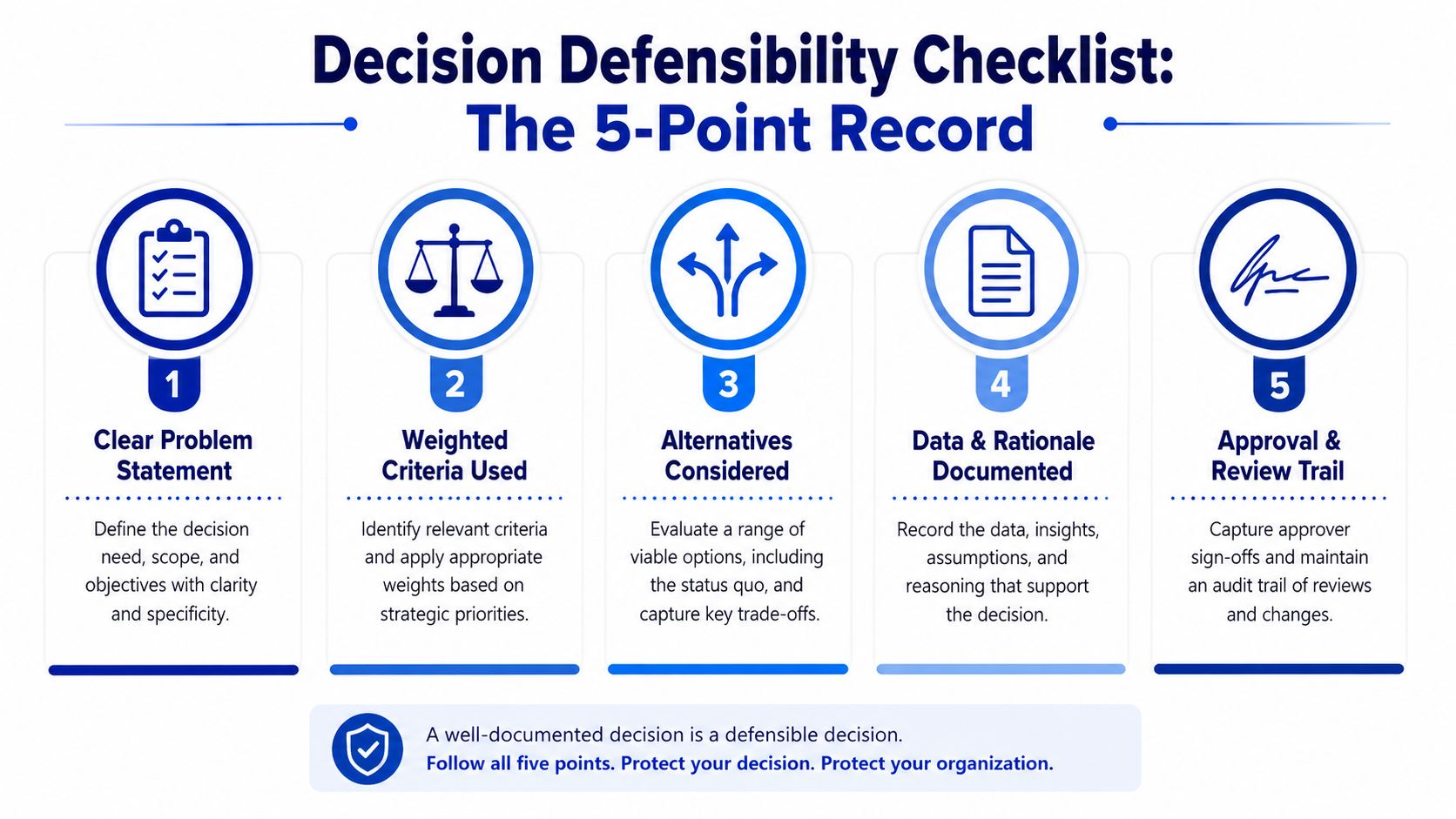
Use this structure every time:
The biggest gaps are predictable. Decisions made only in chat threads. Retrospective rationales written after the action is already done. Unsigned approvals. Missing dates. Vague references to “fit” or “trust” with no supporting context. Those gaps are not harmless administrative sloppiness. They make the organization look improvised.
A simple template is enough if it is used consistently:
Decision subject.
Facts reviewed.
Criteria applied.
Options considered.
Decision owner.
Date of decision.
Follow-up or review date.
A defensible file is usually boring. That's the point.
For SMB leaders, the goal is not paperwork for its own sake. It is a record that shows the organization acted with structure, not impulse. That protects the business when someone asks why the same standard was, or wasn't, applied in a later case.
Models help with one decision. Governance keeps a hundred decisions from drifting in different directions. That matters when the business grows across states and every new leader wants to bring their own style into the room.
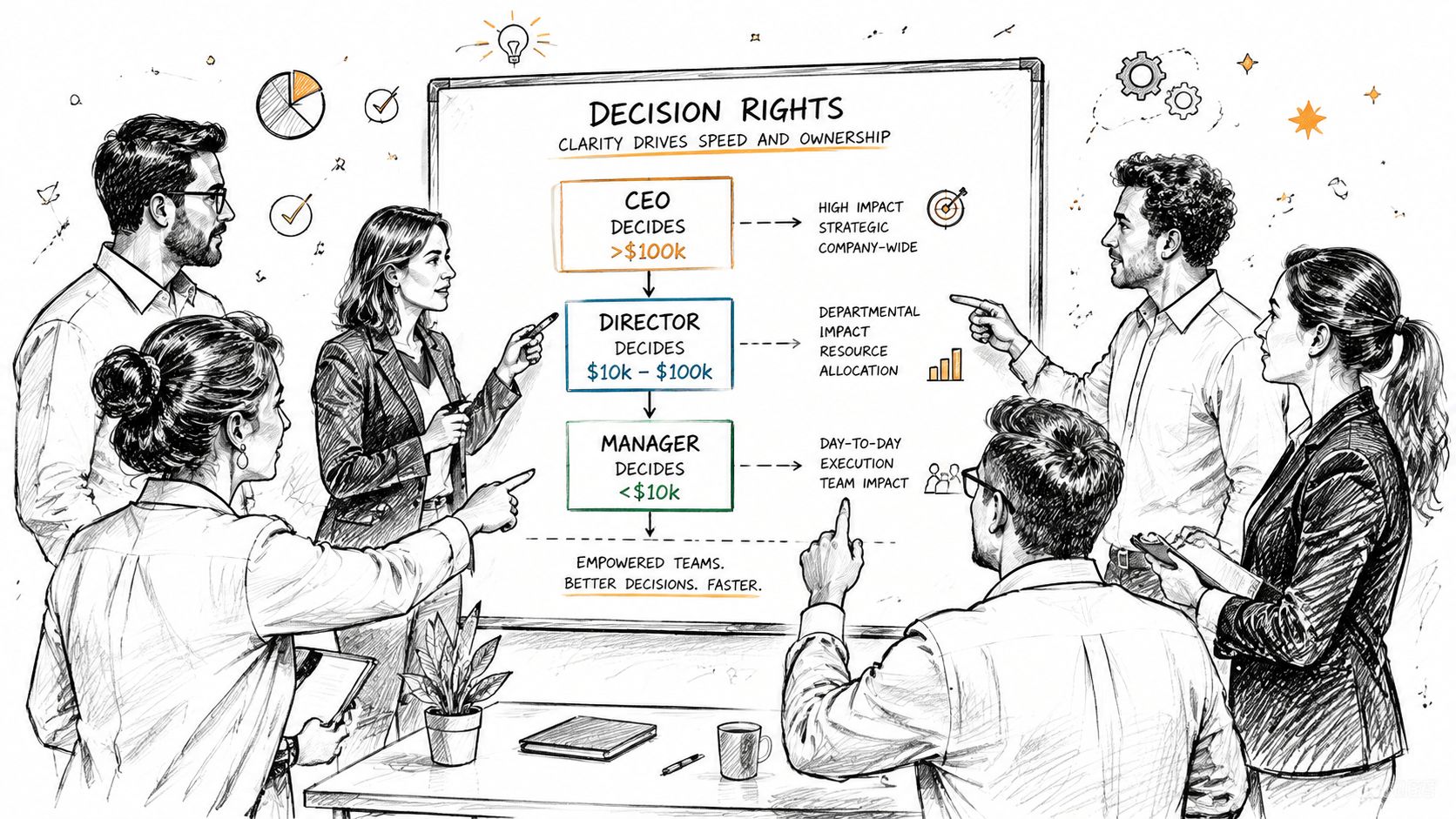
The first habit is decision rights. Define who can decide, who must consult, and when an issue has to move up the chain. The second is escalation triggers, because some matters should not stay local once risk, inconsistency, or conflict crosses a threshold. The third is a decision log, separate from performance reviews, so the business can see patterns without turning every judgment into a personnel issue.
A short cadence works well. Review the hardest decisions regularly, look for inconsistency, and update the rules before the next problem lands. If the process only gets attention after a crisis, it is already too late.
Paradigm International Inc. fits into this kind of work as an advisory option for leadership teams that need help with decision structure, employment risk, and defensible HR practices. For a broader governance lens, HR governance framework is worth reviewing if your team keeps revisiting the same kinds of calls.
When leadership turnover is common, the process has to outlast the person in the chair. That is the whole reason governance exists.
How fast should a termination decision be made? Fast enough to stop the damage, but not so fast that the file is thin and the reasoning is weak. If the facts are incomplete, pause long enough to document what you know and what you still need.
When should you escalate instead of deciding locally? Escalate when the issue crosses state lines, raises retaliation concerns, or creates inconsistency with past cases. Local leaders can handle routine issues, but high-risk calls need a clearer chain.
What if the CEO and HR director disagree? The decision should not be a popularity contest. Re-center on the criteria, the evidence, and the authority level, then force the disagreement into the record.
When should outside counsel or an HR advisor be involved? Pull them in when the facts are disputed, the exposure is material, or the precedent could affect future cases. That is not hesitation, it is risk control.
Paradigm International Inc. helps SMB leadership teams handle high-stakes people decisions with structure, defensibility, and consistency. If your organization needs help applying leadership decision making models to terminations, investigations, or multi-state HR risk, visit Paradigm International Inc. and start the conversation with a team that works in the messy middle where judgment has to hold up later.