

You're not asking a vocabulary question. You're dealing with a real people decision, maybe a misconduct issue, a failing manager, or a team that's starting to drift because the founder is still trying to carry everything through charisma alone. That's where leadership vs managing stops being an academic debate and starts becoming a risk issue.
If you get the distinction wrong, you end up coaching when you should be documenting, inspiring when you should be escalating, or relying on goodwill when defensibility is what you need. For growing SMBs, that mistake gets expensive fast. A leadership team that knows when to switch modes makes better people decisions, protects the business, and keeps growth from turning into chaos.
| Area | Leadership | Managing |
|---|---|---|
| Core purpose | Set direction and align people | Execute work consistently and control outcomes |
| Time horizon | Future-focused | Present-focused |
| Main question | What should change? | How do we make it happen reliably? |
| Best use | Strategy, change, alignment | Staffing, budgets, schedules, standards |
| Success measure | Clarity, trust, movement | Compliance, output, consistency |
A founder calls an employee into a room after a complaint surfaces. The instinct is to rally the team, protect morale, and “handle it like a leader.” That instinct is understandable, but it's the wrong first move if the issue involves repeated misconduct, policy violations, or legal exposure.
That's the trap. Leadership feels human, and managing feels procedural, so executives often delay the procedural response because they don't want to look cold. But when the facts need to be documented, the business needs control, not inspiration.
The historical split matters here. Management became formalized as organizations scaled during the industrial era, while leadership became associated with setting direction and aligning people through uncertainty, according to BMJ Leader. Those are different jobs, and in a growing business they solve different problems.
A multi-state SMB feels that difference more sharply because inconsistency gets more expensive as headcount, locations, and compliance obligations expand. The same source notes that companies with strong management practices see 30% to 50% higher profits BMJ Leader. That's not a morale metric, it's a business case for disciplined execution.
Practical rule: If the issue can create legal, financial, or reputational exposure, don't start with inspiration. Start with control, documentation, and escalation.
The confusion also hurts managers on the ground. When senior leaders expect every people issue to be solved with vision and encouragement, frontline managers get mixed signals about when to coach and when to formalize. That's how bad behavior lingers, weak documentation spreads, and accountability becomes optional.
A manager walks into a review meeting with late deliverables, missing documentation, and a team that is starting to improvise around the process. A leader walks in with a clear direction, but if the work still needs to be tracked, corrected, and defended, inspiration alone will not hold the line. That is the point where executives need to stop using the words interchangeably.
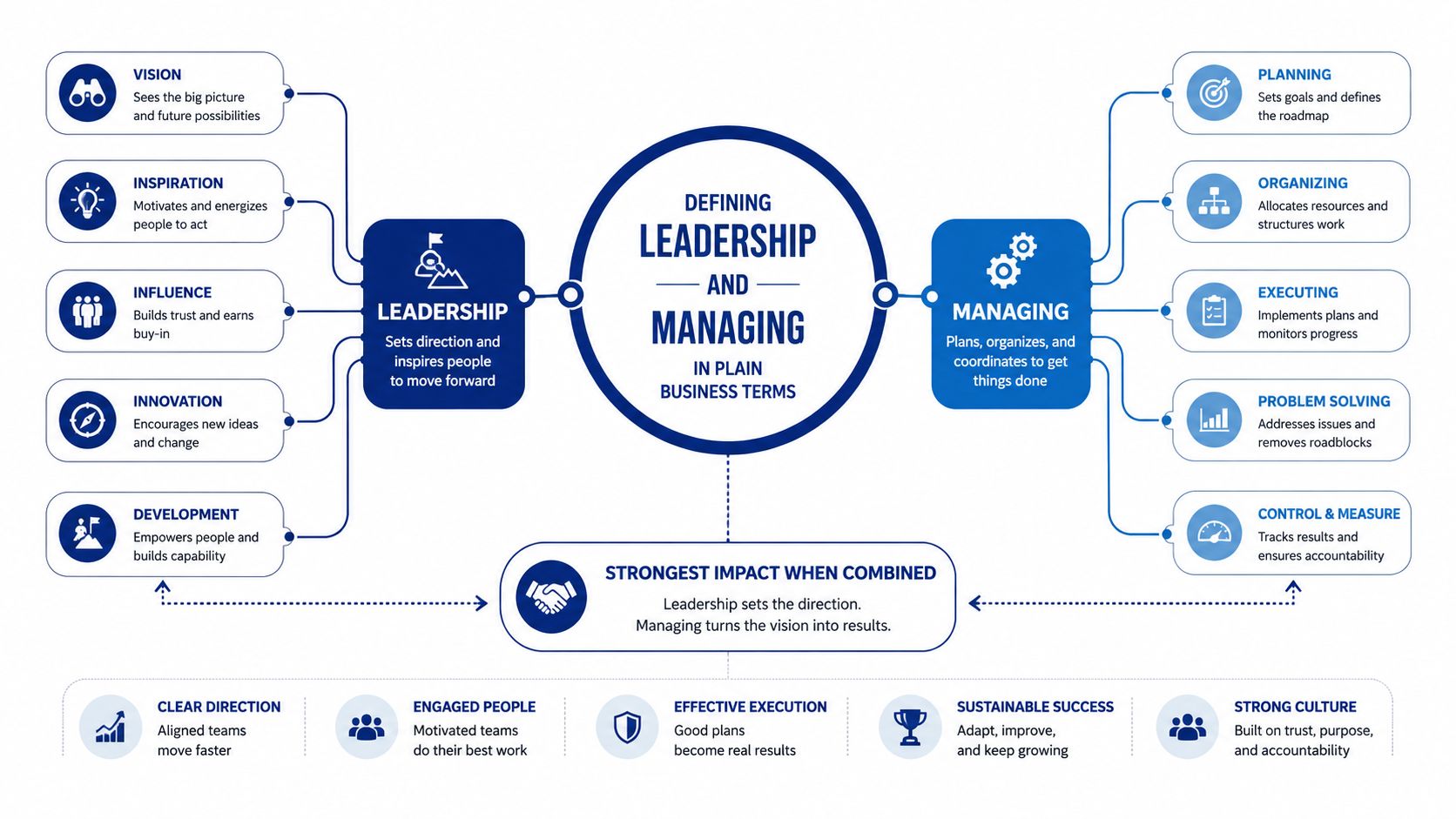
Leadership is direction, alignment, and change. It answers where the business is going, why the change matters, and how people should move with it. Harvard Business School Online frames leadership as setting a direction and inspiring people, while Harvard's Program on Negotiation describes it as direction versus execution HBS Online, Harvard PON.
Managing is execution, consistency, and control. The University of North Florida defines management as handling complexity through planning, budgeting, organizing, staffing, and problem-solving for short-term objectives UNF. In business terms, managing is how strategy becomes repeatable work.
That split is practical, not theoretical. Leadership pushes people through uncertainty. Managing keeps the work reliable when growth adds complexity and risk.
The old shortcut, “leaders inspire and managers execute,” is useful only if you treat it as a division of labor, not a personality test. A business needs both functions in the same room, and it needs clear judgment about which one comes first when people decisions get messy.
Management is also easier to score because it sits close to the work. Operational KPIs like budget performance, productivity, schedule adherence, quality, and efficiency are the common benchmarks for managing because they are immediate and quantifiable LinkedIn post summarizing management KPIs. That does not make management more important, it makes it harder to hide.
Direction tells people where to go. Execution makes sure they get there.
The cleanest executive test is simple. If the question is “what should change,” you are in leadership mode. If the question is “what steps, standards, and controls will make this real,” you are in managing mode.
Walk into a team meeting and watch who frames the agenda, who tracks the follow-through, and who steps in when the discussion gets fuzzy. That is where the distinction shows up. Job titles do not tell you much. Behavior does.
A leader speaks in outcomes, direction, and trade-offs. A manager speaks in tasks, sequence, owners, and follow-through. One role is not superior to the other, but a senior team needs both on purpose, not by accident.
A simple way to read the room is to watch what someone does under pressure. If they widen the conversation, test assumptions, and push people toward a decision, they are acting in leadership mode. If they tighten the work, assign responsibilities, and make sure the next step is clear, they are acting in management mode. That split gives you a practical lens for observing behavior in meetings and during difficult decisions.
| Behavior | Leader Mode | Manager Mode |
|---|---|---|
| Decision posture | Sets direction and weighs change | Chooses the next executable step |
| Time horizon | Thinks ahead and frames the future | Focuses on short-term delivery |
| Communication style | Aligns, motivates, and explains why | Directs, clarifies, and assigns who does what |
| Accountability approach | Creates commitment and ownership | Tracks performance and follows standards |
| Response to ambiguity | Reduces uncertainty with vision | Reduces uncertainty with process |
| Response to routine | Keeps attention on change and priority | Keeps work steady and repeatable |
A weak leader gets vague when facts turn uncomfortable. A weak manager gets rigid about process and misses the human side of execution. The strong version of each role knows its lane and respects the other one.
The day-to-day execution layer is where employee trust is either earned or lost.
Use this test when you are reviewing your own direct reports. If they can rally the room but cannot enforce standards, they are not ready for full people leadership. If they can run a schedule but cannot explain priorities or coach behavior, they are not ready for broader responsibility. That is the point where judgment becomes a people-risk decision, not a style preference.
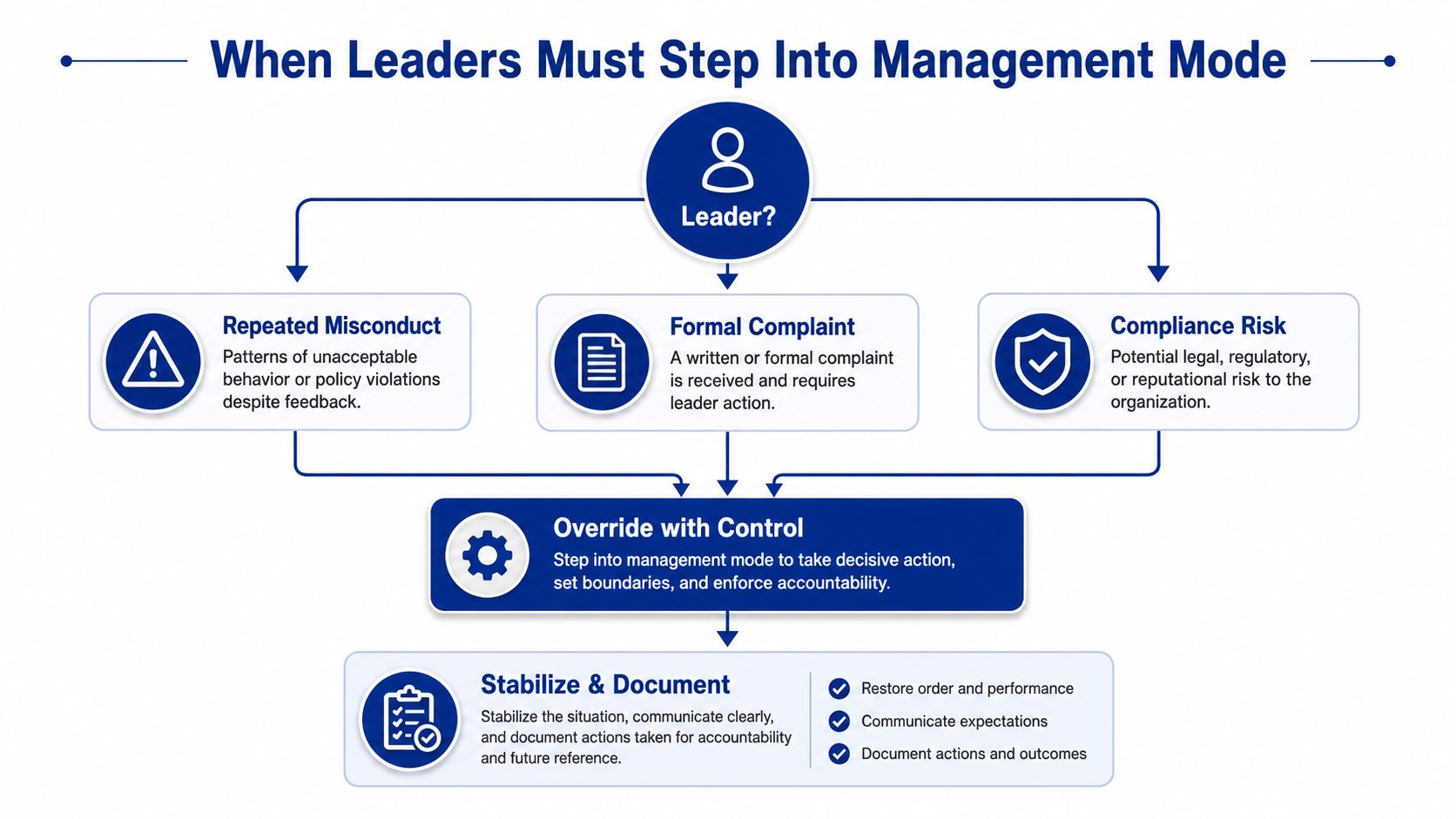
A team can run on inspiration for a while. The moment the same misconduct keeps returning, the leader has a different job. That job is to move from coaching language to documented control.
Repeated misconduct is the clearest trigger. If the same behavior resurfaces after coaching, alignment has already failed. At that point, keep the standard in writing, set a clear timeline, and record the consequences if the behavior continues. Fairness, safety, and trust are no longer abstract concerns, they become the reason to switch modes.
Complaint investigations demand the same discipline. A leader may want to protect relationships, but a complaint changes the priority to defensibility. The process needs facts, consistency, and a clean record. Skip informal side deals. They weaken the case and create uneven treatment.
The Daniels College blog notes that leadership and management overlap in practice, which is exactly why leaders need clear trigger points for shifting from coaching to documented control. That is the gap many businesses leave open. They understand the theory, but they never define the switch.
Defensibility is the lens that matters once the switch happens. The questions change fast. What did we know, when did we know it, who acted, what was documented, and what escalation path was used? Those are the questions that decide a termination, an investigation, or a multi-state compliance issue.
If you underinvest in management rigor, your leadership claims stop sounding credible. A senior team can talk about culture all day, but if the managers can't document, follow through, or handle a hard conversation, the business is still exposed. MIT Sloan has argued that organizations often over-focus on leadership and underinvest in the routines and controls that sustain performance, and that's exactly the gap you need to close in a growing SMB.
Pick managers who can hold a standard without becoming rigid. You want people who can explain expectations, document deviations, and keep calm when pressure rises. If you're screening candidates, interview preparation for aspiring managers is a useful resource for shaping the kinds of questions that expose whether someone can manage, not just talk about leading.
Don't force managers to invent scripts during conflict. Use clear language such as, “This behavior has come up more than once, and it's now a performance issue,” or “I'm documenting this because the pattern needs to change.” That wording is direct, fair, and defensible.
For a more structured approach to accountability, you can also reduce employment risk with accountability using this internal guide. The point is not to add bureaucracy. The point is to make sure standards are visible before a dispute turns into a problem.
Paradigm International Inc. helps leadership teams manage high-stakes people decisions, including investigations, terminations, manager conduct, documentation standards, and multi-state compliance considerations. If the business is growing faster than its people systems, that advisory layer matters more than another motivational speech.
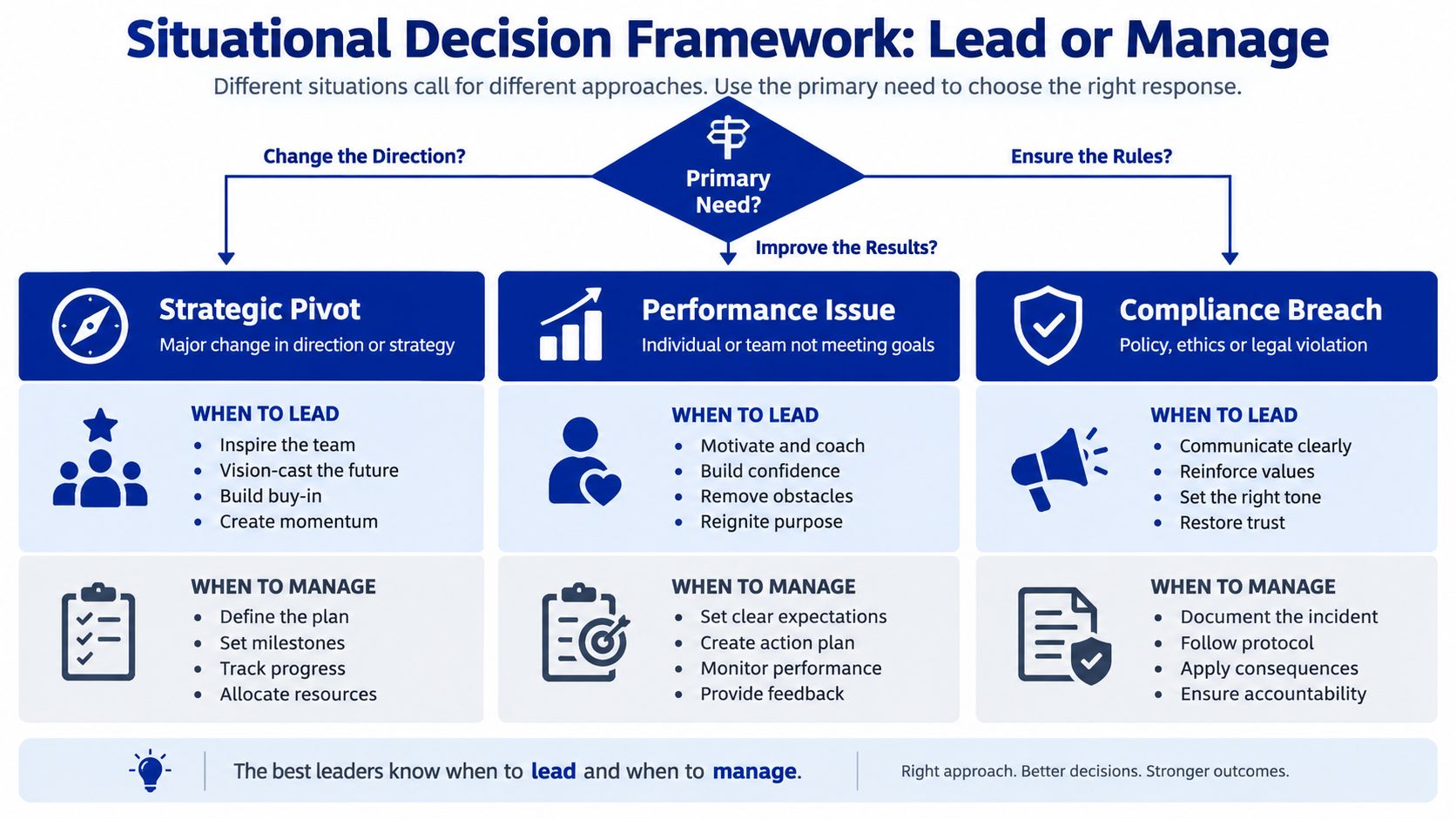
A product launch deadline is approaching and the team still cannot agree on priorities. That calls for leadership first. People need a clear direction, a reason to commit, and a shared picture of what good looks like before execution can tighten up.
A strategic pivot needs the same treatment. State the new direction, explain why the business is changing, and show how each team's work fits the shift. Once that is clear, management takes over and turns the message into owners, deadlines, and operating rhythms.
A performance issue needs a different response. If the problem is confusion or misalignment, start with leadership and reset the expectation. If the problem is repeated underperformance or ignored direction, switch into management mode and put the issue in writing.
Compliance is even less forgiving. A complaint, misconduct issue, or policy breach requires a procedural response from the start. Document the facts, follow the process, and keep the handling consistent. That is not a lack of leadership. It is the discipline that makes leadership defensible.
The useful question is simpler. When does your team need movement, and when do they need control?
For a deeper lens on how executives can think through those switch points, see these leadership decision making models. The value is in giving your team a repeatable way to decide what posture the situation requires.
Use the first 30 days to create a one-page expectation document for executives and people managers. It should define when the business wants leadership behaviors, when it expects management behaviors, and what trigger forces the shift. That document doesn't need to be long, it needs to be usable.
Measure success by whether the leadership team can explain the switch without improvising. If they can't, they're not aligned yet.
At this stage, the question is whether managers can carry the execution layer without getting lost in tone or conflict avoidance. If they can, people risk starts to shrink.
If you're weighing the cost of hiring an HR consultant, review this cost guide against the risk of staying reactive. In many SMBs, the actual cost isn't advisory support, it's the exposure that comes from waiting too long to get the structure right.
International Inc. works with owners, COOs, and executive teams that need structure, judgment, and defensible HR practices as they grow. If you're facing a high-stakes people decision or trying to tighten the line between leading and managing, visit Paradigm International Inc. to learn how advisory support can help your team move with more clarity and less risk.


