
Managing employee leave requests is far more than an administrative task.Managing employee leave requests is far more than an administrative task. Each request represents a critical moment that tests your company’s compliance, operational readiness, and leadership. For a growing business, a single mishandled leave of absence from work can spiral into serious legal penalties, financial hits, and lasting damage to your reputation. This guide provides business owners and HR leaders with the clarity needed to manage these situations fairly, meet legal duties, and protect the organization from preventable risks.

This guide is designed for the business owners and HR leaders tasked with navigating this complex area. We will walk through everything from the different types of leave to the steps for building a consistent, defensible management process. You will gain the clarity needed to handle requests fairly, meet your duties under federal and state law, and shield your organization from preventable risks.
The aim is to equip you with the practical understanding to act with intention, document everything correctly, and keep your business on a stable footing as it scales. In fact, effective leave management is a core piece of a solid strategic plan for HR that underpins responsible growth.
When an employee needs to take a leave of absence from work, it is easy to view it as just an approved break. For a business, however, the employee remains on your team and potentially your payroll, just not actively working. This simple fact creates ripples that can touch every corner of your operations, from team morale to the bottom line.
These absences are not just abstract HR tasks; they carry real financial and operational weight. Understanding that impact is the first step to managing employee leave proactively instead of simply reacting when a request is made.
The most immediate impact of an employee’s absence is the productivity gap. Work slows down, projects can stall, and customer needs may be delayed. This forces the rest of the team to pick up the slack, which can lead to burnout, a dip in morale, and less focus on their own core responsibilities.
The financial strain also extends beyond lost output. Companies often lean on overtime pay to cover the gaps, which directly inflates labor costs. Additionally, managers and HR staff spend valuable time processing paperwork and coordinating coverage instead of focusing on strategic growth initiatives.
A poorly managed leave of absence does not just disrupt one person's workflow. It creates a domino effect of operational strain, hidden costs, and potential compliance risks that can destabilize a small or mid-sized business.
It is tempting to file employee leave under "HR problems," but the data tells a much bigger story. Rising absenteeism is a direct threat to business stability, especially for smaller companies that operate with leaner teams. This is not a small issue.
In the United States, for example, the national absence rate is 3.2%. This translates into a staggering economic impact of over $225.8 billion each year in lost productivity—costing businesses an average of $1,685 per employee. These statistics highlight the very real risk of unplanned absences.
For leaders, these numbers confirm that absences do not just interrupt operations; they drive up costs, with nearly half of all overtime spent covering these gaps. You can explore additional insights on the state of absence to see the full financial picture. This makes it clear: tracking and managing leave is a core business function tied directly to your financial health and operational strength.
To build a fair and effective leave policy, you must first understand why employees need to step away from work. While the reasons vary, they typically fall into a few key categories that every business leader should be familiar with.
Each of these situations calls for a sensitive and consistent approach. By recognizing the legitimacy of these needs and setting clear guidelines, you can manage a leave of absence from work with both compassion and predictability. If your organization is struggling to balance these operational demands with compliance duties, expert guidance can provide clarity. Contact our team to discuss your HR risk management strategy.

When an employee requests a leave of absence from work, a thoughtful policy is a great start. However, that policy must also be legally compliant. For any business owner or HR leader, solid compliance is the foundation that avoids costly legal battles and protects your organization from risk.
These laws are not mere suggestions. They form a complex web of federal and state mandates dictating who gets leave, for how long, and under what specific conditions. Getting it wrong can lead to steep penalties, making a firm grasp of the basics a business necessity.
Two major federal laws form the bedrock of most employee leave rights in the U.S.: the Family and Medical Leave Act (FMLA) and the Americans with Disabilities Act (ADA). While both often relate to an employee’s health, they function in different ways. Understanding that difference is critical for managing leave correctly.
The Family and Medical Leave Act (FMLA) gives eligible employees unpaid, job-protected leave for specific family and medical situations. It provides up to 12 weeks of leave within a 12-month period and ensures their group health benefits are maintained while they are away.
Think of FMLA as a structured framework with clear, defined rules. It covers specific events—like a serious health condition or bonding with a new child—and creates a clear pathway for job-protected time off.
The Americans with Disabilities Act (ADA), on the other hand, is about providing equal opportunity. It requires employers to offer "reasonable accommodations" to qualified employees with disabilities. In some cases, a leave of absence can be that reasonable accommodation, even if the employee does not qualify for FMLA. A deeper look into these requirements is essential, including understanding employee rights under FMLA.
Sorting through FMLA, the ADA, and your own company policies can get confusing. The key is to understand their distinct roles and rules. This table breaks down the main differences.
| Leave Type | Primary Purpose | Eligibility Requirements | Job Protection Status |
|---|---|---|---|
| FMLA Leave | To provide job-protected time off for specific family and medical reasons, like a serious illness or birth of a child. | Based on employee tenure (12 months) and hours worked (1,250 hours) with a covered employer (50+ employees). | Guaranteed; employees must be restored to their original job or an equivalent one upon return. |
| ADA Accommodation Leave | To provide a reasonable accommodation for a qualified employee with a disability so they can perform essential job functions. | Based on the employee having a defined disability and the leave not causing "undue hardship" on the business. | Not guaranteed, but termination could be discriminatory if the leave is a reasonable accommodation. |
| Company Policy Leave | To offer discretionary leave for situations not covered by law, such as personal development or extended travel. | Determined entirely by the company's internal policy, which must be applied consistently. | No legal requirement for job protection unless stated in the company policy or an employment contract. |
It is crucial to understand how these laws interact. For example, an employee might exhaust all their FMLA leave but still be entitled to more time off as a reasonable accommodation under the ADA. As we cover in our guide on leave of absence versus FMLA, these situations are where compliance becomes truly complex.
For businesses that operate in more than one state, the legal landscape becomes even more complex. Federal laws create a floor, not a ceiling. Many states have passed their own leave laws that offer more generous benefits than FMLA.
These state-specific laws might include paid family and medical leave (PFML) funded by payroll taxes, have lower employee thresholds for an employer to be covered, or expand the definition of a "family member." This creates a patchwork of overlapping rules that you must manage carefully. The policy that works for your team in Texas almost certainly will not be compliant for your team in California.
A strong, defensible strategy is one that can adapt to local rules while maintaining a consistent core approach. This is the best way to protect your business from compliance gaps that arise when you apply a one-size-fits-all policy across different states.
When an employee requests extended time off, your first responsibility is to determine exactly what kind of request you are handling. A request for a three-month sabbatical is worlds apart from an urgent need to care for a sick parent. Correctly categorizing the request is the crucial first step to applying the right policies and meeting your legal duties.
Each type of leave is sparked by a different life event and comes with its own set of rules. Some are protected by federal or state law, while others are granted at your company's discretion. Being able to distinguish between them is a critical skill for any leader, as it dictates everything that comes next.
This is likely the leave request you will encounter most often. Medical leave is for when an employee has a "serious health condition" that prevents them from performing their job. This typically involves situations like inpatient care, being unable to work for more than three consecutive days while receiving medical treatment, or chronic conditions requiring ongoing attention.
The FMLA provides the legal backbone for this type of leave, giving eligible employees job protection while they recover. For a deeper look at the specific requirements, our article on what is medical leave offers detailed insights. This is a legally protected area, so handling these requests with precision is non-negotiable.
Parental leave is another legally protected category, created to give employees time to bond with a new child. This applies equally to mothers and fathers and covers birth, adoption, and the placement of a child through foster care. Like medical leave, the FMLA often governs this process, providing up to 12 weeks of job-protected time away from work.
Key triggers for parental leave include:
In addition to federal law, many states are implementing their own paid parental leave programs, which can run concurrently with FMLA. It is vital to understand both the federal and state rules that apply to your team.
A significant and growing number of employees are needing time off for mental health reasons. Burnout, anxiety, and depression are forcing employees to step away to recover, making this a leading driver of leave requests. This type of leave requires extra sensitivity and a firm grasp of your legal duties under both the FMLA and the Americans with Disabilities Act (ADA).
Recent data reveals that mental health-related leaves now make up 11% of all leaves of absence. This represents a 22% increase in just one year and a massive 300% increase since 2017. As this issue continues to grow, you can learn more about the data behind rising mental health leaves and what it means for businesses.
A mental health condition can qualify as a "serious health condition" under FMLA, granting the employee job protection. It may also be considered a disability under the ADA, making a leave of absence a potential reasonable accommodation.
Finally, there are leaves that fall outside of any legal mandate. A personal leave of absence is granted entirely based on your company's policy. These are completely discretionary and can cover a wide range of situations.
Common reasons for a discretionary personal leave might include:
Because these leaves are not required by law, you have much more control over the terms. However, your policy must be crystal clear, and you must apply it consistently to every employee to avoid claims of unfairness or discrimination.
Improvising when a leave of absence request arrives is a surefire way to create inconsistency, which can easily lead to claims of unfairness and legal trouble. The best defense is a repeatable, structured process. This playbook guides you in crafting a solid policy and a clear procedure to ensure every request is handled fairly, consistently, and with legal precision.
This is not just about avoiding legal trouble; it is about building a predictable workflow. It gives your managers a clear path to follow, from the moment an employee asks for time off to the day they successfully return. A great playbook protects your company and shows your team you are committed to transparency and fairness.
Think of your leave of absence policy as the constitution for your entire process. It must be written in simple, clear language that both employees and managers can easily understand. Vague language creates loopholes and invites confusion, so your goal should be absolute clarity.
A comprehensive policy should always have these fundamental components:
This decision tree shows how a structured process helps you quickly classify and manage incoming leave requests, ensuring legal and policy-based paths are followed correctly.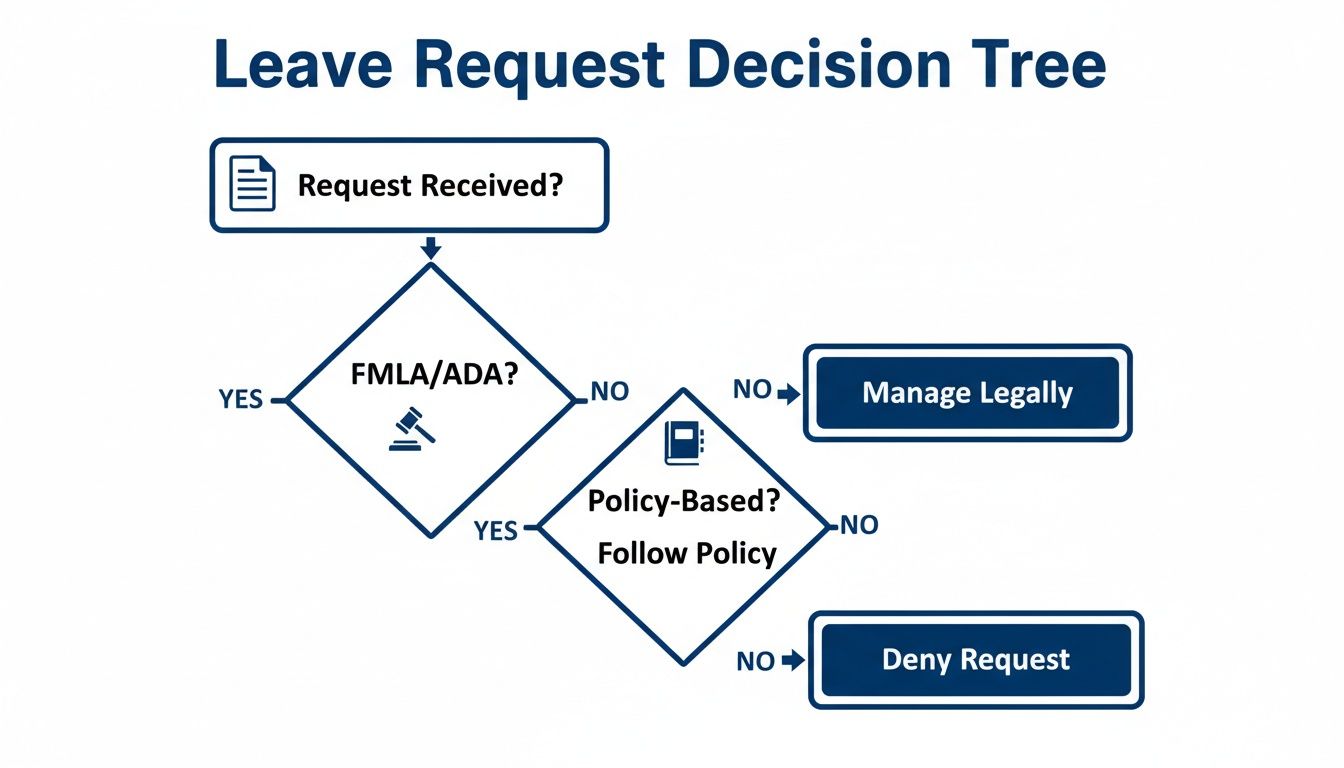
This visual highlights a key first step for any manager or HR professional: determine immediately if a request falls under a law like FMLA or if it is handled purely by your internal company policy.
When it comes to any leave-related dispute, your documentation is your most important line of defense. Your records must be thorough, consistent, and kept secure. Good paperwork is your proof that you followed a fair process and met all your legal obligations.
Adopt these best practices to ensure your documentation is airtight:
A crucial part of any strong leave management playbook is handling an employee's return to work. Including clear procedures, like a guide to Fitness to Work Assessments for Employers, ensures a safe and productive return, minimizing risk for both the employee and your business.
For any business operating in more than one state, a one-size-fits-all policy is a compliance minefield. While federal law provides a baseline, state and local laws often impose additional requirements. Your playbook must be flexible enough to accommodate these differences.
For example, U.S. firms see an average absence rate of 3.2%, which costs the economy an estimated $225 billion annually. For a growing multi-state business, ignoring these benchmarks and failing to standardize processes based on varying state laws can lead to significant financial consequences.
Your core leave policy should act as a "floor," setting the minimum standard for the entire company. Then, create state-specific addendums that address more generous local requirements for eligibility, duration, or pay.
This hybrid approach allows you to maintain a consistent company-wide philosophy while ensuring you are fully compliant everywhere you operate. It strikes the right balance between a unified culture and the complex reality of fragmented state laws. Building this playbook may seem like a significant upfront effort, but it pays for itself by reducing risk, guaranteeing fairness, and giving your leadership team confidence.
Viewing a leave of absence from work as just another administrative chore is a common and costly mistake. It is a core leadership function. When you shift from simply reacting to leave requests to building a proactive, structured system, you dramatically lower your company's risk of legal trouble, financial penalties, and operational chaos.
This is not about pushing paper; it is about creating a framework that protects the business while treating your employees with fairness and respect. A clear policy, consistent procedures, and a solid understanding of your legal duties are the foundations of a strategy that holds up under scrutiny. This approach not only protects your business but also helps build a transparent, fair culture for everyone on your team.
A structured approach to leave management turns a high-risk compliance headache into an opportunity to build trust, demonstrate your company values, and create long-term stability.
As your business grows, the situations you face will only become more complex. Having a trusted partner to help you navigate these high-stakes decisions can make all the difference. Being proactive about leave management is a direct investment in your company’s health and a clear sign of responsible leadership.
If you are ready to strengthen your HR practices and build a more resilient organization, our team is here to help you handle these challenges with confidence. Find the expert guidance you need by connecting with us today.
Navigating the complexities of a leave of absence from work often raises critical questions, even for experienced business owners and HR leaders. Getting the answers right is paramount, as consistency and legal accuracy protect your business from significant risk. This section addresses some of the most pressing questions we hear from leadership teams.
Whether you can deny a request depends entirely on the reason for the leave and which laws apply. If an employee is eligible for job-protected leave under a law like the FMLA or a state equivalent, you cannot legally deny the request, provided they submit proper certification. A leave of absence might also be a required reasonable accommodation under the ADA.
For requests not covered by law, such as an extended personal trip, the decision is up to your internal company policy. The key is to apply your policy consistently to every employee. An inconsistent denial can create more legal risk from discrimination claims than the leave itself ever would.
While you should request documentation to verify the need for medical leave, the law sets strict boundaries on what you can ask. Under the FMLA, you can require a healthcare provider to certify the condition’s start date, its expected duration, and a statement confirming the employee cannot perform their job functions.
You are prohibited from asking for a specific medical diagnosis or attempting to access an employee’s private medical records. Your goal is simply to verify the leave entitlement, not to violate privacy rights protected by laws like the ADA.
The safest way to gather this information is by using the official FMLA certification forms from the Department of Labor. This practice ensures you get what you need to make a decision while staying well within legal boundaries.
How—or if—an employee is paid is determined by a combination of federal law, state law, and your company policies. FMLA leave itself is unpaid. However, your policy can require (or an employee can choose) to use their accrued paid time off, like vacation or sick days, to receive a paycheck while they are out.
Some states now have Paid Family and Medical Leave (PFML) laws that provide wage replacement through state-administered insurance programs. For any leave not covered by FMLA or state PFML, pay is dictated entirely by your established policy. It is crucial that your employee handbook clearly outlines all rules on pay and benefits continuation.
When an employee returns from a job-protected leave like FMLA, you are legally required to reinstate them to their original job or an "equivalent" one. An equivalent position must have the same pay, benefits, shift, and fundamentally similar responsibilities. You cannot penalize an employee in any way for taking protected leave.
You can require a fitness-for-duty certification stating they can safely resume their duties, but only if this is a uniformly applied policy for similar situations. A well-managed return-to-work process, complete with clear communication and a reintegration plan, is the final, critical step in managing a leave of absence from work both effectively and compliantly.
Managing a leave of absence from work correctly is vital for maintaining a stable and legally sound workplace. The team at Paradigm International Inc. specializes in helping leaders navigate these high-stakes decisions with confidence. If you need expert guidance to reinforce your HR practices, we are here to help. For readers looking to learn more about creating a compliant and effective HR framework, additional insights are always available.
Start building a more defensible HR framework by connecting with us today.