Understanding the difference between a general leave of absence and FMLA is not just a matter of good HR practice—it's a critical compliance issue for any business. The distinction is straightforward but vital: FMLA is a federally mandated, job-protected leave, while a general leave of absence is an optional benefit defined by your company's own policies. Confusing the two can expose your business to significant legal and financial risk, making clarity on this topic essential for every business owner and HR leader.
When an employee requests time off for a family or medical issue, you must know whether you are dealing with a legal obligation or a discretionary policy. The Family and Medical Leave Act (FMLA) is a federal law, not a company perk. It requires covered employers to provide eligible employees with up to 12 weeks of unpaid, job-protected leave for specific, qualifying reasons.
A general leave of absence, on the other hand, is entirely at your discretion. This type of leave might be granted for situations not covered by FMLA, such as an educational sabbatical or other personal needs. Since it is not federally protected, you set the rules for eligibility, duration, and whether the employee’s job will be secure upon their return. In short, one is a legal right, and the other is a privilege you extend.
Here is a high-level look at how these two types of leave compare.
This table highlights the fundamental difference: FMLA is a rigid legal framework, while a general leave is a flexible, policy-driven benefit.
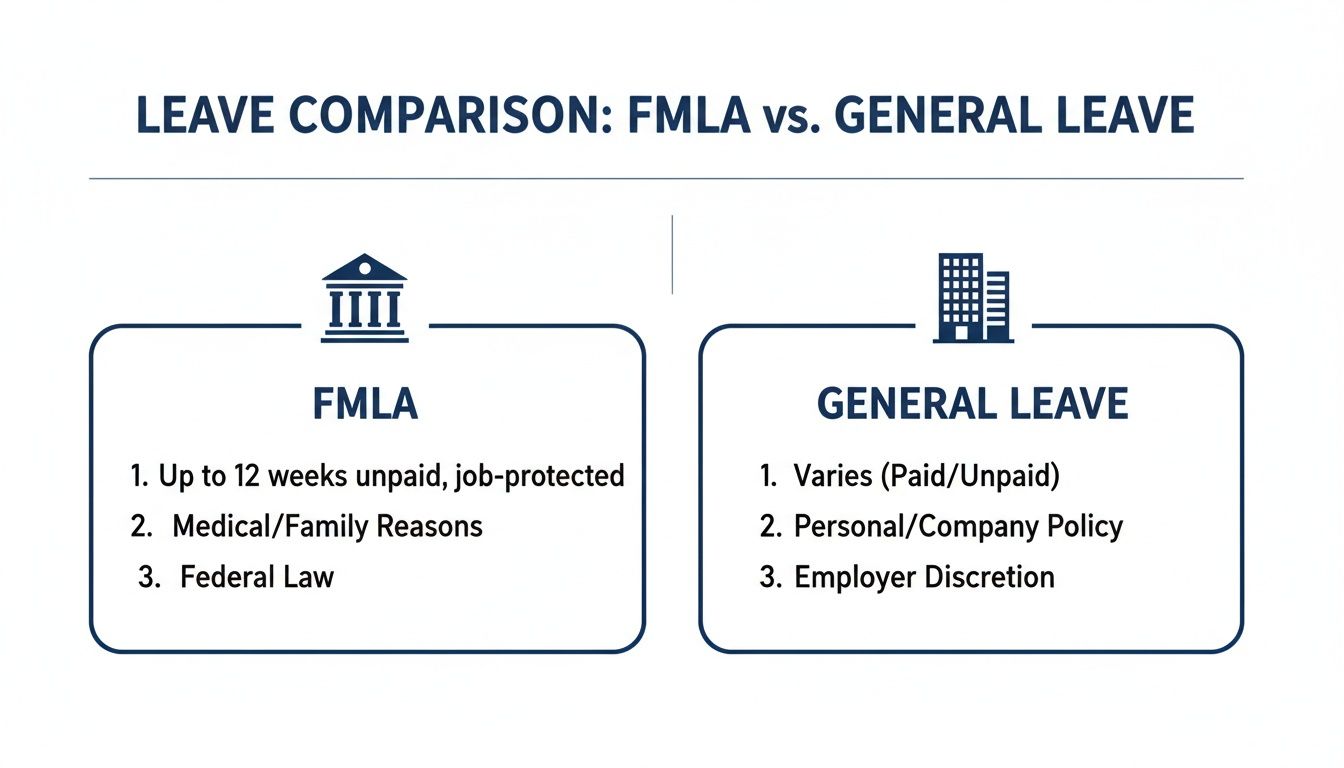
As the chart shows, FMLA comes with strict government mandates and protections, while a general leave is guided by the policies you put in place.
The legal protections that come with FMLA are significant. An employee on qualifying FMLA leave is entitled to be reinstated to their same or an equivalent job upon their return. A general leave of absence carries no such federal guarantee; job protection depends entirely on what your written policy promises.
This is why knowing when a request qualifies for FMLA is non-negotiable. Research from the National Partnership for Women & Families shows millions of workers need leave but either take unprotected time off or avoid it altogether, fearing job loss. A mishandled leave request, especially one that should have been designated as FMLA, can quickly escalate into a Department of Labor complaint or a costly lawsuit. Creating clear, separate processes for FMLA and general leaves is a cornerstone of a defensible HR strategy.
When an employee requests time off for a medical or family issue, your response is governed by specific rules. The Family and Medical Leave Act (FMLA) creates concrete obligations for you as an employer. Unlike a general leave of absence that you grant at your discretion, FMLA follows a strict rulebook. Getting these rules wrong can lead to serious compliance headaches, so it is critical to understand them thoroughly.
The first step is always to determine if the employee is eligible for FMLA protection. This is not a judgment call but a strict, three-part test set by the Department of Labor.
An employee is only eligible for FMLA protection if they meet all three of the following conditions. Think of this as the gateway to FMLA; if an employee passes this test and has a qualifying reason, they have a legal right to take leave.
If an employee meets all three criteria, they are eligible. If even one condition is not met, they do not qualify for FMLA, though you can still offer them a non-FMLA leave under your own company policy. For a step-by-step walkthrough, you can use our FMLA eligibility checklist.
Once you confirm an employee is eligible and has a qualifying reason, your organization has a set of non-negotiable responsibilities. The FMLA provides up to 12 weeks of unpaid, job-protected leave per year. While this may sound daunting, a report from the National Partnership for Women & Families shows that 92% of worksites report no difficulty with FMLA compliance.
To remain compliant, you must adhere to these core duties:
Failing to meet any of these obligations can lead to significant penalties. A clear, consistent process for every FMLA request is not just a good idea—it is essential for protecting your business.
Unlike the rigid framework of FMLA, a general leave of absence is shaped almost entirely by your company's policy. This flexibility gives you control but also places significant responsibility on you to be clear and consistent. A vague or inconsistently applied policy can create confusion, damage morale, and expose your business to claims of unfair treatment or discrimination.
A thoughtfully constructed general leave policy, however, is a powerful tool for retention. It demonstrates a commitment to employee well-being beyond legal requirements and can be a key factor in retaining top talent. The goal is to create a framework that is clear, fair, and legally sound, ensuring every request is handled uniformly.
Your first step is to clearly define who can request a general leave and for what reasons. While FMLA has strict criteria, your policy can be tailored to your workforce and business needs. Specificity is key to avoiding ambiguity and ensuring fair application.
Common reasons for granting a general leave of absence include:
It is a critical mistake to leave eligibility terms vague. Phrases like "at management's discretion" can lead to inconsistent application and claims of favoritism. Instead, set clear, objective criteria, such as requiring a minimum of one year of service before an employee is eligible to request a personal leave.
After defining the "who" and "why," you must address the "how long." Your policy must specify the maximum length of any single leave and how often an employee can take one. Without these limits, you risk significant operational disruptions from open-ended absences.
Consider setting tiered durations based on the reason for the leave. For example, an educational leave might be approved for up to one year, while a personal leave could be capped at 90 days. Your policy should also state whether the leave can be taken intermittently or must be taken in a continuous block. This clarity helps managers plan for coverage and prevents misunderstandings. It is also wise to consider how this leave interacts with other time off policies. Learn more in our guide to creating a comprehensive paid time off policy.
This is arguably the most important part of your general leave policy. Unlike FMLA, there is no federal law requiring you to give an employee their job back after a non-FMLA leave. Your policy must state, in no uncertain terms, what your practice is.
There are generally three approaches to handling job reinstatement:
No matter which path you choose, consistency is everything. Applying reinstatement rules differently for different employees is a direct path to a discrimination claim. A clear, written policy, applied uniformly, is your best defense.
For businesses operating across state lines, managing employee leave becomes a complex web of regulations. The federal FMLA sets a national baseline, but it is just the starting point. Many states have enacted their own laws that are far more generous, creating a patchwork of rules that can be challenging to navigate.
This is where the distinction between a standard leave of absence vs. FMLA becomes critical for compliance. As you expand, a one-size-fits-all leave policy is insufficient. What is perfectly legal in one state could result in significant penalties in another, forcing a shift from meeting federal minimums to mastering a mosaic of local rules.

The most significant departure from federal FMLA is the rapid expansion of state-mandated paid family and medical leave (PFML) programs. While FMLA only guarantees unpaid leave, a growing number of states now require employers to provide paid benefits, funded through payroll taxes. This fundamentally alters the leave landscape for employees.
By 2026, 13 states and the District of Columbia will have a mandatory PFML program in effect. For example, Colorado's Family and Medical Leave Insurance (FAMLI) program provides up to 90% wage replacement for eligible employees. This is a world away from FMLA's unpaid model and highlights why staying current on FMLA and paid leave advancements is so important for multi-state employers.
The interplay between state and federal leave laws creates complex situations that require careful handling. An employee may be eligible for leave under both FMLA and a state law, or they could qualify for one but not the other. This is because state laws often have different eligibility rules.
Here are a few common scenarios you might encounter:
It is crucial to recognize that state and federal leave entitlements often run concurrently. If a leave reason qualifies under both FMLA and a state PFML law, the time off typically counts against both balances simultaneously. Mismanaging this can lead to granting more leave than legally required or, worse, prematurely ending an employee's protected leave.
For an organization with a presence in multiple states, tracking and applying dozens of different leave rules is an administrative burden that invites errors. This raises the risk of compliance fines and lawsuits. A more practical and defensible approach is to adopt a "most generous" leave policy.
This strategy involves creating a single, unified leave policy that incorporates the most employee-friendly provisions from all jurisdictions where you operate. For instance, if one state offers 16 weeks of medical leave and another uses a broader definition of "family," your company-wide policy would apply both standards to all employees. To simplify further, consult our guide on employee handbook requirements by state. While this may mean offering more generous leave than legally required in some locations, it dramatically simplifies administration and reduces legal risk.

Meticulous documentation is the foundation of any defensible leave management program. Whether handling a federally protected FMLA leave or a discretionary general leave, clear paperwork protects both your organization and your employees. It creates a transparent record of requests, approvals, and key dates, which is your best defense against disputes and ensures fair, consistent administration.
When comparing a leave of absence vs. FMLA, the documentation requirements are significantly different. FMLA follows a strict, government-mandated process, while your general leave policy is governed by the procedures you create. A systematic approach to both is essential for mitigating risk.
The Department of Labor outlines a specific, sequential process for FMLA documentation. Failing to follow these steps is one of the easiest ways for a covered employer to face legal challenges. Your process must be consistent and timely.
The required FMLA paperwork includes:
A critical piece of the FMLA puzzle is medical certification. While a healthcare provider must certify the medical need for leave, you cannot require them to estimate travel time to and from appointments on the form. However, that reasonable travel time is still protected under FMLA.
For non-FMLA leaves, you create the process and the paperwork. Your main objective should be to standardize this process to ensure every request is handled equitably. Vague or verbal agreements create significant risk.
Your documentation packet for a general leave of absence should include:
As noted in this insight from the National Partnership for Women & Families, clear policies are your best defense, especially for smaller businesses not covered by FMLA. Using consistent documentation helps avoid claims of discrimination or unfair treatment.
Navigating these requirements can be a challenge. If you need help building defensible and clear documentation, we are here to support you. You can reach out to Paradigm for a consultation.
Knowing the difference between FMLA and a general leave of absence is one thing; putting that knowledge into practice is another. A strong, defensible leave policy is more than just a section in your handbook—it is a complete system built on clear procedures, standard forms, and well-trained managers. This system turns complex rules into a reliable process that protects your company and treats every employee fairly.
This checklist will guide you through the essential steps to build and refine your company's leave policies, reduce ambiguity, and guard against compliance failures.
Before building a better policy, you need a clear picture of where you stand. A thorough audit will illuminate gaps and potential risks. This requires an honest look at what your handbook says versus what your managers are actually doing.
Start by examining these critical areas:
After your audit, it is time to build a policy that is both compliant and simple to manage. Your goal is to eliminate "case-by-case" decisions, which are a magnet for discrimination claims. A well-defined policy ensures every leave request follows the same objective process.
Your written policy needs to explicitly detail:
A robust leave policy also accounts for disability accommodations. For instance, knowing how to provide effective Accommodations For Adhd Autism In The Workplace shows you are not just compliant, but also committed to supporting your team.
Your policy is only as effective as the people implementing it. Standardized forms ensure you gather the right information every time, while manager training prevents small front-line mistakes from becoming major liabilities.
The best-written leave policy can be undermined by a well-meaning manager who makes a promise the company cannot keep or fails to recognize an FMLA-qualifying event. Training is not optional—it is essential risk management.
Focus on these action items:
A structured approach helps your leadership team move with confidence and document every step correctly. We invite you to learn more about how we support businesses like yours by reaching out to us today.
When it comes to employee leave, the written policy is just the beginning. Real-world situations rarely fit into neat boxes, and leaders often face nuanced questions that test the limits of their policies. Getting the answers right is about ensuring every decision is consistent, fair, and legally sound. Below, we address some of the most frequent questions we hear from employers.
Yes, this is a common scenario. An employee might exhaust their 12 weeks of FMLA leave but still require more time off. At that point, your business could grant them additional time under your general leave of absence policy. The key is to be crystal clear in your policy about how these two leave types interact and what job protections—if any—will apply once FMLA leave is exhausted.
The single most dangerous and costly mistake is inconsistency. When you grant a discretionary leave of absence to one employee but deny a similar request from another, you create a risk for a discrimination claim. A well-defined policy, applied uniformly across the organization, is your best defense. Another major misstep is failing to recognize when FMLA might apply. If an employee mentions needing time off for a medical reason, your duty to provide FMLA information is triggered, even if they never say "FMLA."
When managing leave, remember that overlapping benefits can create complexity. For example, many wonder about applying for disability while on workers' comp. Understanding these interactions is key to providing accurate guidance.
Unless a specific state law or an ADA accommodation requires it, no federal law compels you to provide job protection for an employee on a general, non-FMLA leave. This decision is entirely determined by your internal company policy. Your policy must address this head-on, stating explicitly whether an employee's job—or a comparable one—will be available upon their return. Clarity here protects everyone involved.
Managing high-stakes leave scenarios requires precision and sound judgment. Paradigm International Inc. acts as a decision partner for leadership teams, providing the strategic guidance needed to navigate complex employment risks and maintain defensible HR practices. If you need support with your leave policies or other critical HR decisions, we invite you to contact us to learn more.