Misconduct in the workplace is no longer a side issue you can leave to HR and hope it stays contained. In 2025, 55% of U.S. employees experienced or witnessed workplace misconduct, up from 41% in 2024, and reporting rose to 78%, which still leaves more than one-fifth of affected employees silent according to HR Acuity's 2025 workplace misconduct statistics. That should reframe the problem for any owner or operator. You are not managing rare exceptions. You are managing an operational, legal, and leadership risk that is now far more likely to hit your business.
For multi-state SMBs, the risk is sharper. Misconduct complaints don't arrive in neat boxes, and state law doesn't reward improvisation. If your managers handle one complaint informally, another aggressively, and a third with weak documentation, you've already created inconsistency that can be used against you.
The fix isn't complicated, but it does require discipline. You need a system. That means clear definitions, reliable intake, impartial investigations, stronger documentation, and decision-making that holds up whether the subject is a frontline employee, a sales leader, or a founder's top performer.
Many owners still treat misconduct in the workplace as an issue that becomes serious only when lawyers get involved. That's backward. By the time counsel is cleaning up the mess, your culture is already damaged, your managers have already said too much, and your records are already incomplete.
Exposure starts earlier. It starts when someone reports a concern and the manager minimizes it. It starts when two employees in different states receive different responses for the same conduct. It starts when a leader assumes a complaint is “just interpersonal conflict” and misses the retaliation or discrimination issue sitting underneath it.
A misconduct report is a business event. It affects retention, trust, operations, and your ability to defend later decisions. If you run a healthcare group, professional services firm, field operation, or growing multi-state company, you need a repeatable method that works under pressure.
Practical rule: If your response depends on who is involved, how busy your team is, or which manager got the complaint, you don't have a process. You have exposure.
A defensible system does three things well:
Most misconduct guidance is too broad to be useful. It tells you to “take complaints seriously” and “investigate promptly,” but it rarely addresses the practical reality of an SMB operating in multiple jurisdictions with limited internal bandwidth.
That's where leadership judgment matters. You don't need bureaucracy for its own sake. You need structure that helps your company act quickly without cutting corners, and document carefully without paralyzing the business.
Misconduct in the workplace is broader than theft, violence, or blatant harassment. It includes any behavior that violates policy, breaks the law, undermines safety, disrupts operations, or creates an unfair or hostile environment. Owners get into trouble when they define misconduct too narrowly and wait for obvious, dramatic facts.
That approach misses how complaints show up. By 2025, 38% of employees who experienced misconduct encountered four or more distinct issue types, often involving layered concerns such as conflict mixed with discrimination or retaliation, as noted in HR Acuity's analysis of complex misconduct cases. In plain terms, a complaint that sounds like “personality conflict” may also involve pay inequity, exclusion, threats, favoritism, or protected activity.
Here's a practical way to classify common misconduct.
| Type of Misconduct | Example | Potential Business Impact |
|---|---|---|
| Harassment | Repeated sexual comments, racist jokes, or demeaning remarks about religion | Legal claims, turnover, reputational damage |
| Discrimination | Denying opportunities or imposing harsher treatment based on a protected characteristic | Agency scrutiny, litigation risk, morale collapse |
| Retaliation | Cutting shifts after an employee reports a concern | High legal exposure, chilling effect on reporting |
| Insubordination | Refusing a lawful directive, undermining a supervisor in front of staff | Operational disruption, team instability |
| Bullying or intimidation | Public humiliation, threats, repeated verbal abuse | Productivity loss, stress, avoidable attrition |
| Safety violations | Ignoring required safety procedures or exposing others to known hazards | Injury risk, compliance issues, operational shutdowns |
| Misuse of assets or information | Sharing confidential data, falsifying records, using company property for improper purposes | Financial loss, privacy issues, trust damage |
| Time and attendance abuse | Timecard manipulation, repeated dishonesty about hours worked | Payroll disputes, fairness concerns, discipline challenges |
Your handbook can define misconduct in legal language. Your managers need plain language examples. They should understand that gossip can become retaliation, a joke can become harassment, and a scheduling decision can become evidence of bias if it follows a complaint.
If your leaders need a practical refresher on protected-category issues, this overview of employee rights against discrimination is a useful reference point. It helps non-lawyers connect policy language to real workplace conduct.
A complaint doesn't need to be labeled correctly by the employee to trigger your duty to respond correctly.
Too many SMB leaders make the same three mistakes:
They're related. A sloppy response to low-grade misconduct teaches the workforce what your standards really are. That lesson spreads fast.
The legal risk of misconduct isn't limited to the original complaint. It expands through your response. A weak intake process, missing notes, uneven discipline, careless emails, and state-specific mistakes often do more damage than the initial allegation.
For multi-state employers, that risk multiplies. The same allegation can trigger different obligations depending on where the employee works, where the manager sits, and where the decision is made.

For SMBs operating across state lines, misconduct investigations are a compliance minefield. California's FEHA sets a broader standard for harassment than federal Title VII, while New York has heightened anti-retaliation rules. A mishandled case in one state can create legal trouble across jurisdictions, as outlined in this discussion of multi-state workplace misconduct risks.
That means a one-size-fits-all playbook is a mistake. If your company uses the same template closure memo, same investigation timing, and same disciplinary language everywhere, you may be creating problems you don't see yet.
Owners usually focus on lawsuits. Fair enough. But the business damage starts much earlier.
A single mishandled matter can also affect future decisions. Once your credibility is damaged internally, every later complaint gets harder to resolve because employees assume the process is rigged.
Ask these questions about your current system:
If the answer depends on memory rather than documentation, your defense is already weaker than you think.
A defensible organization doesn't just punish misconduct. It creates a record that shows the company acted reasonably, consistently, and with jurisdictional awareness.
The worst investigations start with certainty. A manager thinks they know what happened, speaks too soon, and then spends the rest of the process trying to confirm a conclusion they already reached. That is not an investigation. That is confirmation bias with legal consequences.
A defensible investigation is structured, limited to facts, and consistent from intake through closure. If you need a deeper operational framework, this guide on how to conduct workplace investigations is a practical companion for leadership teams building a repeatable process.
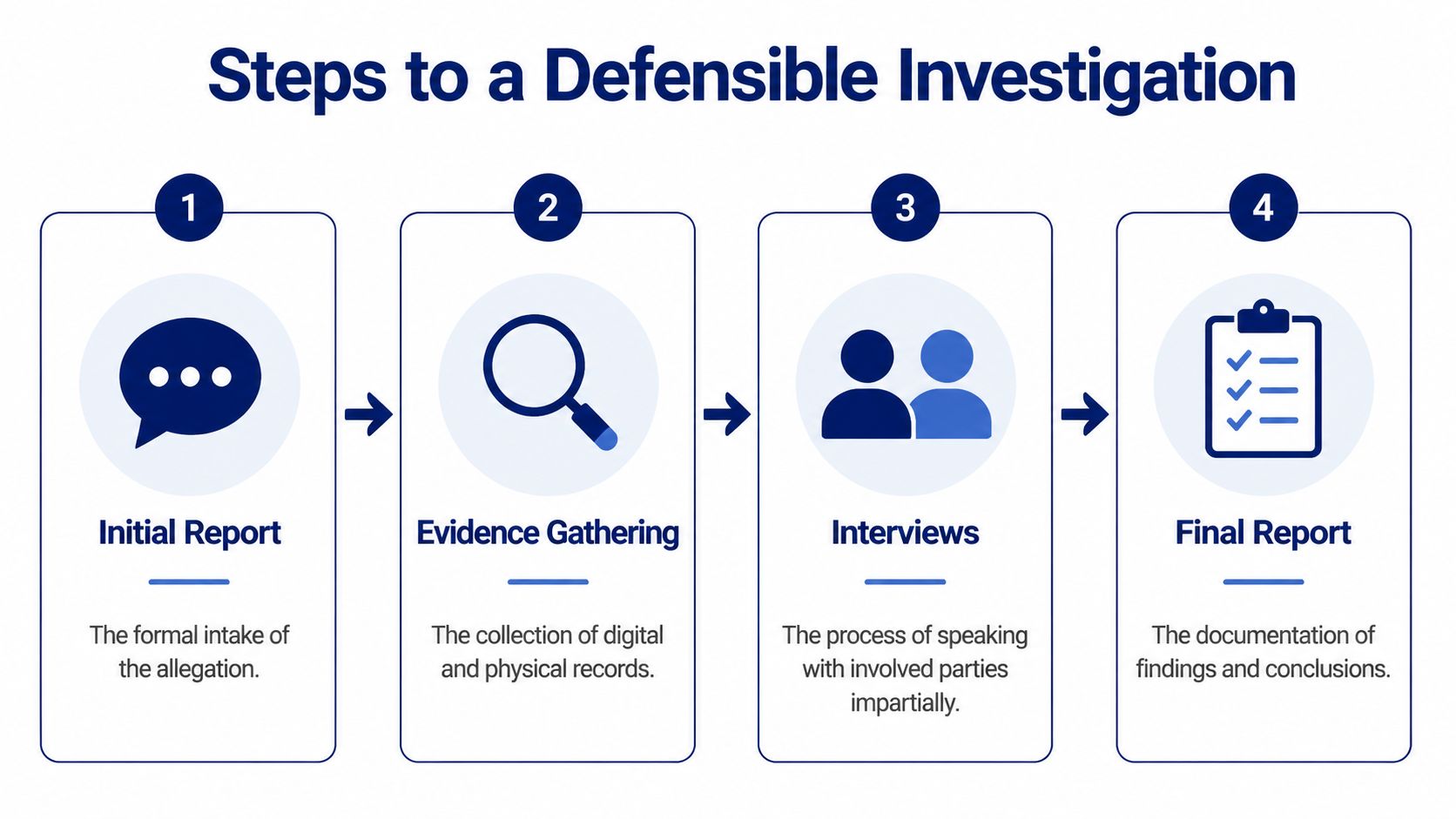
The first move is simple. Capture the allegation clearly. Who reported it, what was alleged, when it happened, who may have witnessed it, and whether there are immediate safety or retaliation concerns.
Do not promise a specific outcome. Do not promise complete confidentiality. Tell the employee the company will review the concern, limit disclosure to those with a business need to know, and prohibit retaliation.
Most internal investigations get weaker because evidence collection is sloppy. Preserve emails, messages, schedules, personnel records, prior complaints, policy acknowledgments, access logs, or customer correspondence before people start editing stories or deleting context.
Use a basic evidence log. You want a list showing what you reviewed, where it came from, and when it was collected. That sounds simple because it is. It also separates serious investigations from improvised ones.
Interview the complainant first if possible. Then speak with the accused employee. Then speak with witnesses who can confirm, contradict, or contextualize the core facts. Keep your questions open-ended at the start, then narrow into dates, language used, locations, and sequence.
Use neutral phrasing. “Tell me what happened after the meeting ended” is better than “Why did you retaliate after the complaint?”
Your conclusion should answer two questions:
Don't write conclusions like “she seemed credible” without explaining why. Tie credibility to observable factors such as consistency, corroboration, contemporaneous messages, or documentary support.
Advisor's note: The goal isn't to prove a criminal case. The goal is to make a fair employment decision based on a reasonable review of available facts.
When the case involves a senior leader, cross-state complexity, or serious protected-category allegations, an outside investigator may be appropriate. Firms specializing in such services provide investigation support for management misconduct and harassment matters where prompt, impartial review is necessary.
Documentation wins or loses employment disputes long before anyone enters a hearing room. If your records are vague, emotional, incomplete, or inconsistent, your decisions become harder to defend. Good intentions won't save bad paperwork.
Most companies don't have a misconduct problem. They have a documentation problem around misconduct. That distinction matters because you can improve documentation immediately.
Use records that are factual, dated, and specific. A solid file usually includes the complaint intake, interim actions considered, witness list, evidence log, interview notes, findings summary, and final action memo. Keep adjectives out unless they describe observed behavior.
For a more disciplined approach to written records, this article on documenting employee discipline is worth reviewing with your HR lead and operations team.
Include:
Leave out:
Your notes may be read later by an agency, a judge, outside counsel, or the employee involved. Write with that audience in mind.
Many handbooks fail because the language is either too vague or too absolute. “We maintain a respectful workplace” is fine as a value statement, but it doesn't tell employees or managers what to do. “Any violation will result in immediate termination” sounds tough and creates problems you may not want.
Use practical policy building blocks instead:
Strong policy language doesn't lock you into one response. It preserves discretion while showing that your standards are clear.
Leader misconduct is different. It carries more influence, more fear, and more potential for contamination of the process. When the accused controls assignments, compensation input, performance ratings, or access to leadership, employees will reasonably doubt whether reporting is safe.
That's why these cases can't be handled casually. Data shows 62% of employees believe leaders and high performers get a pass on misconduct. Executive-involved reports are 37% more likely to be investigated, yet these cases also see a 45% rate of promotion despite the misconduct, according to this report on leadership impunity and misconduct. Those numbers point to a trust problem, not just a process problem.

A manager accused of misconduct often has three advantages:
Weak governance shows up fast in these situations. If HR reports to the accused executive, or if the owner insists on “handling it,” your process isn't neutral.
Leader cases need tighter controls. Limit who knows what. Consider reporting lines carefully. Separate the fact-finding role from the final decision role when possible. If the matter involves a senior executive, board member, or highly sensitive allegations, use an outside investigator.
Technology can also help create better records in sensitive interviews, provided you address confidentiality and legal considerations before using any tool. For teams exploring more accurate spoken-note capture in regulated settings, this medical voice recognition guide offers useful context on how voice documentation tools are being applied in environments where precision matters.
Seniority should increase scrutiny, not reduce it.
Employees don't judge your culture by your values statement. They judge it by what happens when a revenue producer, physician partner, practice leader, or senior operator is accused of crossing the line.
If the company bends the rules for leaders, people notice. If the company follows a fair process and acts consistently, people notice that too. Only one of those paths preserves trust.
The strongest misconduct system isn't built around punishment. It's built around early correction, manager judgment, and psychological safety. If every issue gets ignored until it becomes severe, or escalated immediately into formal discipline, you'll create avoidable damage either way.
Prevention starts with frontline leaders. They need to know how to address disrespect, timecard issues, exclusion, rude comments, and boundary problems before they grow teeth.
Zero-tolerance language makes owners feel protected. It often produces the opposite result in day-to-day management. Research shows that targeted leniency for minor issues, such as coaching on timecard errors instead of immediate formal discipline, can reduce repeat offenses by 22% and improve retention by 15%, based on HR Acuity's discussion of handling minor misconduct.
That does not mean looking the other way. It means distinguishing between minor correctable behavior and misconduct that requires formal action right now.
Most supervisors don't avoid tough conversations because they don't care. They avoid them because they don't know what to say and they fear making it worse. Tools like these ready-to-use work scripts can help managers structure difficult conversations without sounding vague, emotional, or inconsistent.
You should also train managers to escalate when they hear keywords or fact patterns involving protected activity, retaliation, threats, or discrimination. Coaching has limits. Managers need to know where those limits are.
Employees report earlier when they believe three things are true:
That requires repetition. Reinforce reporting options. Train managers with scenarios, not generic slides. Review your standards regularly. If you need a stronger prevention framework, this resource on preventing workplace harassment is a solid place to start.
Misconduct prevention is operational discipline. It's not a poster in the break room.
If your company is dealing with misconduct in the workplace across locations, inconsistent manager responses, or investigations that need to hold up under scrutiny, Paradigm International Inc. works with SMB leadership teams to build defensible processes, strengthen documentation, and manage high-risk employee matters with greater consistency.