


A leave request lands on your desk. Your employee says she's expecting a baby and wants to know what North Carolina requires. You search for a clean state rule and find a mess instead. That confusion is normal, but it's also where employers make expensive mistakes.
North Carolina maternity leave isn't driven by a simple state law for private employers. It's a patchwork of federal FMLA rights, limited paid leave rules for certain public employees, and whatever your company has decided to offer on its own. If you run a small business, a healthcare practice, or a multi-state operation, you can't afford to guess.
The practical issue isn't just whether leave is paid. It's whether your company handles job protection, notices, documentation, and return-to-work rights correctly. A policy that sounds generous can still create liability if it ignores the legal mechanics behind leave administration.
A leave request hits your inbox on Monday morning. Your employee is expecting a baby and asks a simple question: what does North Carolina require? If your answer is, “We already offer PTO, so we're covered,” you are creating risk.
The primary compliance problem in North Carolina is not a missing state maternity leave statute. It is employer confusion about the difference between paid time off and protected leave. PTO can replace wages. It does not automatically satisfy federal job-protection, notice, designation, or reinstatement rules.
That distinction matters most for small and midsize businesses, healthcare practices, and multi-state employers. One manager may approve time off informally. Another may call it parental leave. HR may deduct from PTO and assume the issue is closed. Those shortcuts are exactly how leave disputes turn into retaliation claims, interference claims, and inconsistent treatment problems.
A defensible North Carolina maternity leave policy needs more than a generous benefit. It needs clear eligibility rules, a process for handling federal leave rights, and consistent documentation from the first notice through return to work. If you get that structure right, you reduce legal exposure and make life easier for managers and employees alike.
For private employers, North Carolina maternity leave starts with federal law, not state law. That matters because many employers spend too much time asking whether the state requires paid leave and not enough time asking whether federal job protection applies.
North Carolina has no state-mandated maternity leave law, so eligibility for job-protected leave depends entirely on FMLA. That federal law requires employers to have 50 or more employees within a 75-mile radius, and employees must meet tenure and hours requirements to qualify. The coverage gap is substantial. Approximately 65% of all North Carolinians are ineligible for this unpaid leave due to employer size or tenure requirements, causing an estimated 400,000 unmet leave requests annually in North Carolina, according to this North Carolina maternity leave overview.
A lot of disputes come from employers applying only part of the rule. They remember the company-size threshold and forget the employee test.
An employee generally needs all of the following for FMLA protection:
If the employee qualifies, the leave is unpaid, but the job is protected. That distinction is critical. FMLA is about reinstatement rights and protected absence, not automatic wages.
Practical rule: If your managers talk about leave only in terms of pay, they're missing the legal issue that creates the most exposure.
Because so many workers fall outside FMLA coverage, your internal policy does real work in North Carolina. It fills the gap between what the law requires and what your business wants to provide. That includes defining who's eligible, whether PTO must run concurrently, and what documentation your team will require.
This becomes even more complicated when you operate in more than one state. A leave policy that works in North Carolina may be incomplete somewhere else. If your company is building a broader compliance model, this overview of state family leave laws is a useful starting point.
Business owners often hear that North Carolina offers paid parental leave and assume the rule applies broadly. It doesn't. The state has created a separate track for state employees and public school employees, while most private-sector employers remain outside any state paid leave mandate.
That split has created a two-tier system. Public employees may have access to paid parental leave through state policy. Most private employers still rely on FMLA, PTO, short-term disability, or voluntary employer-paid benefits.
When people say North Carolina has paid parental leave, they're usually talking about public-sector employees, not private businesses. That distinction matters because a lot of owners read a headline and assume the rules changed for everyone.
A critical exception exists for state government employees and public school teachers in North Carolina, who are eligible for Paid Parental Leave. Eligible state employees who give birth receive eight weeks of paid leave, while other parents receive four weeks. A similar rule for public school teachers mirrors this structure, creating a stark disparity where 76% of North Carolina employees mostly in the private sector lack access to paid family leave, as outlined by EdNC's summary of the paid parental leave policy.
Don't copy public-sector assumptions into a private company handbook. Those state-paid benefits don't automatically extend to your workforce, even if your employees ask about them by name.
Instead, answer the practical question employees are really asking. How will they receive income if they take time away from work?
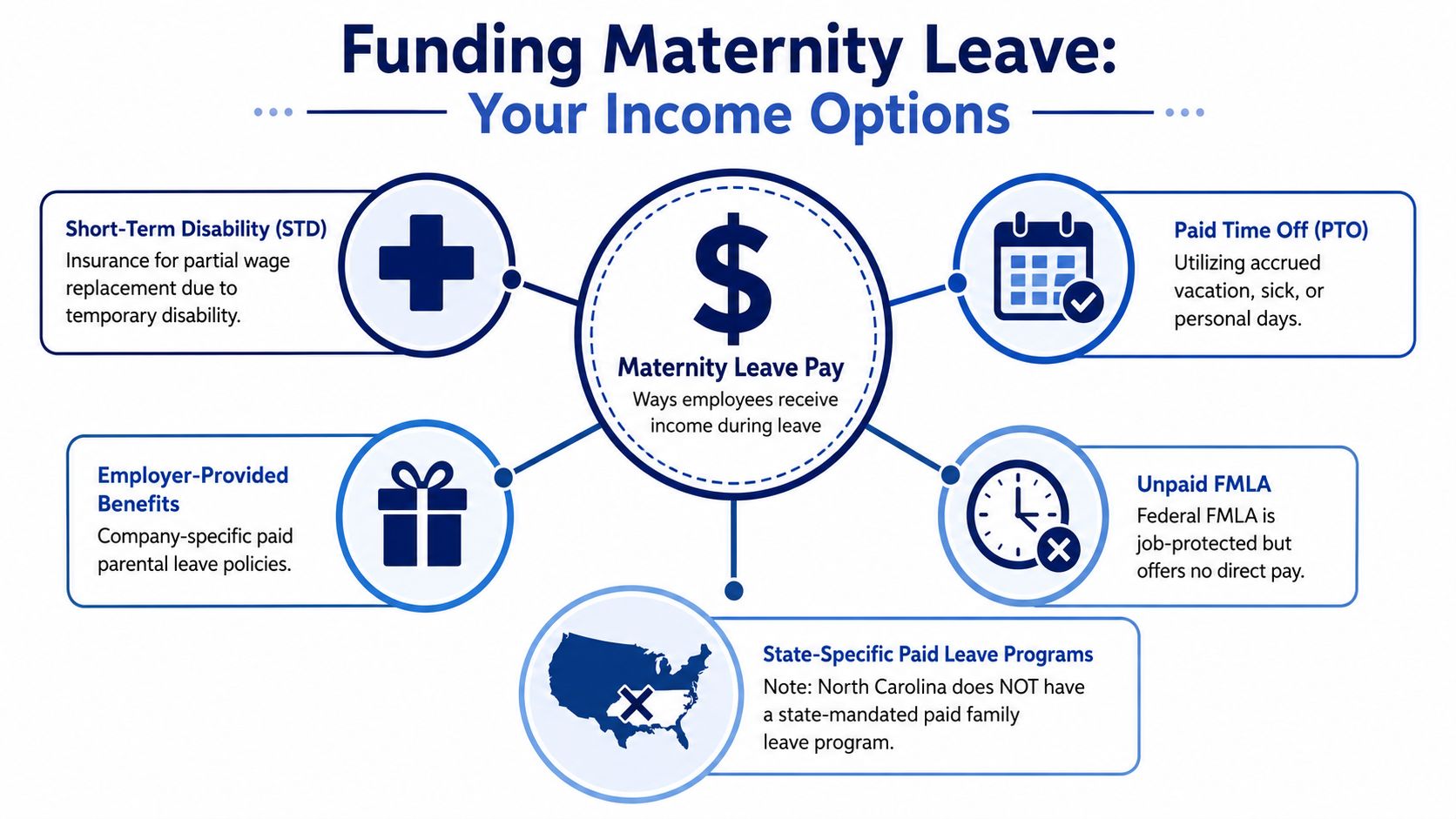
For most private employees, income during leave usually comes from one or more of these sources:
Employees don't separate legal categories the way HR does. They hear “North Carolina paid parental leave” and assume it applies across the board. If your managers can't explain the difference between a public-sector entitlement and a private employer benefit, you'll create frustration fast.
A clean explanation helps. The state offers paid leave to specific public workers. Private employers set their own paid leave benefits unless federal FMLA applies for unpaid job-protected time.
Most employees ask the pay question first. That's reasonable. FMLA may protect a job, but it doesn't create a paycheck. In North Carolina, that means companies need to explain the difference between leave entitlement and income replacement in plain language.
The lack of state-mandated paid leave forces many birthing parents to rely on short-term disability insurance, which isn't mandatory, or return to work prematurely. Nationally, only 41% of women receive paid maternity leave, averaging just 3.3 weeks with 31% wage replacement, according to Family Forward NC's parental leave analysis.
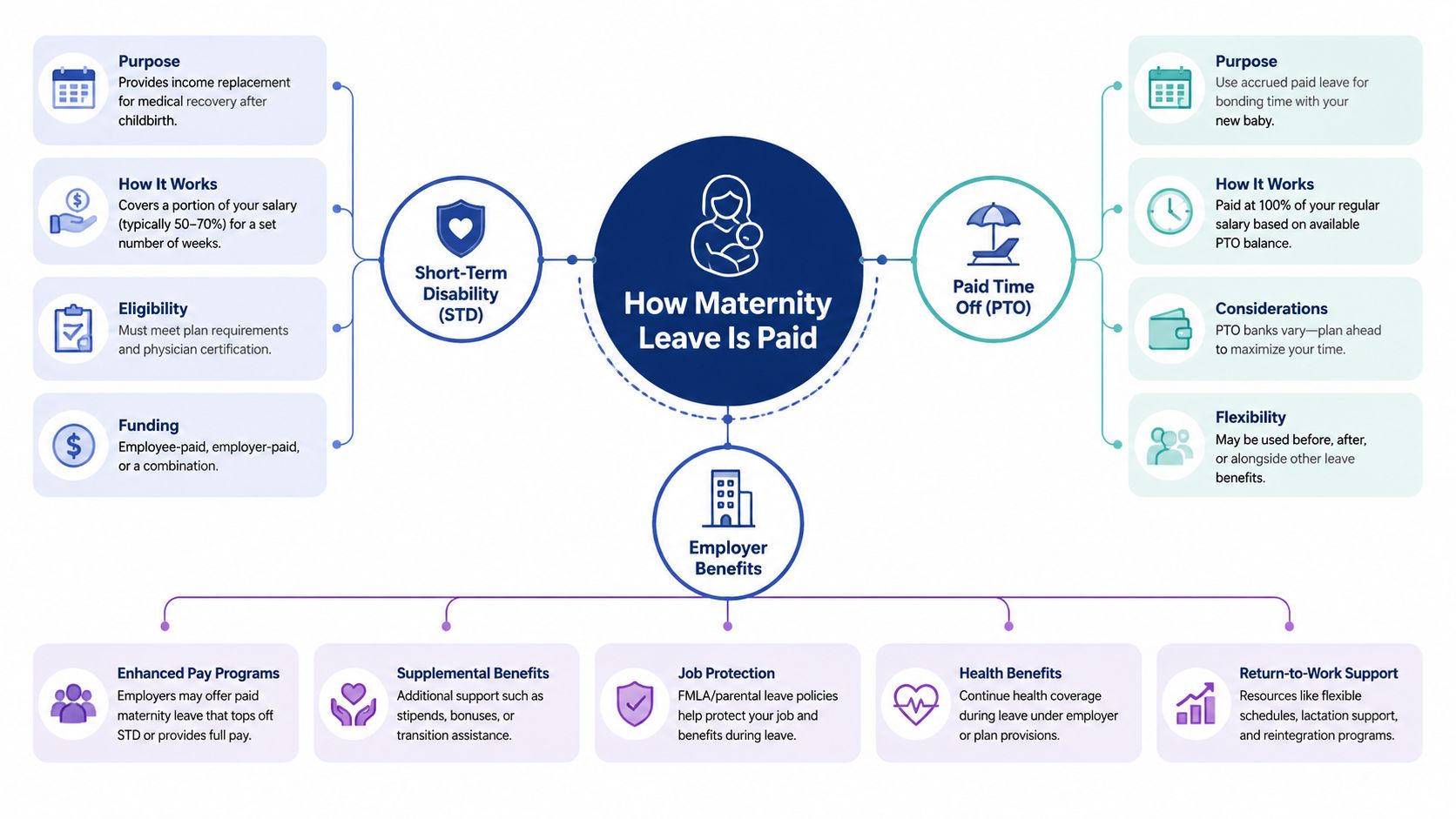
Short-term disability, often shortened to STD, is an insurance benefit. It is not a legal leave entitlement. That's where employers and employees both get tripped up.
If your plan includes STD, it may replace part of the employee's income during the medical recovery period connected to childbirth. But STD doesn't guarantee reinstatement, doesn't expand FMLA, and doesn't substitute for required notices or protected leave handling.
Paid benefits and job protection are separate systems. If you blend them together in your policy, your managers will administer both poorly.
PTO is the most common bridge between unpaid leave and a workable payroll reality. Many employers allow or require employees to use accrued PTO during maternity leave. That can make leave financially possible, but it must be handled consistently.
Use clear rules in your handbook and manager training:
If you want to compete for talent, especially in healthcare, professional services, and leadership-intensive roles, voluntary paid parental leave is often worth serious consideration. But don't build it casually. A loose promise in an offer letter or an inconsistent manager practice can create just as much trouble as having no benefit at all.
A sound policy defines eligibility, duration, interaction with STD and PTO, and whether benefits apply equally to birth, adoption, or foster placement. Consistency matters more than generosity alone.
A defensible maternity leave policy does one job above all else. It removes guesswork. If your handbook leaves managers improvising, you don't have a policy. You have a risk event waiting to happen.
Many multi-state employers and growing SMBs get overconfident. They add generous PTO, mention parental leave in recruiting materials, and assume they've solved the issue. They haven't. A benefit that sounds employee-friendly can still trigger conflict if eligibility, job protection, notice rules, and reinstatement standards aren't spelled out.
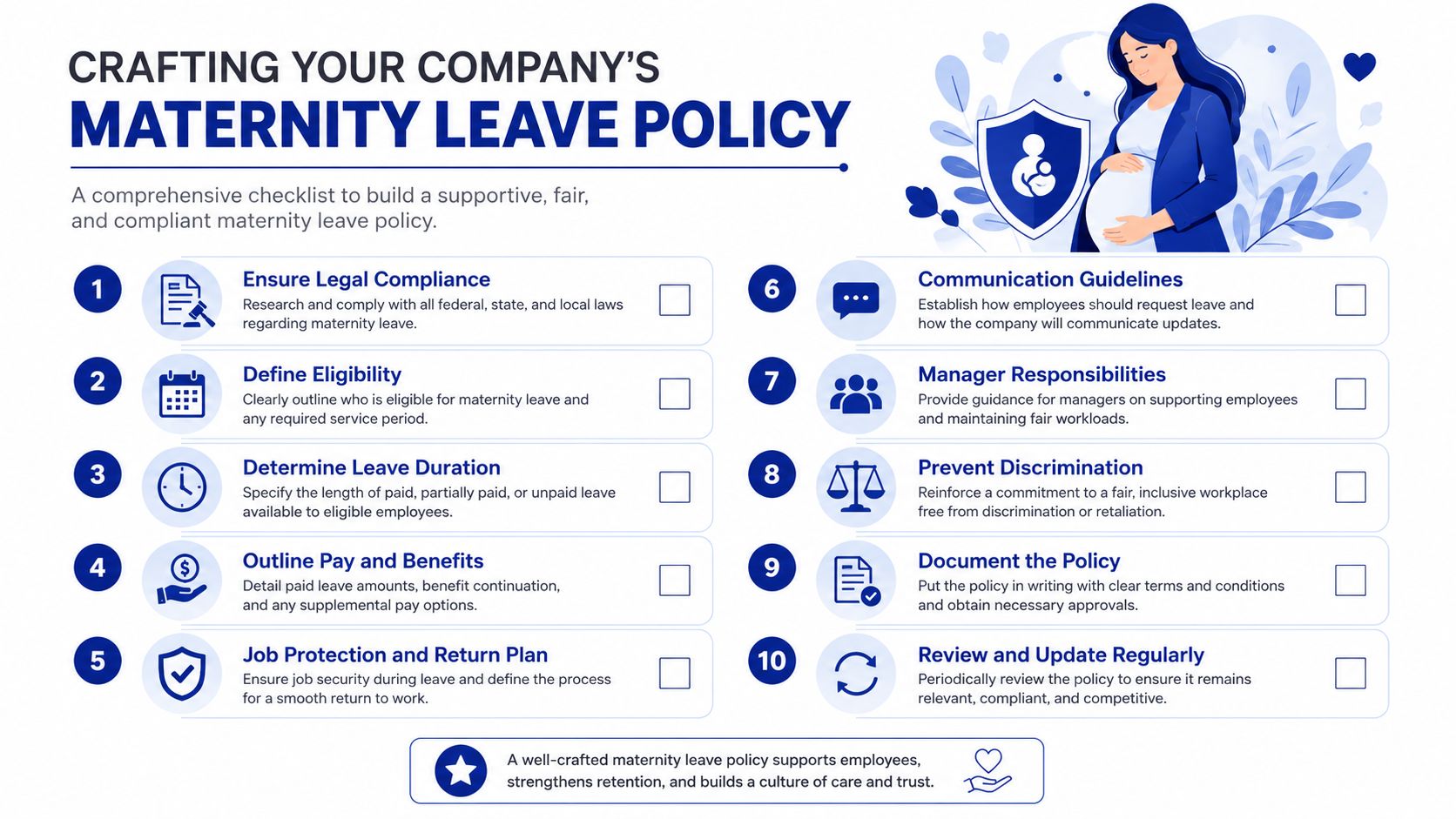
A strong policy should answer practical questions before an employee has to ask them. At minimum, include:
The most dangerous mistake is assuming private PTO replaces federal leave obligations. It doesn't. If your company is covered by FMLA and the reason for leave qualifies, the leave must be handled correctly under that federal framework even if the employee is receiving PTO or disability pay.
That's why multi-state employers need tighter policy architecture than single-location companies often realize. If you're reviewing broader leave design and benefits structure, resources like this guide on leave of absence from work and this practical look at Pounds Health Insurance for small businesses can help frame how benefit design and leave administration should fit together.
Advisor's view: A good policy doesn't just promise leave. It tells payroll, HR, and front-line managers exactly how to administer it.
Don't write your handbook for lawyers. Write it for supervisors and employees who need to use it under stress. Define terms like “parental leave,” “medical leave,” “bonding leave,” and “concurrent leave” in ordinary language.
Then audit your actual practice against the document. If managers are granting exceptions informally, changing dates by text, or making side agreements on return-to-work arrangements, fix that now. Handbooks don't protect companies when real-life administration ignores them.
The most common North Carolina maternity leave mistake isn't malice. It's false confidence. An owner thinks, “We already offer PTO and disability, so we're covered.” That assumption is exactly how leave disputes start.
A critical operational risk for SMBs operating across state lines is the mistaken belief that offering generous internal PTO or short-term disability automatically satisfies federal FMLA job-protection mandates. Few leaders understand that private PTO does not replace federal job rights, leaving them vulnerable to wrongful termination claims when they assume PTO coverage implies job security, as explained in this review of how FMLA works with PTO, maternity leave, and sick time in North Carolina.
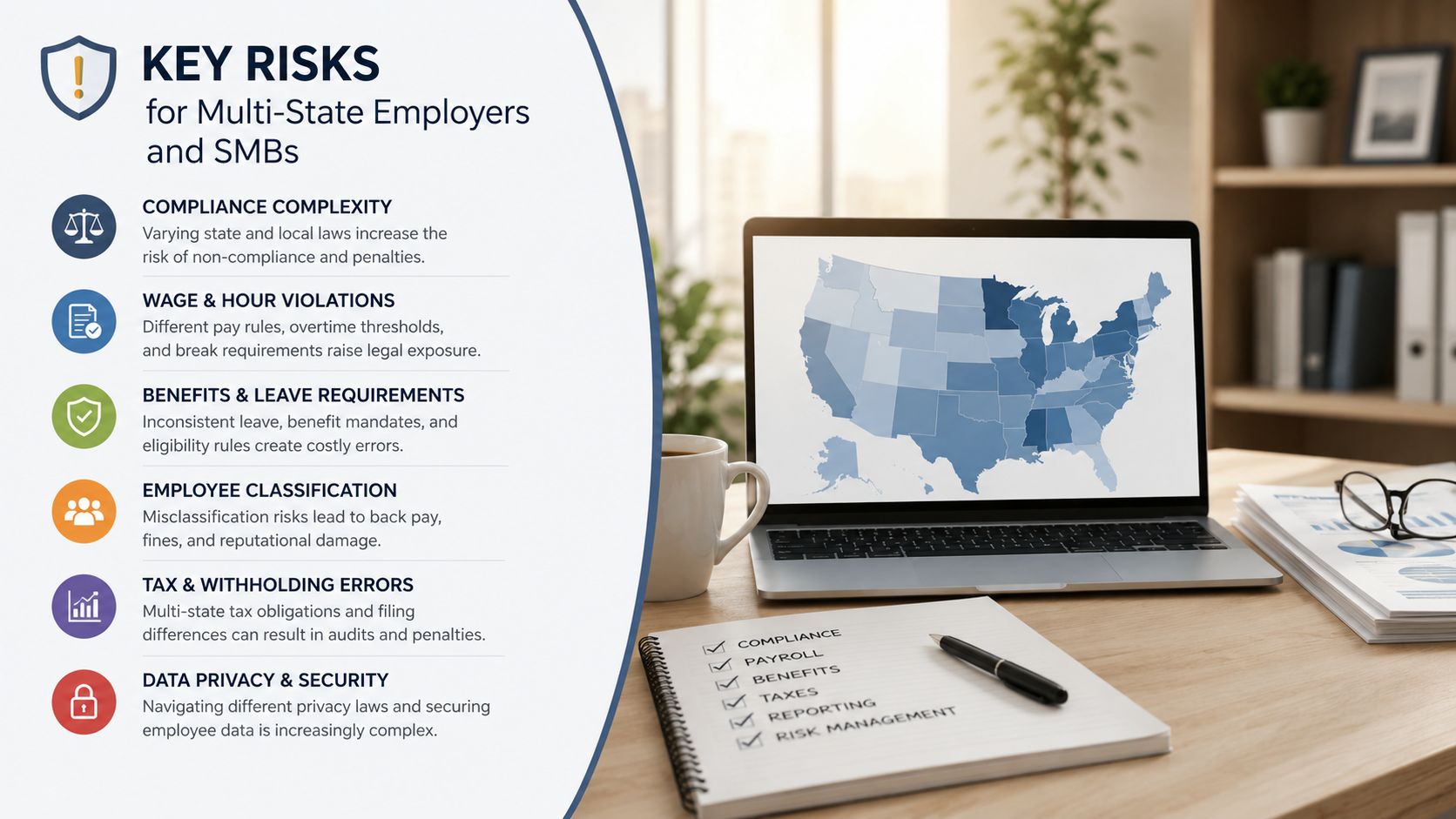
The risk usually appears in administration, not policy language alone. A manager approves time off as PTO. Payroll pays it correctly. Then nobody designates the leave properly, tracks the protected period, or confirms reinstatement rights.
That creates problems in several places:
A North Carolina-only company has enough to manage. A multi-state employer has far more. One leave framework may need to account for North Carolina's FMLA-centered approach while also accommodating more protective state systems elsewhere.
That doesn't mean you need a separate handbook for every location. It does mean you need a base policy with state-specific overlays, disciplined administration, and manager training that reflects where employees work.
Use a repeatable leave workflow instead of ad hoc judgment. For planned maternity leave, require one intake path, one documentation review process, one designation process, and one return-to-work checklist. The cleaner the system, the lower the chance that a well-meaning manager creates inconsistency.
When leave administration depends on the memory of one office manager or one supervisor, the company has already lost control of the process.
Strong leave compliance depends on paperwork discipline. Not glamorous. Still essential. Employers get into trouble when they treat maternity leave as an informal accommodation instead of a regulated employment event.
For FMLA-covered situations, your process should include timely eligibility and rights notices, clear designation practices, and a documented return-to-work path. If your team is still handling medical leave requests through loose email chains, rebuild that process. Standardized forms and decision points reduce avoidable mistakes.
A workable file should show what the employee requested, when the company responded, what documentation was requested, what leave category applied, and what return date was communicated. If you need a practical reference point for medical certification workflow, this guide to the FMLA Form 380-E is useful for organizing the process.
Keep your records clean and role-based. Supervisors should know what they need to know. They should not become custodians of sensitive medical detail.
Most private maternity leave policies are too narrow. They focus on live birth and bonding, then go silent on pregnancy loss. That silence creates both operational and legal risk.
North Carolina's state employer explicitly provides up to four weeks of paid leave for stillbirths at 20+ weeks gestation, while this protection is absent from most private employer policies, according to North Carolina State University's paid parental leave guidance. Private employers should address pregnancy loss directly in policy language and manager guidance because accommodation in these situations can be an important part of complying with anti-discrimination obligations.
When protected leave applies, reinstatement is not optional. The employee should return to the same or an equivalent position, and your managers need to understand that before they make staffing moves during the absence.
Use a simple checklist:
North Carolina maternity leave is manageable once you stop looking for a single state answer that doesn't exist. Private employers need to think in layers. Federal FMLA may control job protection. Internal policy controls much of the employee experience. Documentation and manager conduct determine whether that policy holds up under pressure.
The safest approach is proactive, not reactive. Write the policy before the request arrives. Train managers before the first difficult conversation. Build one leave process that your business can repeat consistently.
That broader discipline often connects to other workforce risk decisions too, including fitness-for-duty evaluations and return-to-work planning. For leaders reviewing those adjacent issues, this workplace health assessment guide offers useful context.
A defensible HR framework isn't about having the longest handbook. It's about making fewer judgment calls in moments where decisions carry significant weight.
If your leadership team needs a clearer, more defensible approach to leave management, employee documentation, and multi-state HR risk, Paradigm International Inc. can help you build the structure behind those decisions. You can contact Paradigm to learn more about creating policies and practices that protect both your business and your people.

