
A leadership team usually reaches this issue under pressure. Revenue has changed, a contract may be ending, or a site consolidation is on the table. Someone asks whether Oklahoma has its own layoff notice law, and the room gets quiet because nobody wants to get the timing, documentation, or employee messaging wrong.
That uncertainty is common, especially for employers that operate in multiple states. Oklahoma sounds like it should have its own version of WARN, but the actual question isn't which state form to pull. It's whether the federal rules apply to your business, whether your planned action triggers notice, and how to handle the process in a way that holds up if anyone later challenges it.
If you're weighing a reduction in force in Oklahoma, you're probably dealing with more than legal definitions. You're balancing payroll pressure, manager communications, employee morale, continuity of service, and the risk of getting boxed into an avoidable claim. In practice, the hardest part often isn't deciding whether change is needed. It's knowing what the law requires before you act.
The phrase Oklahoma WARN Act causes a lot of confusion. Many business owners assume Oklahoma has its own mini-WARN law layered on top of the federal rules. That assumption leads to wasted time, bad advice, and sometimes the opposite problem, where an employer delays proper planning because the compliance picture feels more complex than it really is.
The cleaner answer is this. In Oklahoma, your layoff notice analysis centers on federal WARN. That simplifies the legal framework, but it doesn't make execution casual.
Practical rule: Treat workforce reduction planning as a documentation exercise from day one. The employers in the strongest position are usually the ones that counted correctly, defined the event correctly, and documented why they made each timing decision.
A defensible approach starts with three questions:
Those are the questions that matter in Oklahoma.
A common mistake in Oklahoma layoff planning is assuming there must be a separate state WARN statute, then building the process around forms, thresholds, or filing rules that apply in other states. Oklahoma does not add a state mini-WARN layer. The controlling notice law is the federal WARN Act.
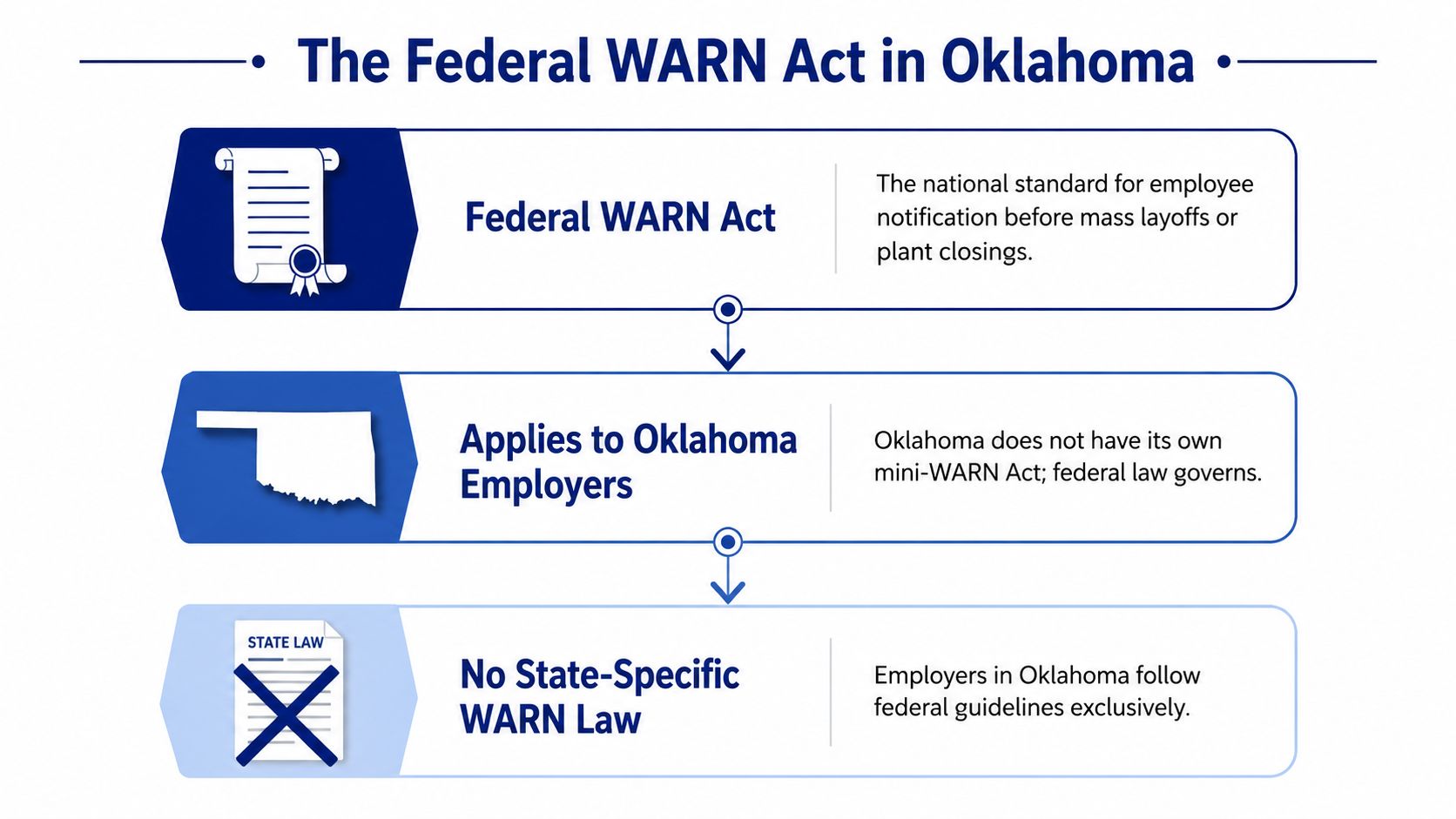
That sounds simpler, and legally it is. Operationally, the simplification creates its own risk. Employers sometimes spend too much time looking for Oklahoma-specific notice rules and not enough time confirming whether the federal statute applies to their facts.
Multi-state employers run into this often. If your HR team also manages locations in states with mini-WARN laws, it is easy to import the wrong assumptions into an Oklahoma reduction in force. That can lead to wasted motion, delayed decision-making, or inconsistent communications. None of those help if the event later gets examined by counsel, employees, or a court.
The practical point is straightforward. In Oklahoma, the WARN analysis turns on one legal framework, not two.
That means employers should concentrate on the questions that affect exposure:
The absence of a state mini-WARN law does not reduce the need for discipline. It narrows where the legal work belongs.
I see confusion in two directions. Some employers overcomplicate Oklahoma and delay planning while they search for a state rule that does not exist. Others hear "no Oklahoma WARN Act" and assume the layoff can be handled informally. Both approaches create risk.
Federal WARN is only one part of the layoff picture. Selection decisions still need to be documented. Communication scripts still need to be controlled. Final pay, benefits, releases, and discrimination risk still need separate review. For teams that need help organizing timelines, drafts, and supporting records, targeted employment law paralegal support can reduce administrative mistakes while leadership and counsel make the legal calls.
The clean takeaway is this: stop searching for an Oklahoma-specific mini-WARN statute. Apply federal WARN correctly, and put your time into the parts of the analysis that decide whether notice is required at all.
A lot of Oklahoma employers lose time on the wrong question here. They ask whether some separate Oklahoma threshold applies, then miss the harder federal question that controls exposure: does this employer meet WARN's coverage test?
For most private employers, coverage starts with employer size under the federal statute and regulations. The U.S. Department of Labor's WARN Employer's Guide explains that WARN generally applies to businesses with 100 or more employees, with special counting rules for part-time employees and an alternative hours-based test.

That is where the analysis usually gets sloppy. A payroll headcount, an HRIS snapshot, and a WARN count are not always the same thing. Federal WARN uses its own definition of part-time employee, and that definition affects whether the business is covered at all.
Start with the active roster for the period you are analyzing. Then sort employees using WARN's terms, not your internal labels. Someone carried as active in payroll may still be excluded from the coverage count if the person has short service or low average weekly hours under the statute.
The Cornell Legal Information Institute text of 29 U.S.C. § 2101 is the cleanest place to confirm those definitions. It lays out who counts as a part-time employee for WARN purposes and frames the employer-size test you need to apply before you get into notice timing or event analysis.
Use a disciplined screen:
That last point matters more than many teams expect. Employers sometimes stop after concluding they do not have enough full-time employees, but WARN can still apply under the alternative test tied to aggregate weekly hours. The statute is technical enough that a quick finance estimate is not a reliable answer.
The common failure is treating coverage as a casual planning assumption instead of a documented legal conclusion. Leadership says the company has "around 100 employees," HR pulls a rough spreadsheet, and the layoff plan keeps moving. If the count is close, that approach creates avoidable risk.
I advise clients to build the count from source records they can defend later: hire dates, average hours, leave status, and site assignment. That takes more effort on the front end, but it is far cheaper than explaining a bad threshold call after notice was skipped.
This issue also shows up when a company starts designing the broader layoff before confirming whether WARN applies. If you are still shaping the overall action, this guide on what is a reduction in force helps separate the business planning work from the WARN coverage analysis.
Before leadership approves any reduction, HR and counsel should be able to answer these questions with supporting records:
| Question | Why it matters |
|---|---|
| Which employees meet WARN's part-time definition? | Coverage depends on WARN-specific counting rules |
| Which employees have short service under the statute? | They may be excluded from the main threshold |
| Are average weekly hours documented, not estimated? | Hour-based exclusions need support |
| Does the workforce require analysis under the alternative hours test? | A part-time heavy operation can still be covered |
If the count is close, do not rely on impressions. Reconcile the roster, document the exclusions, and make the coverage call from records you would be comfortable producing in litigation.
A common Oklahoma mistake happens here. Leadership assumes there must be a separate state layoff trigger under an "Oklahoma WARN Act," then analyzes the reduction under the wrong framework. There is no Oklahoma mini-WARN statute to fall back on for private employers. The question is whether the planned action triggers notice under the federal WARN Act, applied to the facts at the affected site.
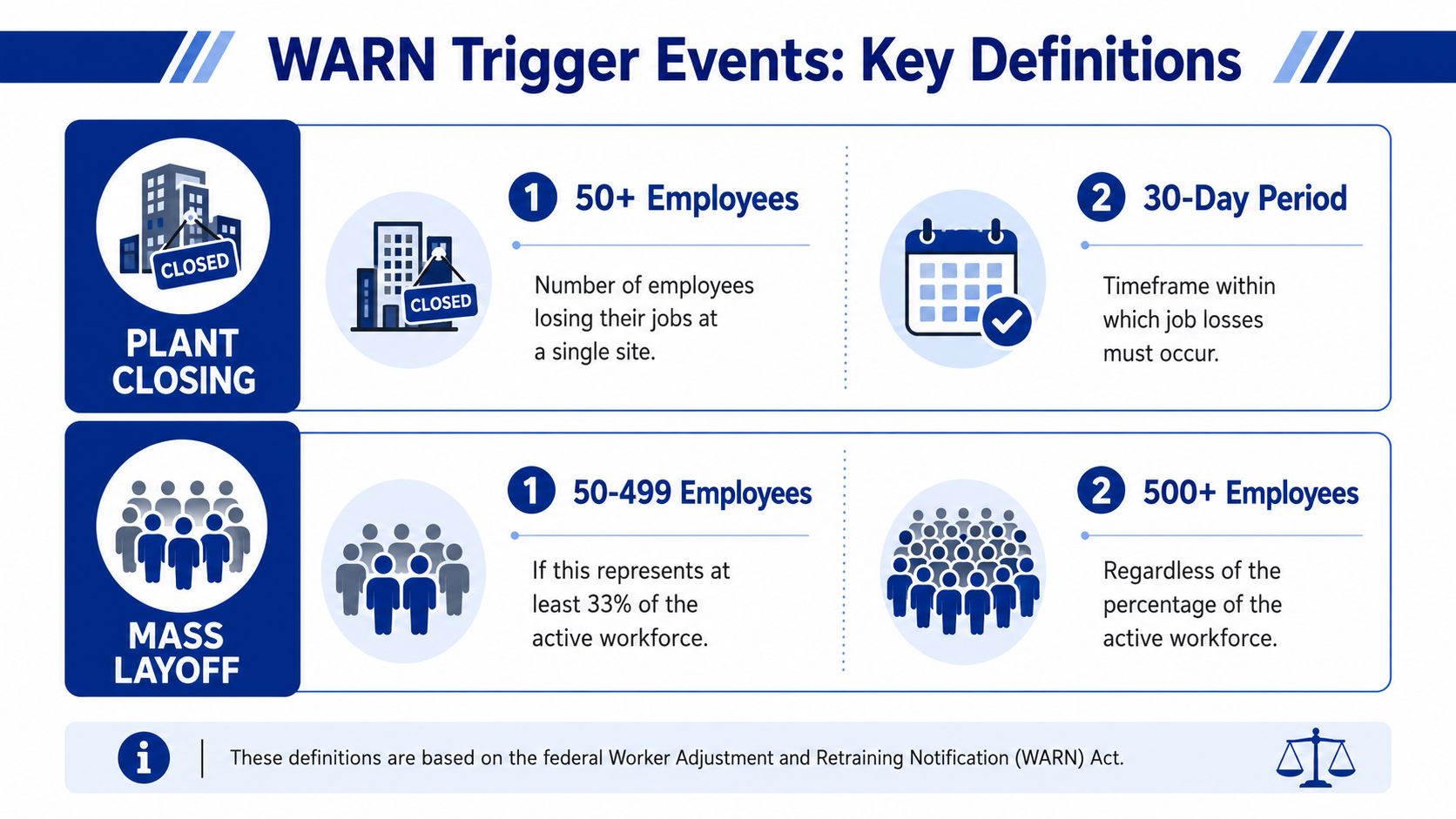
Two trigger events drive the analysis: a plant closing and a mass layoff. The U.S. Department of Labor explains both in its WARN Employer's Guide. A plant closing generally involves shutting down a single site of employment, or an operating unit within that site, where the shutdown leads to enough employment losses during the measuring period. A mass layoff is different. The site stays open, but the number of employment losses at that single site reaches the federal threshold.
That distinction matters because employers often describe the decision in business terms that do not match the legal test. "Restructuring," "rightsizing," and "efficiency plan" are internal labels. WARN looks at what is happening, where it is happening, and how many employees at that site suffer an employment loss within the statutory period.
I tell clients to test the event in this order:
| Business scenario | WARN issue to answer |
|---|---|
| "We are shutting this location" | Is this a site shutdown or operating-unit shutdown that causes enough employment losses? |
| "We are keeping the site open but cutting headcount" | Do the losses at that site reach the mass layoff threshold? |
| "We are doing this in stages" | Do separate rounds need to be aggregated within the statutory look-back period? |
The single-site point is where companies get into trouble. A company may announce one statewide reduction, but WARN is not measured by the statewide total. It is measured site by site. In Oklahoma, that matters for employers with operations spread across Tulsa, Oklahoma City, Norman, or smaller field locations. A broad reduction can fall below the trigger at each site, or a smaller overall reduction can still trigger WARN if one site carries most of the losses.
Phased layoffs also need discipline. If management intends multiple rounds, HR should not evaluate each round in isolation without checking whether the losses may be counted together under the federal rules. A staggered plan can still produce a WARN event.
If the business is still shaping the reduction itself, this guide on how to handle layoffs is useful for sequencing decisions and communications while the legal analysis is still being built.
A defensible trigger analysis usually answers four points with precision: the affected site, the type of action, which employees will experience an employment loss, and the timing of those losses. If any of those facts are still vague, the WARN call is premature.
Once an Oklahoma employer confirms that WARN applies, the next risk is execution. I see companies spend days modeling severance and only hours on the notice package. That is backwards. WARN is a written notice law with timing and content rules, and the notice has to reach the right recipients before the employment loss occurs.
That point matters in Oklahoma because employers sometimes assume there is a separate state WARN form or state-specific mini-WARN process. There is not. The governing rule is the federal WARN notice framework, and Oklahoma employers still have to send notice to the state rapid response contact, local government, and any union representatives.
A compliant process covers every required audience, not just employees.
The recipient list usually includes:
Missing one recipient can create avoidable exposure even if the company got the timing right for everyone else.
A WARN notice should read like a business record, not a morale memo. It needs enough detail for employees, government officials, and labor representatives to understand what is happening and when.
The U.S. Department of Labor's employer guidance explains that notice content should address whether the action is expected to be permanent or temporary, identify the worksite, state the expected date of the first separation and any schedule for later losses, list affected job titles and the number of affected employees in each category, explain whether bumping rights exist, and provide a company contact name and telephone number in this DOL WARN notice guide.
Use that list as a drafting standard.
Short, generic notices cause problems. So do notices that hedge on basic facts the company already knows. If the date, site, or scope is still changing, label the estimate carefully and update the notice process as facts become firmer.
Severance does not replace notice. Pay in lieu does not replace notice either.
The Department of Labor's WARN FAQs state that the law does not provide an alternative such as paying employees instead of issuing notice in this DOL WARN FAQ.
That is the practical line business owners need to remember. Severance is a strategy choice. WARN notice is a legal requirement. A company may decide to offer both, and many do, but those decisions should be documented separately so the file shows that the employer addressed the federal notice duty directly.
A defensible file usually includes the final recipient list, dated notice versions, proof of delivery, the timeline used to calculate the notice period, and the internal analysis supporting the trigger decision. That record often matters almost as much as the notice itself when the layoff is reviewed later.
A common Oklahoma mistake is assuming there is some state-level flexibility here because people talk about an "Oklahoma WARN Act." There is not. The risk analysis still comes back to the federal WARN Act, including its exceptions and remedies.
If an employer misses the notice requirement and no valid exception supports the shortened timeline, liability can include back pay and the value of lost benefits for each affected employee for the violation period, subject to the statute's cap. Courts may also award attorney's fees. The U.S. Department of Labor's Worker Adjustment and Retraining Notification Act overview is a useful starting point, but the practical takeaway is simpler. A layoff handled too fast can create wage exposure, benefits disputes, and litigation costs at the same time the business is trying to reduce expense.
The exception Oklahoma employers cite most often is unforeseeable business circumstances. The statute also recognizes other limited exceptions, including faltering company and natural disaster, in specific situations. The legal question is not whether the business had a good reason for moving quickly. The question is whether the facts fit the exception and whether the employer still gave as much notice as practicable.
That last point matters. An exception may shorten the notice period. It does not cancel the notice duty.
The statutory text is the best reference here. The federal WARN provisions at 29 U.S.C. § 2102 set out both the notice rule and the main exceptions.
When leadership believes an exception applies, the file should show disciplined judgment, not guesswork.
Many employers create avoidable problems. They focus on whether an exception sounds available in principle, but they do not build a record showing why it applied on the dates that matter.
One more correction is important. Employers sometimes hear that they can clean this up after the fact by paying people quickly. That is not how WARN works. As noted earlier, severance or pay in lieu does not replace notice. Post-event payments may affect damages analysis, but they do not erase a notice failure.
If a WARN issue has already occurred, speed still matters. Investigate the count, confirm whether the event triggered WARN, issue any notice that is still required, and get counsel involved before managers start making inconsistent statements about why the timeline changed.
That approach will not remove every risk, but it puts the company in a far better position than treating a federal notice duty as optional because Oklahoma does not have its own mini-WARN statute.
When employers strip away the confusion around the Oklahoma WARN Act, the decision path becomes more manageable. The challenge isn't memorizing legal language. It's confirming the facts in the right order and documenting each call carefully.
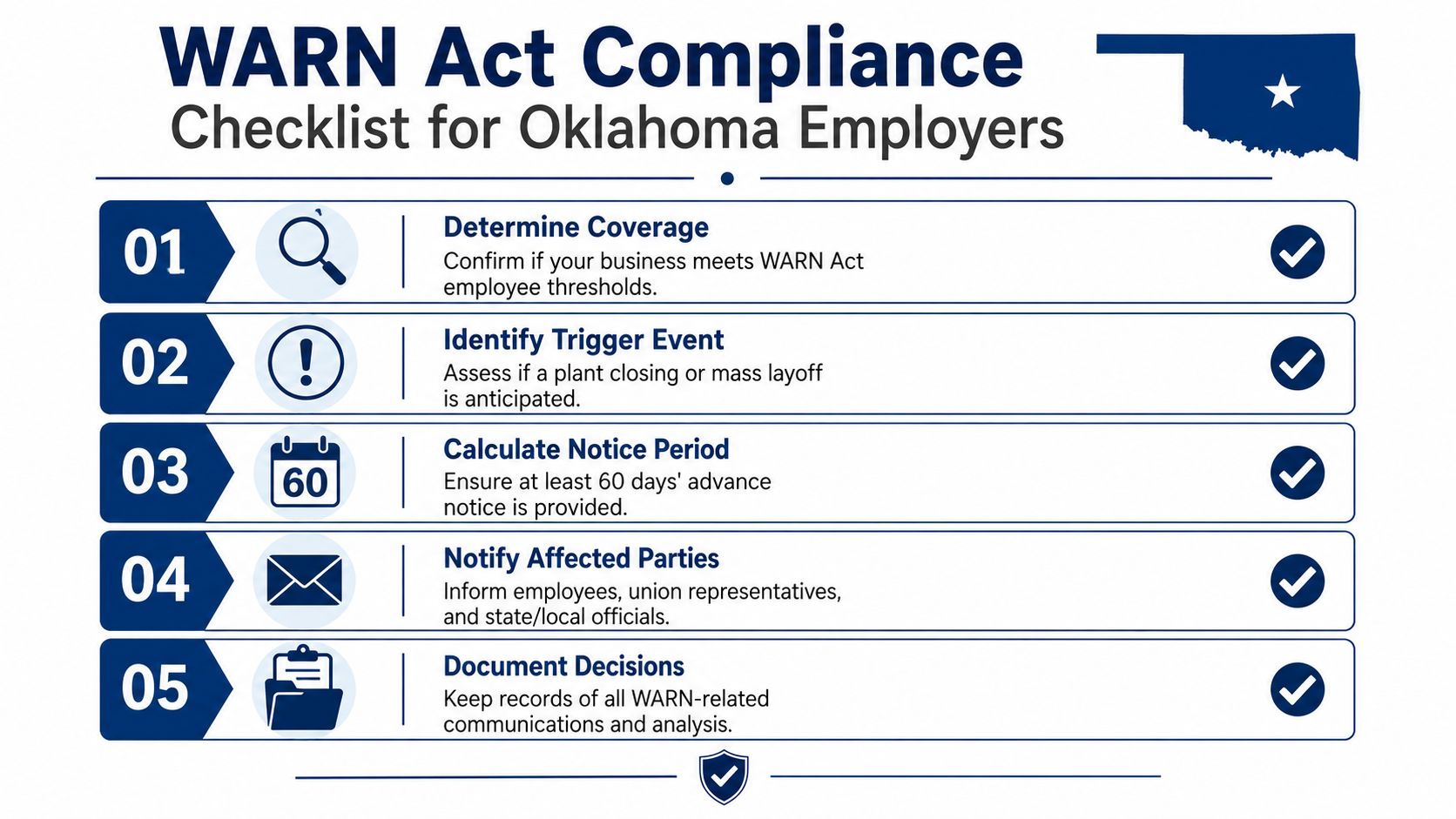
Use this checklist before any final announcement:
For teams that are tightening broader HR controls at the same time, this HR compliance checklist is a useful reference point. It helps place WARN planning inside the larger discipline of defensible employment practices. On the payroll side, layoffs also affect timing, deductions, and final compensation administration, so a practical refresher on understanding payroll regulations can help align HR and finance before notices go out.
The right process in Oklahoma is usually less about complexity and more about precision. If your organization is approaching a reduction and wants a steadier way to assess exposure, document decisions, and move carefully, you can contact Paradigm International Inc. to learn more.
If you're facing a possible layoff, site closure, or multi-state workforce reduction, Paradigm International Inc. can help you assess the risk, structure the process, and document decisions in a way that's practical and defensible. To discuss your situation, contact Paradigm International Inc..