
An employee loses a parent on Tuesday morning. Your manager wants to approve time off immediately, payroll wants to know which bucket to use, and your handbook still says bereavement leave is “manager discretion.” That’s where Colorado trips up a lot of employers. If you search for a simple bereavement leave colorado rule, you’ll find half-answers, outdated summaries, and one critical nuance that changes how you should run your policy.
The practical answer is straightforward. Colorado doesn’t require a standalone bereavement leave bank, but it does require employers to let employees use accrued paid sick leave for bereavement under the state’s Healthy Families and Workplaces Act. If your policy language, manager training, and payroll coding don’t reflect that reality, you’re creating avoidable risk.
A Colorado employee calls out after a sibling dies. The manager approves time off out of basic decency, then HR discovers the handbook treats bereavement as discretionary and payroll has no idea whether the absence should be paid. That is the compliance failure point.
Colorado does not require a separate bereavement leave bank. The state’s rule works differently. Bereavement time is tied to paid sick leave under the Healthy Families and Workplaces Act, which means employers need to treat many bereavement-related absences as a lawful use of accrued HFWA leave. Employers looking for a standalone summary of Colorado bereavement leave rules and how they fit into state leave laws need to keep that structure front and center.

Employers get tripped up by labels. “Bereavement leave” sounds like an optional perk. In Colorado, the legal issue is whether your paid sick leave policy allows eligible employees to use accrued leave after a family member’s death for covered purposes such as grieving, attending services, or handling related matters.
That distinction matters because handbook language drives frontline decisions. If your policy says bereavement leave is unpaid, subject to manager approval, or restricted in a way that ignores HFWA usage rights, you increase the odds of an improper denial. You also make it harder for payroll and HR to document leave consistently.
Practical rule: Treat bereavement in Colorado as a paid sick leave compliance issue first. Then decide whether you want to add a separate employer-funded benefit on top.
A better policy also helps with employee relations. Legal compliance is the floor. Market expectations are often higher, and many employers choose to offer additional compassionate leave for grieving families so managers are not forcing employees to drain a limited statutory bank during a major loss.
For Colorado employers and multi-state businesses with Colorado workers, the right setup is straightforward:
If you remember one point, remember this. In Colorado, bereavement leave is not mainly a question of whether you offer a standalone benefit. It is a question of whether employees can use accrued HFWA leave when the law says they can.
A Colorado employee tells a supervisor, “My aunt died. I need a few days to travel for the service and handle paperwork.” If your manager treats that as a discretionary bereavement request instead of a paid sick leave request under Colorado law, you have a compliance problem.
That is the key operational rule. In Colorado, bereavement-related time off often sits inside HFWA administration, not outside it. Your handbook, request process, and manager training need to reflect that reality.
Your Colorado paid sick leave policy should say, in plain language, that employees accrue paid sick leave and may use that accrued time for qualifying bereavement purposes. If you need the broader state-by-state context, see our guide to bereavement leave laws and Colorado HFWA coverage.
At a minimum, your written policy should address:
Many employers still get this wrong. They draft a narrow bereavement policy, leave paid sick leave in a separate section, and create a conflict between the two. Colorado will not honor the conflict in your favor.
HR should focus on the reason for the absence, not the label a manager puts on it. If the employee needs time because of a covered family member’s death, review the request under HFWA.
Common qualifying uses include:
Keep the intake process simple. A grieving employee should not have to guess which dropdown option protects their rights.
Do not let supervisors apply their personal view of who counts as family. That is how employers create inconsistent decisions, employee complaints, and bad records.
Your Colorado process should use the HFWA family-member standard that applies to paid sick leave. If your standalone bereavement policy recognizes only a narrow list of relatives, but HFWA is broader, the HFWA rule controls for statutory leave use. HR should make that call, not a frontline manager.
A clean rule works best: any death-related request that may fall under HFWA goes to HR or leave administration for review.
If your documents and workflows are not aligned, correct them before the next request hits a supervisor’s inbox:
Precision matters here. If a Colorado employee loses a family member, your team should know exactly how to classify the request, how to pay it, and who reviews it. That is what defensible compliance looks like.
Legal compliance is the floor. It isn’t your talent strategy, and it isn’t your culture.
Colorado employers already knew this before the law changed. An Employers Council 2022 Paid Time Off Survey found that 87% of participating Colorado employers offered paid bereavement leave averaging 4 days, according to the Employers Council discussion of Colorado bereavement practices. That’s the market signal business owners should pay attention to.
If you offer only the legal minimum and nothing more, you may be compliant. You may also look out of step with your labor market, especially if you compete for experienced professionals, healthcare staff, managers, or client-facing talent.
HFWA gives employees access to accrued paid sick leave. That’s useful, but it has limits. The employee may not have enough accrued time when the loss happens. The employee may need time for travel, services, estate tasks, and recovery. And if your policy forces them to drain sick leave for bereavement, they may have little paid protection left for their own health needs later.
That’s why I recommend separating two questions:
Those are not the same question.
| Policy Element | HFWA Minimum Requirement | Recommended Best Practice |
|---|---|---|
| Leave structure | Use of accrued paid sick leave for qualifying bereavement purposes | Keep HFWA rights intact and add a separate bereavement benefit where possible |
| Amount of paid time | Based on accrued balance, subject to the 48-hour annual HFWA cap | Offer a dedicated paid bereavement allotment that doesn’t force employees to exhaust sick leave first |
| Trigger for eligibility | Qualifying death-related use under Colorado paid sick leave rules | Clear eligibility language plus examples for funeral travel, arrangements, and administrative tasks |
| Administration | Track through paid sick leave process | Track statutory leave and employer-provided bereavement leave separately in HRIS and payroll |
| Manager discretion | Not appropriate for statutory entitlement decisions | Use limited discretion only for supplemental leave beyond the written policy |
| Employee communication | Explain right to use accrued leave | Explain both the legal minimum and any company-provided enhancement in plain language |
For most multi-state businesses, the cleanest policy model is this:
The smartest policy is easy to explain in a hard moment. If a manager needs ten minutes to figure out whether an employee can attend a funeral, the policy is poorly designed.
Owners waste time and create risk. A generic handbook often treats bereavement as a simple perk with a fixed number of days and a rigid relationship list. That approach may ignore Colorado’s paid sick leave rights entirely.
A better draft does three things at once. It preserves statutory compliance, gives managers a clear playbook, and meets employee expectations in a crisis. If you’re trying to choose between “compliant” and “competitive,” choose both. Colorado employers have already shown that the market expects more than bare-minimum language.
A compliant policy still fails if managers respond badly in the moment. The first conversation matters. It shapes employee trust, documentation quality, payroll handling, and legal exposure.

Managers don’t need legal jargon. They need a short, calm response they can use without improvising.
Use language like this:
“I’m sorry for your loss. Take the time you need today, and we’ll work with HR to make sure your leave is handled correctly.”
Or this:
“Thank you for letting me know. Please focus on your family right now. I’m connecting HR so we can confirm your paid leave options and next steps.”
That response does three important things. It shows empathy, avoids a premature denial, and routes the matter to the right process.
The worst mistakes usually come from speed, not malice. Train managers to avoid these common errors:
Colorado administration gets touchy when employers ask for documentation too aggressively. Your documentation process should be measured and consistent.
A defensible approach looks like this:
If your team needs a broader framework for handling absences consistently, this guide on managing a leave of absence from work is a useful reference point for process design.
Too many companies get the conversation right and the coding wrong. That creates downstream trouble when an employee later claims they were denied paid leave or charged the wrong bank.
Your payroll and HR team should agree on these questions in advance:
When an employee reports a death, HR should move through a short sequence:
This doesn’t need to feel bureaucratic. It needs to feel steady. Grief is already disorienting. Your internal process shouldn’t add confusion.
Colorado is manageable on its own. Colorado inside a multi-state workforce is where problems multiply.
In multi-state operations, Colorado’s requirement that employees be allowed to use sick leave for bereavement stands apart from the 40+ U.S. states that have no mandate, which is why Colorado leave compliance for multi-state employers calls for geo-fenced policy appendices and warns that improper denials under HFWA can trigger claims and penalties. If your handbook uses one national bereavement paragraph for everyone, it’s probably too blunt for your actual risk profile.
A common mistake is tying leave rules to company headquarters. That’s the wrong lens. If an employee lives and works in Colorado, Colorado rules may apply even if the company is based elsewhere.
That means your remote workforce map matters. So does your HRIS setup. State-specific eligibility, accrual tracking, and handbook acknowledgments should align with the employee’s actual work location, not a corporate default.
A strong process usually includes these controls:
For broader strategy on distributed teams, this overview of remote worker compliance across states is worth reviewing.
Many leaders worry that state-specific rules will look unfair. That concern is understandable, but trying to force identical leave treatment across all states can create bigger compliance problems.
The smarter approach is consistent structure, not identical substance. Use one national framework for bereavement and paid leave, then layer state-specific rights where required. Explain internally that some benefits are company-provided and some are jurisdiction-driven. Employees can handle that distinction if your language is clear.
Uniformity is not the same as defensibility. In leave administration, the better goal is controlled variation.
Bereavement itself doesn’t automatically create federal leave rights, but grief can overlap with other protected situations. An employee may develop a serious health condition after a loss. Another employee may need a separate approved leave path after paid options are exhausted.
HR should think in sequences:
The risk isn’t only denial. The risk is fragmented administration. If payroll, HR, and managers each operate from a different understanding of the leave sequence, your records won’t hold up well when challenged.
A good Colorado bereavement leave process should survive three tests. It should be legally accurate, operationally clean, and understandable to a stressed employee who reads it for the first time after a death.
Use this as a direct audit list.
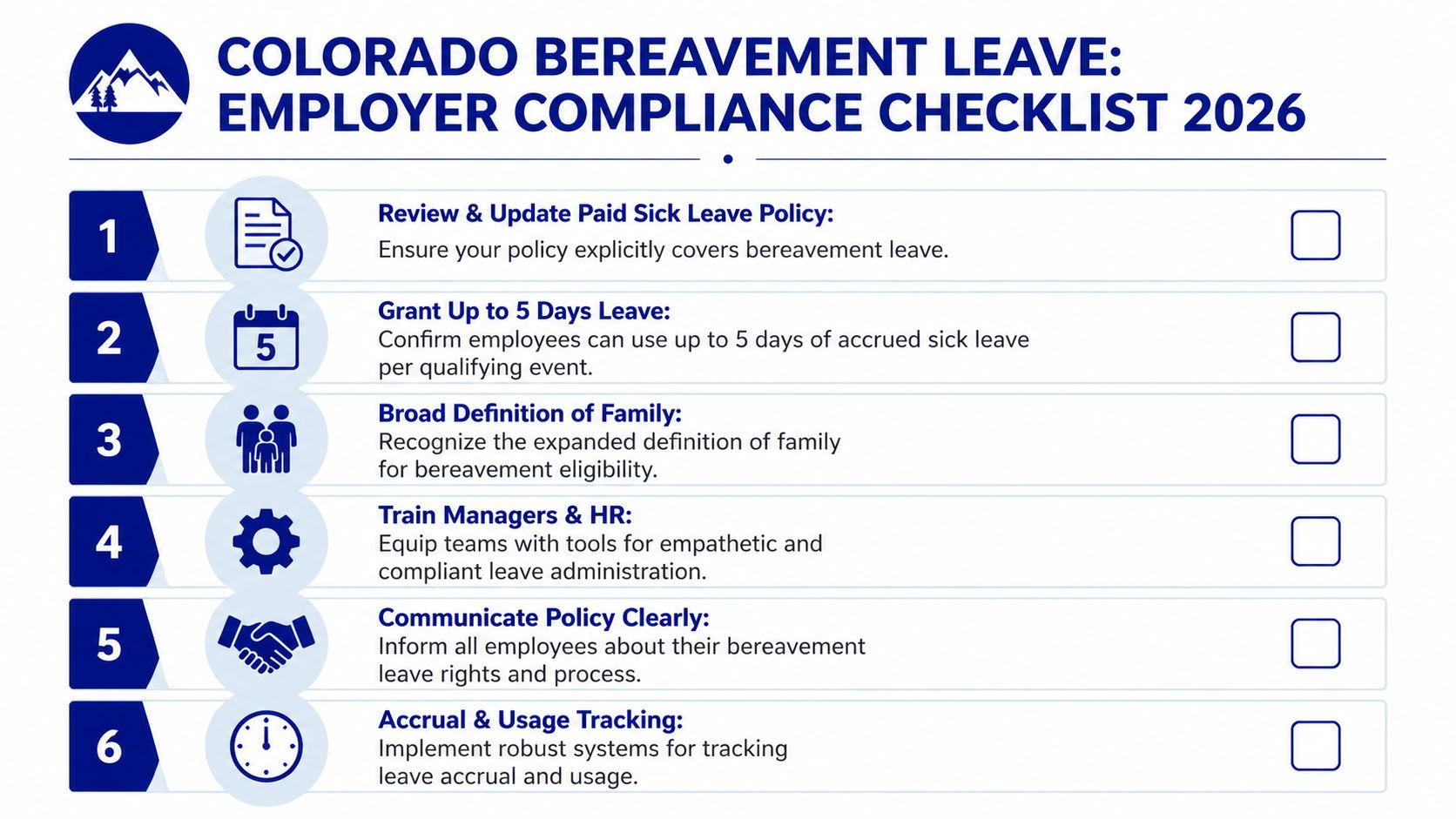
If your policy only makes sense to HR, it isn’t finished. Managers and employees need to understand it quickly and use it correctly.
A Colorado employee calls in after a death in the family. The manager wants to approve “bereavement leave,” payroll asks which leave bank to use, and HR realizes the handbook never explains that Colorado usually treats this issue through HFWA paid sick leave. That gap creates confusion fast.
Use these answers to tighten your process and keep decisions consistent.
No. Colorado does not require a separate bereavement leave bank.
What Colorado does require is allowing eligible employees to use available HFWA paid sick leave for covered bereavement-related reasons. If your policy ignores that point and only talks about a standalone bereavement benefit, you create compliance risk.
My recommendation is simple. State clearly that HFWA leave may be used for qualifying bereavement purposes. Then decide whether you also want a separate employer-paid bereavement benefit for recruiting, retention, and manager simplicity.
Yes, if the employee has no available HFWA leave left, there may be no statutory paid leave available for that request.
That does not end the analysis. HR should check whether the employee can use PTO, a separate bereavement benefit, unpaid time off, or another protected leave. Do not let front-line managers make that call casually. Require HR review and send a written response that identifies the leave type, pay status, and any next step.
Yes. Part-time employees can use HFWA leave for qualifying bereavement purposes if they are covered and have accrued available leave.
The compliance mistake is usually administrative, not legal. Employers assume part-time staff are ineligible or they apply a standard full-time allotment instead of using actual accrual records. Check timekeeping, accrual settings, and payroll codes before a real request exposes the error.
Yes, if the reason fits HFWA’s permitted bereavement-related use.
Do not write or apply your policy as if leave only covers the funeral service itself. Employees may need time for memorial events, arrangements, and related matters after the death. A narrow manager interpretation causes avoidable disputes and weakens your position if the employee challenges the denial.
Start with Colorado’s applicable family-member definition under HFWA, not with outdated handbook shorthand like “immediate family only.”
If your standalone bereavement policy is narrower than HFWA, the HFWA standard still controls for covered paid sick leave use. If you want cleaner administration, broaden the company bereavement policy so managers are not forced into fact-specific judgment calls they are not trained to make.
Yes, but control it carefully.
Do not ask for proof as a reflex when the employee first reports a death. Route documentation decisions through HR, keep any request limited, and apply the same process across similar cases. Intrusive or inconsistent requests create unnecessary employee relations problems and can invite claims that your leave process is being used to discourage lawful leave.
This is one of the hardest policy questions because many employers use the phrase “bereavement leave” loosely when the legal issue is really HFWA leave, plus any separate company policy.
There is still uncertainty around how grieving-related HFWA use applies in some pregnancy loss situations in the private sector, while some employers and institutions address the issue directly in their own policies, as shown in Colorado College’s bereavement leave policy example.
Do not leave this to manager discretion. Write a clear internal rule, coordinate it with medical leave and accommodation processes where needed, and require private HR handling.
Usually, yes.
The legal minimum covers compliance. It does not guarantee a policy that employees view as fair or that managers can apply without mistakes. A separate paid bereavement benefit often makes sense because it preserves HFWA sick leave for illness-related needs and gives your team a cleaner, more humane process during a family crisis.
Keep it direct. Confirm the approved dates or expected schedule, identify which leave bank applies, state whether the time is paid or unpaid, explain any documentation step, and name the HR contact handling follow-up.
The employee should not have to guess what happens next.
Treat that as a new review, not a default denial.
The next option may be PTO, unpaid leave, another statutory leave, or an accommodation analysis depending on the facts. Strong policies separate the first bereavement request from the later decision about extended time off, and they assign that second review to HR instead of the manager who took the initial call.