
A supervisor texts you that an employee “just got checked out” after a minor incident. Nobody is sure yet whether it was first aid, whether restrictions are coming, or whether HR even needs to do anything today. That's where many OSHA recordkeeping problems start.
The OSHA 300 Form often gets treated like paperwork you clean up later. In practice, it's a decision record that shows how your business classifies injuries, routes incident facts, and documents judgment under pressure. If that process is loose, the form will expose it.
For business owners, HR leaders, and operators with multiple sites or mixed labor models, the primary challenge usually isn't filling in boxes. It's building a process that gets the right facts to the right person quickly enough to make a defensible call. That's especially true when supervisors, staffing firms, clinic notes, and different state requirements all affect the recordkeeping trail.
If you're responsible for workplace compliance, the OSHA 300 Form sits at the intersection of safety, HR, operations, and legal risk. A case that looks simple on day one can turn into a recordkeeping issue, a workers' compensation issue, a supervisor training issue, or all three. Businesses that handle it well don't just know the form. They know how to move information.

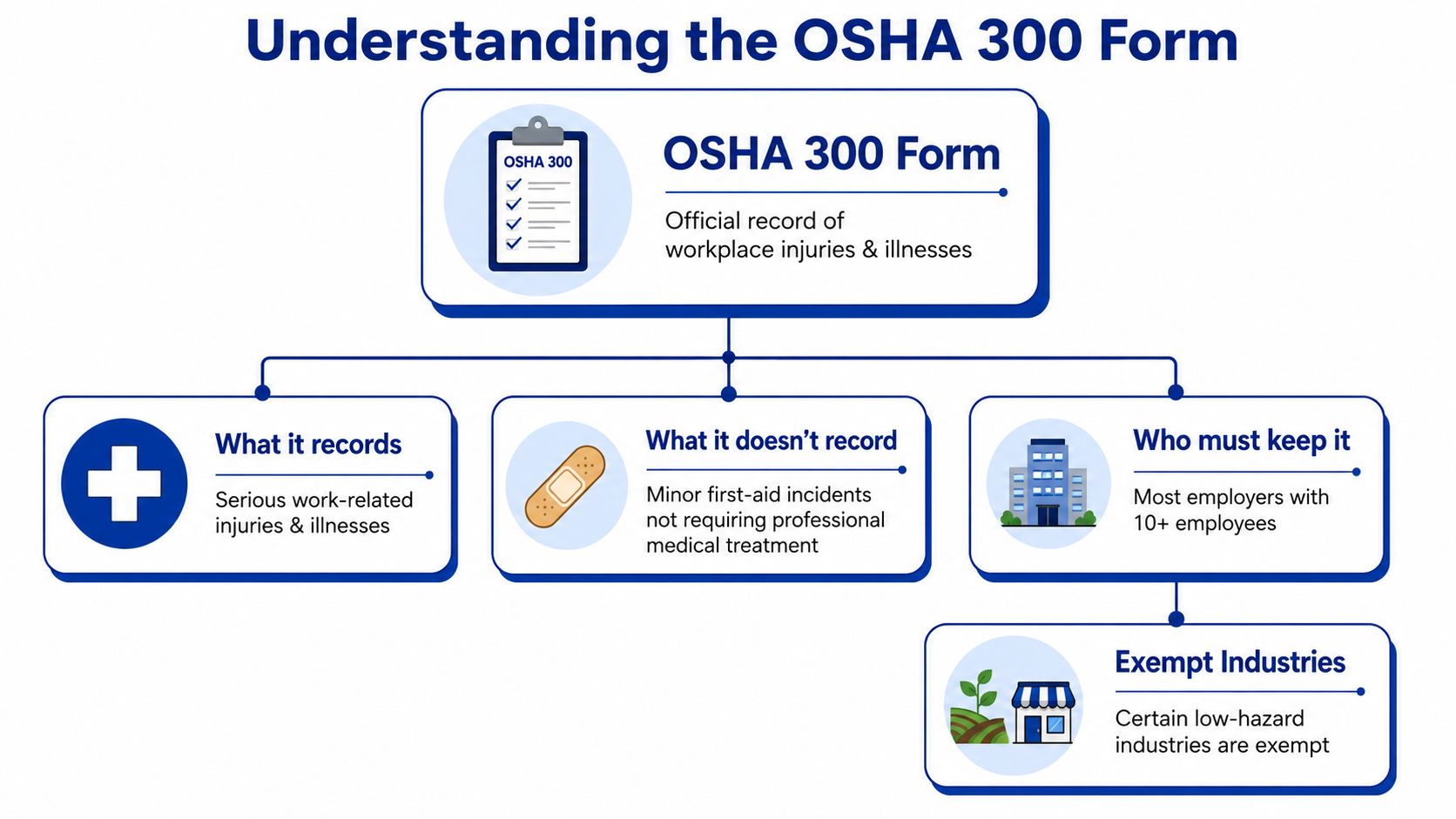
The form matters because it creates an official record of work-related injuries and illnesses that meet OSHA's recording rules. That record affects internal trend review, audit readiness, insurance conversations, and your ability to explain why a case was handled the way it was. A clean log suggests disciplined reporting. A messy one usually points to deeper operational gaps.
For many employers, the answer is yes. Most employers with more than 10 employees need to keep these records unless they fall into an exempt low-hazard industry category. Even when leaders assume they're outside the rule, the first step should be confirming employee count and industry classification rather than relying on old assumptions.
A practical way to think about it is this:
The OSHA 300 Form is rarely just an HR document. It's the output of a reporting system.
Leaders who treat it that way usually have fewer surprises. They also tend to have better documentation when a claim, audit, or internal review forces them to show their work.
The OSHA 300 Form is best understood as a classification log, not a narrative incident report. OSHA's own forms package explains that employers must code each recordable case by the most serious outcome, with death ranked above all other outcomes and “other recordable cases” as the least severe category in the hierarchy on the OSHA recordkeeping forms package. That design matters because it forces consistent severity triage across cases.
When businesses misunderstand this, they often over-focus on the incident story and under-focus on the classification decision. The story still matters, but it belongs in the supporting incident documentation. The log itself is designed to show what happened in a structured, comparable way.
A narrative can be inconsistent from one manager to another. A classification framework is more defensible. When every case is coded by the most serious outcome, you reduce the chance that similar incidents get treated differently because one supervisor writes better notes than another.
That has practical value in at least three situations:
Practical rule: If two similar cases would land in different columns depending on who reported them, your process needs tightening before your form does.
Many private employers do. As a general business test, employers with more than 10 employees often need to maintain the log unless they qualify for a low-hazard industry exemption. The key point for leadership teams is not to guess.
Use a simple internal check:
| Question | Why it matters |
|---|---|
| Do you have more than 10 employees? | Employee count affects whether the recordkeeping rules generally apply. |
| What industry classification applies to the establishment? | Exemptions often turn on industry category, not what leaders casually call the business. |
| Do you have multiple establishments? | Recordkeeping duties may need to be managed at more than one operating location. |
Exempt status is one of those areas where organizations get comfortable too early. A professional services business with warehouse activity, field staff, light manufacturing, or clinical operations can't rely on a broad label like “office-based” if the actual establishment profile is more complicated.
It is not your complete investigation file. It is not the same as workers' compensation paperwork. It is not a place to explain every fact in prose.
It is also not a list of every minor issue that occurs at work. Small incidents may still require internal reporting, supervisor follow-up, or first-aid documentation without becoming OSHA-recordable cases. That distinction is where many businesses either over-log or under-log.
For owners and operators, the most useful mindset is simple. The OSHA 300 Form is a structured legal record that sits on top of a much larger operational process.
Recordability is where most businesses struggle. The question isn't whether something happened at work in a general sense. The question is whether the case meets OSHA's recording criteria after you evaluate work-relatedness and outcome.
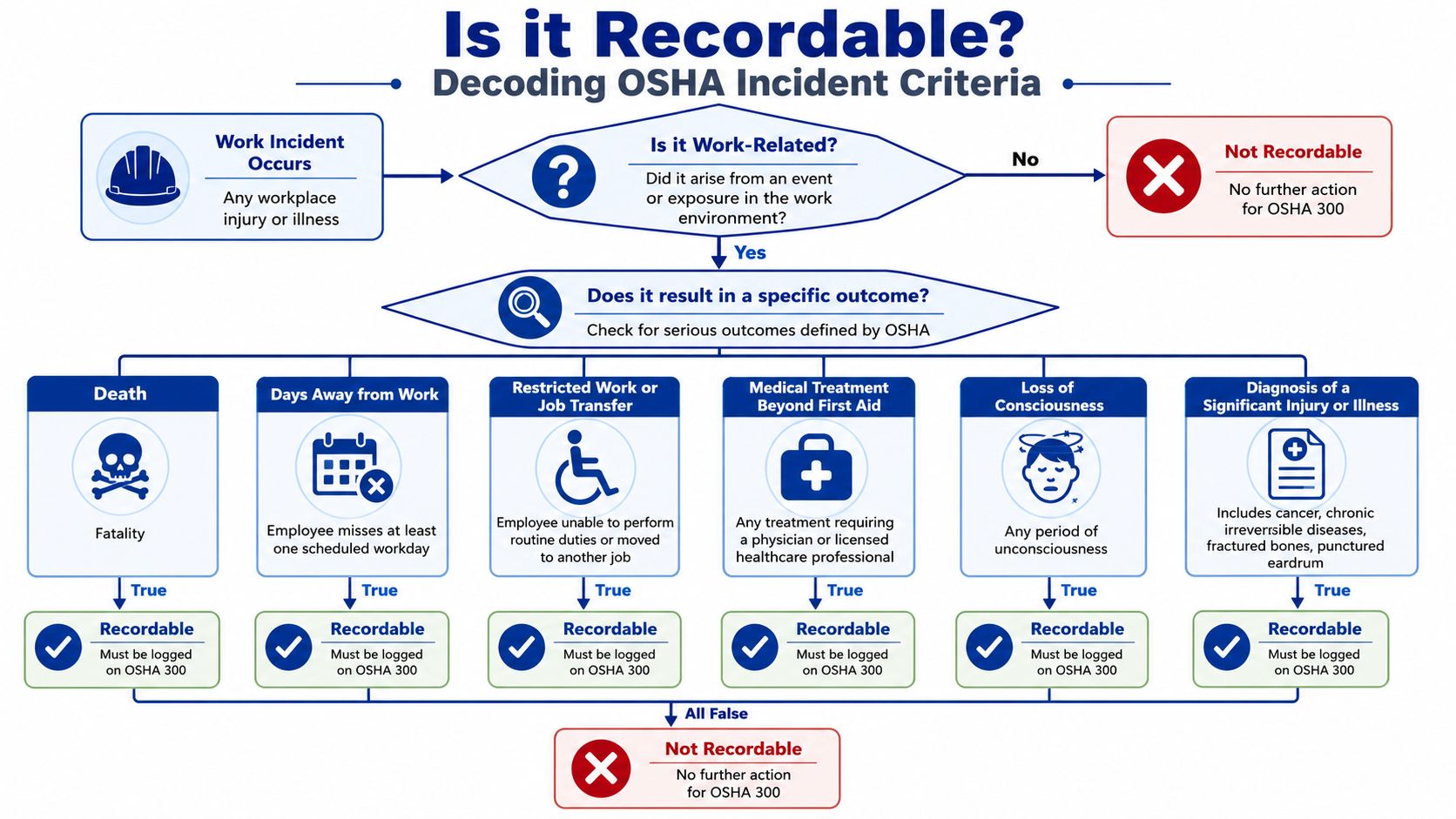
That's why frontline intake matters so much. If the first report is vague, late, or missing key facts, the business may end up making a classification call with incomplete information. Strong incident reporting best practices help because they improve what supervisors capture before memories fade or documentation gets fragmented.
Use a disciplined sequence instead of jumping straight to “put it on the log” or “leave it off.”
Businesses get into trouble when they skip from step one to step four because someone “thinks it probably counts.” Good-faith instincts aren't enough when the record has to stand up months later.
This is often the hardest line to hold consistently. Many incidents look minor at first, then change once a clinician imposes restrictions, prescribes treatment, or diagnoses something more significant. The mistake is locking in a casual label too early.
A useful internal approach is to separate these questions:
Don't classify the case based on what someone expected to happen. Classify it based on the facts you can support.
This is one reason many teams benefit from a standard review path tied to incident intake, clinic documentation, and HR or safety review. If your current process is informal, a more structured approach like the one described in this OSHA recordkeeping compliance guide can help leaders build a better decision trail.
Once a case is determined to be recordable, the log needs enough information to reflect the event clearly and classify it correctly. That includes the employee identifier, job title, date, where the event occurred, a brief description, and the appropriate outcome category.
The quality test is straightforward. Another reviewer should be able to understand why the case landed in that classification without needing to reconstruct the entire incident from memory.
Many employers assume the hard part is deciding whether a case is recordable. In reality, the hard part is often getting from first notice to completed log entry without delay, confusion, or inconsistent documentation. The form itself is manageable. The workflow around it is where businesses stumble.

OSHA recordkeeping rules require employers to classify a case on Form 300 within seven calendar days of learning that the incident is both work-related and recordable, and the linked Form 301 incident report captures the underlying facts supporting that entry, as explained in this OSHA Form 300 timing overview. The important operational point is that the clock starts when the employer has enough information to recognize recordability. It doesn't wait until every medical detail is finalized.
The first two steps happen before anyone touches the form.
This is why “HR handles OSHA logs” is only partly true. HR may maintain the record, but supervisors and site leaders usually control the speed and quality of the facts.
Once recordability is confirmed, complete the log entry with discipline.
| Form area | What to focus on |
|---|---|
| Employee and case details | Match names, titles, dates, and locations to your underlying records. |
| Description of injury or illness | Keep it brief, factual, and specific enough to understand the event. |
| Classification column | Choose the most serious outcome, not every outcome that might apply. |
| Days away or restriction tracking | Count consistently and update the entry if the case develops further. |
A common error is trying to make the log carry every nuance of the event. It shouldn't. Use it as a clean summary record, then maintain the fuller support file separately.
What works in practice is a short, repeatable chain of responsibility. Supervisor reports the incident. Operations or safety gathers initial facts. HR or a designated reviewer applies the recordkeeping standard. Someone owns follow-up if restrictions or time away change the classification picture.
What doesn't work is waiting for “final paperwork” before anyone reviews the case. That approach sounds cautious, but it often creates avoidable compliance risk because the deadline isn't tied to perfect certainty.
If your process depends on a single person remembering to chase clinic notes days later, it isn't a reliable OSHA recordkeeping process.
The businesses that stay out of trouble usually make one structural shift. They stop treating the OSHA 300 Form as an annual admin task and start treating it as a live workflow with clear owners.
The most expensive OSHA 300 Form mistakes usually don't come from handwriting or formatting errors. They come from wrong ownership, slow routing, and fragmented supervision. Those issues are harder to spot because the form looks complete even when the process behind it is weak.
One of the biggest blind spots is responsibility for workers supplied by staffing firms or used across decentralized operations. OSHA's recordkeeping rule says employers must record injuries and illnesses for workers they supervise on a day-to-day basis, including temporary help workers, and the Teamsters summary of the rule also notes that California's Cal/OSHA requires the log and incident report to be completed within seven calendar days once a recordable case is known, as discussed in this recordkeeping rule explanation.
That matters because many businesses assume the staffing agency owns the record just because it owns payroll. That assumption can leave a case unlogged when the host employer controlled the daily work.
A practical review question is simple: who directed the worker's tasks, monitored the work, and would have been first to know about the incident? In many host-employer environments, that answer drives the recordkeeping duty more than the employment contract does.
The second major pitfall is decentralized reporting. A single-site business can sometimes get away with informal communication because everyone knows whom to call. A multi-site operator usually can't.
Watch for these patterns:
The compliance failure often starts before the form is touched. It starts when the incident doesn't move.
Some cases require extra care because the log itself isn't the only concern. Sensitive situations may raise privacy issues, employee-relations concerns, or state-specific handling questions. Leaders need a process that protects confidentiality while still preserving a complete internal record.
That usually means separating three functions clearly:
Businesses with complex labor models often benefit from a written recordkeeping map that identifies decision-makers by site, backup reviewers, and escalation points for unusual cases. A specialized advisory firm provides that type of advisory support for organizations that need more structure around multi-state and high-exposure HR processes.
The OSHA 300 Form doesn't finish the job by itself. Recordkeeping is a cycle, and leadership teams need to manage the annual summary, retention, and any required submissions with the same discipline used for the original case entries.
The annual summary must be prepared and posted for employee visibility during OSHA's required posting window. The underlying records also need to be retained for the required period, along with the related incident reports and summary forms. If your broader records program is inconsistent, this is a good point to align OSHA files with your larger employment records retention requirements.
The practical risk isn't just missing a posting task. It's losing the relationship between the log entry, the annual summary, and the supporting incident documentation that explains why the case was classified the way it was.
Some establishments also have electronic submission obligations tied to OSHA's reporting framework. For leadership teams, that means the OSHA 300 process shouldn't sit in isolation from payroll data, establishment records, and executive certification workflows.
A useful operating model includes:
The strategic point is simple. The annual summary and related reporting requirements test whether your day-to-day recordkeeping process is trustworthy. If the underlying workflow is loose, year-end compliance becomes a scramble. If the workflow is disciplined, year-end tasks become an orderly review.
Strong OSHA recordkeeping doesn't start with the form. It starts with manager behavior, reporting discipline, and documented decision-making. That's why the OSHA 300 Form belongs inside a larger HR and operations framework, not on an island.
A defensible approach usually includes supervisor training, a standard intake path, a clear reviewer for recordability decisions, and periodic checks for consistency across sites. Businesses that are already strengthening broader HR compliance for businesses often find that OSHA recordkeeping improves when documentation standards improve across the board. A practical next step is reviewing your existing protocols against a working HR compliance checklist so incident reporting, documentation, and retention don't operate as separate systems.
The goal isn't perfection. It's a process you can explain, support, and repeat under scrutiny. If your organization needs help building a more defensible approach to OSHA recordkeeping and related HR risk decisions, you can contact Paradigm International Inc. to continue the conversation.
If your team is dealing with multi-state operations, decentralized managers, or inconsistent incident routing, a focused outside review can help you tighten the process before a recordkeeping issue turns into a larger compliance problem. Paradigm International Inc. works with leadership teams that need clearer structure, stronger documentation standards, and better decision support in high-risk employment environments.