
Handling human resources internally can feel overwhelming for any growing business. The complexity of multi-state labor laws, delicate employee relations, and ever-changing compliance rules creates a minefield of risk. This is why many small and medium-sized businesses (SMBs) now view outsourced HR services not just as an administrative time-saver, but as a core strategy for responsible, sustainable growth.
As a company grows, HR tasks become exponentially more complicated. What starts as simple payroll and hiring can quickly spiral into a web of legal obligations and high-stakes decisions. For a leader focused on operations or sales, keeping up with HR demands is a full-time job they don't have. This administrative weight can pull focus away from activities that actually generate revenue.
Outsourced HR offers a strategic solution. Instead of building an in-house department from scratch, you can partner with external professionals who specialize in these complexities. HR then transforms from a potential liability into a pillar supporting stable, compliant expansion.
Today’s employment landscape is filled with legal traps. A single misstep in handling a termination, a poorly documented performance review, or an incorrect employee classification can lead to a costly lawsuit. An outsourced HR partner provides the seasoned judgment needed to make defensible decisions every time.
Expert guidance is especially critical in a few key areas:
By engaging an outsourced HR team, business leaders gain a decision partner focused on shielding the company from risk. This frees you to scale your operations with confidence, knowing your HR foundation is solid.
If you’re ready to see how expert HR guidance can protect your business, we can help build a strategy that fits your needs. You can learn more by contacting our team.
Deciding to outsource your HR is a big step, but the next is choosing the right model. The world of HR outsourcing offers a spectrum of services, each designed for specific business needs. Selecting a partner that aligns with your company's size, risk tolerance, and long-term goals is critical for success.
The demand for expert HR support is booming. The global Human Resource Outsourcing (HRO) market is projected to grow from $190.68 billion in 2018 to $423.61 billion by 2033. This growth shows how many businesses are turning to outside experts to manage the increasing complexities of employment.
As your business grows, HR evolves from simple administrative tasks into a strategic function where the challenges constantly increase.
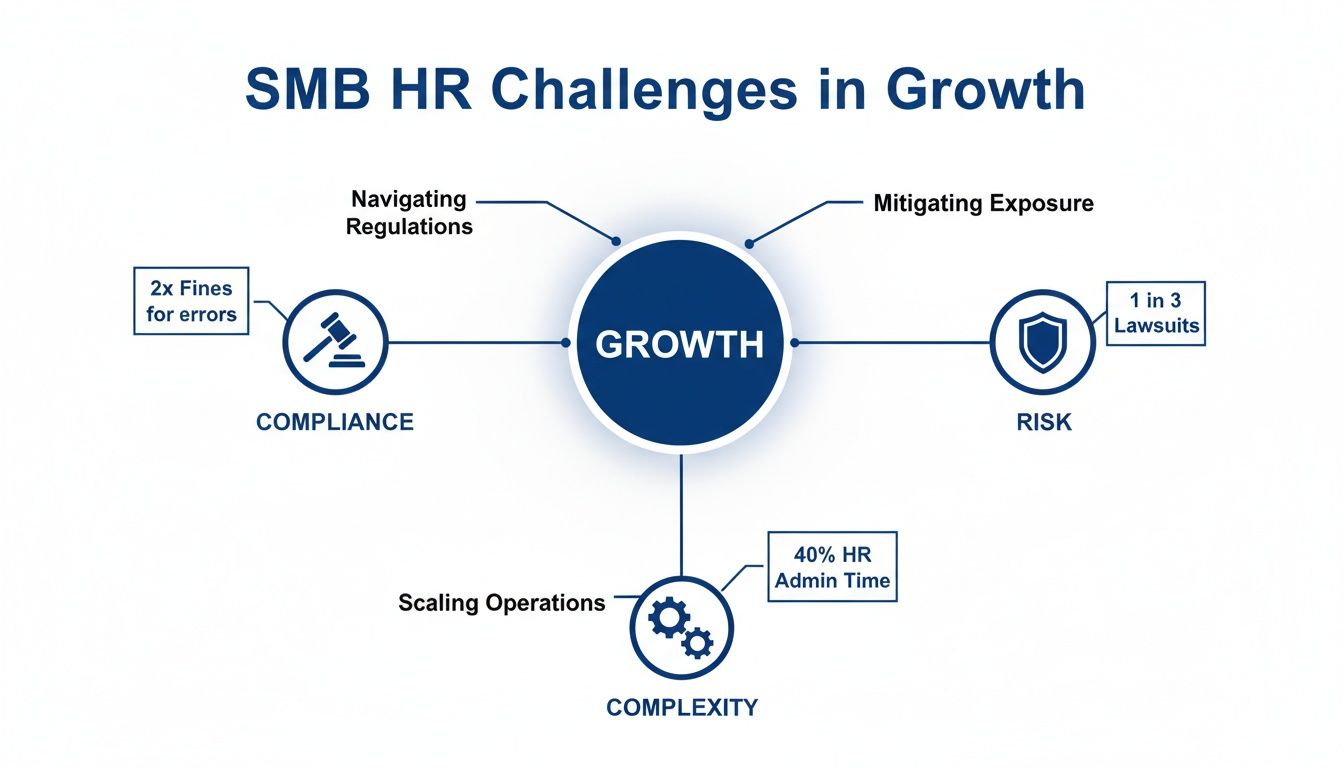
This visual highlights how growth brings a heavier compliance burden, operational complexity, and greater risk. This is the point where a sophisticated level of HR support becomes non-negotiable.
A Professional Employer Organization (PEO) offers the deepest level of HR integration. When you partner with a PEO, you enter a co-employment relationship. The PEO becomes the "employer of record" for tax and benefits purposes, while you maintain full control over daily work and business operations.
A PEO handles payroll, files taxes under its own ID, manages workers' compensation, and provides access to top-tier benefits packages. This model is a game-changer for smaller companies wanting to offer great benefits and offload the entire HR administrative burden. However, it does tie your business closely to the PEO's systems. To dig deeper, check out our guide on outsourced vs. in-house HR teams.
An Administrative Services Organization (ASO) delivers a similar set of HR services as a PEO, but without co-employment. With an ASO, your company remains the sole employer of record. All payroll and tax filings are processed under your company’s tax ID numbers.
Think of an ASO as an à la carte menu. You select specific administrative tasks to hand off—like payroll processing or benefits administration—while retaining full legal responsibility for your employees. This model is perfect for businesses that need to offload time-consuming administrative work but want to maintain their existing legal structure.
Finally, HR Advisory or Consulting Services provide high-level, strategic guidance rather than handling daily administrative tasks. This is the least integrated option but often the most strategic, acting as your on-demand expert for complex situations.
This model is like having an employment law specialist on call. You engage them when navigating a tricky termination, conducting a workplace investigation, or developing multi-state policies. An HR advisory firm serves as a strategic partner to your leadership team, bringing specialized expertise to prevent major risks. It's an ideal fit for businesses in highly regulated industries or those expanding into new states.
A helpful parallel can be found in other business services. This guide on Managed vs Co-Managed IT models offers valuable insights into finding the right operational fit for your needs.
This table provides a clear, at-a-glance comparison of the most common outsourced HR models to help business leaders choose the right fit.
Each of these models offers a distinct level of support. By understanding the core differences, you can find the approach that strikes the perfect balance of administrative relief and strategic guidance for your business.
Viewing outsourced HR as just a way to offload administrative tasks is a common mistake. For leaders focused on growth, it's a strategic move that strengthens the business far beyond simple cost savings. It builds a defensive shield, unlocks specialized knowledge, and frees you to focus on running and scaling your company.

This shift in perspective creates real value, turning HR from a reactive cost center into a proactive, strategic asset. Let's break down the three core benefits: airtight compliance, on-demand expertise, and renewed focus on your business goals.
For any business operating across multiple states or in a regulated industry, compliance is a critical function that protects you from serious legal and financial threats. Employment laws are constantly changing, and a single misstep with FMLA, wage-and-hour laws, or termination procedures can expose your business to significant risk.
An outsourced HR partner lives and breathes this complex legal landscape. They ensure your policies, employee handbooks, and documentation are not just current but truly defensible. This proactive approach turns compliance from a source of anxiety into a well-managed function, safeguarding your business from preventable legal battles.
No single in-house HR generalist can be an expert in everything. As your business grows, you will inevitably face high-stakes situations that demand specialized knowledge, such as a complex employee investigation or a reduction in force. An outsourced partner provides immense value by giving you access to a full team of specialists without the overhead of hiring them full-time.
Outsourcing HR gives you a deep bench of expertise. You get the judgment of an experienced investigator, the precision of a compliance specialist, and the foresight of a strategist, all available exactly when you need them. For example, an HR advisor can provide immediate, state-specific guidance to a company expanding into a new state, stopping costly mistakes before they happen.
Another key benefit is gaining access to expertise for effective employee benefits administration, often at a more competitive cost. This ensures you can attract and retain top talent with competitive packages managed by professionals.
Every hour your leadership team spends on HR administration is an hour not spent on strategy, innovation, or customer relationships. Outsourcing removes that burden, allowing your key people to concentrate on activities that drive revenue and growth. This isn't just about saving time; it's about reallocating your leadership's attention to where it matters most.
The efficiency gains are significant. SMBs using outsourced HR services can see a 21% boost in HR delivery efficiency by integrating modern workplace technology, according to market analysis. This allows leadership to focus on strategic moves instead of getting bogged down in administrative tasks. You can find more insights on these market trends on Technavio.
By delegating HR functions to a trusted partner, you create the bandwidth needed for sustainable growth. It's a strategic alignment that ensures your HR practices support your business objectives rather than distracting from them.
If you're ready to transform your HR function from a drain on resources into a strategic asset, we're here to help. You can reach out to our team to discuss your specific needs.
Choosing the right HR partner is a high-stakes decision that can either fortify your business or create new, expensive headaches. When leaders rush the process or focus on the wrong criteria, they often end up in partnerships that fail to deliver. Knowing the common pitfalls is the first step toward making a confident choice.
A misaligned provider can leave you with generic advice that is useless for your industry or, worse, expose you to the very compliance risks you were trying to avoid. Let's walk through the most frequent errors business leaders make so you can steer clear of them.
One of the most dangerous assumptions is that HR is a commodity. Choosing a provider that offers generic, templated solutions is a gamble because effective HR depends entirely on context. A policy that works for a retail shop in one state could be a compliance disaster for a healthcare practice in another.
For instance, a national provider might offer a standard employee handbook. But if that handbook fails to address critical state-specific rules—like unique meal and rest break laws—the company is left completely exposed. That single oversight can lead to wage and hour claims that wipe out any savings from a "low-cost" plan.
Budget is always a factor, but making cost the only consideration is a recipe for disaster. When it comes to risk management and expert judgment, the cheapest option is rarely the best. Low-cost providers often limit access to real experts, relying instead on call-center support models where you may not get consistent advice.
When you're dealing with a sensitive termination or a complex employee investigation, you need seasoned judgment from someone who understands the nuances of employment law. Investing a bit more in a partner who provides direct access to experienced advisors is an investment in risk mitigation. The cost of one mishandled HR issue can easily dwarf the annual savings from a bargain provider.
Your outsourced HR partner should feel like a natural extension of your leadership team. If their communication style, values, or problem-solving approach clashes with your company culture, the relationship will be filled with friction. This goes deeper than just personal compatibility; it’s about ensuring they understand and respect your business's operational needs and goals.
Before signing an agreement, get a feel for their advisory philosophy.
A true partner takes the time to learn your business and offers guidance that is both compliant and practical. A transactional vendor, on the other hand, provides generic answers without considering the bigger picture. The right choice is a firm that offers both expert judgment and a genuine partnership.
Navigating these potential missteps is critical to finding an HR partner who will truly support your business. To discuss how a tailored, advisory-first approach can safeguard your company, feel free to contact our team.
Selecting an outsourced HR partner is a high-stakes decision that will shape your company’s culture, risk tolerance, and employee relations. To get it right, you must move beyond a simple price comparison and dig deeper. The goal is to find a true partner who brings expert judgment and precision, not just an administrator who checks boxes.

It all comes down to asking the right questions to understand how a provider thinks, operates, and handles pressure. This turns a daunting task into a clear, confident process focused on finding a firm that fits your operational reality.
Before you start looking at providers, get clear on what you need. Are you trying to offload administrative tasks like payroll, or is your bigger concern navigating multi-state compliance and complex employee situations? Nailing down your core needs is the first step.
From there, create a detailed scope of work. This document is your best tool for comparing providers and preventing misunderstandings.
Your scope should clearly define:
Not all outsourced HR services are created equal. You need a provider with proven, hands-on experience in your specific industry and operational environment. This is especially true if you are in a regulated field or have employees across multiple states. A generic, one-size-fits-all approach won't work when nuanced compliance knowledge is required.
Ask direct questions to gauge their depth. A provider’s answers will quickly reveal whether they are equipped to handle your unique challenges or are just selling a pre-packaged solution. Your business isn't generic, so your HR partner shouldn't be either. Look for a firm with a demonstrated track record of supporting businesses with similar complexities.
For businesses looking to scale, recruitment is a major component. The recruitment outsourcing market is projected to grow from $10.3 billion in 2024 to $25.8 billion by 2034. For SMBs, outsourcing this function can lead to 21% efficiency gains in HR and 18% in talent management, all while reducing exposure to hiring risks. You can explore the full recruitment outsourcing market analysis for more details.
This may be the most critical part of your evaluation. How does a potential partner handle high-stakes situations? Their advisory philosophy separates a true decision partner from a transactional vendor. You need to understand their process before you are in the middle of a crisis.
Ask specific, scenario-based questions to understand how they operate:
Their answers should demonstrate a structured, thoughtful, and defensible process. You are looking for a partner who values precision and risk mitigation over quick, templated answers. For a deeper look at this vetting process, check out our guide on how to select the right HR partner for your business.
Choosing a partner requires a systematic evaluation to ensure their capabilities and philosophy align with your business needs. This checklist provides a framework for asking the tough questions that reveal a provider's true value.
By methodically working through these areas, you can move past surface-level impressions and make an informed decision based on competence and alignment.
The service agreement is the blueprint for your partnership, so read every word to ensure it aligns with your scope of work. This document governs how the relationship functions, and the details matter.
Look for absolute clarity on these key points:
Choosing the right HR partner is a deliberate process of finding the right alignment. By focusing on expertise, process, and a clearly defined scope, you can select a firm that will become a trusted advisor as your company grows.
Engaging an outsourced HR partner is more than a tactical move to offload administrative work. It's a foundational strategy for building a resilient, responsibly growing business. The different service models solve unique problems, and selecting the right partner is critical for navigating the complexities of modern employment law.
In an environment of constant regulatory change, a trusted decision partner is essential for keeping risk in check. Having an expert in your corner to ensure your practices are defensible is invaluable, especially when handling sensitive situations. You can get a deeper look at this process by reading our guide on how to manage a defensible HR investigation.
The first step is to be honest about your company's specific risk profile and operational needs. That clarity allows you to find a partner who provides not just support, but true strategic judgment. When you’re ready to take that step, our team is here to help you find the right solution.
Ready to build a more defensible HR framework for your business? Contact our team today to learn how our advisory services can help protect your growth.
Bringing in an external HR partner is a significant decision, and it’s natural for business leaders to have questions. You want to be sure you are making a choice that supports your goals and protects you from risk. Here are answers to some of the common questions we hear from owners and executives exploring outsourced HR services.
Not at all. In fact, small and mid-sized businesses often gain the most value. Most SMBs lack the resources for a full-time, specialized HR team, yet they face the same compliance and employee relations challenges as large corporations.
An outsourced partner gives smaller companies access to enterprise-level expertise without the high cost of an in-house team. It levels the playing field, allowing you to manage risk effectively and focus on growth.
This is a common concern, but a good HR partner works to strengthen your culture, not replace it. A strategic HR advisory firm takes the time to understand your business's unique values and builds HR processes that reinforce your identity.
You maintain complete control over all business decisions and daily management. Your HR partner provides the expert guidance to ensure your people operations are consistent, fair, and legally sound, which in turn fosters a stronger culture.
There is no single price tag, as the cost depends on the service model and the scope of your needs. Pricing is typically structured in one of three ways:
While it is tempting to focus on the monthly fee, the real value lies in the costs you avoid. The expense of one mishandled termination or compliance mistake can easily exceed the annual cost of a quality HR partner.
A strong partnership begins with a structured onboarding process. A reputable provider will start with a deep dive into your business to understand your current practices, risk exposures, and long-term goals.
This discovery phase typically includes:
From there, your partner should present a clear action plan to address the most urgent risks first and build a solid foundation for ongoing support. The goal is a seamless transition that inspires confidence from the start.
Choosing the right partner is a critical step toward building a more stable and resilient business. To learn more about how expert HR guidance can support your company's growth and protect you from risk, we invite you to explore your options with us.
If you are ready to move forward with a trusted decision partner, contact us to learn more.