
Managing labor costs while maintaining legal compliance is a critical challenge for every business leader. At the heart of this challenge is the choice between overtime pay and compensatory time, a decision that frequently trips up private companies. The difference seems simple: overtime is a cash payment for extra hours, while comp time is paid time off granted instead. However, the legality of offering comp time depends entirely on whether you are a public or private employer, creating one of the biggest compliance traps in wage and hour law.
When your non-exempt employees work more than 40 hours in a week, the Fair Labor Standards Act (FLSA) dictates how they must be compensated. The default, and for most private businesses the only legal option, is overtime pay.
Compensatory time, or "comp time," is a tool almost exclusively available to public sector (government) employers. For private businesses, offering comp time instead of overtime is not a flexible perk; it is a direct violation of federal law. This mistake can lead to audits, back pay claims, fines, and costly litigation.
To clarify the distinction, here is a direct comparison of these two compensation methods.
To manage compensation correctly, you must understand the legal definitions set by the Fair Labor Standards Act (FLSA). The FLSA establishes the ground rules for how employees are paid for extra hours, making it the ultimate source of truth for your pay policies.
Under the FLSA, overtime pay is straightforward: it is cash paid at one-and-a-half times a non-exempt employee's regular rate for every hour worked over 40 in a workweek. Compensatory time is paid time off that accrues at the same 1.5x rate, given to an employee instead of cash.
Here is the most critical distinction for business leaders: while overtime is a universal requirement for non-exempt employees in the private sector, comp time is almost exclusively reserved for public sector (government) agencies. For private businesses, this is a firm legal line that cannot be crossed. Proper compliance often starts with drafting employment contracts that align with federal and state rules. For a deeper look at these regulations, our guide on Tampa HR FLSA compliance offers more detail.
The legality of offering comp time instead of overtime pay depends on one question: is your organization a public agency or a private business? This single factor is the root of many compliance failures, as private-sector leaders often mistakenly assume they can use comp time as a flexible, cost-saving tool. The reality is much stricter and carries serious financial risk.
The Fair Labor Standards Act (FLSA) draws a clear line. It explicitly allows government agencies to offer comp time under specific conditions while strictly forbidding private employers from substituting it for mandatory overtime pay. Understanding this distinction is the cornerstone of a defensible compensation policy.
For any private business, the rule is absolute. Non-exempt employees who work more than 40 hours in a workweek must be paid overtime. This payment must be in cash at a rate of 1.5 times their regular hourly wage. Federal law provides no flexibility for a private employer to offer—or for an employee to accept—comp time instead of this cash payment.
The FLSA’s prohibition on comp time in the private sector is designed to protect employees. It ensures they are compensated promptly for extra work and prevents employers from creating arrangements that might defer or deny earned wages.
Even if an employee requests or agrees to take comp time, the arrangement is legally void. An employee cannot waive their right to overtime pay, and any business that attempts such an arrangement is exposed to significant liability for unpaid wages, damages, and penalties.
In stark contrast, public sector agencies—such as state, county, or municipal governments—are permitted to provide comp time. This is only an option if a collective bargaining agreement or another formal agreement is in place before the work is performed. Under those conditions, public employees can accrue paid time off at a rate of 1.5 hours for every overtime hour worked.
This sharp divide is a significant compliance trap. Public employees can accrue up to 240 hours of comp time annually (or 480 hours for those in public safety), but private employers have no such flexibility. For more details, how comp time regulations work on BeforeSunset.ai offers a helpful overview.
This flowchart maps out the simple but critical compliance path for handling extra hours.
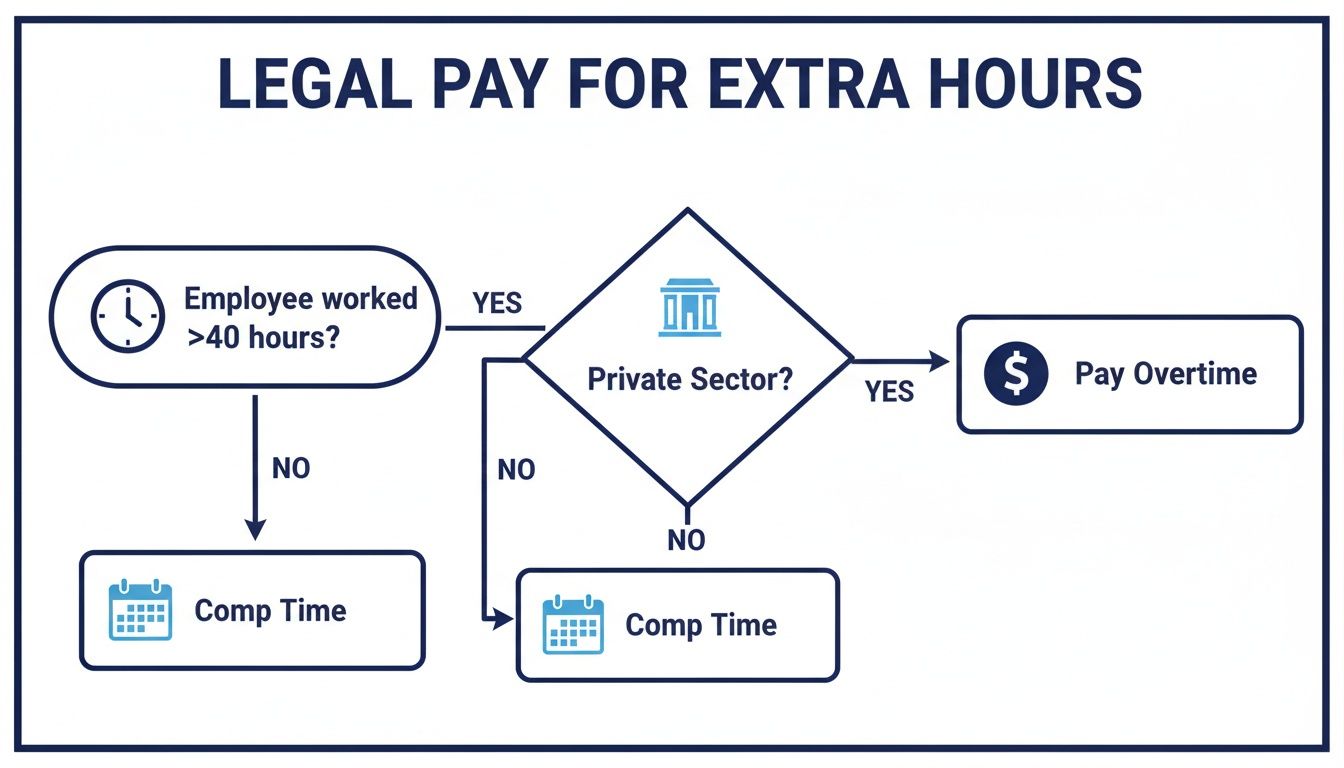
As the visual makes clear, the decision is straightforward. For a private business, the only compliant path for non-exempt employees working over 40 hours is to pay overtime.
To put these distinct rules into perspective, here's a side-by-side look at how the FLSA treats each sector.
This table reinforces the core takeaway: if you run a private company, the "overtime vs. comp time" debate is already over. The law has made the decision for you.
Understanding this clear legal separation is the first step toward building a compliant compensation strategy. Navigating complex wage and hour laws requires precision. If you need guidance on establishing defensible pay practices for your organization, connect with our team of HR risk advisors.
Beyond the legal requirements of the FLSA, the choice between overtime and comp time has significant financial and operational consequences. How you manage extra hours is a strategic decision that directly affects payroll, budgeting, and team productivity. It is important to look beyond the line-item labor cost to see the full picture.
Overtime pay is a direct, predictable, and immediate expense. When a non-exempt employee works extra hours, that cost appears on the next payroll run. This creates administrative simplicity, as your payroll system calculates the premium pay, and the expense is closed. However, this predictability can strain cash flow, especially for businesses with seasonal demand, where a sudden surge in overtime can cause a significant jump in payroll expenses.

While comp time is illegal for private employers, its financial model illustrates why the FLSA mandates cash overtime. Comp time does not eliminate a cost; it defers it. Instead of a straightforward payroll expense, it creates an accounting liability on your balance sheet for unused paid time off.
This liability grows with every hour of comp time an employee banks. If that employee leaves, all accrued time must be paid out at their current or final pay rate, which is likely higher than when they earned the hours. This creates a floating, unpredictable financial obligation that complicates long-term budgeting.
Operationally, the risks of comp time become even clearer. Overtime is a financial cost, but comp time introduces a scheduling and productivity risk. Imagine several key employees deciding to use their banked comp time at once, perhaps during your busy season.
This can cause major operational disruptions, including:
These trade-offs create different risk profiles. Overtime compensation is a visible budget expense, while comp time carries hidden operational risks. An analysis of the trade-offs between overtime and comp time on empmonitor.com shows how simultaneous use of accrued time can create staffing gaps, disrupt service, and force you to hire expensive temporary help.
For most small and mid-sized businesses, the predictability and administrative simplicity of cash overtime outweigh the complex liabilities and operational risks of comp time. A direct, manageable expense is often safer than a deferred, unpredictable one.
Ultimately, the FLSA's structure protects private businesses from these problems. By mandating cash overtime, the law ensures compensation is immediate, transparent, and administratively straightforward. This promotes financial stability and predictable staffing by preventing the accumulation of hidden liabilities and operational disruptions. If you need help structuring policies that support your business goals, you can Contact us to learn more about building a defensible HR framework.
Correctly managing overtime requires more than just knowing the federal baseline. Two additional factors—employee classification and varying state laws—can create compliance challenges. Addressing these details is essential for building a defensible pay strategy, especially for businesses with teams in multiple states.
At the center of this issue is the distinction between exempt and non-exempt employees. This classification, defined by the FLSA, determines who is eligible for overtime pay. Non-exempt employees are entitled to overtime for hours worked over 40 in a workweek, while exempt employees, who must meet specific salary and job duty tests, are not. Misclassifying employees is one of the easiest and most expensive mistakes a business can make.
Before creating an overtime policy, you must classify your team correctly. This first step requires a careful review of an employee’s daily duties, level of authority, and compensation. You can learn more about the distinction between exempt and nonexempt employees from expert resources.
The stakes are high, as this decision directly impacts labor costs and legal risk. Work expectations for these two groups differ significantly. While only 20% of non-exempt workers report working more than 40 hours a week, a staggering 44% of exempt workers do. This gap highlights that employers can require extra hours from exempt staff without additional pay, while every extra hour for a non-exempt employee comes at a premium rate. You can learn more about these overtime findings.
If your business has grown or roles have evolved, you should audit classifications regularly. For a deeper analysis, our guide on exempt vs nonexempt employees outlines the criteria and common pitfalls.
Misclassification isn't a minor slip-up—it's a fundamental compliance failure. A single incorrect exemption can unravel your entire pay structure, exposing your business to years of unpaid overtime claims from just one employee.
In addition to the FLSA, you must also comply with state-specific wage and hour laws, which are often stricter than federal rules. Federal law sets the minimum standard, not the maximum. This can become particularly complex for businesses with employees in different states, requiring you to navigate a mix of regulations.
Several states have their own overtime rules that provide greater employee protections. This means what is compliant in one state could lead to violations in another.
Here are a few key examples of stricter state laws:
These state-level differences mean a one-size-fits-all overtime policy is rarely suitable for a multi-state company. You must tailor your payroll and timekeeping to follow the strictest applicable law for each employee based on their work location. Ignoring these local rules carries the same penalties as a federal violation. To discuss your specific challenges, please contact our advisory team.
A clear, well-documented overtime policy is your strongest defense against compliance claims and wage disputes. It shifts your approach from reactive problem-solving to proactive risk management. For any business leader, this policy is a critical tool that sets clear expectations, ensures fair compensation, and creates a defensible record of your pay practices.
Without a formal policy, you operate in a gray area where misunderstandings can escalate into costly legal challenges. A strong policy eliminates ambiguity by providing managers and employees with a clear framework for how extra hours are approved, recorded, and compensated. This protects your business from the significant risks tied to the overtime vs. comp time debate.
The first step in building a defensible policy is to precisely define your organization’s workweek. The FLSA requires a fixed and consistently recurring period of 168 hours—seven consecutive 24-hour periods. This definition is the foundation for all overtime calculations.
Your policy must explicitly state when the workweek begins and ends (e.g., "Sunday at 12:01 a.m. through Saturday at 11:59 p.m."). This simple statement prevents confusion and ensures overtime is calculated correctly for every non-exempt employee. This is especially important for employees with unconventional schedules, as it provides a consistent standard.
Unauthorized overtime is a common source of payroll disputes and budget overruns. Your policy must outline a clear, mandatory procedure for approving overtime hours before they are worked. This puts control in the hands of managers and leadership.
A robust authorization process should include these key elements:
A common mistake is refusing to pay for unauthorized overtime. The FLSA is clear: if a non-exempt employee works the hours, they must be paid for them. Your policy should separate the act of payment from the disciplinary action for violating procedure.
Accurate and contemporaneous time records are your best evidence in a wage and hour claim. Your policy must detail strict, non-negotiable requirements for how employees record their work time.
Your timekeeping rules must specify that:
This creates a documented, verifiable history of hours worked, which is invaluable if your pay practices are ever questioned. A comprehensive policy is a core component of your risk management strategy, much like the other essential policies detailed in a complete employee handbook checklist. If you need expert guidance in developing a defensible framework, our team is ready to assist. You can contact us to learn more about our advisory services.
Navigating the rules of overtime vs. comp time often raises questions for business leaders. Getting the answers right is not just about compliance—it is about building a pay strategy you can confidently stand behind. Here are clear answers to the most common questions we hear.
No. Under the Fair Labor Standards Act (FLSA), private-sector employers are strictly forbidden from substituting comp time for overtime pay. This is a firm rule that holds even if an employee requests the arrangement or signs an agreement.
An employee cannot legally waive their right to cash overtime wages. Any such agreement is unenforceable and exposes your business to liability for unpaid wages and penalties. For a private business, the only compliant option is paying 1.5 times the employee's regular rate for all hours worked over 40 in a workweek.
These two concepts are often confused, but they are entirely different. The key distinction is when the hours are adjusted.
For example, a non-exempt employee could work 10 hours on Tuesday and arrange to work only 6 hours on Thursday. Since their weekly total remains at 40 hours, no overtime obligation is created.
Flextime is a compliant way to manage schedules and control labor costs. Comp time is a legally restricted form of deferred pay. Knowing the difference is critical to staying out of trouble.
No, and this is one of the most common and costly compliance mistakes. A salaried non-exempt employee must be paid overtime, not given comp time. "Salaried" describes how they are paid (a fixed amount), while "non-exempt" defines their legal right to overtime under the FLSA.
If your salaried non-exempt employee works more than 40 hours in a week, you are legally required to calculate their regular hourly rate for that week and pay them 1.5 times that rate for every extra hour. Offering comp time instead is a direct violation of federal wage and hour law.
Getting the details right on overtime, employee classification, and state-specific pay laws requires precision. Understanding these complex rules is essential for building defensible HR practices that support responsible growth. If you need expert guidance on your compensation policies, you can contact us to learn how we can help.