You're probably here because someone on your team said, “Can we just grab a PTO template and move on?” That's understandable. A time off policy sample looks simple on the surface, but the wrong template can create confusion around accruals, carryover, approvals, sick leave coordination, and payout at separation.
That risk grows fast when your business adds locations, layers of management, or a mix of hourly and salaried roles. Federal law under the FLSA doesn't require PTO, but state and local rules often shape what your policy can and can't do, especially around paid sick leave and final pay treatment. If you also need to coordinate with US family and medical leave rules, the policy has to do more than sound professional. It has to hold up in practice.
The seven resources below are worth reviewing because each serves a different purpose. Some are better as a starting draft. Others are more useful for manager training, multi-state validation, or deciding whether a traditional accrual model makes more sense than an open-ended one.
A common small-business scenario looks like this. Leadership wants a PTO policy in the handbook by Friday, payroll needs clear rules for accruals, and managers need to know what they can approve or deny without creating inconsistency. Workable's PTO policy template is useful in that situation because it gives you a clean draft fast.
It reads like handbook language, which matters. Owners, HR leads, and managers can review it together without translating dense legal phrasing into day-to-day practice.
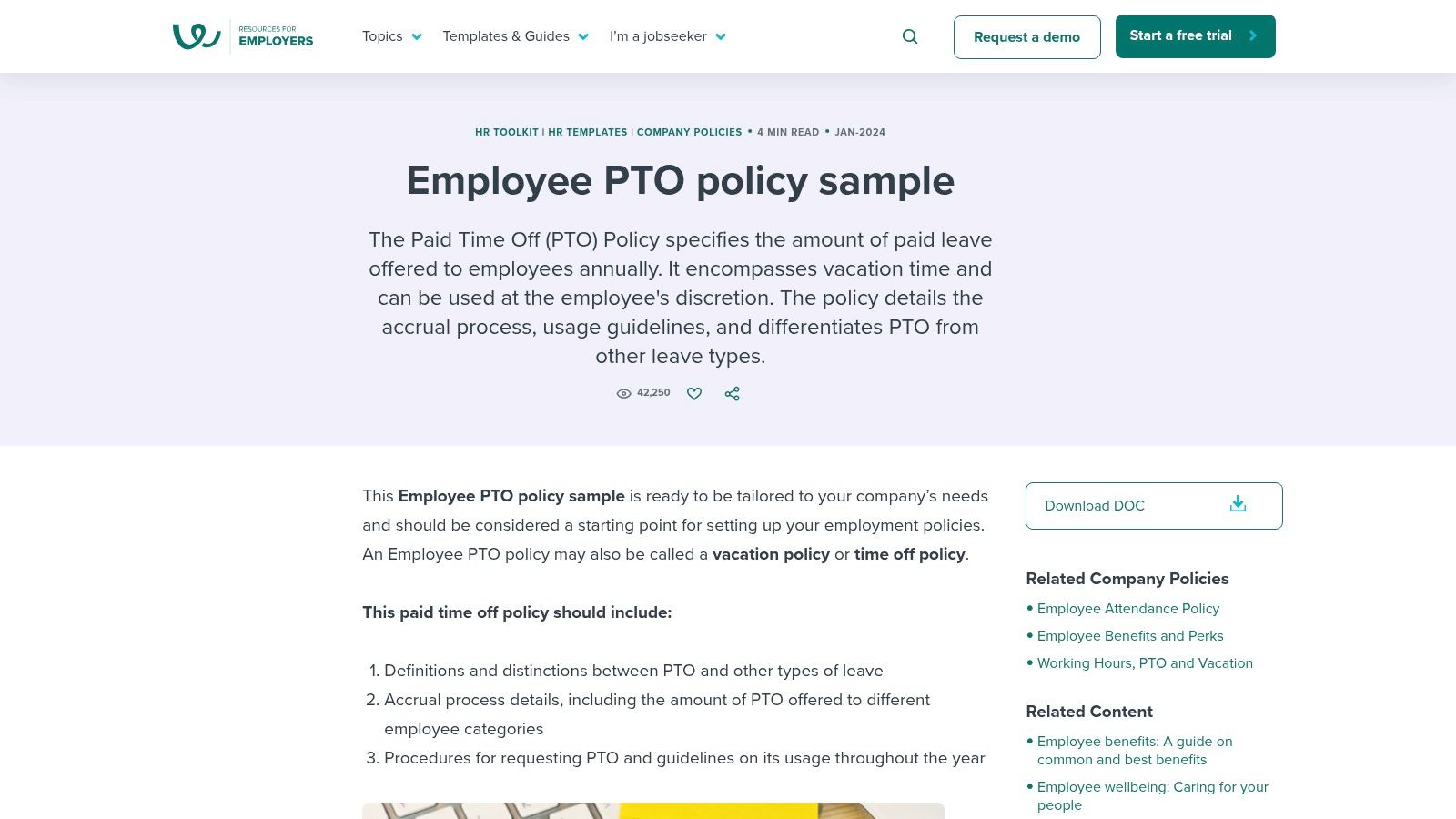
Workable is a strong starting point for employers that want a standard PTO structure with the sections people expect: eligibility, accrual, request procedures, and administration. If your current rules live in a mix of offer letters, manager habits, and payroll settings, this template helps consolidate them into one document.
Its main advantage is flow. The policy follows the questions managers and employees usually ask in real life: who receives PTO, how it accrues, how requests are submitted, and how business coverage affects approval decisions.
Use this template as a draft, not a finished policy. The biggest mistake is publishing generic language before anyone decides how the policy will operate. That creates the gap where disputes start.
For example, a template may say PTO requests are subject to manager approval. That sounds fine until two supervisors handle the same request differently, or an employee asks whether unused PTO is paid out at separation. A defensible policy answers those questions in advance. It should spell out notice expectations, blackout periods, request channels, approval authority, minimum increment rules, and how PTO interacts with any separate sick leave obligations.
Manager guidance matters just as much as policy wording. If supervisors do not know when they can deny time off, what documentation they can request, or when HR must step in, the template will not protect you.
Practical rule: If a manager cannot answer “Can I approve this?” or “What happens when someone leaves?” after one read, the policy is still incomplete.
For accrual design, many employers use market norms as a reference point. As noted earlier, private-sector vacation offerings often rise with tenure. That makes Workable a good shell for companies building a standard accrual ladder, but you still need to decide how much liability you are willing to carry, whether rollover is capped, and how simple the math needs to be for payroll and employee understanding.
Indeed's PTO policy guide and sample is more detailed than Workable, and that's exactly why some leadership teams will prefer it. It doesn't just give you sample language. It shows how a fuller policy hangs together, including accrual logic, scheduling rules, unexpected absences, and the questions executives usually ask once they see a draft.
If your COO or finance lead wants to understand the implications of rollover and payout language before counsel gets involved, this is a practical document to review together.
Some templates are too thin to drive decision-making. This one isn't. The sample structure helps teams compare policy models before they get stuck debating wording.
That matters because architecture choices have real consequences. An accrual-based approach with a monthly earning pattern and a defined carryover cap is often easier to defend operationally. One example structure is outlined in Apps365's PTO policy discussion, which describes a model where employees earn 1.25 days monthly for 15 annual days with a 5-day maximum rollover. The value of that approach isn't the exact formula. It's the predictability, documentation trail, and liability control.
Indeed gives you a strong draft, but it doesn't replace a business-specific operating rule set. If you stop at the sample, managers may still improvise.
Add written direction on issues like overlapping requests, partial-day use, request deadlines around peak seasons, and what happens when an employee changes status from full-time to part-time or vice versa. Those are the moments when “good sample language” breaks down if the employer hasn't translated it into actual administration.
A policy isn't finished when HR likes the wording. It's finished when payroll, managers, and leadership would all administer it the same way.
Betterteam's paid time off policy template is the most immediately editable option on this list. The Word format matters. For many small and midsize businesses, getting the policy into redline form is half the battle.
This is the kind of time off policy sample that works well when you already know your policy direction and need a document your team can mark up quickly. It includes practical sections employers often forget until late in the process, such as carryover, records, and separation treatment.
The downloadable format is the draw, but its main benefit is that Betterteam prompts employers to address the areas that tend to create disputes later. Many templates stop at accrual and approvals. Betterteam pushes further into what happens when employment ends or unused time accumulates.
That makes it stronger for businesses that want handbook-ready text, not just a planning guide. I'd use this one when the issue is speed and document control.
The moment this template becomes risky is when a company copies payout or forfeiture language without testing it against state rules. In some jurisdictions, accrued PTO is treated more like earned wages than a discretionary benefit.
That's why the termination section deserves extra scrutiny. You need to decide, in writing, what happens to accrued balances, whether caps are lawful where you operate, and whether your payroll system mirrors the policy exactly. If those don't match, the document won't protect you.
A broader implementation reminder appears in Paycor's sample PTO policy article, which notes that federal law under the FLSA doesn't require PTO and that 14 states plus D.C. mandate paid sick leave as of 2025. For any employer with employees across jurisdictions, that's the dividing line between “template complete” and “compliant.”
A shift supervisor is staring at next week's schedule, two employees want the same Friday off, and no one is sure who has approval authority. That is the kind of problem Homebase's small business PTO guide is built to solve.
It is a practical fit for restaurants, retail, field services, and other hourly teams where time off decisions affect coverage the same day, not just payroll at the end of the month.

Homebase focuses on the parts of PTO administration that usually break first. Notice requirements, blackout periods, who can approve leave, and what happens when multiple employees request the same dates. Those decisions are not minor details for shift-based employers. They are the difference between a policy managers can apply consistently and one they ignore under pressure.
That makes this guide more useful as an operating policy than as a legal template.
The main trade-off is straightforward. A policy built around coverage and approvals can be easier to use, but it can also leave legal gaps if you stop at the template.
Expand the language if your workforce is covered by state or local sick leave rules, protected leave laws, or specific payout requirements at separation. Clarify whether PTO and sick leave are combined or tracked separately. Define how requests are prioritized, who gives final approval, and when a manager can deny a request based on business need. If those points stay vague, supervisors will make up their own rules.
Manager training matters here more than many owners expect. Employees may have access to PTO on paper and still avoid using it if managers consistently praise constant availability, reject requests inconsistently, or treat absences as a sign of low commitment. A clean policy does not fix that by itself.
Policies that look fair on paper can still fail if managers reward availability and punish absence informally.
Connecteam's free PTO template is stripped down in a useful way. It doesn't try to educate you at length. It gives you a simple artifact you can compare against your existing handbook language and start editing immediately.
That makes it useful for teams that already know where their policy is weak. If leadership wants a short draft to react to, this can get the conversation moving faster than a long article.

The clean layout is the value. Scope, eligibility, accrual, approvals, and carryover are all there, without much clutter. That's helpful when the main task is leadership alignment, not initial education.
I'd use Connecteam in two situations. First, when a company already has policy instincts and needs a draft to pressure-test. Second, when you want a side-by-side comparison against an older policy that has grown inconsistent over time.
The trade-off is limited commentary. You won't get much guidance on how to reconcile local sick leave rules, separation payout treatment, or related policy conflicts. You have to bring that analysis yourself.
This is also where implementation discipline matters. A policy can be concise, but your tracking can't be vague. The JUCM discussion of unlimited PTO implementation and administration notes that Ask.com documented a reduction of about 52 administrative hours annually in vacation tracking and management after moving to an unlimited policy. That administrative lesson applies more broadly. Whether your policy is simple or detailed, tracking and documentation still need to be rigorous enough to support decisions later.
Gusto's unlimited PTO policy guide is the strongest option here if your real question isn't “Which time off policy sample should I copy?” but “Should we even move to unlimited PTO?”
That distinction matters. Unlimited or open PTO isn't just a different template. It's a different risk model. You're replacing earned-bank administration with discretionary approval, culture signals, and manager judgment.
Gusto does a good job separating discretionary PTO from statutory leaves. That distinction is essential. A lot of employers get excited about “open PTO” language and forget that sick leave, disability accommodation, and other protected leave categories still need their own handling.
The sample language is also useful because it forces executive teams to confront critical operating questions. Who's eligible. What approval standard applies. Can performance concerns limit usage. What happens when employees leave. Those are the questions that make or break unlimited models.
The appeal is obvious. Administrative friction can drop, and the policy can look modern and flexible. Employee sentiment also leans positive. A roundup of unlimited PTO statistics from Flamingo reports that employees on unlimited plans average 13 to 16 days off annually, while traditional capped plans average 14 to 15 days. The same source notes that 82% view unlimited PTO favorably.
But a favorable reaction doesn't make the policy self-executing. Some employees take less time because they don't know what's acceptable, and some managers apply discretion unevenly. If you use this sample, add minimum-use expectations, manager escalation rules, and documentation standards. Otherwise, “flexibility” can become a policy with no clear floor and no defensible approval logic.
“Unlimited” only works when leaders define what reasonable use looks like and model it openly.
SHRM's model policies library is less about quick drafting and more about validation. If you're building or revising a time off policy sample for a growing employer, SHRM is often where teams go to sense-check related policies and keep up with ongoing leave-rule developments.
The membership barrier is real, so this won't be the fastest option for every business. But for employers managing multiple states or trying to align PTO with attendance, holiday, and leave-adjacent rules, the depth is useful.
A standalone PTO template can only take you so far. Once a business grows, policy conflicts start to show up between PTO, sick leave, attendance control, holiday pay, and inclement weather rules. SHRM is helpful because it supports consistency across those connected areas.
That's a major advantage for employers who've outgrown one-page templates. At that point, your policy problem usually isn't missing language. It's inconsistent language across documents.
Membership access means this isn't the best “grab it and go” option. It's better for employers who already have a draft and want stronger validation, broader policy alignment, or ongoing updates as rules change.
That matters because poor leave experiences affect more than compliance. Verified data in the brief notes that 57% of workers report decreased loyalty after poor leave experiences. When a company applies leave inconsistently, employees often experience it as unfairness first and policy failure second.
| Template | Implementation complexity | Resource requirements | Expected outcomes | Ideal use cases | Key advantages |
|---|---|---|---|---|---|
| Workable – Employee PTO Policy Template | Low–Medium | HR customization and legal review | Baseline, configurable PTO policy | SMB handbooks and manager consistency | Clear plain-English structure and guidance links |
| Indeed – PTO Policy Template and Sample | Medium | Stakeholder review and legal check | Detailed draft with accruals and rules | Owners/COOs aligning structure before legal review | Full sample language and accrual tables |
| Betterteam – PTO Policy + Word Download | Low | Redlining in Word and state adjustments | Operational-ready policy with accrual schedule | US SMBs needing fast handbook insertion | Downloadable .doc and clear placeholders |
| Homebase – Small Business PTO Guide | Low | Integration with scheduling tools and manager training | Policy aligned with scheduling and ops | Frontline businesses (restaurants, retail) | Industry examples and operational tips |
| Connecteam – Free PTO Template (PDF) | Very low | Minimal; add multi-state clauses as needed | Quick, no-frills template for leadership sign-off | Rapid leadership alignment and simple handbooks | One-click PDF download and simple placeholders |
| Gusto – Unlimited/Open PTO Sample Language | Medium–High | Legal counsel and policy communications | Draft unlimited/discretionary PTO language | Organizations considering unlimited PTO models | Sample clauses with legal caveats and risks |
| SHRM – Model Policies Library (membership) | Medium–High | Membership access plus legal/HR tailoring | Defensible, up-to-date multi-state policies | Multi-state employers and HR teams | Authoritative templates and ongoing rule updates |
Selecting a time off policy sample is the easy part. The harder part is deciding what kind of policy your business can administer consistently. That means looking beyond the wording and into the operating model underneath it. Who approves leave. How balances are tracked. What happens at year-end. What happens at termination. How paid sick leave and other protected leave interact with general PTO.
For many SMBs, the safest mistake is assuming a polished sample equals a finished policy. It doesn't. A defensible policy has three parts. Written rules, accurate system setup, and manager behavior that matches both. If one of those fails, the whole program becomes harder to enforce fairly.
Traditional accrual models are still often the easiest to document and defend, especially for employers with mixed workforces or multi-state exposure. Unlimited PTO can work, but it requires more manager discipline than many companies expect. If leaders choose that route, they should define approval standards, clarify what counts as reasonable use, and separate discretionary PTO from statutory leave categories.
Usage matters too. A company can offer PTO and still create a culture where people hesitate to take it. The verified data provided for this article shows that workplace pressure and workload concerns still keep many employees from using available time. In practice, that means implementation should include manager training, executive modeling, and routine review of actual usage patterns, not just annual policy updates.
The best final draft usually answers these questions clearly:
If your business is revising a handbook, expanding into new states, or trying to clean up inconsistent manager practices, a second review is worth the time. A specialized consultancy is one option for SMB leadership teams that need advisory support on defensible HR practices in complex employment settings.
If you need help turning a time off policy sample into a policy your managers can apply consistently, contact Paradigm International Inc.. Their team works with SMB leaders navigating multi-state compliance, documentation standards, and higher-risk people decisions.