Growth starts with a simple staffing decision. You add more part-time roles to cover demand, protect labor costs, and stay flexible. Then the core questions arise. Which benefits are required, which are optional, and which choices create avoidable legal exposure when you operate across more than one state?
That is where many SMB leadership teams get into trouble. They treat part time employees benefits as a payroll setting or a handbook line item. It is not. It is a risk decision that affects ACA exposure, retirement plan administration, documentation standards, and your ability to hire and keep reliable people.
The gap in access is already stark. Only 25% of part-time workers have access to medical care benefits, compared with 89% of full-time civilian workers, and among part-time workers whose employers do offer health benefits, only 64% are eligible to enroll, according to the March 2025 Bureau of Labor Statistics data (BLS). If you are designing a plan now, your job is not to copy what other employers do. Your job is to build something clear, consistent, and defensible.
If your company is growing, part-time hiring looks efficient on paper. You get schedule coverage, role flexibility, and room to scale without immediately committing every hire to a full-time structure.
That logic is fine. What fails is the assumption that part-time status keeps benefit decisions simple.
For multi-state SMBs, part time employees benefits sit at the intersection of cost control, legal thresholds, and workforce stability. A policy that works in one location can create a problem in another. A vague eligibility rule can become an audit issue. A “we’ll decide case by case” approach can turn into inconsistent treatment that is hard to defend later.
Most employers do not need a richer philosophy on benefits. They need a sharper operating standard. That means knowing the legal floor, deciding what strategic benefits support retention, and documenting every threshold so payroll, HR, managers, and leadership apply the same rules the same way.
Strong benefit design is not about offering everything. It is about offering the right things, to the right groups, under rules you can defend in an audit, dispute, or acquisition review.
Benefits work like a building. The foundation is made up of legal obligations you cannot ignore. The architecture is what you choose to build on top of that to stay competitive.

Start with the essential requirements. Federal law, state law, and local rules may all affect your part-time workforce, especially if you have remote staff or small teams spread across jurisdictions.
Use this simple test:
Once the legal floor is covered, the next question is not “What can we afford?” It is “What supports hiring and retention without creating inconsistent treatment?”
That means a narrower set of practical choices:
A broad overview of employee benefits packages for small businesses can help leadership teams compare plan components before they start drafting policy language.
The mistake is thinking this is only a finance issue. It is also an operations issue and a control issue.
If you underbuild, you may struggle to staff key part-time roles. If you overbuild without clean eligibility rules, you can create compliance problems and administrative drag. The right answer is a plan that is modest, consistent, and easy to enforce.
The most expensive benefits mistake is getting the threshold wrong. Not the philosophy. Not the communication. The threshold.
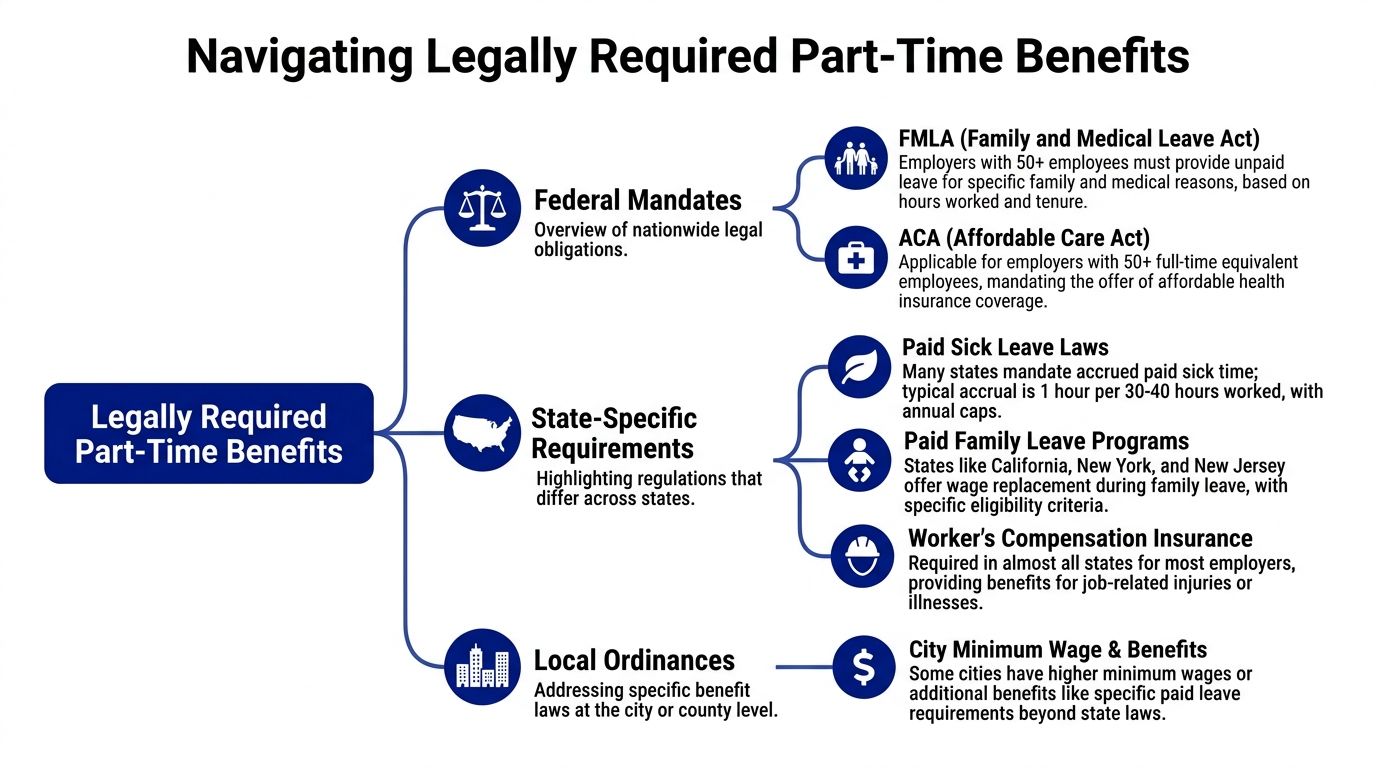
Under the Affordable Care Act, applicable large employers with 50 or more full-time equivalents must offer health insurance to employees averaging 30 or more hours per week, or face penalties of up to $2,970 per full-time employee in 2025 (Duncan Insurance).
That rule matters even if you think of someone as “part-time” internally. Your internal label does not control ACA exposure. Hours do.
Here is the practical takeaway:
If your scheduling model regularly places employees close to the ACA line, you need a measurement method that payroll, HR, and operations all understand the same way.
A number of benefit disputes start earlier, with worker classification. If your organization blurs the line between employee and contractor status, every benefit determination becomes harder to defend.
For leadership teams reviewing staffing models, this overview of 1099 vs W4 classifications is useful because it clarifies the distinction before it spills into payroll, taxes, and benefit eligibility decisions.
Health coverage gets the attention, but it is not the only area to watch. Part-time employees may also be affected by leave laws, workers’ compensation requirements, unemployment insurance rules, and state-specific benefit mandates.
The issue is not that every part-time employee gets every benefit. The issue is that different laws use different eligibility tests. Hours worked matter in one context. Employer size matters in another. State location may control a third.
That is why one policy line such as “part-time employees are not eligible for benefits” is dangerous. It may be wrong in multiple ways.
If you want a defensible setup, review these items now:
Compliance is the floor, not the full answer. The companies that manage part time employees benefits well do not stop at avoiding penalties. They use benefit design to reduce friction in hard-to-fill roles and create a more stable workforce.
That approach works best when you separate two questions:
| Question | What leadership should ask |
|---|---|
| Legal obligation | What must we offer, to whom, and under what threshold? |
| Competitive choice | What should we offer because it supports retention and operational stability? |
If those questions get mixed together, you either overspend or under-protect the business.
The strongest plan is not the most generous plan. It is the plan that matches legal requirements, fits your workforce, and survives scrutiny when someone challenges it.
Once the legal floor is set, the competitive choices begin. At this point, many SMBs either oversimplify or overengineer.
Some employers offer almost nothing and call it cost control. Others add scattered perks with no eligibility logic and call it culture. Neither approach is strong. Strategic part time employees benefits should be selected for usability, administrative control, and consistency across locations.
The headline issue with discretionary benefits is adoption. A benefit that looks good in a recruiting ad but is too expensive, too narrow, or too confusing will not solve much.
In 2024, 14% of large firms with 200 or more employees offered reduced-premium health plans for low-wage or part-time workers, and voluntary benefits adoption rose 22% post-PAFCA incentives, but upfront costs still deter 40% of low-income part-timers (KFF).
That points to a hard truth. Access is not the same as usefulness. If the employee contribution is still too high, the plan may exist on paper but fail in practice.
Use a simple decision lens. Ask three questions for each benefit: What does it cost the employer, how hard is it to administer, and will employees likely value it enough to change behavior?
| Benefit Type | Typical Cost to Employer | Administrative Burden | Impact on Retention |
|---|---|---|---|
| Voluntary dental or vision | Usually lower than major medical | Moderate, depends on enrollment setup | Moderate when employees value routine care |
| Telehealth access | Often more manageable than broad medical coverage | Lower if bundled through a vendor | Strong when access is simple and low-cost |
| Retirement plan access for eligible part-timers | Varies based on plan design and match structure | Higher because tracking matters | Strong for long-term part-time staff |
| Pro-rata PTO or limited paid leave enhancements | Variable and policy-driven | Moderate to high | Strong when scheduling reliability matters |
| Employee assistance resources | Usually modest compared with richer benefit categories | Lower if outsourced | Moderate, especially in high-stress roles |
If you are evaluating broader package structures, this related guide on small business benefits packages can help frame what belongs in a right-sized SMB plan.
A pro-rata model can be smart. It can also become a mess if leaders apply it inconsistently.
Good uses of pro-rata design include scaling employer contributions, waiting periods, or access to select benefits based on clearly documented average hours. Bad uses include manager exceptions, ad hoc promises during hiring, and one-off adjustments for “critical” employees.
The test is simple. If you cannot explain the rule in one paragraph and administer it through payroll data, it is too loose.
Consider a few common failures:
These are not fringe issues. They are normal growth-stage problems.
For most SMBs, the strongest discretionary package is not broad. It is deliberate.
Prioritize:
Skip benefits that require custom approvals, manager discretion, or manual tracking. They create more exposure than value.
Multi-state growth changes the risk profile fast. A policy that feels clean from headquarters can break the moment you hire in a new jurisdiction or convert one part-time role to remote work.

Multi-state SMBs face meaningful compliance risk from varying state mini-COBRA laws, ACA applicability triggers, and SECURE Act 2.0 401(k) eligibility rules tied to two years of 500 or more hours, especially when documentation is weak across locations (Paychex).
That means your part-time policy cannot just say “benefits are governed by company policy.” It must also account for where the employee works and which law controls.
The dangerous pattern is not always a missing benefit. It is inconsistent administration.
A few examples:
When that happens, the company looks disorganized even if the original intent was reasonable.
A related issue is worker status. If your team needs a sharper view of where role design and legal exposure intersect, this overview of employee misclassification penalties is worth reviewing alongside your benefits policies.
Use language that narrows discretion and points back to documented criteria.
Write policies like this:
Avoid wording like “may be eligible,” “not eligible,” or “management can approve exceptions as needed.” That language invites inconsistency.
In an audit or dispute, a mediocre policy applied consistently is often easier to defend than a generous policy applied unevenly.
This is the cleaner operating model:
That approach reduces confusion and lowers the chance that growth creates silent compliance gaps.
Most benefit problems become expensive because the company cannot prove what rule it used. Not because the company had no good intent.
A defensible part time employees benefits framework starts with documentation that is specific enough to administer and simple enough to enforce. Your handbook, offer letters, plan summaries, payroll practices, and manager guidance should point to the same eligibility rules.
Bad wording creates room for dispute.
Bad: “Part-time employees are generally not eligible for benefits unless approved by management.”
That sentence creates three problems. “Generally” is vague, “benefits” is overbroad, and “approved by management” invites inconsistent exceptions.
Use wording like this instead:
Better: “Eligibility for employer-sponsored benefits is determined by the applicable plan document, hours worked, and company classification rules as administered by HR and payroll. State-specific requirements will apply where required by law.”
That language is not flashy. It is useful.
A strong policy file should answer operational questions before someone asks them in a dispute.
Include at minimum:
If your leave practices interact with benefit eligibility, align those terms with broader policy language. This resource on paid time off policy is a useful reference point when reviewing whether your handbook language is coordinated or fragmented.
Before you finalize a plan, confirm these points:
This consulting firm works with SMB leadership teams on these documentation and policy-control issues when growth, multi-state operations, or regulatory risk make internal alignment harder to maintain.
Documentation is not administrative clutter. It is evidence. If your records do not show a coherent process, your policy will not carry much weight when challenged.
You do not need a complicated blueprint. You need disciplined execution.
Review your part-time population by role, average hours, work location, and length of service. Look for employees near key thresholds, long-term part-timers who may trigger retirement eligibility, and roles where managers have made informal commitments.
If the data is messy, fix that first. A clean benefit strategy cannot sit on top of weak workforce records.
Compare a few realistic options. One may focus on strict legal compliance plus voluntary benefits. Another may add limited employer-paid support for retention-critical groups. A third may use a pro-rata design.
Stress-test each option against these questions:
If the answer is no, simplify.
Employees should know what they are eligible for, when, and how eligibility is determined. Managers should know what they cannot promise. HR and payroll should use the same reference documents.
That is what keeps part time employees benefits from turning into a dispute about fairness, favoritism, or broken promises.
For most growing SMBs, the right move is this:
That model is practical and defensible. It supports growth without inviting unnecessary exposure.
No. These are different concepts. A person you classify as part-time may still matter in full-time equivalent calculations used for ACA analysis. Leadership should not rely on internal labels alone when reviewing exposure.
Yes, but the structure has to be based on clear, legitimate criteria. Hours worked, job category, location, and plan terms may all matter. Informal exceptions and manager-by-manager decisions are where risk starts.
No. That is the wrong instinct. The safer approach is to offer a limited set of benefits under written, consistently applied rules. Avoiding all discretionary benefits can hurt hiring and retention without removing compliance obligations.
Track hours carefully and apply plan terms consistently. Long-term part-time eligibility is an area where weak documentation causes avoidable errors. If you have staff with variable schedules over multiple years, this should be reviewed proactively, not after someone asks to enroll.
They should not do that on their own. If your business needs exception authority, define who approves it, what standards apply, and how it is documented. Uncontrolled exceptions create disparity and make your policy harder to defend.
They focus on cost and ignore administrability. A policy is only as strong as the records behind it. If your team cannot show who qualified, when they qualified, and which rule controlled, the plan is weak even if the intent was fair.
If your leadership team is weighing part time employees benefits across multiple states, changing headcount, or cleaning up inconsistent policies, this consulting firm can support a more defensible approach. The work is not choosing benefits. It is building rules, records, and operating practices that hold up when decisions are questioned.