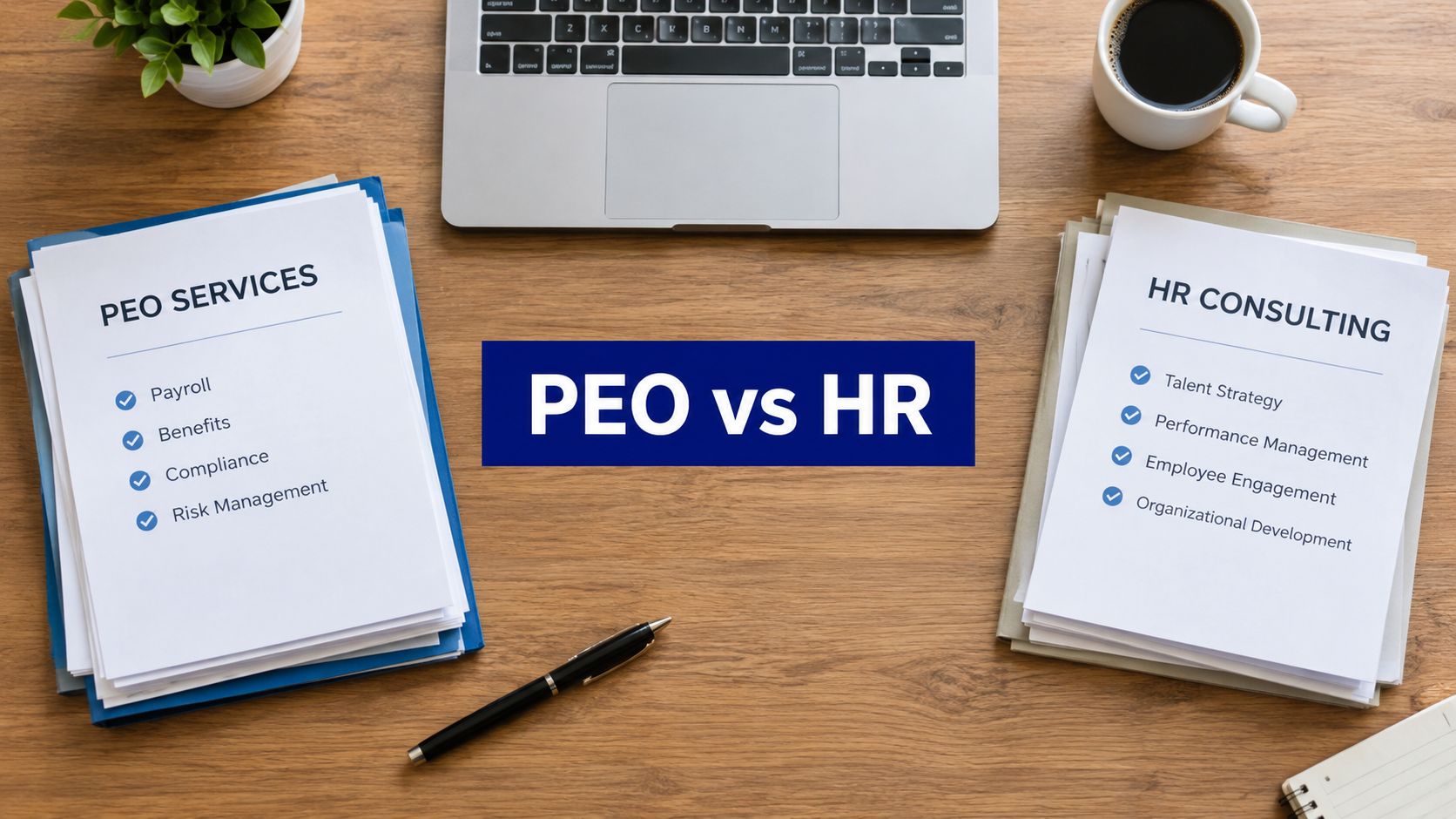
Your company has just hired a remote employee in another state. At the same time, a manager complaint has landed on the COO's desk, payroll questions are taking too much time, and nobody is confident the handbook reflects every location. The leadership team starts comparing a PEO vs HR consultant, assuming one option should solve everything.
That assumption creates avoidable risk. A PEO can add administrative capacity, while an independent HR consultant can improve decision quality. The right choice depends on whether your primary problem is repeatable HR infrastructure, high-consequence judgment, or both.
The decision usually appears after a business crosses an operating threshold. You add an employee in a second state, discover that leave rules differ by location, or realize that payroll and workers' compensation processes depend on one person's memory. Then a more sensitive issue appears, such as a complaint against a manager or a proposed termination with an unclear documentation history.
At that point, leadership often asks, “Should we hire a PEO or an HR consultant?” That question is understandable, but it starts too far downstream. The first question should be, what kind of risk are we trying to solve?
A PEO addresses recurring administration. An HR consultant addresses judgment, governance, and difficult employment decisions. Those services overlap around HR, but they aren't interchangeable.
Practical rule: If the problem repeats every pay period, evaluate infrastructure. If the problem requires someone to assess facts and consequences, evaluate independent advisory judgment.
Consider a multi-state professional-services firm with payroll already running through an established system. Its immediate problem isn't processing wages. The COO needs help deciding how to investigate a complaint, whether managers applied discipline consistently, and what records should support the final decision. A PEO may administer the workflow, but it won't automatically make the underlying decision defensible.
Now consider a growing construction company with employees in several states and no dependable payroll, benefits, or workers' compensation process. Its first need is different. The company needs a system that can execute recurring obligations consistently, with clear ownership and escalation procedures.
The answer may be one provider, or it may be both. The useful comparison isn't a feature checklist. It's a decision about administrative transfer versus executive judgment.
A Professional Employer Organization, or PEO, is an operating and administrative arrangement. In the United States, PEOs commonly serve as co-employers for client worksite employees and may handle payroll processing, employment-tax administration, benefits access, workers' compensation coordination, and routine HR infrastructure. Nebraska law describes this relationship as an ongoing allocation of employer rights, duties, and obligations between the client and the PEO as co-employers. Nebraska's statutory definition of a PEO relationship illustrates why this is more than just outsourced advice.
A Certified Professional Employer Organization, or CPEO, operates within a voluntary federal certification framework created by the IRS in 2016. Under Internal Revenue Code section 3511, a CPEO is treated as the employer, and no other person is treated as the employer, for remuneration the CPEO pays to worksite employees. The Journal of Accountancy explanation of CPEO tax treatment provides useful context for distinguishing certification from ordinary HR consulting.
The IRS also requires specific application and financial safeguards. Applicants provide audited financial information, a CPA attestation regarding federal employment-tax compliance, a surety letter, and a $1,000 application fee. After certification, the surety bond must equal 5% of the CPEO's section 3511 liability, subject to a $50,000 minimum and $1 million maximum, as described in the IRS CPEO application requirements.
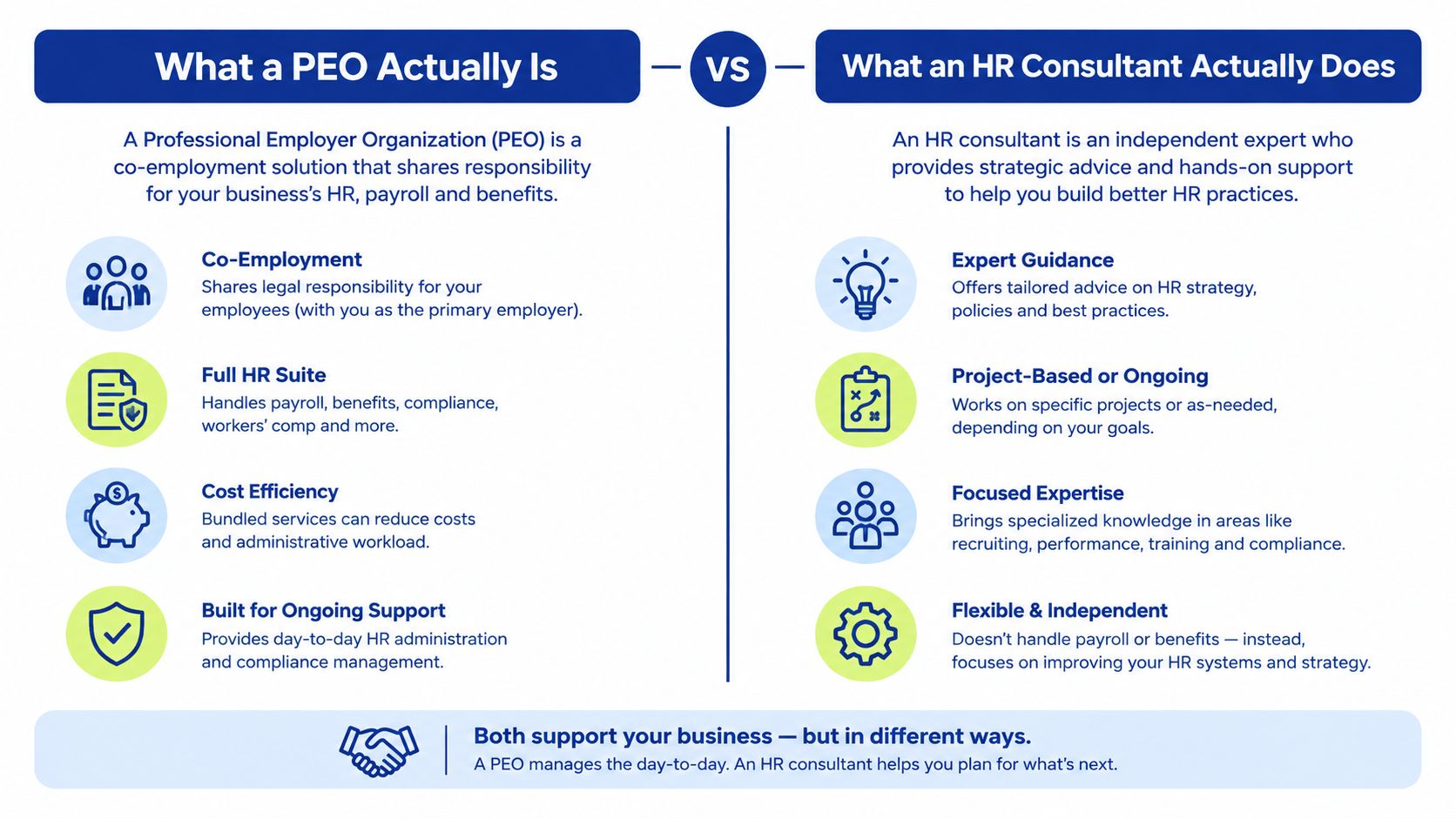
An HR consultant generally provides independent advice through a project, hourly engagement, or ongoing retainer. The consultant may design policies, coach managers, support investigations, review documentation, advise on discipline and termination, and assess multi-state exposure. The consultant doesn't usually become the employer or take over the recurring transaction layer.
That distinction matters when the business needs someone to challenge leadership's assumptions. A consultant can ask whether the investigation was impartial, whether comparable employees were treated consistently, whether a manager's conduct creates retaliation concerns, and whether the written record supports the proposed action.
Businesses should also separate payroll execution from payroll accuracy. Leaders responsible for internal processes can use practical resources on avoiding common payroll mistakes while deciding whether their broader needs call for a PEO.
For a plain-language introduction to the operating model, review understanding PEO for small employers. The essential buying question is simple: are you purchasing a system of record and recurring administration, independent judgment, or a defined combination of both?
A useful decision matrix should show where responsibility moves, not just which provider offers more services. The table below gives the structural difference at a glance.
| Criterion | PEO | HR Consultant |
|---|---|---|
| Primary purpose | Recurring HR administration and infrastructure | Independent advice, risk assessment, and decision support |
| Employment relationship | Commonly a co-employment arrangement | Usually no co-employment arrangement |
| Payroll and benefits | Typically central capabilities | Usually reviews or advises rather than processes |
| Workers' compensation | Often coordinates administration and claims processes | May advise on process, documentation, and response |
| Multi-state execution | Useful for registrations, payroll taxes, benefits, and standardized workflows | Useful for state-specific policy analysis and judgment |
| Sensitive employee matters | May provide process guidance or escalation | Can support investigations, discipline, termination, and manager conduct |
| Leadership control | Shared operational responsibilities, with client decisions still requiring clarity | Leadership retains direct control while receiving independent advice |
| Cost structure | Often recurring and bundled | Often hourly, project-based, or retainer-based |
| Exit considerations | Requires transition planning for records, benefits, payroll, and workflows | Usually easier to end or change by engagement terms |
| Best fit | Administrative capacity gap | Decision quality or governance gap |
A PEO can absorb or coordinate substantial operational work. That doesn't mean it absorbs every employment-law consequence. The client still needs to understand who makes decisions, who documents them, who handles escalations, and who responds when a process fails.
An HR consultant keeps the advisory relationship separate from the operating platform. That separation can be valuable when leadership wants an independent review rather than guidance limited to the provider's workflow.
A PEO is strongest when compliance depends on repeatable execution. Payroll taxes, benefits administration, workers' compensation coordination, and employee records benefit from standardized processes.
A consultant is stronger when compliance depends on interpretation and consistency. A handbook may need revision, but the harder question is often how managers apply it in real situations.
PEO pricing may be easier to budget because services are commonly bundled into a recurring arrangement. That predictability can come with less flexibility if the business pays for capabilities it rarely uses or must follow the provider's operating process.
Consulting offers more control over scope. The trade-off is that a major investigation, policy project, or leadership issue can require more advisory time than expected.
A PEO can help a business scale recurring administration without building every process internally. Implementation, however, requires disciplined data migration, clear ownership, and a plan for employee communications.
A consultant can improve the organization's framework without replacing its payroll or benefits infrastructure. If that infrastructure is weak, advice alone won't create reliable execution.
The decisive criterion is not which provider has the longer service list. It's whether the business needs transactions handled consistently, decisions challenged independently, or both.
Price comparisons often fail because they treat the PEO as a per-employee purchase and the consultant as an hourly purchase. Total cost includes implementation effort, management time, exclusions, escalation terms, transition risk, and the consequences of a poorly handled employment decision.
PEOs commonly use percentage-of-payroll pricing, per-employee-per-month pricing, or bundled service tiers. Those structures can combine payroll, benefits administration, workers' compensation coordination, HR technology, and support. The contract may also separate pass-through costs from service fees, so leadership should request a complete invoice model rather than relying on the headline rate.
HR consultants commonly work through hourly engagements, defined projects, or recurring advisory retainers. A retainer may create continuity for manager coaching and policy work, while a project engagement can fit a handbook revision, investigation review, or multi-state audit. The business should define what counts as included advice and what triggers additional work.
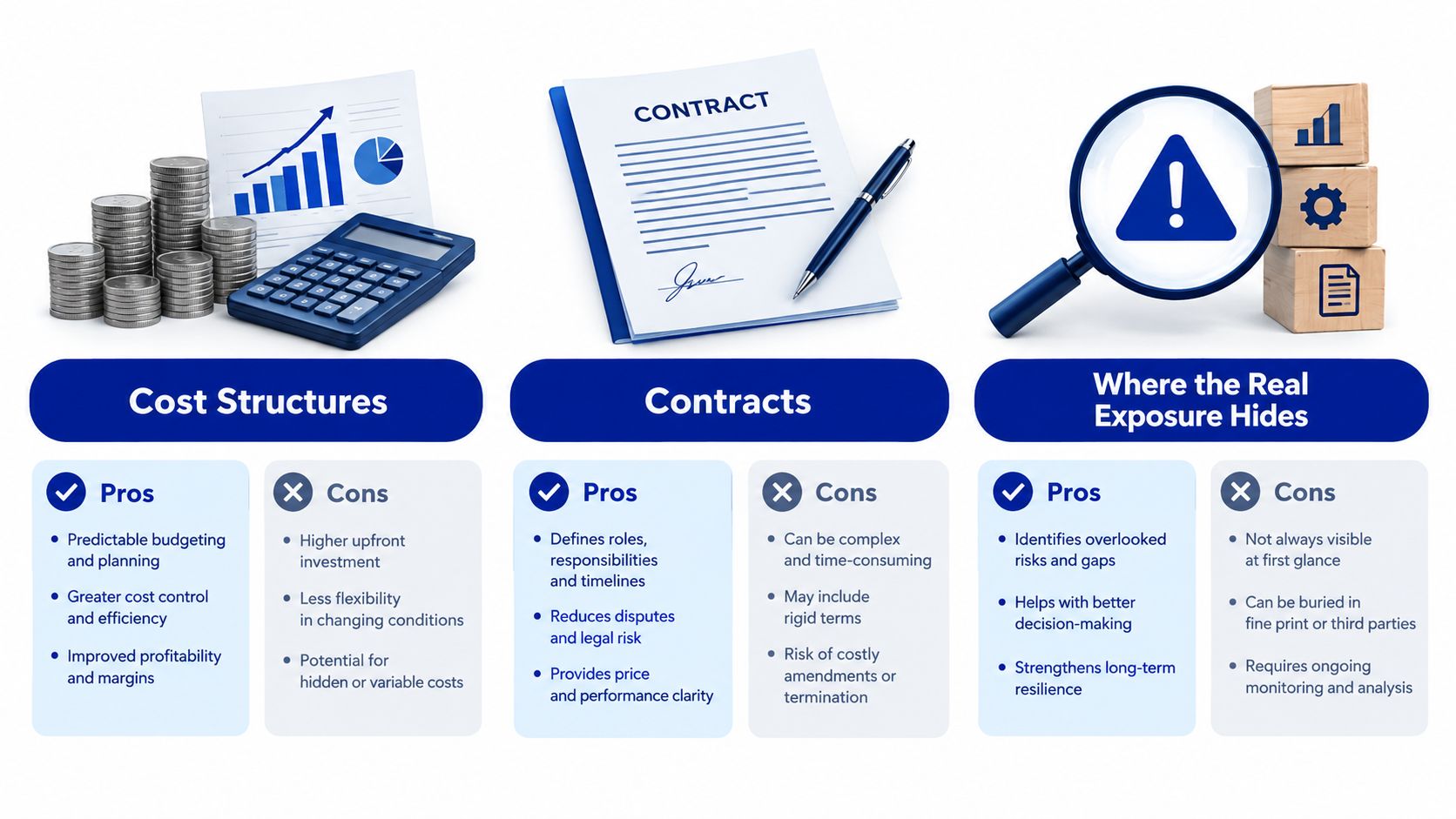
The most important contract terms often sit outside the pricing page.
A co-employment structure can clarify certain administrative responsibilities, but it can also create confusion if leadership assumes the PEO owns every employment decision. The Department of Labor explains that joint employers can each remain responsible for FMLA obligations when the applicable threshold is met. Its guidance states that private employers generally are covered when they employ at least 50 employees during 20 or more calendar workweeks in the current or preceding year. Review the Department of Labor FMLA guidance before treating a PEO arrangement as a complete transfer of responsibility.
The low-cost option can become expensive when it leaves a complaint, termination, or manager-conduct issue without independent review. Model cost against the specific exposure, not against an abstract HR budget.
Different triggers point to different solutions. Use the underlying problem, not the company's employee count, to choose the response.
Choose a PEO when the immediate gap involves payroll tax handling, state registrations, benefits access, workers' compensation administration, or recurring employee records. The PEO can provide an operating framework for the new location.
Add an HR consultant if the expansion also raises questions about pay practices, leave policies, remote-work expectations, manager authority, or documentation standards. A new state creates administrative work, but it can also expose inconsistent leadership practices that a system cannot correct.
Choose the consultant, or use both providers with clearly divided roles. The PEO may provide a reporting channel, forms, and procedural guidance. An independent adviser can help leadership assess scope, preserve neutrality, interview the right people, evaluate retaliation risk, and document the decision.
Do not let a payroll or benefits platform become the de facto investigator just because it is the easiest place to ask a question.
A healthcare, logistics, construction, government contractor, or other regulated operator may need a PEO for repeatable records, payroll administration, and workers' compensation coordination. It may need a consultant to determine whether policies match actual manager behavior and whether disciplinary decisions can withstand scrutiny.
The right combination depends on where the weakness sits. If records are missing because no system exists, start with infrastructure. If records exist but don't explain why leaders acted, start with independent review.

A PEO is the stronger first move when payroll, benefits, onboarding, and employment-tax administration are consuming leadership time. Industry data cited by the U.S. Chamber of Commerce on PEO usage reports approximately 173,000 small and midsized companies and about 4 million workers using PEOs.
Use a consultant alongside it when managers are making inconsistent decisions or the business lacks a clear escalation process. Administrative scale won't produce leadership consistency by itself.
Start with independent advisory support. The urgent need is fact assessment, documentation review, consistency analysis, and a disciplined response. A PEO may help retrieve records or explain its process, but it shouldn't be the only perspective leadership receives.
Use both when the review includes payroll and benefits records as well as employment practices. The PEO can help organize recurring administrative data. The consultant can test whether policies, investigations, manager decisions, and termination files are coherent and defensible.
The binary choice breaks down because growing businesses often have two separate problems. They need someone to execute recurring HR administration, and they need someone to challenge leadership before a difficult decision creates exposure.
A hybrid model works when responsibilities are explicit:
This model prevents the PEO from becoming the only source of advice on a sensitive matter. It also prevents the consultant from being asked to compensate for a payroll or benefits process that lacks reliable infrastructure.
A PEO may recommend a process that fits its platform. That can be useful for administration, but the provider's process may not answer the executive question: is this particular decision fair, consistent, documented, and defensible?
Leadership remains exposed when the reasoning is defective, even if the PEO processed the paperwork correctly. An independent adviser can review the facts without being limited to administering the provider's system.
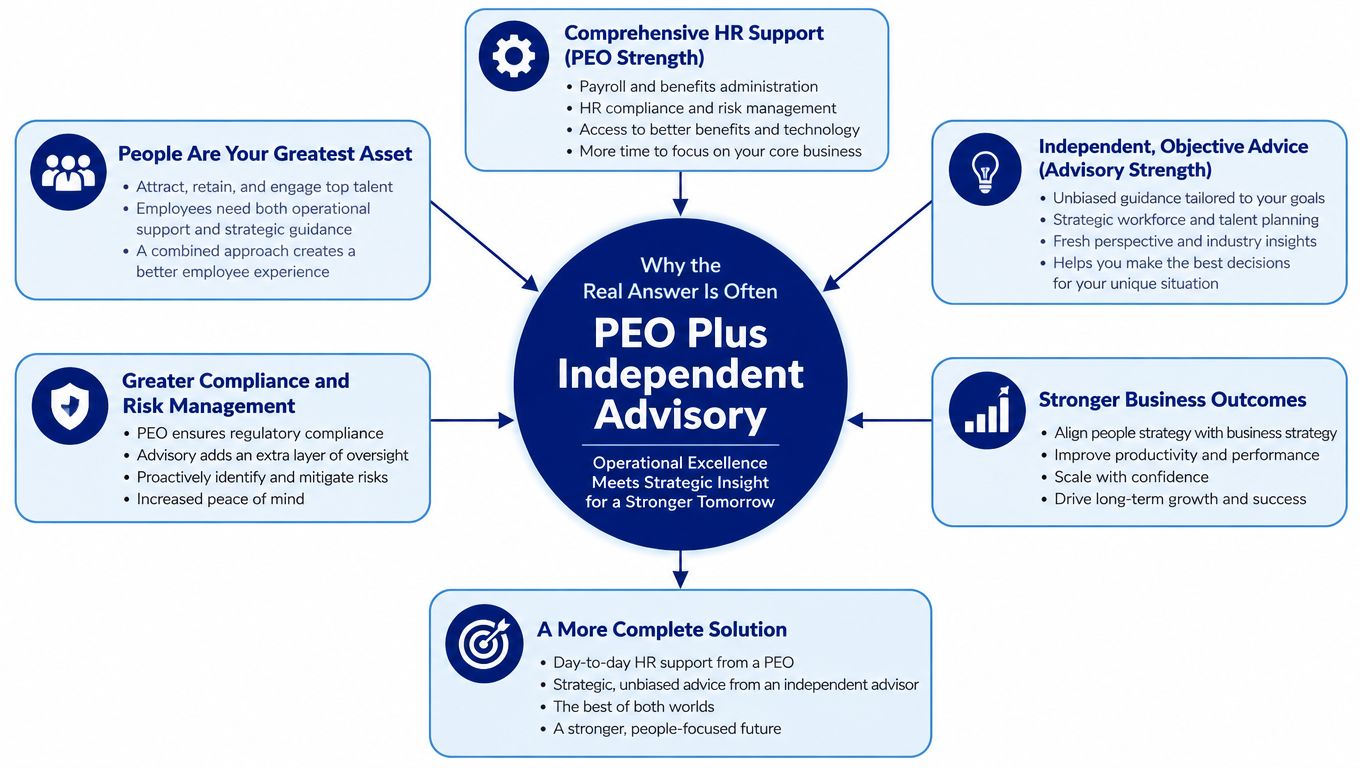
The hybrid arrangement also improves resilience. If the company eventually leaves the PEO, leadership should already know which policies, records, decision protocols, and advisory practices belong to the business rather than to the platform.
Decision test: Use a PEO to make recurring administration dependable. Use independent advisory support to make consequential decisions deliberate and defensible.
Provider diligence should begin with a written risk map. Identify the recurring work that must run each pay period, the states where employees work, the decisions likely to test leadership, and the records needed during an audit, complaint, or transaction. This separates administrative capacity from executive judgment before a sales promise shapes the decision.
Ask the PEO to explain its operating model in writing:
The PEO should describe its role without merging administration and judgment. If sales staff promise that the provider will “handle HR,” while the service model leaves sensitive decisions with leadership, treat that mismatch as a material warning.
A consultant should define the engagement, not just offer general support. Ask:
A policy review should address employee handbook requirements across states. It should also test whether managers apply the policies consistently and whether leadership can explain the reasoning behind a decision.
Watch for vague service-level commitments, advisory guidance presented as legal opinion, bundled pricing that obscures the consultant's scope, and consultants who cannot identify their limits. A PEO that cannot explain who handles a sensitive escalation is not ready to manage one. A consultant who promises certainty without stating the engagement boundaries creates a different risk.
Assess the working relationship, not only the credentials. Ask for a clear communication rhythm, named contacts, and a process for disagreements between operational recommendations and leadership decisions.
Choose one provider only when it covers the full risk profile. If the company needs payroll and benefits infrastructure plus independent judgment on sensitive decisions, a PEO and an independent HR consultant should be evaluated as a coordinated arrangement.