


A strong employee resigns on a Tuesday, and by Friday the underlying problem is clear. The departure wasn't sudden at all. The warning signs were there in workload strain, manager friction, stalled growth, or compensation issues, but no one had connected them early enough to act.
That's the operating reality for many SMB leaders. They aren't short on data. They're short on forward visibility. Most HR reporting still tells leaders what already happened, which is useful for board packets and monthly reviews, but not for preventing avoidable disruption.
Predictive HR analytics changes that posture. It helps leadership teams spot patterns that often show up before turnover, absenteeism spikes, or hiring gaps turn into expensive operational problems. That matters because only 21% of organizations with HR analytics have advanced predictive capabilities, while 76% have basic analytics, and the same projection says predictive HR analytics typically delivers ROI of 187% to 421% with payback in 6 to 18 months according to Proklamate's 2026 HR analytics report.
For a COO, that's the core business case. This isn't about buying another dashboard. It's about reducing surprises, improving consistency, and making people decisions you can explain and defend when a manager, employee, regulator, or attorney asks why a decision was made.
SMB leaders usually meet predictive HR analytics after a painful event. A clinic loses a key practice manager. A regional operator sees attendance problems spread across locations. A professional services firm realizes two high performers have been disengaging for months. In each case, the organization had signals, but no disciplined way to turn those signals into an early warning.
That gap creates more than inconvenience. It affects staffing continuity, service quality, manager credibility, and legal risk. When leaders rely too heavily on instinct, they often make uneven decisions. One employee gets a stay interview, another gets ignored. One department receives added support, another is told to push through.
Predictive HR analytics gives leadership a more structured way to look ahead. It uses workforce data to estimate the likelihood of specific outcomes, then helps teams act before those outcomes hit the business. The point isn't to automate judgment. The point is to strengthen it with evidence.
Larger enterprises have been building analytics maturity for years, but SMBs often have the sharper need. They have thinner management layers, less redundancy in key roles, and less room for unplanned turnover or compliance mistakes. One bad people decision can ripple across operations quickly.
A practical predictive model can help leadership answer questions like these:
Practical rule: If a workforce issue repeatedly surprises you, it's a candidate for predictive analysis.
The strongest implementations start with risk, not technology. They focus on a narrow problem, use available data, and build a process leaders can trust. That's what makes predictive HR analytics useful in the SMB environment, especially where employment risk is high and resources are limited.
Most leaders know descriptive analytics already. It tells you what happened. Headcount rose. Turnover increased. Time-to-fill slipped. Those reports matter, but they're backward-looking.
Predictive HR analytics is different. It asks what is likely to happen next.
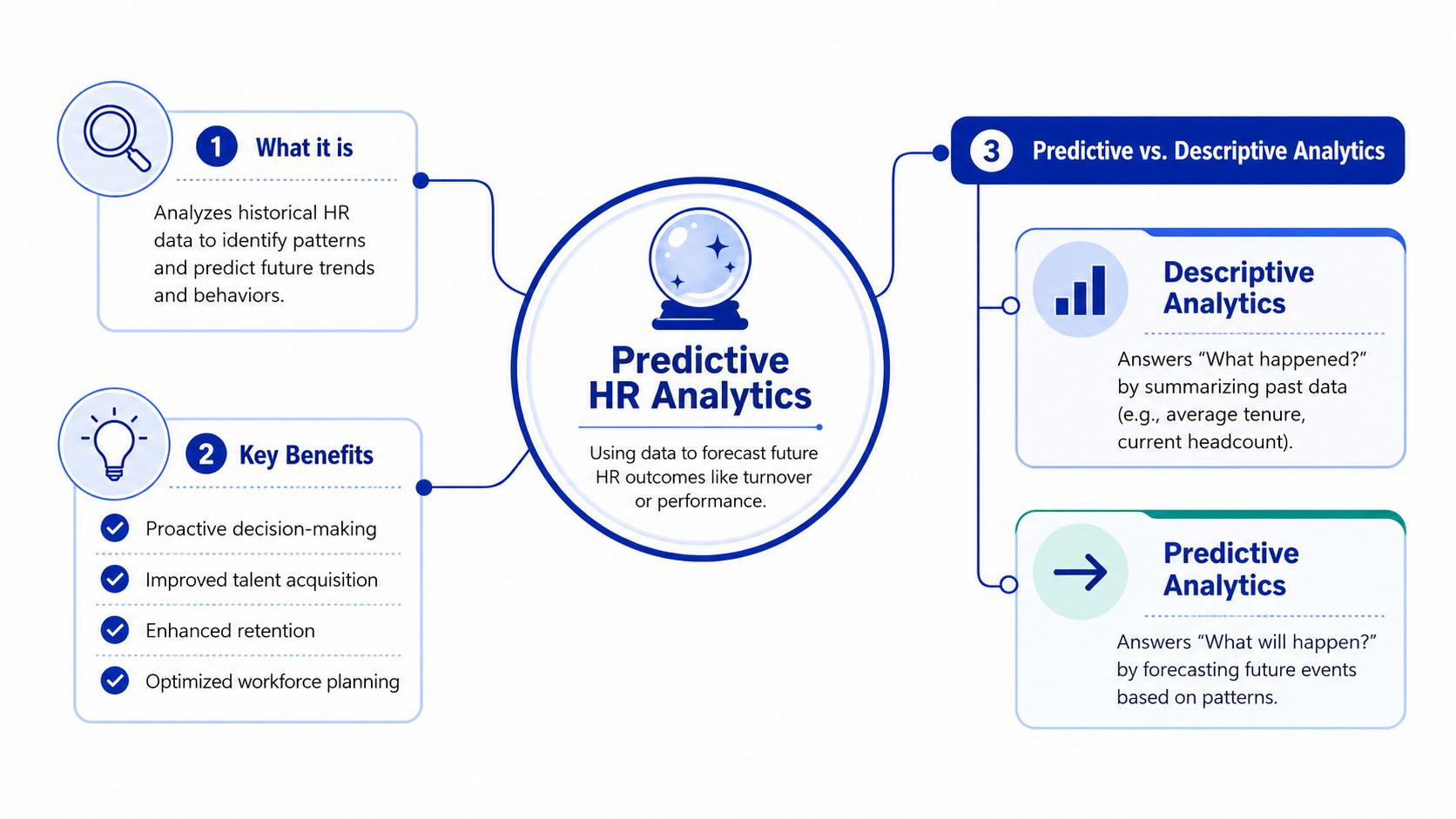
A simple way to explain it is weather forecasting. Descriptive analytics says it rained yesterday. Predictive analytics says there's a strong chance of rain this afternoon, so bring an umbrella and change the schedule if needed. In HR, that means using past and current workforce patterns to estimate risks before they become events.
According to HR University's overview of predictive analytics in HR, predictive HR analytics forecasts outcomes such as voluntary turnover within a defined window, short-term absenteeism spikes, and time-to-hire for priority roles by analyzing patterns in tenure, compensation, engagement surveys, and manager effectiveness. It also translates model outputs into practical business language such as “weeks until head-count shortfall” or “likelihood of hitting a performance target.”
A typical descriptive report might say:
A predictive model tries to go further:
That shift matters because descriptive reporting supports review. Predictive analysis supports action.
Leaders often overestimate or underestimate the technology.
It isn't magic, and it isn't a black box that should run your workforce. A good model doesn't replace manager judgment, HR review, or legal oversight. It gives those people a better starting point.
Good predictive work narrows uncertainty. It doesn't eliminate it.
It also isn't useful if the output stays trapped in an analyst's spreadsheet. The practical value comes when leadership uses the signal to change something concrete, such as retention conversations, manager coaching, staffing plans, or workload balancing.
The strongest teams treat predictive HR analytics as a decision-support tool. That framing keeps the model in its proper place and makes adoption much easier across HR and operations.
The best use cases solve operational pain that leaders already feel. For SMBs, that usually means attrition, absenteeism, and planning pressure in critical roles. The value isn't abstract. It shows up when a manager gets enough warning to act early and HR can support a documented, consistent response.

This is the most practical starting point for many organizations.
Voluntary turnover models can reach 60% to 75% probability accuracy when they use features such as tenure, compensation gaps, engagement survey changes, and performance trend data, according to Visier's analysis of predictive HR analytics. That same analysis identifies manager effectiveness variance as explaining 32% of variance and compensation relative to internal peer groups as explaining 24% of variance.
For a COO, the lesson is straightforward. If your managers vary widely in effectiveness, and if internal pay positioning is off, your attrition risk likely isn't random.
A useful response looks like this:
What doesn't work is using the model as a label. “High risk” is not a conclusion. It's a prompt to investigate and intervene thoughtfully.
Absenteeism is often treated as a policy issue after it becomes visible. Predictive analytics lets leaders treat it as a staffing and support issue before it spreads.
Some organizations use workforce and engagement signals to identify patterns that suggest a near-term spike in absences. When that happens, operations can adjust schedules, cross-train, review local supervision issues, or address employee strain earlier. In labor-tight or multi-site environments, that kind of lead time can protect customer service and reduce reactive scrambling.
This use case is especially valuable where missed shifts trigger overtime, compliance strain, or patient and client disruption. The prediction itself isn't the win. The win is what managers do with it.
A model is valuable only if it changes a manager's next conversation or an operator's staffing plan.
Another overlooked use case is planning around likely vacancies before they hit the org chart.
When leaders can see which role groups may face shortfalls, they can make cleaner decisions about internal development, recruiting priorities, succession readiness, and coverage design. That's especially important in SMBs where one vacancy in a specialized role can slow revenue, care delivery, or project execution.
Three practical planning questions tend to produce the best early wins:
| Business question | Predictive insight |
|---|---|
| Which roles are most exposed to near-term exits? | Highlights likely turnover concentration by role or team |
| Where could one departure create operational strain? | Shows thinly staffed functions and manager load risk |
| Which teams may need hiring attention first? | Helps sequence recruiting effort instead of reacting all at once |
The common thread across these use cases is simple. Start where the business feels pain, where managers can act, and where the output can be documented. That's where predictive HR analytics earns trust.
A model can be technically interesting and still be operationally dangerous. In HR, defensibility matters as much as accuracy. If leadership can't explain what data went into the model, how it was tested, and how people used the output, the analytics program creates risk instead of reducing it.
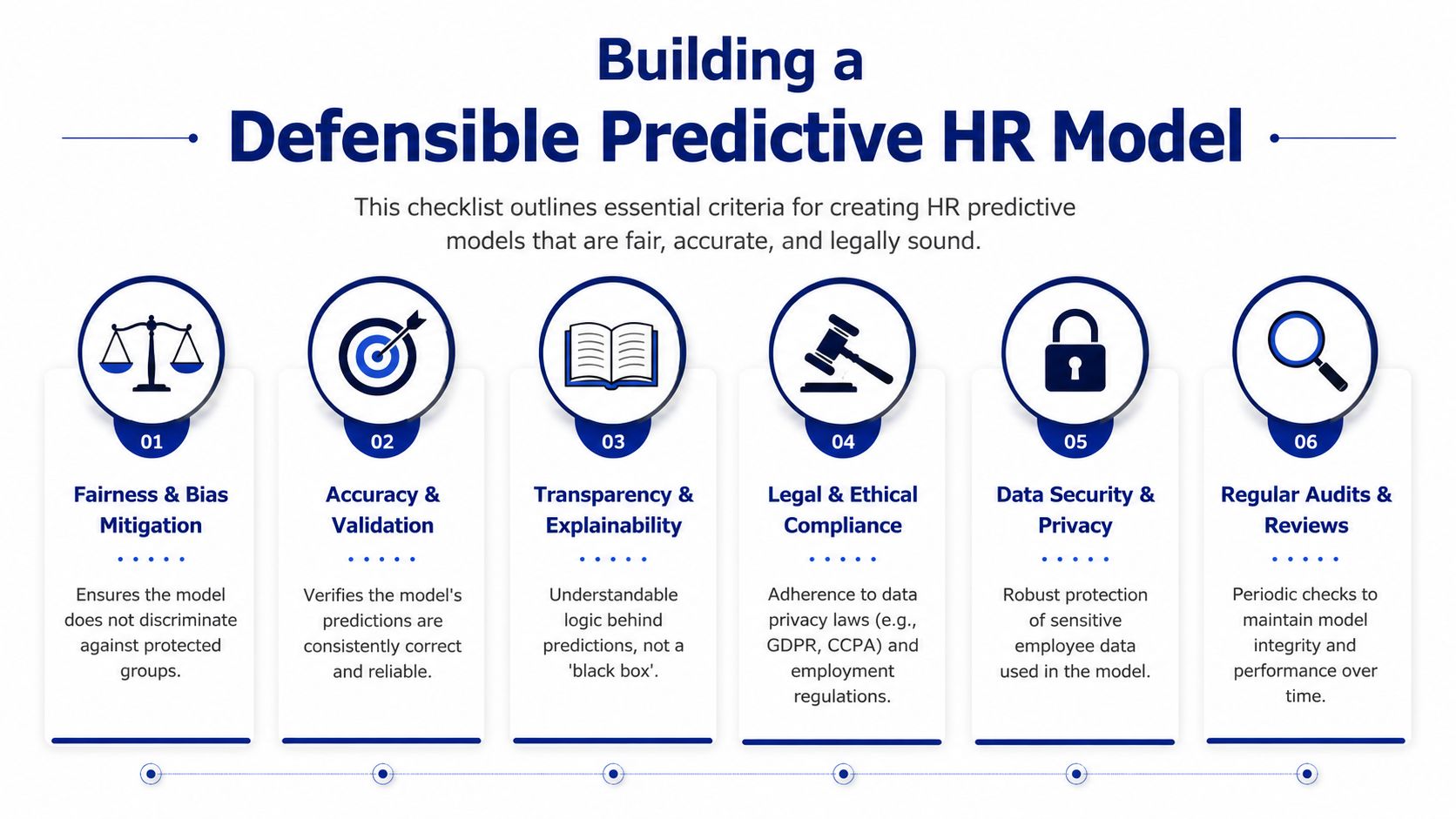
A valid model starts with disciplined input data. PeopleSpheres' practical guidance on HR predictive analytics notes that organizations should audit and pool data points such as tenure, pay positioning, performance scores, manager changes, commute time, engagement pulse scores, and badge-in variability because these factors correlate with flight risk and future performance outcomes. It also notes that data preparation should include a 70/30 training-test split, checking precision-recall balance, and quarterly model refreshes.
Not every available field should be used, but the right operational signals matter.
Many leaders fixate on accuracy because it sounds intuitive. In workforce risk models, that can mislead. A model can appear accurate overall while still missing many of the employees you most needed to identify.
A more useful evaluation discipline includes:
Governance point: If you can't explain the model in plain language to a manager, you shouldn't use it to influence a high-stakes people decision.
That's the standard mature organizations apply. The model should be accurate enough to help, simple enough to explain, and structured enough to audit. Anything less creates exposure.
SMBs don't need a massive analytics function to begin. They need a narrow question, usable data, and a pilot that leadership can manage. Predictive HR analytics works best when the first project is small, specific, and tied to a business decision people already care about.
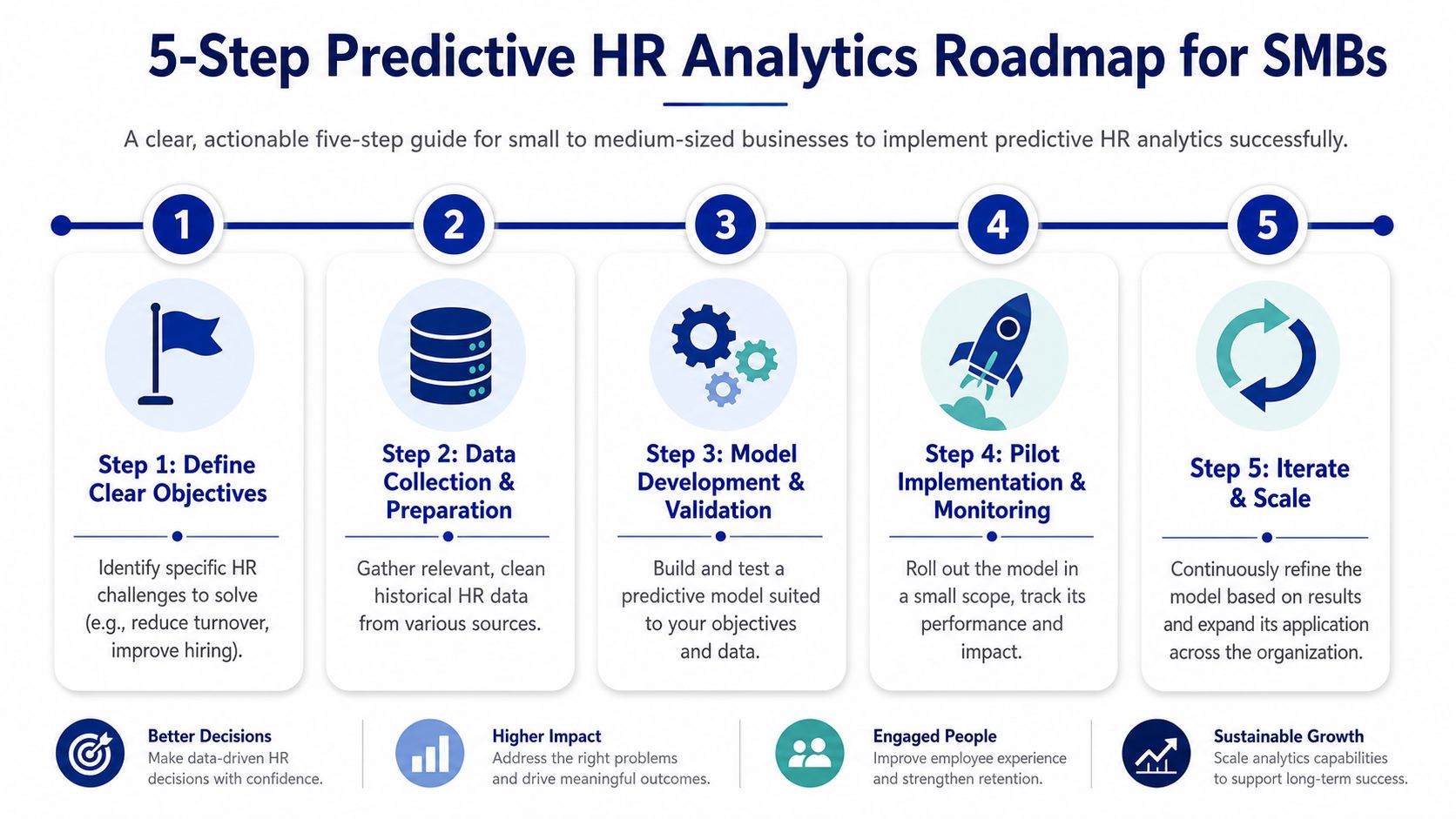
Hyring's guide to predictive analytics in HR states that effective attrition models usually need 18 to 24 months of historical workforce data to train algorithms that achieve accuracy above 65% in pilot phases. It also outlines a practical build sequence: Month 1 selects a high-impact target such as attrition, Month 2 assembles and cleans the dataset, and Month 3 builds a logistic regression model using tools such as Python, R, or Excel.
Start with one question that has a clear operational consequence. “Who is likely to resign in a critical role?” is useful. “Can AI improve talent strategy?” is too vague.
Then assess the data you already have. In many SMBs, the data exists across an HRIS, payroll system, engagement tools, spreadsheets, and manager notes. It may be messy, but that doesn't make the effort impossible. It means someone has to standardize fields, confirm ownership, and remove obvious quality problems before modeling starts.
If you're modernizing workflows at the same time, it helps to understand how analytics fits into process design. A related discussion of automating human resources can help leadership separate useful automation from automation that creates more noise.
Choose a model that matches your maturity. Many SMBs should begin with a simpler, explainable approach before moving to more complex methods. That improves trust and makes manager adoption far easier.
Pilot the model in one business unit, one geography, or one role family. Don't launch company-wide. A pilot lets you test signal quality, refine thresholds, and check whether managers use the output well.
Consider these operating questions during the pilot:
Operationalize only after the pilot proves two things. First, the model identifies useful patterns. Second, managers can act on those patterns consistently.
That usually means embedding the output into regular workflows:
| Workflow | How predictive insight fits |
|---|---|
| Talent reviews | Flags employees or teams that need immediate discussion |
| Workforce planning | Highlights likely shortfalls before budget and recruiting decisions |
| Manager check-ins | Prompts structured conversations instead of informal speculation |
A good roadmap is deliberately modest. One target, one model, one pilot, one review cycle. That's how SMBs build confidence without overcommitting budget or creating governance problems they can't manage.
Predictive HR analytics can reduce risk, but only if leadership treats governance as part of the system. Without that discipline, analytics can amplify inconsistency, embed bias, or encourage leaders to act on signals they don't understand.
The first legal issue is fairness. If a model relies on flawed data, poorly chosen proxies, or undocumented manager inputs, the organization may give unequal attention, opportunities, or scrutiny to different employees. That doesn't just create morale problems. It can create exposure when decisions touch pay, discipline, promotion, scheduling, or separation.
A risk score should never become an employment decision by itself. Someone still has to ask whether the prediction is reasonable, whether the data is current, and whether the planned action is consistent with policy and practice.
That human review should include:
The safest use of predictive analytics is to trigger review, not to automate consequence.
The second major issue is employee data. Predictive models often combine information from HRIS, payroll, engagement systems, and operational tools. Leaders need clear rules for data access, use, retention, and employee communication.
That includes practical questions such as who can view risk flags, whether sensitive fields are excluded, how records are secured, and how long derived analytics outputs are retained. A broader discussion of employee privacy rights is useful here because many organizations underestimate how quickly analytics questions become privacy questions.
The ethical standard is simple. Use data to support better decisions, not to create hidden surveillance or opaque labeling.
That means leadership should be able to explain:
When those questions have clear answers, predictive HR analytics strengthens governance. When they don't, the technology becomes harder to defend than the gut feel it was supposed to replace.
Vendor demos make predictive HR analytics look easy. Clean dashboards, polished heat maps, and confident claims can hide the questions that matter most. SMB leaders need a screening process that focuses less on features and more on fit, transparency, and risk.
A good vendor should help you understand what the model does, what data it requires, how it integrates with your existing systems, and where human review belongs. If the answers are vague, the relationship will likely create work for your team instead of reducing it.
Start with the basics. Ask the vendor to explain the model as if they were briefing a department leader, not a data scientist. If they can't do that clearly, trust will be hard to build internally.
Then pressure-test the operating realities:
If you're comparing platforms more broadly, a review of best HRIS systems can help frame the larger systems question around integration and operational fit.
| Category | Key Question |
|---|---|
| Model transparency | Can you explain the main drivers behind a risk score in plain language? |
| Data requirements | What minimum historical data is needed before the model is useful? |
| Integration | Which HRIS, payroll, and survey tools do you connect with directly? |
| Security | How do you control access to employee-level predictions and sensitive fields? |
| Validation | How do you test model performance over time and detect drift? |
| Workflow fit | Where do predictions appear in day-to-day manager or HR workflows? |
| Bias controls | What checks are in place to identify unfair or distorted outputs? |
| Implementation support | Who owns configuration, training, and post-launch refinement? |
| Reporting | Can we document why a prediction was surfaced and what action followed? |
| Customer fit | What kinds of SMB environments do you support best? |
Ask the vendor to show a weak result, not just a success screen. That's where you learn how honest and usable the product really is.
The right partner doesn't just sell prediction. They help your team govern it.
Predictive HR analytics is most useful when leaders keep it grounded. It doesn't replace management judgment, employee relations skill, or legal review. It makes those functions better by giving them earlier, clearer signals.
For SMBs, that matters because workforce risk rarely arrives one issue at a time. A resignation affects staffing. Staffing affects manager pressure. Manager pressure affects engagement, consistency, and documentation quality. Predictive tools help leadership see those patterns sooner and respond with more discipline.
The practical future isn't a fully automated HR function. It's a better-informed one. Leaders still make the call. Managers still hold the conversation. HR still validates fairness, consistency, and compliance. The difference is that decisions are based less on instinct alone and more on patterns the business can observe, explain, and act on.
That's where predictive HR analytics becomes more than reporting technology. It becomes part of how a company protects stability while it grows.
Organizations that want to use predictive HR analytics well usually need more than software. They need sound judgment, clean decision pathways, and an approach that holds up under operational and legal pressure. Paradigm International Inc. works with SMB leadership teams that need exactly that kind of structure, especially when workforce decisions carry real risk and require defensible execution.


