
You’re probably looking at sabbatical leave from one of two angles. Either a key employee has asked for it and your team has no real rules, or you’re considering adding it because retention is getting harder and burnout is showing up in places you can’t ignore. In both cases, the risk isn’t the idea of a sabbatical. The risk is offering one casually.
For a multi-state SMB, sabbatical leave rules need to do two jobs at once. They need to support retention and leadership continuity, and they need to hold up when someone claims unfair treatment, inconsistent approval, or interference with another leave right. If your policy can’t survive pressure, it’s not a benefit. It’s exposure.
A sabbatical is employer-designed extended leave, usually tied to tenure, that gives an employee time away from work for rest, renewal, study, travel, caregiving, or personal development. It isn’t the same as vacation, and it isn’t the same as legally protected leave like FMLA. That distinction matters because employers usually have much more control over the rules.
That control is exactly why sabbaticals can help or hurt you. If you define the benefit clearly, it can reward loyalty, retain institutional knowledge, and create a practical off-ramp for burned-out high performers before they resign. If you leave it vague, managers start making one-off decisions, and that’s where fairness problems begin.
The market has moved in this direction. According to WorldatWork’s sabbatical survey summary, 27% of organizations offered unpaid sabbaticals in 2022, up from 18% in 2016, while 10% offered paid sabbaticals. The same summary notes that another 12% of employers plan to add them within two years, driven by attraction and retention pressure.

Sabbaticals have shifted from niche perk to selective retention tool. They’re still uncommon enough to differentiate your business, but common enough that experienced employees now ask about them, especially in competitive labor markets.
A COO should view sabbatical leave rules through a business lens:
Practical rule: If you offer sabbaticals, treat them as part of workforce planning, not as a goodwill exception.
Many employers often make mistakes in this area. A sabbatical is not a substitute for legal leave rights, and it shouldn’t be described as an informal reward managers can “work out” on their own. Once a pattern develops, employees will compare decisions, and you’ll need a defensible reason for every approval and denial.
It’s also not just an “extended vacation.” If you want the program to support retention instead of resentment, the policy should explain the business purpose. That purpose might be renewal, professional development, long-service recognition, or executive sustainability. Pick one or two reasons and write them down.
If you’re considering a sabbatical program because turnover has become expensive operationally, that instinct is sound. But the right move isn’t to announce a perk and work out details later. The right move is to build rules first, manager training second, and communication third.
If retention is the trigger, this guide on how to prevent employee turnover is a useful companion because sabbaticals work best when they sit inside a broader retention strategy rather than acting as a stand-alone fix.
A defensible policy is one that a manager can apply consistently, HR can administer without guesswork, and legal counsel can read without wincing. Most sabbatical problems don’t start with bad intent. They start with fuzzy language, exceptions made under pressure, and approvals that aren’t tied to objective criteria.
The safest approach is to build your sabbatical leave rules like any other high-risk employment policy. Define eligibility. Define process. Define decision rights. Define limits. If a point feels awkward to document, that’s usually the point most likely to create a dispute later.
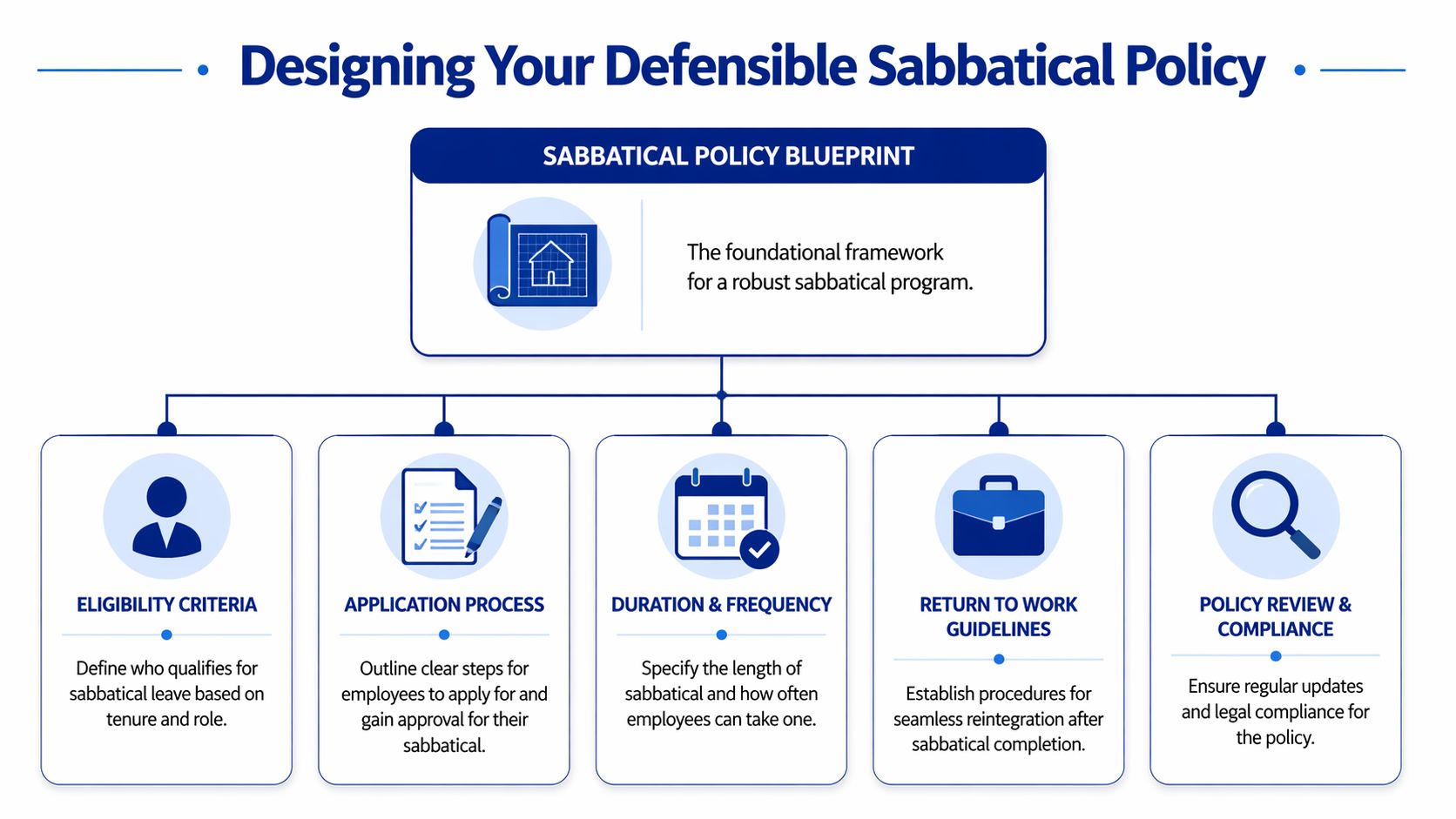
According to TriNet’s guidance on sabbatical leave, employers typically tie eligibility to 5 to 10 years of continuous service plus performance criteria. The same guidance notes that requiring 6 to 12 months’ notice and limiting frequency to once every 5 to 7 years helps support consistent application and reduce discrimination risk.
That framework is smart because it removes manager discretion from the front end. A good policy should answer these questions in plain English:
Tenure alone is too blunt. If you approve sabbaticals for anyone who hits a service anniversary, you can create major operational gaps in key roles and deny requests inconsistently later. Tie the benefit to both service and business readiness.
Use criteria like these:
| Policy area | Better rule | Why it matters |
|---|---|---|
| Eligibility | Continuous service plus satisfactory performance | Reduces favoritism arguments |
| Notice | Advance written request with planning time | Gives leaders time for coverage |
| Frequency | Limited repeat use | Prevents program abuse |
| Approval | Final sign-off by a designated executive | Creates consistency |
| Operational review | Written handover and coverage plan required | Protects continuity |
A written policy should also align with your broader employment contract approach where individual terms, return obligations, and post-leave expectations might intersect with existing agreements for key employees.
The policy should never say approval is based on “leadership discretion” alone. That phrase invites inconsistency.
Many templates fall short. They state an employee “may be granted an extended leave” and provide no further detail. That’s not a rule. That’s an opening for argument.
Set fixed parameters, even if you allow some flexibility within them. Your policy should state:
If you want room to adapt by role, create bands or tiers. Just make sure the distinctions are written and tied to business reasons, not personal preference.
A sabbatical request should never start and end in private conversations with a manager. Require a standard form, a defined review sequence, and written approval or denial. For a multi-state employer, this isn’t bureaucracy. It’s evidence.
Your process should include:
This is also the right place to cross-reference your paid time off policy, so employees and managers don’t confuse accrued PTO with a sabbatical benefit that runs under a separate set of rules.
You may need exceptions. Acquisitions happen. Retention situations happen. Senior executives sometimes negotiate special terms. Fine. But if exceptions exist, control them tightly.
Use a narrow standard. Require documented business justification and executive-level approval. Then track every exception in one place.
Here’s the blunt truth. The fastest way to destroy a sabbatical program is to let high-value employees negotiate side deals while everyone else gets the handbook version. If you want a premium executive arrangement, handle it separately and document it separately.
Pay is where a sabbatical stops being a cultural idea and becomes an employment risk question. If you don’t define compensation, benefit continuation, accrual treatment, and return rights with precision, people will fill in the gaps themselves. They usually fill them in your least favorable direction.
The first decision is whether the leave is unpaid, partially paid, or fully paid. There’s no universally correct answer. There is only the answer your business can afford and administer consistently.

According to AIHR’s sabbatical leave guidance, unpaid sabbaticals are most common, and paid sabbaticals require attention to possible deferred compensation issues under IRS 409A rules. The same guidance says policies should explicitly address PTO accrual and pension contribution rules during leave to avoid liability disputes later.
That’s the practical heart of it. The more generous the pay model, the more important the legal and administrative structure becomes.
Here’s the cleanest way to evaluate options:
| Pay model | Strength | Main risk |
|---|---|---|
| Unpaid | Lower direct cost, simpler budgeting | Employees may assume benefits or accruals continue when they don’t |
| Partially paid | Better retention signal without full payroll cost | Inconsistent formulas create fairness disputes |
| Fully paid | Strong loyalty and recruiting message | Higher cost and more scrutiny on eligibility and tax treatment |
Your policy needs a dedicated section for benefits. Don’t bury this in general leave language. Address each major category directly.
Include answers to these questions:
If your policy is silent, disputes get expensive fast. An employee comes back expecting PTO to have accrued, bonus targets to remain untouched, and service credit to count the same as active work. If your documents don’t answer those points clearly, you’re negotiating after the fact.
Operational advice: Put compensation and benefits terms in the approval letter as well as the policy. Don’t rely on the handbook alone.
Employers often create trouble by promising the employee will return to “the same role” without qualification. That sounds employee-friendly, but it’s often operationally unrealistic. Teams change. Clients move. Reporting lines shift.
If you want defensible sabbatical leave rules, define return rights with care. In many cases, “same or equivalent position” is the safer phrase, paired with language that reserves the employer’s ability to make legitimate business changes unrelated to the leave.
That doesn’t mean you should use vague language to preserve maximum discretion. It means you should state a clear rule that protects both sides. Employees should know whether they are coming back to a guaranteed role category, equivalent compensation status, and similar responsibilities.
If you pay for a sabbatical, especially for senior or hard-to-replace employees, consider a return commitment and repayment provision. That needs legal review, but the business rationale is straightforward. If the company funds extended leave, it’s reasonable to protect against immediate resignation after return.
Be careful here. Overreaching repayment clauses can create employee relations issues and legal friction. Narrow clauses tied to paid benefits and clearly defined post-return periods are easier to defend than punitive language drafted in anger.
Employees on sabbatical are still bound by core employment obligations unless your policy says otherwise. If confidentiality, client restrictions, or public communications matter in your business, say so explicitly in the pre-leave agreement.
This matters most in regulated industries, client-facing roles, and executive positions. A sabbatical should create distance from daily work, not confusion about ongoing duties.
Many employers make the same mistake. They assume sabbatical leave sits in its own lane because it’s voluntary. It doesn’t. Once an employee’s sabbatical overlaps with a medical condition, family need, disability issue, pregnancy-related limitation, or state leave entitlement, your “perk” collides with statutory obligations.
That’s why sabbatical leave rules can’t be drafted in isolation. Your policy has to account for what happens when another leave law enters the picture and changes the analysis.

According to Ogletree Deakins’ discussion of sabbatical pitfalls, a major compliance risk is how sabbaticals interact with statutory leave rules. The article notes that federal FMLA may allow employers to require substitution of paid leave, while some state laws give the employee that control instead. If your policy language is imprecise, an employee may be able to use paid sabbatical time during a state-mandated leave in a way you did not intend.
That’s not a drafting technicality. That’s a cost and compliance problem.
If you operate in more than one state, stop assuming one leave rule applies everywhere. It won’t. Your HR team needs to know whether state law changes who controls paid leave substitution, whether local protections affect job restoration, and whether your sabbatical wording creates obligations broader than the law requires.
Watch for these pressure points:
If your team needs a plain-language refresher on where federal protected leave differs from broader leave concepts, this guide on leave of absence vs FMLA helps frame the distinction.
A sabbatical policy shouldn’t answer legal leave questions by accident. It should answer them on purpose.
The cleanest policy separates sabbatical leave from statutory leave at the outset. State that sabbatical leave is a discretionary employer benefit subject to policy terms, and that statutory leave rights are governed by applicable law and separate policy provisions. Then address whether and when the leaves may run concurrently.
That keeps your internal benefit from implicitly expanding into a broader entitlement. It also gives HR a roadmap for evaluating requests that change midstream. A personal renewal leave can become a medical issue. A preapproved break can become a disability accommodation discussion. Your policy should anticipate that shift.
A surprising amount of leave exposure comes from well-meaning manager commentary. A supervisor says, “Use your sabbatical for this surgery,” or “You can just count this as your long-service leave,” and now HR is cleaning up an avoidable mess.
Managers need one simple rule. They can support the employee. They cannot improvise legal interpretations. Direct all leave overlap questions to HR or counsel.
If you have employees in California, Texas, New York, or any mix of states with different leave frameworks, a generic template won’t carry the load. Review your sabbatical leave rules against each jurisdiction where you employ people. The goal isn’t to make the policy unreadable. The goal is to identify where a state addendum or administrative note is needed.
For a growing SMB, precision pays off. The sabbatical itself is optional. The legal consequences of sloppy administration are not.
A good policy can still fail on rollout. Employees misunderstand it. Managers overpromise. HR applies it one way at headquarters and another way in a field office. If you want sabbatical leave rules to work, implementation has to be as disciplined as drafting.
Start with the handbook. If your handbook is outdated, inconsistent, or full of broad manager discretion language, fix that before launch. A well-drafted employee handbook is still one of the best tools for reducing avoidable disputes because it creates a single reference point for managers and employees.
Use at least two channels. Issue a written policy update and hold manager training before employees begin applying. Don’t rely on a handbook upload and assume people will interpret it correctly.
Cover these points in the rollout:
Manager training should include actual language to use. Most inconsistency starts when supervisors paraphrase policy from memory. A simple script protects everyone.
For example:
“I’m glad you raised this. Sabbatical requests go through a formal review so we apply the policy consistently. HR will walk us through the next step.”
That answer is better than a thoughtful but risky improvisation. It doesn’t deny the request. It doesn’t promise anything. It keeps the process intact.
Every approved sabbatical should trigger a coverage checklist. Identify key tasks, client-facing responsibilities, approval authorities, and system access issues. Then assign backup ownership before the leave starts.
Use a short implementation checklist:
If your policy launch doesn’t include documentation controls, you’re not implementing a benefit. You’re creating a future fact pattern.
Leaders usually don’t struggle with the concept of a sabbatical. They struggle with the hard edge cases. That’s where bad policy language gets exposed.
Yes, if you can tie the distinction to a legitimate business rationale and apply it consistently. A sabbatical doesn’t have to cover every employee group in the same way. But if you create different eligibility tracks, document why.
Good reasons include retention strategy for hard-to-replace roles, leadership continuity planning, or role-specific development objectives. Bad reasons include convenience, personal preference, or “that’s how we’ve always handled senior staff.”
You can ask for the general purpose of the leave, but don’t overreach. If your policy turns into a moral judgment test about whether the employee’s plans are worthy, you’ll create inconsistency and resentment.
The better approach is to focus on operational questions. Proposed dates. Transition plan. Confirmation of return intent if required. Compliance with policy conditions. You don’t need to approve someone’s life choices. You need to administer a defined leave program.
Keep the application focused on business administration, not personal justification.
Yes. Eligibility should not equal automatic approval. Your policy should say that approval also depends on operational feasibility and the employee’s completion of the required request process.
That said, denials must be documented and rooted in real business conditions, not vague statements about timing. If one employee is denied because a major implementation is underway, and another employee in a similar role is approved during a similar crunch period, expect questions.
Both. The handbook should state the program rules. The individual approval should sit in a separate written agreement or approval letter that confirms dates, pay status, benefit treatment, return expectations, and any repayment terms for paid leave.
That two-document approach works better because it gives you one standard policy and one employee-specific record. It also reduces later arguments about what was communicated.
Your policy should address this directly. If the leave is unpaid, resignation may effectively end the employment relationship and any associated benefits under plan terms. If the leave is paid, you may want repayment language for specific paid benefits, subject to legal review.
Don’t improvise this after someone submits notice from another country. Set the rule in advance. Include where notice must be sent, when employment ends, and what financial obligations survive the leave.
Only if your policy allows it. Some employers prohibit outside work that conflicts with company interests, violates confidentiality obligations, or undermines the purpose of the leave. Others allow limited outside activity with prior approval.
Pick a rule and write it clearly. If your company has conflict-of-interest, moonlighting, or confidentiality policies, the sabbatical document should cross-reference them.
That’s exactly why your return-to-work language matters. If you promised the “same job,” you boxed yourself in. If you promised a same or equivalent position subject to legitimate business changes, you preserved flexibility without making the leave meaningless.
On return, hold a formal reintegration meeting. Confirm reporting structure, compensation status, active projects, and any required training refreshers. Don’t let the employee discover major role changes through an org chart update.
Sometimes. But don’t copy a large-company model because it sounds progressive. A smaller employer can get real value from an unpaid or partially paid program if the rules are clear and the leave is treated as a meaningful long-service benefit.
The right question isn’t whether paid leave sounds attractive. The right question is whether your business can sustain the cost, administer the tax and benefit consequences properly, and defend the eligibility choices you make.
A COO approves a sabbatical for a high performer, the team covers the work, and the leave looks like a culture win. Then another employee in a different state asks for the same deal, a manager handles it differently, and what started as a retention tool turns into an inconsistency problem with legal exposure attached.
That is why disciplined sabbatical rules beat informal executive promises every time. A written policy forces leadership to define eligibility, approval standards, coverage expectations, and return terms before emotions and favoritism drive the decision. For a multi-state SMB, that discipline reduces one of the biggest risks in leave administration. Similar employees getting different outcomes with no defensible reason.
Sabbaticals can support retention and help prevent employee burnout. They only do that when employees trust the program and managers can apply it the same way across locations. If your rules are vague, the benefit loses credibility fast.
The better question is whether your program is governable across your actual footprint, manager bench, and budget. If the answer is yes, a sabbatical policy can strengthen loyalty, improve succession readiness, and show employees your company plans for sustainability instead of running on constant overextension. If the answer is no, fix the policy before you promote the benefit.
If your leadership team is weighing whether to add a sabbatical program, revise outdated leave language, or pressure-test policy decisions across multiple states, Paradigm International Inc. can help you build a structure that’s practical, defensible, and aligned with how your business operates.