If you run a business in more than one state, leave compliance probably already feels unstable. One employee asks about bonding leave, another needs time off to care for a parent, and a manager assumes federal FMLA answers everything. It doesn't. State family leave laws now create separate obligations that can affect eligibility, job protection, payroll practices, notices, and documentation.
The biggest mistake I see is treating leave as a policy issue only. It's a risk issue. If your company operates across jurisdictions, you need one defensible operating model that managers can follow consistently, even when the underlying laws differ.
The first rule is simple. Apply the law that gives the employee the greater protection or benefit when federal and state rules overlap. If your team doesn't understand that principle, every downstream decision gets harder.
Federal FMLA is still the baseline framework many employers recognize. But it is not the whole framework. A state law can expand who is covered, what reasons qualify, what family members count, whether pay is available, and whether a smaller employer still has obligations.
A clean analysis starts with three questions:
That sounds basic, but most leave errors happen because someone skips straight to the third question without confirming the first two.
For example, some state laws reach employers that federal FMLA doesn't cover. Others create paid benefits through a state program while job protection may come from a different law entirely. That means an employee may have access to wage replacement, job protection, both, or one without the other. Your managers need to stop treating leave as one single bucket.
Practical rule: Never deny a leave request because “we're not covered by FMLA” until you've checked the employee's work state, residence state when relevant, and any state-specific leave rules that might still apply.
That's also why medical and mental health issues around pregnancy and recovery require careful handling. If your team is evaluating postpartum-related leave questions, this overview of FMLA for postpartum anxiety is a useful example of how a condition can trigger legal analysis that goes beyond a manager's instinct.
Most compliance failures fall into a short list:
A lot of executives also blur the difference between a leave of absence and protected FMLA-style leave. If your internal teams need a practical reset, this breakdown of leave of absence vs. FMLA is the right starting point.
You don't need every manager to become a leave lawyer. You do need a disciplined triage process. Route every leave-related statement through one review path, confirm the governing law set, then apply the most employee-favorable rule where required. That's how you keep leave administration consistent and defensible.
Leave law is full of ordinary words with very specific legal meaning. If your policy uses these terms loosely, your company will make inconsistent decisions.
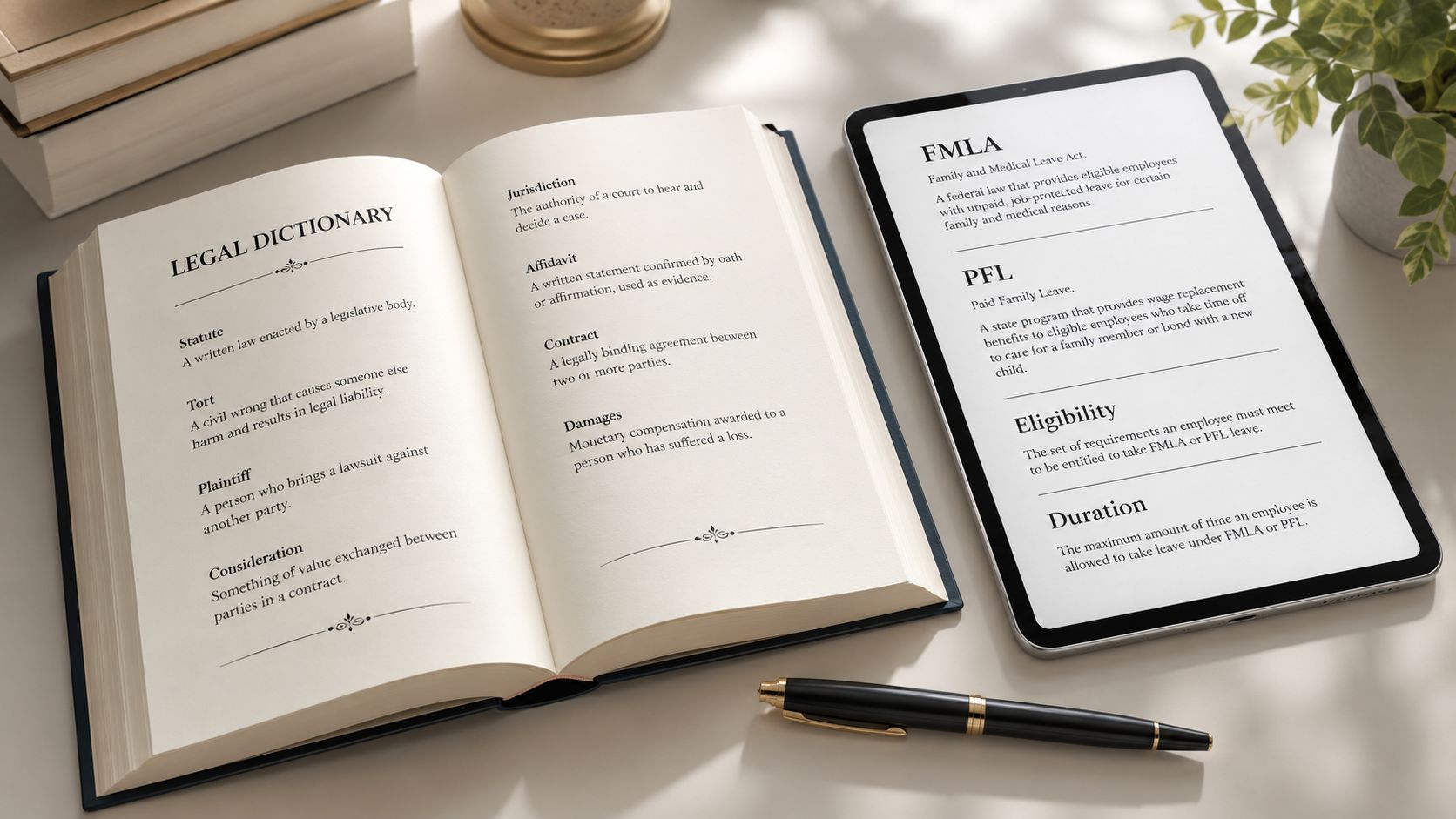
A manager doesn't need statutory language. They need decision cues.
If a supervisor hears “my parent needs treatment every Thursday,” that is not an attendance problem to solve casually. It may be an intermittent leave issue that belongs in HR review immediately.
A second example is family member. Business leaders often assume that term is fixed. It isn't. State family leave laws may define family more broadly than federal FMLA, which changes who an employee may take leave to care for.
Use these terms in three places only if they mean the same thing each time:
| Term | Where it must match |
|---|---|
| Covered employer | Handbook, manager guide, legal review notes |
| Eligible employee | Leave request forms, HR workflow, payroll coordination |
| Qualifying reason | Intake scripts, certification process, approval letters |
| Benefit year | Tracking system, notices, leave balances |
| Intermittent leave | Attendance rules, scheduling process, supervisor training |
If those sources conflict, the law won't rescue you. Consistency has to come from your process.
The paid leave environment is no longer a niche issue. As of early 2026, there are 13 states plus the District of Columbia that have enacted mandatory paid family and medical leave laws, covering more than 30% of the U.S. workforce, according to the Bipartisan Policy Center's explainer on state paid family leave laws. For multi-state employers, that means paid leave can affect payroll deductions, notices, employee communications, and coordination with state agencies.
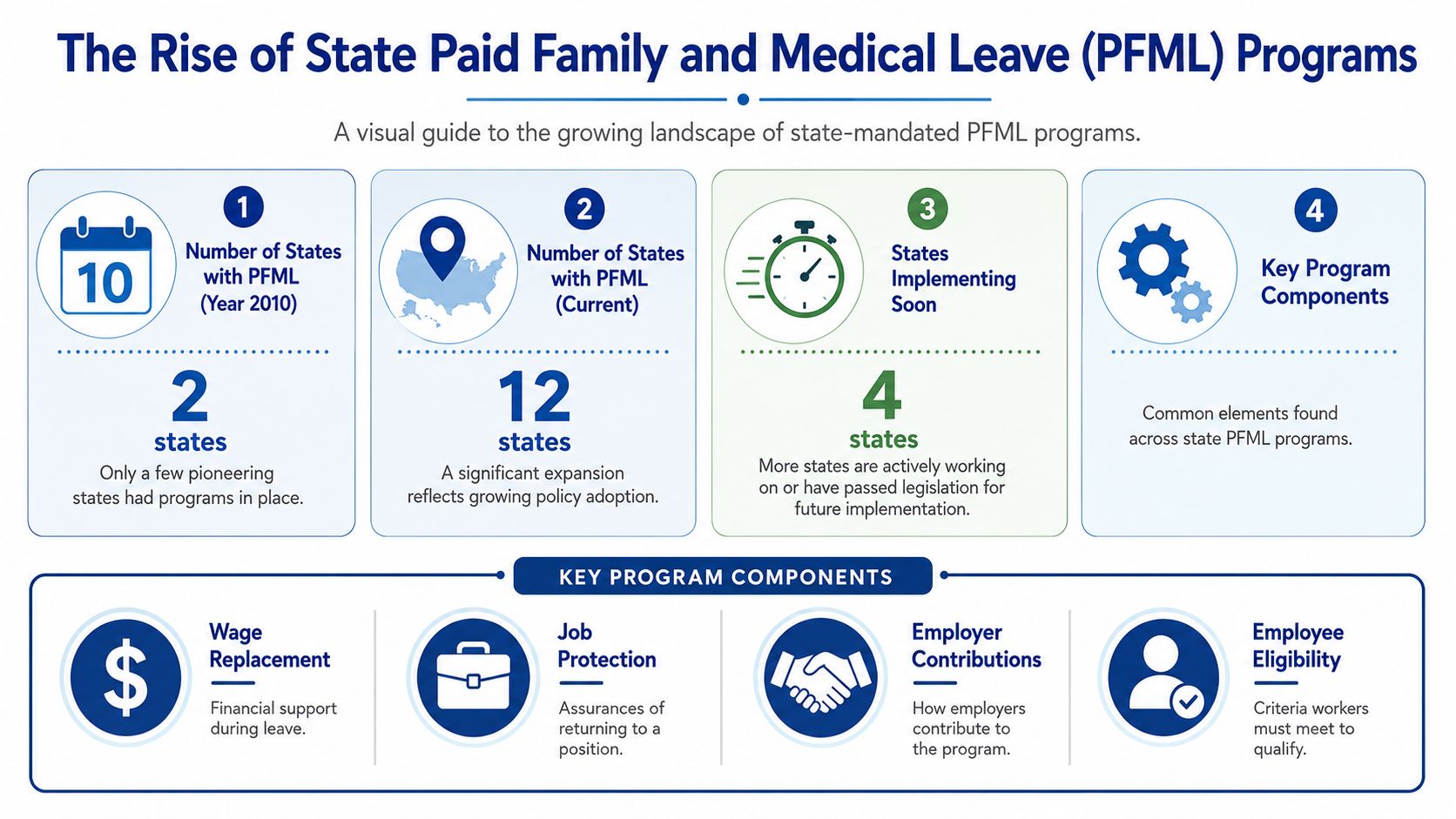
At a high level, employers commonly encounter mandatory paid family and medical leave obligations in jurisdictions such as:
The exact status, start dates, contribution mechanics, and administrative rules differ. Don't run your program off a memory of “states with paid leave.” Build a current jurisdiction list tied to where employees work and, where relevant, where they are localized for payroll and benefit purposes.
Executives often ask for a single chart showing funding, benefit amount, duration, and qualifying reason for each state. That chart is useful, but it can also create false confidence. The deeper compliance issue is that state programs differ in structure, not just generosity.
A state PFML program may vary on points such as:
That's why a state list alone isn't enough. Your risk doesn't come from not memorizing every program detail. It comes from failing to assign ownership across payroll, HR, and leadership.
The safest approach is to treat paid family and medical leave as a coordinated compliance function, not a benefits side task.
Use this quick-reference lens when reviewing any PFML state:
| Compliance area | What to verify internally |
|---|---|
| Payroll setup | Are contributions configured correctly for the covered workforce |
| Employee notices | Are required notices included at hire, at leave request, and in policy documents |
| Claims workflow | Does HR know when the employee files with the state, with the company, or both |
| Job protection review | Is someone checking whether a separate federal or state law protects the position |
| Manager conduct | Do supervisors know not to discourage claims or ask for off-script documentation |
Many companies overbuild their leave process around California or New York because those programs are familiar. That's a mistake. A defensible system needs a repeatable intake method that works across all covered jurisdictions, then routes the case to the correct state-specific rules.
A strong internal standard looks like this:
If your current process depends on one HR generalist remembering which states require what, it's already fragile.
Paid leave gets the attention, but unpaid leave is where many smaller employers get blindsided. A business can fall outside federal FMLA and still owe job-protected leave under state law. That's the gap that causes avoidable denials.
State unpaid leave laws often fill one of two gaps. They either cover smaller employers, or they protect leave reasons that federal law handles differently or not at all.
That matters in real operations. A manager may think the issue is simple because no state benefit payment is involved. But if the employee has a right to return to work after protected leave, the legal exposure is just as real.
Common state-level leave categories can include:
Small and mid-sized businesses often have informal leave habits. That works until a supervisor says yes to one person, no to another, and documents neither.
A company doesn't need to be large to create leave liability. It only needs a manager who improvises.
Broad leave administration discipline matters more than legal sophistication. If your team still treats requests as ad hoc schedule adjustments, you're exposed. A practical review of leave of absence from work can help leadership distinguish between ordinary discretionary time off and legally protected leave categories.
When unpaid leave requests come in, ask:
If the answer to the last question is no, your process is the problem. State family leave laws are hard enough. You can't afford informal manager judgment on top of that.
The hardest part of multi-state leave administration isn't the existence of different laws. It's that eligibility and duration rules are built on different logic. Some laws ask how long the employee has been with you. Others care more about hours, wages, payroll contributions, or a state-specific service test.
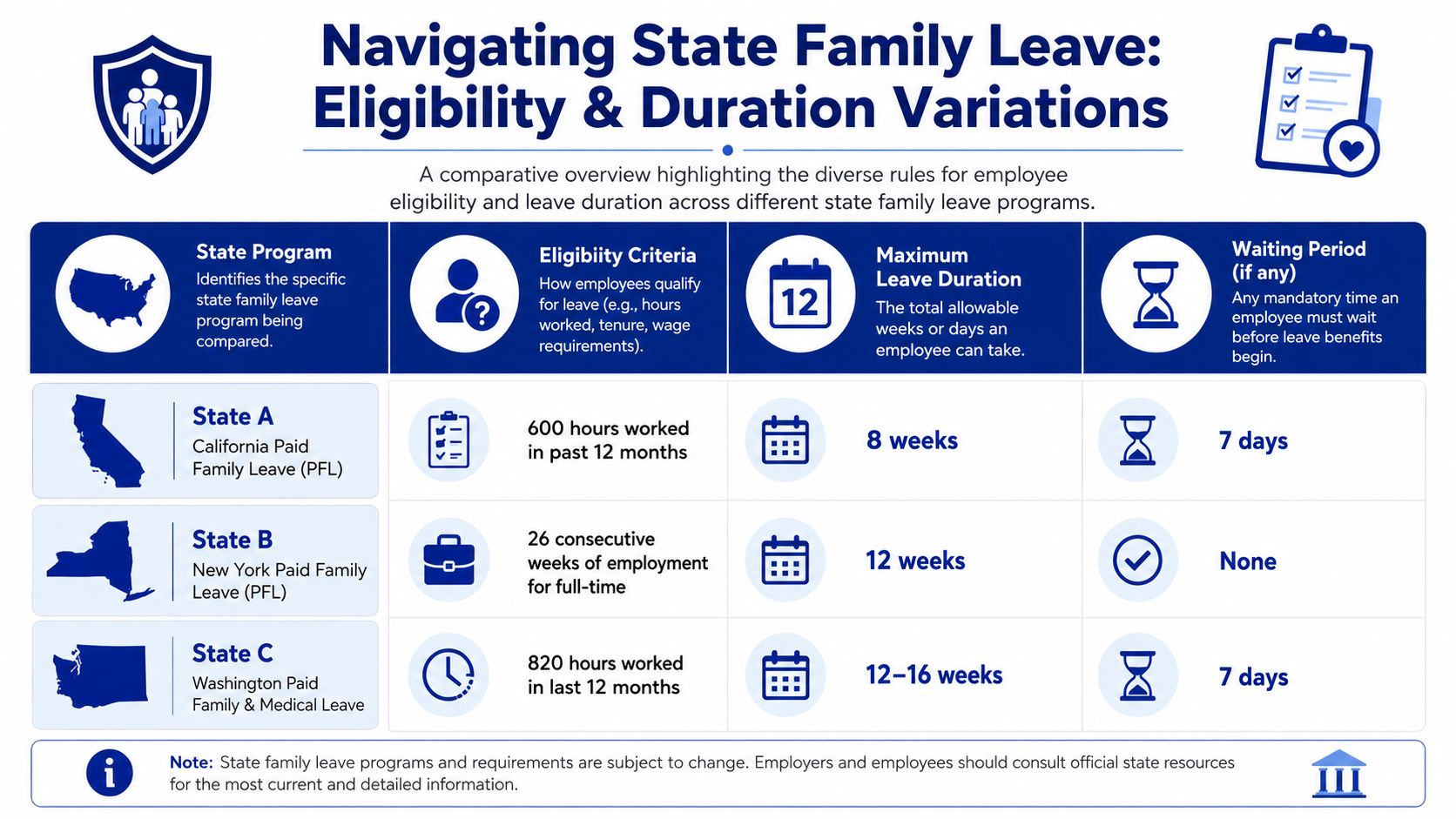
Stop trying to memorize every state's rule in isolation. Group the rules into operating categories instead.
| Rule type | What it means for your process |
|---|---|
| Employer size threshold | You need a jurisdiction-by-jurisdiction coverage map |
| Service-based eligibility | HR must verify hire date and employment continuity |
| Hours-based eligibility | Timekeeping accuracy becomes a compliance issue |
| Wage or contribution-based eligibility | Payroll records become central to leave decisions |
| Different duration rules | Your tracking system must calculate by law, not by habit |
Many otherwise strong HR teams encounter a significant challenge. They rely on a single leave worksheet built around federal assumptions, then manually override exceptions. That is not a system. It's a recurring error source.
A scalable approach has two levels.
First, create a standard intake file that captures the same core facts for every request: work location, hire date, recent service status, reason for leave, family relationship, expected timing, and whether the leave may be intermittent.
Second, use a jurisdiction rule matrix behind the scenes. That matrix should tell HR which eligibility test to apply, what duration standard controls, whether a waiting period exists, and whether another law runs concurrently.
Good multi-state compliance doesn't mean every employee gets the same leave package. It means every request moves through the same disciplined decision process.
If your leave process depends on spreadsheets maintained by one person, fix that before the next complex request arrives. The priority order is straightforward:
Once those pieces are in place, state-by-state variation becomes manageable. Without them, each request turns into a custom legal puzzle.
Leave compliance breaks down fastest at the point of notice. An employee says something vague, a manager responds casually, and the company loses control of timing, documentation, and legal designation.
You need a formal reporting process, even if your company is small. Employees don't have to use legal buzzwords, but managers should know that any statement about a medical issue, childbirth, caregiving need, or protected family event must go to HR immediately.
That process should require:
Ask only for information the applicable law allows you to request. Employers often overreach by asking for diagnosis details, treatment history beyond what's needed, or broad medical records. That creates risk and doesn't improve decision quality.
Use a clean standard:
If certification is incomplete or unclear, use a defined correction process. Don't let a supervisor call the provider directly because they're frustrated by ambiguity.
Some leaders think strict documentation means asking for more paperwork. Usually it means asking for the right paperwork, at the right time, in the same way for every employee in similar circumstances.
Documentation principle: Be specific, lawful, and repeatable. If your standard changes based on the employee, your defense gets weaker.
You also need clear rules for foreseeable versus unforeseeable leave. If the event is planned, require notice as early as reasonably possible under the law and your policy. If it isn't planned, focus on prompt reporting, not perfection. Employees rarely describe emergencies neatly.
Managers should not decide whether a condition sounds serious enough. They should not edit medical forms. They should not promise approval or deny requests on the spot.
Their job is simpler:
That division of responsibility is what keeps your process credible.
Most multi-state employers make one of two policy mistakes. They either write a single national leave policy that is too general to be useful, or they bolt on so many state exceptions that no manager can apply it correctly.
I recommend a baseline policy plus state-specific addendums for most multi-state businesses. It is more work upfront, but it's the most defensible model for organizations that want operational consistency without unintentionally granting the broadest possible benefit in every location.
A “highest standard everywhere” policy has one obvious advantage. It simplifies employee messaging. In theory, everyone gets the most generous rule the company encounters anywhere.
In practice, it often creates avoidable problems:
Use a layered model.
| Policy layer | What belongs there |
|---|---|
| Core national policy | General reporting expectations, anti-retaliation, centralized administration, coordination principles |
| State addendums | Eligibility rules, qualifying reasons, benefit coordination, notices, job protection details |
| Manager guide | Escalation rules, prohibited statements, documentation handling, return-to-work steps |
That structure keeps the employee handbook readable while preserving legal accuracy. If you need a benchmark for how handbook obligations vary by location, review employee handbook requirements by state.
Your leave policy should answer the questions a manager and employee face:
Don't bury those answers in legal prose. A policy is compliant only if people can use it.
The strongest leave policy is not the longest one. It's the one your managers can follow correctly under pressure.
If your handbook currently reads like a summary of laws instead of an operating document, rewrite it. State family leave laws punish ambiguity.
Most companies don't need another memo about leave. They need an audit list they can act on this quarter.
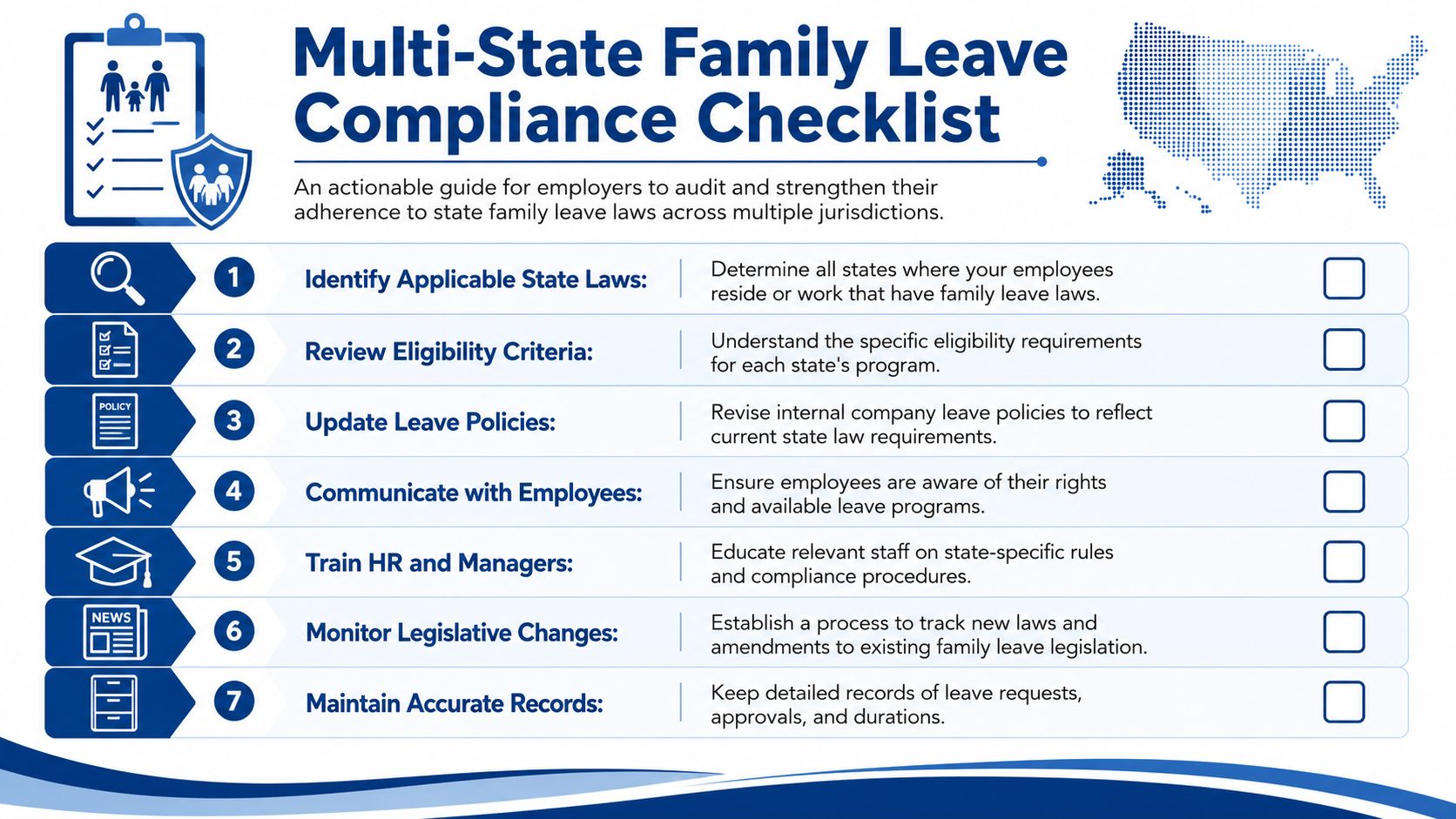
Don't patch problems one request at a time. That's how companies end up with inconsistent precedent and uneven treatment across states.
Instead, fix the operating system:
That approach is more disciplined, and it holds up better when an employee challenges a decision.
If your leadership team needs a clearer, defensible approach to multi-state leave compliance, Paradigm International Inc. helps business owners and executives build practical HR frameworks that reduce risk and hold up under scrutiny.