A regional operations director is preparing to terminate a remote account manager who lives in Oregon, performs work connected to California, reports to a manager in Texas, and is paid through a payroll operation in Delaware. The decision looks simple until someone asks when final wages are due, whether unused vacation must be paid, which separation notices apply, and how unemployment and benefits communications should be handled.
That situation captures the central problem with termination rules by state. Termination risk rarely sits inside one statute or one payroll task. It moves through a chain of obligations triggered by the separation, and a mistake in the separation reason or payment date can affect wage compliance, benefits administration, recordkeeping, unemployment responses, and retaliation exposure.
The director first needs to identify the law connected to the employee's actual work, not just the state where payroll is processed. Oregon may control important wage-payment questions because the employee lives and works there, while California rules may matter if the employee performs work in California or is covered by California employment requirements. Texas may affect manager communications and internal documentation, but the manager's location alone doesn't automatically decide every employment-law question. Delaware payroll administration also creates an operational connection, not necessarily the controlling wage-law jurisdiction.
The immediate decision points should be written down before the meeting occurs:
A remote employee doesn't create a single “remote worker rule.” The employer must map the facts to each potentially applicable jurisdiction and then select the earliest or most protective operational deadline where the law requires it.
Practical rule: Treat the separation date, separation reason, and employee work location as three separate compliance triggers. Don't let payroll infer any of them from a manager's informal email.
The rest of the process should follow that map. Final pay triggers a wage review. Loss of coverage triggers benefits communications. The stated reason for separation affects unemployment handling and may become evidence in a discrimination or retaliation claim. A deliberate workflow is safer than trying to repair disconnected tasks after the employee has left.
At-will employment is a starting point, not a free pass. In the United States, every state and the District of Columbia except Montana generally follows the at-will presumption, while Montana requires good cause after a probationary period, as summarized by this overview of at-will employment rules. Under the baseline rule, either the employer or employee may end the relationship for almost any reason, with or without notice, as long as the reason isn't illegal and no controlling agreement or restriction applies.
The U.S. Department of Labor's employer guidance explains that, absent discrimination, whistleblower retaliation, or a labor or private-contract issue, termination is generally controlled by contract or labor-law limits rather than a federal just-cause standard. USAGov's termination guidance and the National Conference of State Legislatures identify Montana as the lone state that doesn't follow the general at-will presumption.
The operational mistake is treating “at-will” as the answer to the risk review. State courts may recognize exceptions based on handbook language, manager promises, public policy, or good-faith obligations. A company can also create contractual limits through an offer letter, incentive agreement, collective bargaining agreement, or severance document.
| Default At-Will Rule | Common Exception or Limit |
|---|---|
| Either party may end employment for a lawful reason. | An implied contract may arise from handbook language, oral assurances, or consistent employer practices. |
| No general federal just-cause standard controls private employment. | A state statute, public-policy doctrine, or contract may restrict the decision. |
| Notice isn't generally required by the at-will doctrine itself. | A state or federal notice law, agreement, or collective bargaining provision may require advance notice or other action. |
| The employer may rely on documented business judgment. | Protected leave, wage complaints, whistleblowing, workers' compensation activity, or other protected conduct can create retaliation exposure. |
A legal survey summarized by Thomson Reuters' analysis of the at-will employment doctrine reports that implied-contract protections are recognized in 44 states, public-policy exceptions in 42 states, and the covenant of good faith and fair dealing in a minority of states. A MIT Economics paper discussed in that analysis notes that by the early 2000s, 10 states recognized each of the three broad classes of at-will exceptions. Those figures aren't a substitute for state-specific legal analysis, but they show why a handbook or manager statement can matter differently across jurisdictions.
Ask whether the employee recently complained about pay, requested leave, reported misconduct, sought an accommodation, filed a workers' compensation claim, or participated in a workplace investigation. Then compare the proposed reason with how similar employees were treated and with the employer's written policies.
The decision may later be reviewed by an unemployment agency, the EEOC, a state civil rights agency, or plaintiff's counsel. Document the legitimate business reason, the evidence supporting it, the reviewer's analysis, and the timing of any protected activity. At-will status may support the decision, but it doesn't eliminate the need to defend it.
A termination should be reviewed as a group of connected workstreams, not as a final-pay calculation followed by an informal goodbye. State requirements can govern the timing and contents of final wages, the treatment of accrued vacation, notices, records, unemployment responses, benefits continuation, and protected activity.
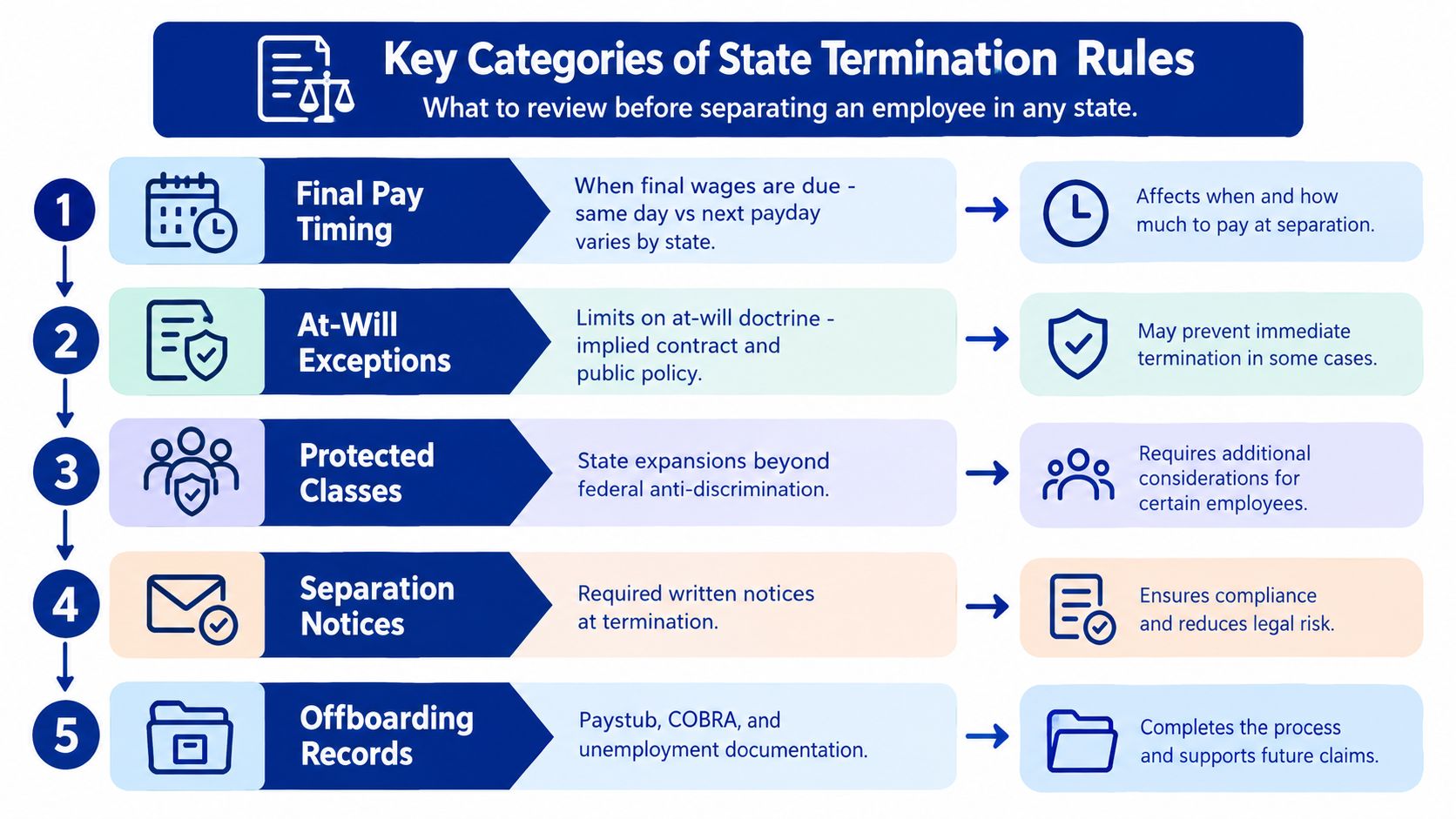
Final pay timing can change based on whether the employee quits, gives advance notice, is discharged, or is laid off. California, Oregon, and Texas illustrate how the separation type can be as important as the last day worked.
PTO and vacation payout requires a policy and state-law review. Some jurisdictions treat earned vacation as wages that must be paid, while others allow employers to define whether unused balances expire. Payroll shouldn't apply a national forfeiture rule without checking the governing policy and jurisdiction.
Notice obligations may arise from federal WARN requirements, state mini-WARN statutes, individual separation rules, or industry-specific protections. California's updated Cal-WARN requirements effective January 1, 2026 add information to written notices for certain mass layoffs, relocations, and terminations, including workforce-service coordination information and CalFresh information, as described in the 2026 California employment-law update.
At-will exceptions include implied contracts, public policy, and good-faith doctrines. Written policies, oral promises, and inconsistent discipline can all affect the analysis.
Payroll records and paystubs must match the final calculation. Reconcile hours, rates, deductions, commissions, PTO, and the final statement format required by the applicable law.
Unemployment and benefits create parallel post-separation duties. The separation reason must be consistent across the termination letter, payroll record, unemployment response, and internal approval. Loss of group health coverage may trigger federal COBRA or state continuation obligations, depending on the plan and employee coverage.
A termination isn't complete when the manager ends the meeting. It's complete when every wage, notice, benefit, and recordkeeping trigger has been closed.
The practical recommendation is to build one baseline offboarding checklist and attach state-specific variables to it. That structure keeps the process consistent without pretending that a single national template can resolve every jurisdictional question.
A useful state reference entry must work under pressure. HR should be able to open the entry, identify the separation type, and see which tasks require immediate action. A list of final-pay deadlines alone isn't enough because the deadline may interact with PTO treatment, notices, unemployment reporting, and benefits continuation.
Start with a fixed template. Require a reviewer to validate each field against the current statute or agency guidance before the entry is approved. The reviewer should also record the workforce classification, work location assumptions, payroll owner, and any policy language that could alter the outcome.
| Reference Field | Required Detail |
|---|---|
| Final pay, involuntary | Deadline, payment method, required wage components, and special triggers. |
| Final pay, voluntary | Deadline based on notice given, effective date, and resignation type. |
| PTO and vacation | Whether accrued balances must be paid, and which written policy controls. |
| Notice requirements | Individual notices, mass-layoff rules, state forms, and pay-in-lieu considerations. |
| At-will exceptions | Implied contract, public policy, good faith, statutory limits, and contract review. |
| Payroll records | Final paystub content, deductions, commissions, hours, and retention requirements. |
| Unemployment | Wage reporting, claim response owner, separation reason, and response documentation. |
| Benefits | Federal COBRA, state continuation coverage, plan administrator responsibilities, and delivery records. |
| Protected activity | Leave, accommodation, complaints, whistleblowing, workers' compensation, and retaliation flags. |
| Approval record | Reviewer, source verification date, operational owner, and escalation requirement. |
Don't bury exceptions in footnotes. If a state's rule changes based on whether the employee quit with notice, place that distinction next to the voluntary final-pay field. If a PTO policy may create an implied promise, flag it beside both the PTO field and the at-will-exceptions field.
Payroll leaders who need broader operational context can also review local CPA payroll compliance insights from Bookkeeping and Accounting of Florida Inc.. Use that resource to strengthen payroll controls, then confirm termination-specific requirements through the relevant state agency or counsel.
Every entry should identify the source checked, the date it was checked, and the person who approved the interpretation. HR shouldn't publish a state card that says “next payday” without explaining whether the rule changes for discharge, resignation, short notice, or a special industry.
The reference should also identify intersections. A final-pay rule may connect to PTO. A separation notice may connect to unemployment. A leave flag may require counsel review before the employer communicates a reason. A good state entry tells the user what to do next, not merely what the law says.
California, Oregon, and Texas demonstrate why payroll can't use one national termination setting. The employee's separation type and notice given can change the payment deadline, and the employer must still determine which wages and PTO balances belong in the final payment.
| State | Involuntary Termination | Voluntary Resignation |
|---|---|---|
| California | Final wages are due immediately at discharge. | Payment is due within 72 hours after a quit without sufficient notice. If the employee gives at least 72 hours' notice, wages are due at the time of quitting. |
| Oregon | The final paycheck is due by the end of the next business day. Certain fair-employment situations have a special weekend and holiday rule. | With less than 48 hours' notice, payment is due within five business days or on the next regular payday, whichever comes first. With at least 48 hours' notice, payment is due on the last day, unless that day is a weekend or holiday. |
| Texas | Final pay is due within six calendar days after involuntary separation. | Payment is due on the next regularly scheduled payday after the resignation's effective date. |
California's requirements come from the state's official final-pay guidance. California also explains that a quitting employee may request final wages by mail, with the mailing date treated as the payment date. The employer should still confirm that the selected delivery method and authorization comply with applicable requirements.
Oregon's paycheck guidance distinguishes short-notice quits from quits with sufficient notice. It also provides a special rule for state and county fair employment when termination occurs on a weekend or holiday. That detail belongs in the state entry, not in a generic payroll note.
Texas separates voluntary and involuntary departures. The Texas Workforce Commission final-pay guidance makes the separation reason a direct timing trigger. HR should ensure the reason entered into payroll matches the approved separation record.
For each state, reconcile:
For more detail on the Texas calculation and workflow, review the Texas paycheck law for employers. The safest operational rule is to identify the controlling jurisdiction, calculate every component before the separation meeting, and use the earliest applicable deadline when the facts create uncertainty.
An at-will policy doesn't erase promises made elsewhere. A handbook may promise progressive discipline. A manager may tell an employee that the position is secure if performance improves. A tenure policy may suggest that long-service employees will be terminated only for cause. Courts can examine those statements when deciding whether the employer retained unrestricted discretion.
Express agreements create a more direct limitation. Offer letters, employment contracts, commission plans, severance agreements, and collective bargaining agreements may define notice, cause, payment, or dispute procedures. HR should identify those documents before approving the separation, not after the employee challenges it.

Implied contract claims often arise from the gap between written disclaimers and actual conduct. A handbook may say employment is at will, yet managers may consistently follow a progressive-discipline process and promise that termination won't occur without prior warnings. That inconsistency can become evidence against the employer.
Public-policy claims can arise when an employee is dismissed for refusing to perform an unlawful act, reporting a violation, exercising a legal right, or participating in a protected process. The employer should compare the timing of the proposed action with complaints, reports, leave requests, and investigations.
Retaliation risk requires a timeline, not a slogan. Review wage complaints, family and medical leave use, accommodation requests, workers' compensation activity, whistleblowing, and other legally protected conduct. Then ask whether the decision-maker knew about the activity and whether the stated reason is supported by contemporaneous evidence.
Good-faith and just-cause concepts don't apply identically across states or employee groups. A multi-state employer should not generalize from one favorable jurisdiction to another.
Managers create risk through casual promises, inconsistent discipline, emotional messages, and changing explanations. HR should preserve the original performance records and ask the manager to explain the decision using specific, job-related facts.
For practical guidance on how to avoid wrongful termination at work, focus on timing, consistency, documentation, and protected-activity review. Then connect each concern to the state reference entry, especially the fields for implied contract, public policy, protected activity, and approval evidence.
Escalation trigger: If the employee recently complained, requested leave, reported misconduct, or challenged pay, pause the termination workflow until an employment professional reviews the timeline.
Payroll, HR, benefits, and managers often use different systems. That separation creates avoidable gaps. The final-pay calculation may be correct while the benefits administrator lacks the separation date, or the unemployment response may use a reason that doesn't match the termination letter.
Use the separation event as the common key. Every department should work from the same effective date, separation type, work location, and approved reason.
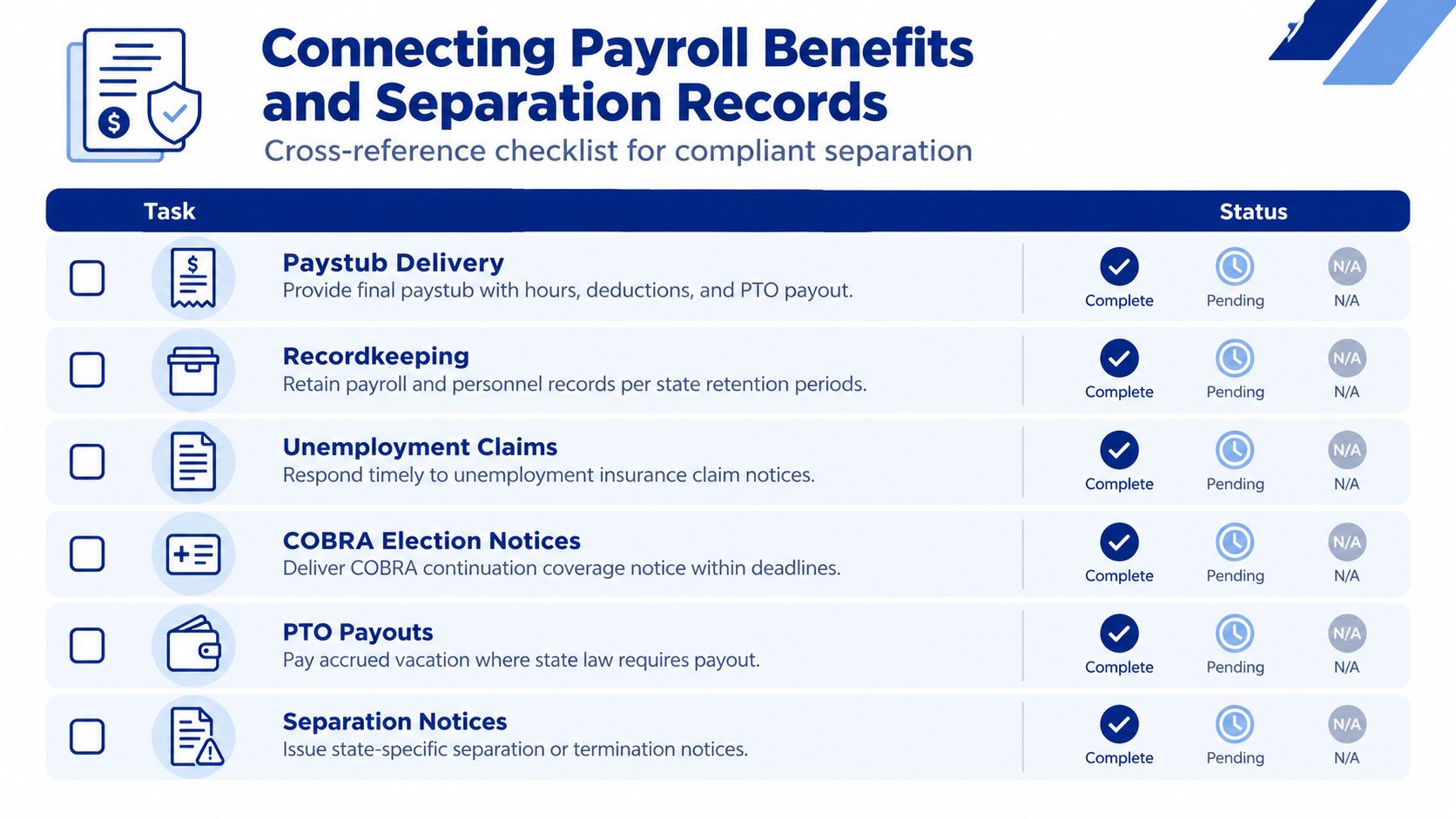
Final-pay timing and benefits deadlines don't necessarily begin on the same date or follow the same calendar. An unemployment or COBRA timeline may run from the separation event, not from the date payroll issues the final check. HR should therefore record the separation date once and use it to calculate each independent deadline.
The closing file should contain the approved termination decision, final wage worksheet, PTO analysis, final paystub, notice copies, delivery proof, benefits transmission record, unemployment response, and equipment-return documentation. Store records in a controlled location with access limited to personnel who need them.
Don't let a payroll system become the only source of truth. Payroll may hold the check details, while HR holds the decision record and the benefits administrator holds continuation documentation. A cross-functional closeout confirms that all three records tell the same story.
A defensible process has three phases. Each phase should identify an owner, required evidence, and a clear stop point. The state reference entry changes the deadlines and notices, but the baseline control structure remains consistent.

HR should collect written performance documentation, review the employee's agreement and handbook, and compare the proposed action with similar cases. The manager should explain the business reason, while HR reviews bias, consistency, protected activity, leave usage, accommodation requests, and pending complaints.
Counsel escalation should be mandatory when the file involves protected leave, an active complaint, a potential mass layoff, a collective bargaining agreement, or an uncertain state-law exception. The approver signs the decision only after the state entry confirms final-pay, notice, PTO, benefits, and recordkeeping requirements.
Use a consistent message that states the decision, effective date, pay process, benefits information, property-return expectations, and contact channel for administrative questions. Don't improvise legal explanations or debate the employee's history in the meeting.
IT should apply access controls at the agreed time, while HR documents the delivery of the termination materials. Payroll should already have the calculation ready, not begin it after the meeting.
Payroll issues final wages and the final paystub. Benefits transmits continuation materials. HR sends required notices, responds to unemployment matters, archives records, and confirms that all systems show the same separation date and reason.
For the technology and access-control side of the process, leaders can review how to offboard employees securely from Finchum Fixes IT. The reference entry should supply the state-specific adjustments, while the baseline process protects consistency.
Paradigm International Inc. is one option for leadership teams seeking structured guidance on terminations, manager conduct, documentation standards, and multi-state HR risk. Its advisory work is designed for owners and operating leaders who need a documented decision process rather than reactive administration.
Consider a mid-quarter discharge of a California employee whose manager recommends termination for repeated performance failures. The state entry should require HR to confirm the written warnings, compare treatment of similarly situated employees, review leave and complaint history, calculate final wages, assess accrued vacation, prepare notices, and coordinate benefits.
Because California requires immediate final pay at discharge, payroll must complete the calculation before or at the separation event. The California official payday guidance should be the governing source for the payment workflow, while the employer's PTO policy must be reviewed for accrued vacation treatment. HR should also confirm whether the event is an individual termination or part of a broader action that raises Cal-WARN questions.
The same template can be adapted for Oregon or Texas, but the deadline fields and separation triggers must change. Leaders who need a broader state-by-state framework can consult the guide to multi-state employment termination rules, then validate the entry against the employer's actual policies and operations.
Reference entries support decisions, but they don't replace jurisdiction-specific counsel when the facts involve protected leave, mass-layoff thresholds, collective bargaining language, pending discrimination claims, or conflicting work locations.
For a same-day or next-day termination, HR should use this sequence:
Escalate before action when the employee is on protected leave, has an active discrimination complaint, is pregnant, is covered by a collective bargaining agreement, or works in a state with implied-contract or good-cause limits. Speed matters, but it never replaces a documented review.
Which state controls for a remote employee? Usually, the facts of where the employee performs work, the employment agreement, and the applicable state-law connection must be assessed together. Final pay generally follows the governing employment law, not the state where payroll is administered.
Does unused PTO have to be paid? It depends on the applicable state rule and the employer's written policy. When must group health coverage continue? Review federal COBRA, the plan documents, and any state continuation requirement.
Which notices are mandatory? That depends on the separation type, benefits, work location, and whether a larger workforce action is involved. Maintain an updated state matrix, and escalate ambiguous cases before issuing final pay or release documents.
Paradigm International Inc. helps leadership teams build defensible termination workflows, review manager decisions, and coordinate payroll, benefits, documentation, and multi-state compliance. Visit Paradigm International Inc. to discuss a structured HR risk review for your organization.