


A resignation hits your inbox at 8:12 a.m. By noon, IT sees a burst of downloads from a shared folder. Two months later, a competitor starts showing up with eerily familiar pricing logic, sales sequencing, and customer knowledge. At that point, the argument is no longer whether the information mattered. It is whether your company treated it like a protected asset before it walked out the door.
That is the core problem. Trade secret protection is an operating discipline. CEOs and COOs get exposed when valuable information lives everywhere, access is broad, managers improvise, and the company cannot show a consistent pattern of control. An NDA alone will not save you. You need proof that leadership identified sensitive information, restricted access, trained employees, enforced rules, and kept records that can withstand scrutiny in a dispute, an audit, or an employee misconduct investigation.
This matters most in companies with distributed teams, cloud systems, contractors, regulated workflows, and fast employee movement. In that setting, trade secret loss rarely looks like a dramatic theft. It looks like routine behavior no one stopped in time: overshared folders, copied contact lists, personal device transfers, weak offboarding, or careless disposal of records and hardware. Cases that start as suspected employee theft of confidential business information often trace back to basic operational failures that leadership tolerated.
The legal standard is straightforward. Information can stay protected as a trade secret if it has economic value because it is not generally known and the company uses reasonable steps to keep it secret. The practical standard is harder. You need controls that work in real operations, across teams, systems, and state lines.
That is why this guide focuses on discipline over theory. Protection starts with knowing what is worth protecting, but it holds up only if HR, IT, operations, and managers handle access, training, retention, offboarding, and destruction with consistency. Even disposal practices matter. Beyond Surplus' data destruction insights are a useful reminder that information loss does not end at the screen. It also happens through old devices, printed records, and unmanaged storage.
If leadership waits for outside counsel to define the problem, leadership is already late. The companies that protect trade secrets well do not rely on slogans about confidentiality. They build repeatable habits, document them, and enforce them before an employee leaves, a regulator asks questions, or a competitor gets hold of something it should never have seen.
A CEO usually notices the problem too late. A top performer resigns. A shared folder gets copied. A former manager appears at a competitor with suspiciously similar pricing logic or client knowledge. Then leadership starts asking whether the information was protected, who had access, and what the company can prove. Those are bad questions to answer under pressure.
The first move is simple. Stop treating all confidential information the same. Some information is routine and replaceable. Some of it is the spine of the business. Your job is to identify the latter and build controls around it before loss, theft, or accidental disclosure turns it into ordinary information.
Start with a practical audit.
Practical rule: If a competitor could use it quickly and your company would struggle to replace it, treat it as a candidate for trade secret protection.
Leaders also miss one dull but critical point. Disposal matters. Old hard drives, printed reports, retired laptops, and decommissioned servers can undermine every policy you wrote. If you need a grounded look at end-of-life risk, Beyond Surplus' data destruction insights are useful because they focus on secure disposal as part of information governance, not just IT cleanup.
A lot of trade secret losses also begin with employee misconduct that looked small at first. If you're assessing internal risk patterns, this employee theft overview is worth reviewing because it connects bad controls with very predictable human behavior.
A sales leader resigns on Friday. By Monday, your competitor is quoting your accounts with suspiciously accurate pricing and timing. That failure rarely starts in court. It starts much earlier, when leadership never defined which information drives margin, retention, product speed, or market position.
That is the job in this section. Identify the few categories of information that would hurt you if copied, exposed, or carried out the door, then document them with enough precision that your controls can hold up under scrutiny.
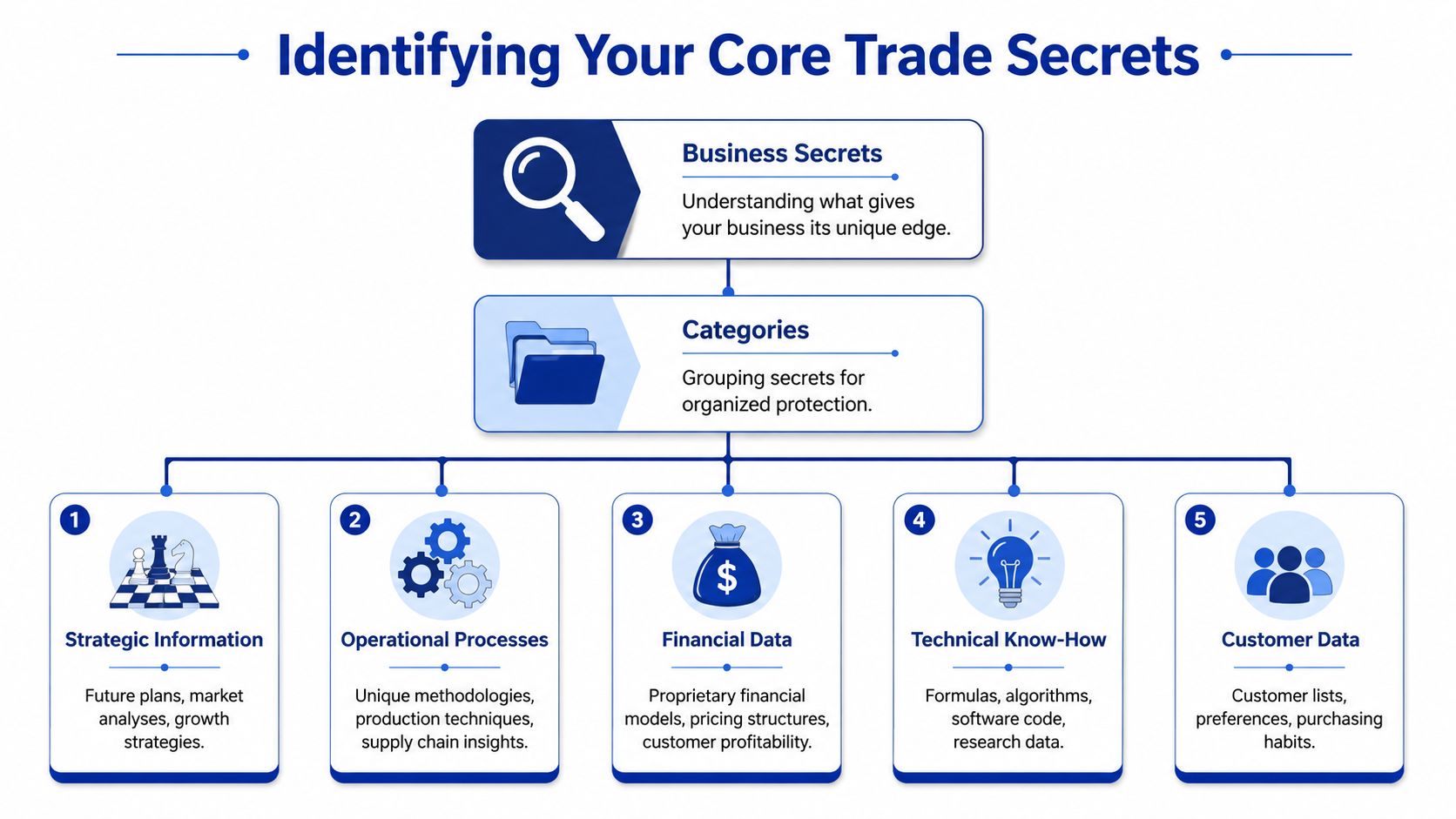
Use five categories, but do not let department heads hide behind vague labels like "proprietary process" or "confidential data." Make them name the exact asset, where it lives, who uses it, and why a rival would care.
| Category | Typical examples | Key question |
|---|---|---|
| Strategic information | Expansion plans, market entry plans, acquisition targets | Would disclosure change a competitor's next move? |
| Operational processes | SOPs, workflows, routing logic, fulfillment methods | Does this help you deliver faster, cheaper, or better? |
| Financial data | Pricing logic, margin models, discount structure, forecasting assumptions | Could a competitor use this to undercut you? |
| Technical know-how | Source code, formulas, research notes, manufacturing methods | Is this hard to independently recreate? |
| Customer data | Customer lists, buying patterns, account histories, preferences | Would this shorten a rival's path to your accounts? |
These buckets are a starting point, not the answer. Public information, generic know-how, and poorly controlled files do not become trade secrets because someone labeled them confidential. If the material is broadly available, casually shared, or easy to reconstruct, treat it accordingly and stop pretending it is protected.
A useful audit produces a written record a court, regulator, buyer, or insurer can follow. If your team cannot show what the secret is, why it matters, and what controls surround it, your program is weak no matter how often people say the word confidential.
Require each business unit to document:
This is operational discipline. It separates companies that can prove reasonable protection from companies that are relying on assumption and memory.
Many SMB leadership teams weaken their own case by over-labeling. If every file is marked confidential, nothing is meaningfully prioritized, access gets sloppy, and enforcement looks arbitrary.
Use a simple three-tier model:
That distinction should also show up in your contracts, job design, and manager practices. Generic paperwork is not enough. Employees who handle sensitive information should have agreements that match the realities of their role, and this guide to what an employment contract should address is a useful reference if your current documents read like recycled boilerplate.
One more point deserves attention. Some information carries value partly because exposure creates reputational, security, or extortion risk along with competitive harm. That is one reason the discipline around secret identification overlaps with broader IP protection for public figures, especially when executives, founders, or visible brand operators hold sensitive business information across public and private channels.
A sales director resigns on Friday. By Monday, your team is arguing over which customer files count as trade secrets, whether the employment agreement covers personal cloud storage, and who was supposed to disable external sharing. That is not a legal problem first. It is an operating failure that your documents failed to prevent.
A defensible framework does two jobs. It gives the business clear rules before something goes wrong, and it gives counsel a credible record after it does. If your contracts say one thing, your managers say another, and your systems allow a third, you have handed the other side an argument that you did not treat the information like a secret.
Trade secret rights can last as long as secrecy and business value remain intact, as noted earlier. The practical point for leadership is simpler. Courts look for reasonable protection, and reasonable protection is visible in contracts, policies, approvals, training records, and exit procedures.

Generic NDAs are not enough. Your framework should cover employees, contractors, vendors, consultants, and anyone else who can touch sensitive information. It should also reflect how people really work across remote devices, collaboration tools, AI tools, shared drives, and regulated systems.
Start with role-specific documents. A product engineer, a sales executive, and a fractional consultant do not create the same risk. Their agreements should not read the same either. If your templates still look interchangeable, review this guide on what an employment contract should address and tighten the provisions that deal with confidential information, ownership, return of company property, and post-employment duties.
Your baseline terms should be explicit:
Policy language fails when it describes a disciplined company that does not exist.
If your handbook says trade secret access is limited, approvals should be documented. If your agreement bans unauthorized retention, offboarding should include device checks, access reviews, and written certifications. If managers tell teams that certain material is highly sensitive, those materials should be labeled, stored in approved systems, and excluded from casual channel sharing.
Many SMBs lose credibility. They buy legal forms, then allow exceptions in the name of speed. One executive stores board materials in a personal Dropbox. One manager forwards pricing logic to a Gmail account to work over the weekend. One recruiter sends candidate compensation data through an unapproved tool. Those habits erase the discipline your paperwork claims to impose.
Ask a harder question than “Do we have an NDA?” Ask whether HR, Legal, IT, Security, and line managers would describe the same approval path, the same storage rules, and the same exit steps. If they would not, fix that before you need to enforce anything.
Do not create six disconnected policy fragments buried in different systems. Create one company standard for trade secret handling, then map each function to it.
That standard should answer a short list of operational questions:
Write the standard in plain language. Then make department leaders adopt it in their own workflows, not just sign off on it once.
A good framework also accounts for information that creates reputational or identity-based exposure, not just competitive loss. Executive communications, founder content, customer-facing assets, and public persona materials often cross legal, HR, security, and brand risk. That overlap is one reason broader resources on IP protection for public figures matter here. The common lesson is specific control. Define what is protected, who controls it, where it can live, and what happens if someone misuses it.
The goal is not more legal text. The goal is a framework you can prove your company follows.
A manager approves a new hire on Monday. By Tuesday, that employee can open pricing models, customer exports, product roadmaps, and archived board materials because IT copied the last person's access. That is how trade secrets leave a company. Not through exotic espionage. Through lazy provisioning, sloppy sharing, and weak supervision in ordinary work.
Daily control is the proof point. If your company cannot show who had access, why they had it, where protected information lived, and what blocked improper sharing, your policy framework is decoration.
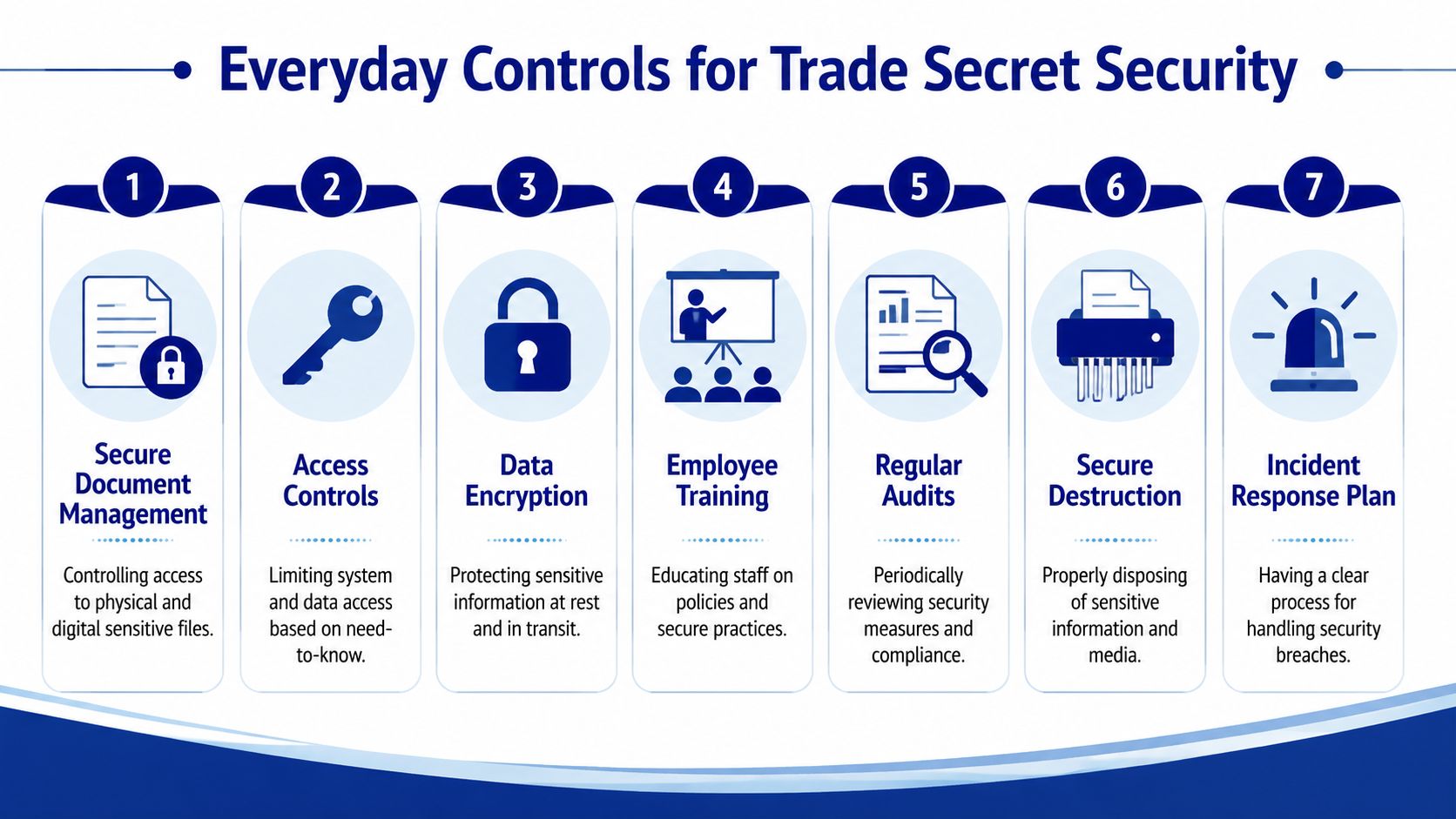
Start with access design, not trust.
A new employee should get the minimum access needed to perform the first phase of the job. Expand later if the role proves it needs more. Senior title is not a valid reason for broad visibility. In distributed companies, over-access spreads fast because shared drives, chat threads, and cloud tools make copying permission errors easy.
A sales leader may need pipeline visibility but not pricing logic. A developer may need one repository and test data, not every codebase and historical archive. An operations manager may need current SOPs, not acquisition plans or margin models.
Use controls that are easy to audit:
Trade secret loss usually starts with a shortcut. Someone sends a file to a personal email to finish work at night. Someone copies a customer list into an unsanctioned app. Someone downloads a sensitive report before travel because offline access feels easier than requesting a secure method.
Your job is to make the wrong action harder than the right one.
| Risk point | Weak practice | Defensible practice |
|---|---|---|
| File access | Broad shared-drive permissions | Need-to-know permissions with scheduled review |
| Document handling | No labels or retention rules | Clear classification, storage, and disposal standards |
| Remote work | Personal device use without controls | Approved devices, monitored sessions, and restricted downloads |
| Collaboration | Ad hoc sharing through personal tools | Approved platforms with controlled permissions and admin oversight |
The strongest control is often the one that prevents bad behavior from becoming possible.
That matters even more in remote and regulated environments, where trade secret exposure often overlaps with privacy, security, and compliance failures. If your team needs a practical companion on application-layer risk, this sensitive data exposure guide is useful because it shows how ordinary technical gaps expose protected information long before anyone calls it a breach.
Run these controls as operating discipline, not one-time setup:
The highest-risk period is often the stretch between notice and separation. People who seemed low risk can still copy files, message customers, or retain access through overlooked apps and tokens. Good manners do not reduce exposure.
Use a scripted exit sequence and run it the same way every time. Your employee exit process for sensitive access roles should include immediate access review, credential shutdown, device recovery, confirmation of retained materials, and a clear reminder of post-employment confidentiality obligations.
Focus on actions that create evidence:
Operational discipline turns trade secret protection into something you can defend under pressure. That is the standard that matters.
The biggest mistake HR teams make is treating trade secret protection as a document event. It's not. It's a lifecycle process that starts before hiring and becomes most important when someone leaves under stress, underperforming, or heading to a competitor.
Common trade secret advice often breaks down in digital and global environments. Guidance on cross-border and remote work issues stresses layered controls, especially for cloud access and distributed teams, and notes that “reasonable” efforts are judged case by case, as discussed in this global trade secret enforcement analysis. That means the same policy can be enough in one setting and weak in another.
Use the employee lifecycle to close those gaps.
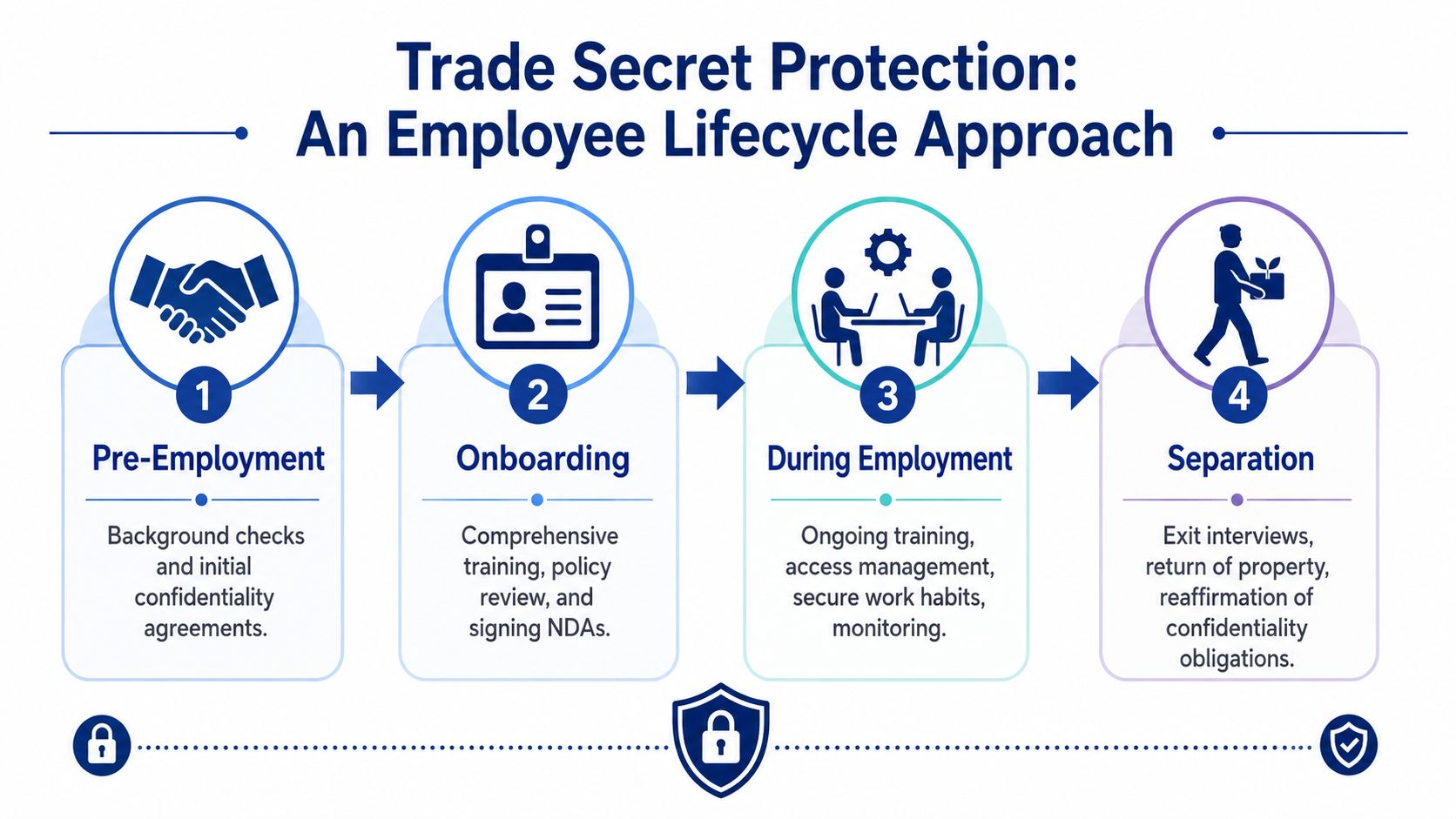
Pre-employment controls shouldn't be heavy-handed, but they should be deliberate. If the role touches sensitive information, the company should define that sensitivity before the employee starts, not after a problem arises.
Onboarding should include more than signatures. Show employees what the company treats as protected, where those materials live, how they may be used, and what they may never do with them.
This stage is mostly about reinforcement. Most employees don't wake up planning to misuse confidential information. But they will follow convenience unless leadership interrupts it with standards, reminders, and controls.
Good mid-employment discipline includes:
Leaders often overreact or freeze in such moments. Do neither. Follow a decision framework.
Don't confront first and investigate later. By then, the evidence may be gone and the story may already be shaped against you.
Exits deserve their own rigor. Voluntary resignations, layoffs, terminations for cause, and role transitions all carry different risk levels, but all require structure.
A disciplined offboarding process should include access shutoff, device retrieval, reminder of continuing duties, and confirmation that company information has been returned or removed from personal control. This employee exit process guide is a useful companion because it treats offboarding as a risk event rather than an administrative task.
A senior engineer resigns on Monday. By Tuesday, your team sees unusual file activity. By Wednesday, a manager wants to confront the employee, IT wants to lock every account, and someone suggests sending a threatening letter before the facts are clear.
That is how companies damage their case.
Monitoring and enforcement only work when they support a disciplined operating model. If your controls are sloppy, your records are incomplete, or your team treats every incident like a fire drill, enforcement gets expensive fast and results get worse. The goal is not maximum aggression. The goal is a response you can defend, explain, and repeat across offices, states, and regulated workflows.
The first hours decide whether you preserve options or destroy them.
Start with control. Restrict access tied to the suspected activity, but do it narrowly so you do not disrupt unrelated operations or signal the investigation too broadly. Preserve logs, devices, email, chat, file histories, and access records before anyone edits, wipes, or reimages anything. Build a single fact timeline. Use confirmed events only.
Then define the asset with precision. Identify the exact files, datasets, formulas, customer information, or process documents at issue. "Confidential company information" is too vague to support a serious response. You need names, dates, owners, storage locations, access history, and business value.
After that, pull in a small response group. That usually means legal, HR, IT, and one business leader with authority to make decisions. Keep the group tight. Loose internal chatter creates inconsistent stories and invites mistakes.
A download alert by itself does not prove much. It shows movement. It does not show that the information was treated as secret, that access was limited for a reason, or that your company drew clear lines around what mattered most.
That is the operational gap many leadership teams miss.
Real enforcement strength comes from showing a pattern of disciplined conduct. The company identified specific trade secrets. It limited access based on role. It documented legitimate business need. It trained employees on handling rules. It responded consistently when risk appeared. That record matters more than a dramatic screenshot or a manager's suspicions.
This becomes harder in distributed and regulated businesses. Teams share data across locations, vendors, and systems. Some information must be disclosed to auditors, customers, agencies, or outside experts under controlled conditions. Your monitoring program should reflect that reality. Track access to high-value assets, exceptions to normal handling rules, unusual exports, and policy deviations that matter to the business. Do not bury the team in noise from low-risk activity.
Enforcement is a business decision first. Legal tools support it. They do not replace judgment.
Some incidents call for a preservation notice, a return-of-property demand, a reminder of ongoing confidentiality duties, or a written certification that company materials were deleted from personal accounts and devices. Other incidents justify immediate court action because the risk of use, transfer, or disclosure is active and specific.
Use this decision screen:
| Question | Why it matters |
|---|---|
| Is the information specific and identifiable? | Vague claims collapse under pressure |
| Can you show the company treated it as secret? | Courts and counterparties look at conduct |
| Is there a current risk of use, transfer, or disclosure? | Speed matters when the threat is active |
| What outcome matters most to the business? | Stopping use, recovering data, or containing spread may matter more than damages |
| Will this response help or hurt parallel HR, customer, or regulatory issues? | A strong legal move can still create operational fallout |
A lawsuit should never be the default setting. It is one option in a broader response plan. The right move is the one that protects the asset, preserves evidence, supports your employment actions, and holds up if a regulator, judge, or future buyer reviews the file later.
Treat monitoring and enforcement as a repeatable operating discipline. That is how you protect trade secrets in the world.
Trade secret protection gets harder when your business operates across states, uses global vendors, or works in regulated sectors. In these complex situations, generic advice usually breaks down.
The hardest problem is not theft by a rogue employee. It's what happens when a regulator, agency, or public-interest process demands sensitive information. USTR's best-practices paper notes that governments should limit required submissions to what is necessary, restrict access to confidential information, and provide mechanisms to challenge disclosure, as outlined in this USTR trade secret best-practices paper. That's a practical signal to businesses. You shouldn't assume every disclosure request deserves a full, unfiltered response.
Use a disciplined review process.
A multi-state or regulated business needs a tighter model than “protect everything.” It needs a documented system that balances secrecy, legal obligations, and operational reality without losing control of its most valuable information.
If your leadership team needs a clearer, more defensible way to handle trade secret protection across hiring, operations, investigations, and employee exits, Paradigm International Inc. can help you build practical controls that hold up under pressure. For businesses operating across states or in regulated environments, that kind of structure often matters most in critical situations.


