
An owner gets a demand letter. A clinic manager gets notice of an inspection. An HR director is asked one simple question after an incident: can you prove the employee was trained, on the right material, by the right person, and at the right time?
That's where most weak systems fail. The training happened. The records don't show it clearly enough to defend the business.
Training documentation standards are the rules your business uses to record, store, update, and retrieve proof of employee training. In practice, they're less about paperwork and more about evidence. When a regulator, plaintiff's attorney, insurer, or internal investigator asks what happened, your documentation is what speaks for the organization.
A lot of SMBs still rely on scattered sign-in sheets, certificate PDFs, calendar invites, and manager memory. That might feel workable until the first serious challenge. Then the gaps become obvious. You may know the employee attended a session, but you can't show what version of the material they saw, whether they passed a knowledge check, or whether the trainer was qualified to deliver the content.
A 2024 industry analysis found that 37% of organizations globally lack a formal compliance training plan, and the average annual cost of non-compliance failures is approximately $14.82 million (Lorman compliance training statistics). That doesn't mean every SMB will face the same loss. It does show the exposure attached to weak structure and inconsistent records.
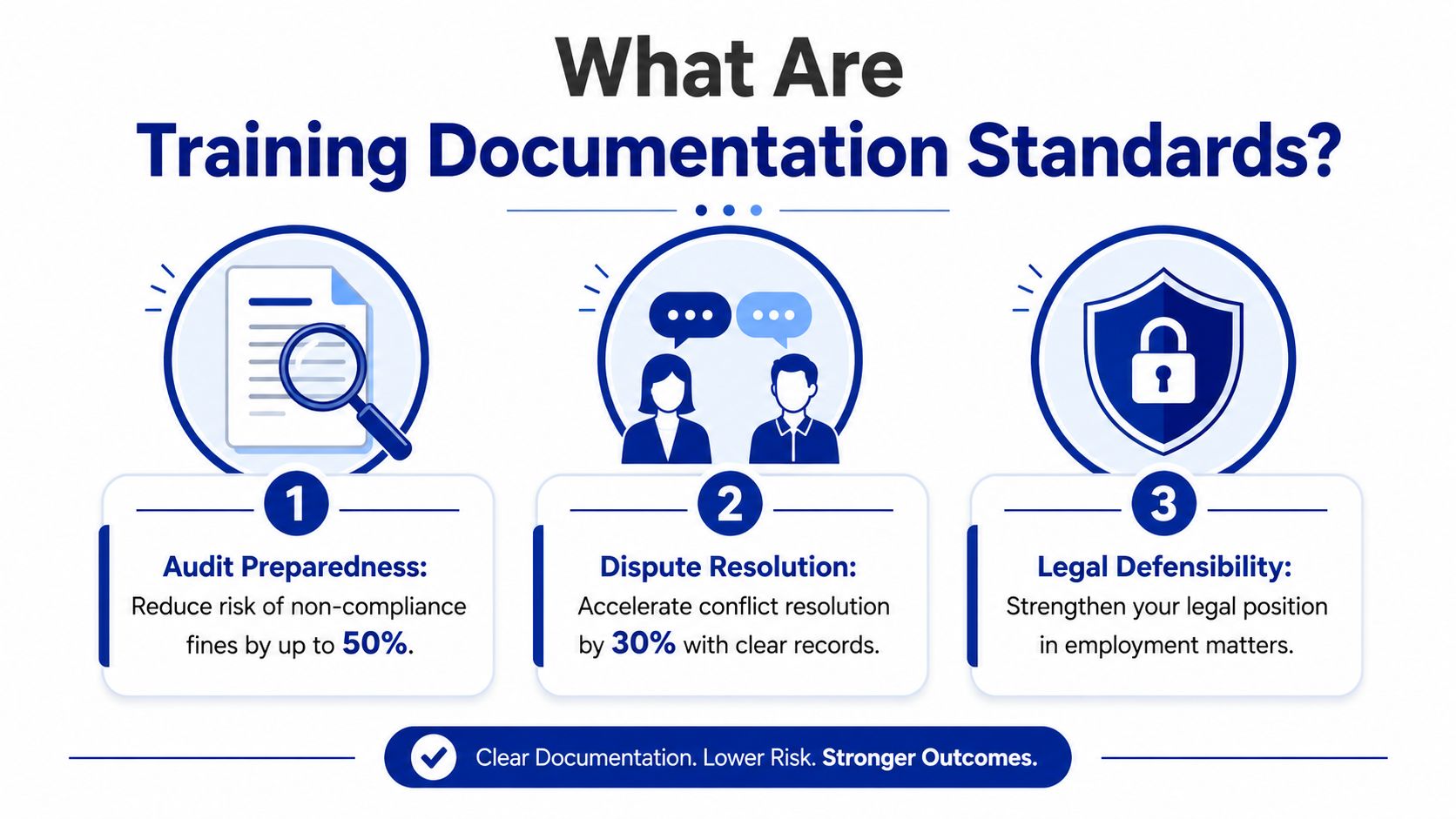
Good training documentation standards do three jobs at once:
If one supervisor keeps signed acknowledgments, another keeps screenshots, and a third keeps nothing but a spreadsheet note, you don't have a standard. You have a patchwork. Patchwork systems create uneven legal defensibility.
Practical rule: If your records depend on a single manager's habits, you don't have a reliable system.
For growing companies, this matters beyond compliance. Clear standards reduce confusion during onboarding, support manager accountability, and make internal investigations less subjective. Teams that already consume practical operational content, including articles for online entrepreneurs, often recognize the same pattern. Businesses scale better when repeatable processes replace improvised admin work.
Most weak systems share a few traits:
That last point is where many organizations underestimate risk. If your only record is “completed,” you may still struggle to prove reasonable diligence when an employee later claims confusion, forgetfulness, or inconsistent instruction.
A defensible system needs structure before it needs software. Tools help. They don't fix vague expectations, missing ownership, or inconsistent records. The strongest systems usually rest on three pieces: a written policy, standardized templates, and disciplined version control.
The federal government provides a useful benchmark for completeness. The U.S. Office of Personnel Management requires federal agencies to report 27 data elements for every training event, including cost data even when the cost is $0 (OPM reporting training data requirements). Most private employers won't mirror that exact framework, but it's a strong reminder that auditable documentation is detailed by design.
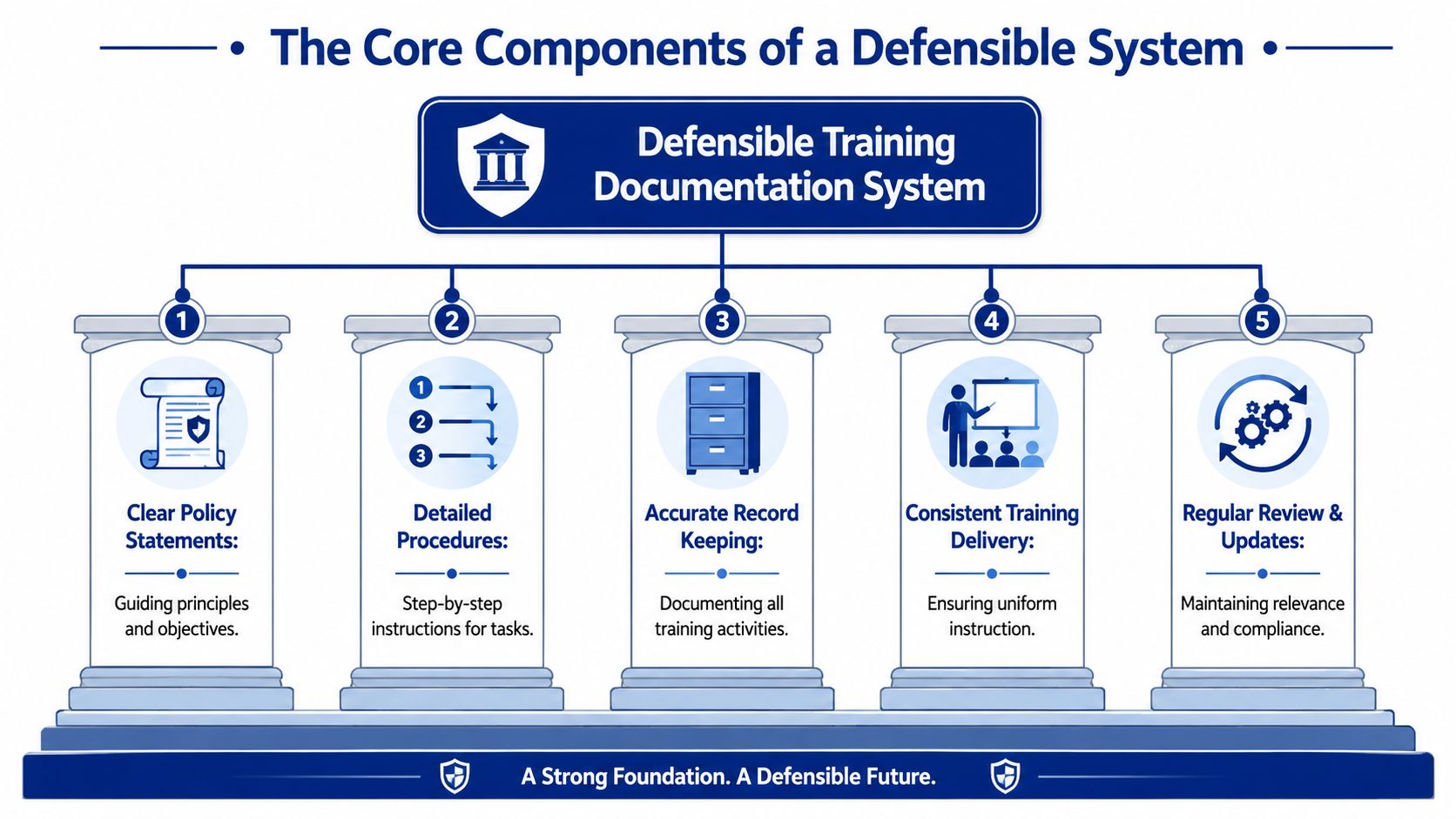
Your policy should answer basic operational questions before anyone creates a record.
| Component | What it should define |
|---|---|
| Scope | Which training must be documented and which business units are covered |
| Ownership | Who creates records, who reviews them, and who stores them |
| Timing | When records must be completed and filed after training |
| Retention | How long records stay available and where they're stored |
| Exceptions | What happens when attendance, assessments, or signatures are missing |
A policy is where leaders set the standard for consistency. Without it, managers invent their own rules. One department may document live sessions thoroughly while another records only course completion from a learning platform.
A defensible template should capture enough detail that an outside reviewer can understand what happened without interviewing three people to fill in the blanks.
At minimum, most organizations should capture:
Different training types need different records. Harassment prevention training, forklift safety, HIPAA orientation, and manager coaching shouldn't all live on the same stripped-down form. Standardized doesn't mean identical. It means consistent logic.
A good record lets someone outside the event reconstruct it accurately.
Version control is where many otherwise organized employers break down. They can prove that training occurred, but not which policy version, slide deck, handbook section, or procedure the employee received.
Use a versioning process that records:
If an employee was trained on a superseded procedure, that distinction matters. If the policy changed after a complaint, that timing matters too. Documentation standards should preserve those facts instead of forcing HR to reconstruct them later from file names and old emails.
Most leaders don't need a giant compliance project. They need a system they can launch, enforce, and defend. The most practical way to build one is in phases, with clear accountability at each step.
A benchmarked methodology for training documentation uses a five-phase lifecycle of Gap Analysis, Program Development, Technology Integration, Cultural Accountability, and Continuous Monitoring, and it has been shown to reduce documentation error rates by 22% and increase audit-readiness by 19% (ProProfs training documentation methodology).

Start by identifying where your current records would fail under pressure.
Ask direct questions:
That review becomes your gap analysis. For some businesses, the biggest issue is storage. For others, it's manager inconsistency. In regulated settings, the bigger problem is often that training happened but was documented too generically to prove compliance.
Then build the program itself, defining required templates, workflow timing, approval points, and manager responsibilities. If your team needs a starting point on role-based compliance structure, the provided overview of HR compliance training practices is a useful reference for mapping documentation duties to actual operational risk.
Technology should support the process, not become the process. A learning management system, HRIS, document management platform, or secure shared repository can all work if the workflow is clear. If the underlying rules are weak, software only helps you store incomplete records faster.
The practical setup usually includes:
Cultural accountability is where the system becomes real. Managers need to know that documenting training isn't optional admin work they can finish later. It's part of performance, supervision, and risk control.
Manager checkpoint: If a leader assigns work that requires training, that leader should also confirm the record was completed and filed.
Continuous monitoring doesn't have to be elaborate. It does have to be consistent.
Use periodic internal checks to review:
This is also the phase where many organizations decide whether to add a more formal tool. Options can include an LMS, HRIS workflows, secure document repositories, or a structured template set such as the one a global advisory firm uses in its advisory work to identify documentation weaknesses before they become liabilities.
A generic training log usually breaks first in regulated businesses and multi-state operations. The problem isn't effort. It's mismatch. One record format rarely captures all the elements different laws and agencies expect.
Healthcare offers the clearest example. HIPAA training records must be retained for a minimum of six years and include an assessment component, while certain OSHA-related provider requirements use a five-year retention period and call for specific details such as the trainer's name and qualifications (HIPAA proof of training and retention requirements). In hazardous environments, OSHA-related documentation expectations can also require proof of dates, content summaries, and attendee identity details. That means a one-line spreadsheet entry won't do the job.
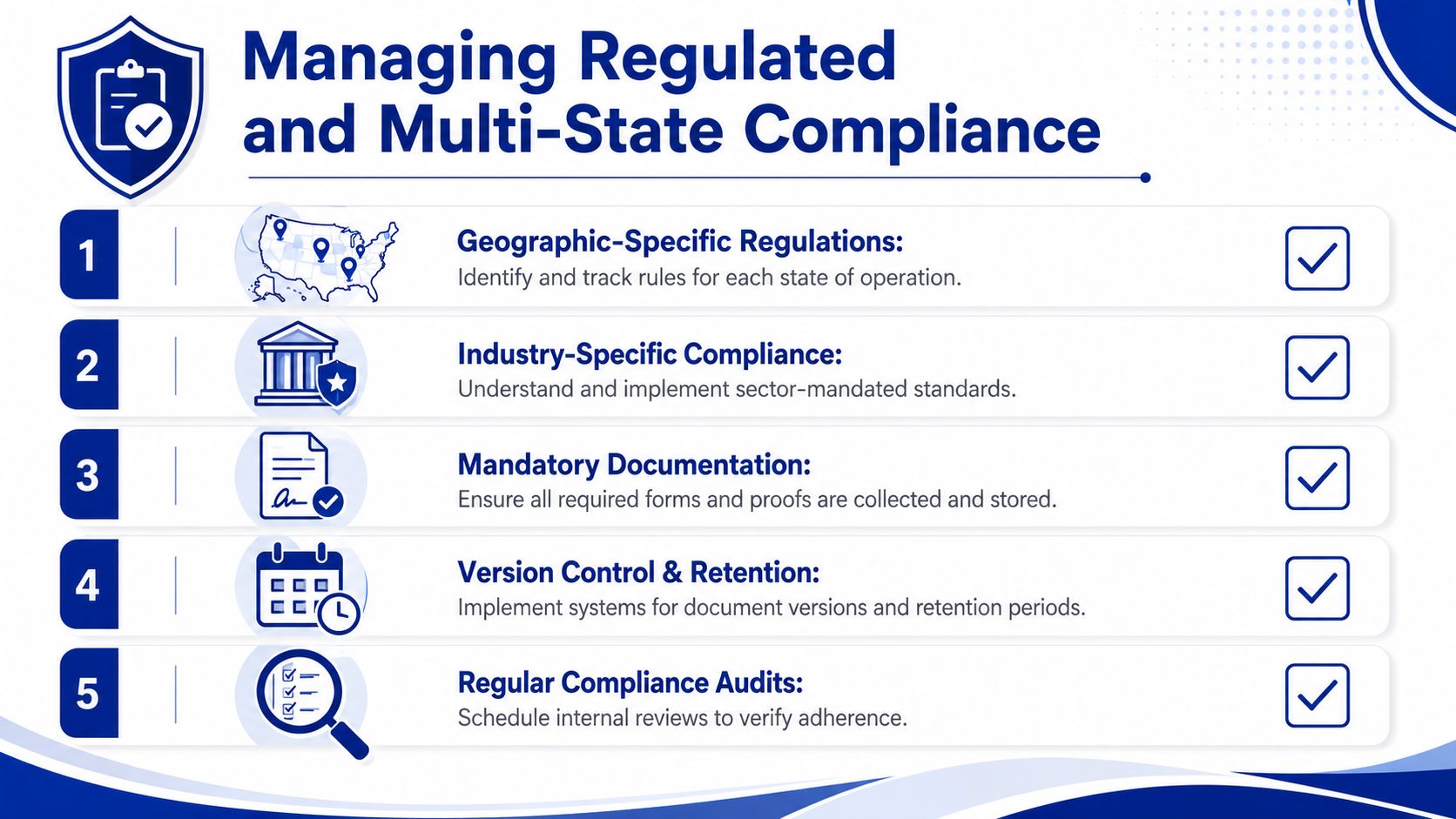
For multi-state SMBs, the cleanest approach is a layered documentation model.
This structure avoids two common mistakes. The first is creating one oversized form that nobody completes properly. The second is allowing each site to invent its own records because “local requirements are different.”
When reviewing your current setup, focus on whether the record answers the questions a regulator would ask.
| Compliance question | Record should show |
|---|---|
| Who was trained | Full employee identity and role |
| What they received | Topic summary and linked policy or training material |
| When it happened | Exact training date and, where needed, duration |
| Who delivered it | Trainer name and qualifications where required |
| How long records stay available | Retention rule matched to the applicable requirement |
For businesses operating across several states, retention planning is where discipline matters. The safest approach is to map training categories to the strictest applicable rule within your footprint, then document why that rule governs storage and retrieval. If your team is revisiting broader file retention at the same time, this guide to employment records retention requirements helps align training records with the rest of your HR documentation framework.
Compliance gets easier when your system is built to handle exceptions on purpose instead of discovering them after an audit begins.
Completion is easy to track. Understanding is what protects you.
That distinction matters more in hybrid and remote environments, where managers often assume that assigning a course and receiving a completion notice is enough. It usually isn't. A 2025 McKinsey study found that 74% of employees in hybrid roles fail to retain key training content after 30 days, while 95% of existing documentation standards still require only a completion checkbox (training retention and documentation gap data).
A completion certificate proves exposure. It doesn't prove comprehension, retention, or ability to apply the training in a real setting. In an employment dispute, safety incident, or privacy breach, that gap can become the central issue.
The practical answer is to add evidence points after the event itself.
Electronic workflows can help here if they're set up carefully. A digital acknowledgment with timestamping is stronger than a missing paper form, but only if it captures identity, content, and timing clearly. Businesses moving away from paper often benefit from reviewing how electronic signatures in HR forms fit into a defensible recordkeeping process.
Weak proof usually falls into one of these patterns:
If a record can't show what the employee understood, it may not answer the question that matters most after an incident.
For remote teams, this is often the missing layer. The training platform records attendance. Nobody records whether the employee could apply the material afterward. In high-risk roles, that's not a technical gap. It's a defensibility gap.
The businesses that handle training documentation well don't treat it as clerical cleanup. They treat it as part of management judgment. That's the difference between records that merely exist and records that can defend a decision.
A strong system is usually visible in everyday behavior. Managers close out training records promptly. HR reviews exceptions instead of tolerating them. Leaders ask whether employees understood the material, not just whether the LMS marked them complete.
It's usually built through a few repeated habits:
This approach also changes how leaders think about templates. A template isn't the system. It's one tool inside a broader discipline of policy, accountability, retrieval, and review.
The real standard isn't whether you have a form. It's whether the form, the workflow, and the record would hold up when the facts are disputed.
For multi-state SMBs and regulated practices, that standard matters more each year. Documentation has to be usable across locations, specific enough for industry rules, and clear enough to show not only that training was assigned, but that the organization took reasonable steps to make it stick.
If your current records would be hard to defend under audit, investigation, or litigation, that's usually the right moment to tighten the structure before the next high-stakes issue arrives.
If your team needs to strengthen training documentation standards across multiple states, regulated workflows, or high-risk manager practices, Paradigm International Inc. works with leadership teams to build documentation systems that are practical, consistent, and defensible.