Your company may have started with a straightforward PEO decision. Now you're adding employees in new states, asking managers to handle more sensitive issues, and discovering that payroll, benefits, compliance, and employee relations don't always fit neatly inside one service model. At that point, switching from TriNet isn't just a search for another feature list.
The right choice depends on the problem you're trying to solve. You may need full PEO administration, clearer pricing, tighter HR and IT integration, specialized risk support, or better advisory judgment beyond routine administration. You'll also need to assess contract terms, state coverage, implementation ownership, and escalation support before comparing dashboards and modules.
This guide evaluates TriNet alternatives by the operating decision behind each one. It also considers what changes when you leave a more managed PEO arrangement and take greater responsibility for payroll controls, documentation, compliance follow-through, and employee issues. If your broader people strategy is changing too, review this guide to strategic total rewards implementation alongside your provider evaluation.
Insperity is a strong choice for an SMB that wants to stay within a traditional, full-service PEO model while gaining a service-oriented alternative to TriNet. Its offering combines HR administration, payroll, compliance support, benefits access, risk management, and safety programs under one relationship. That breadth matters when internal leaders don't want to coordinate separate vendors for employment administration and workplace risk.
The platform is particularly suitable for employers operating across multiple states or managing processes that need consistent governance. Insperity's established operating model can help companies formalize onboarding, payroll administration, policy execution, and compliance workflows as they grow.
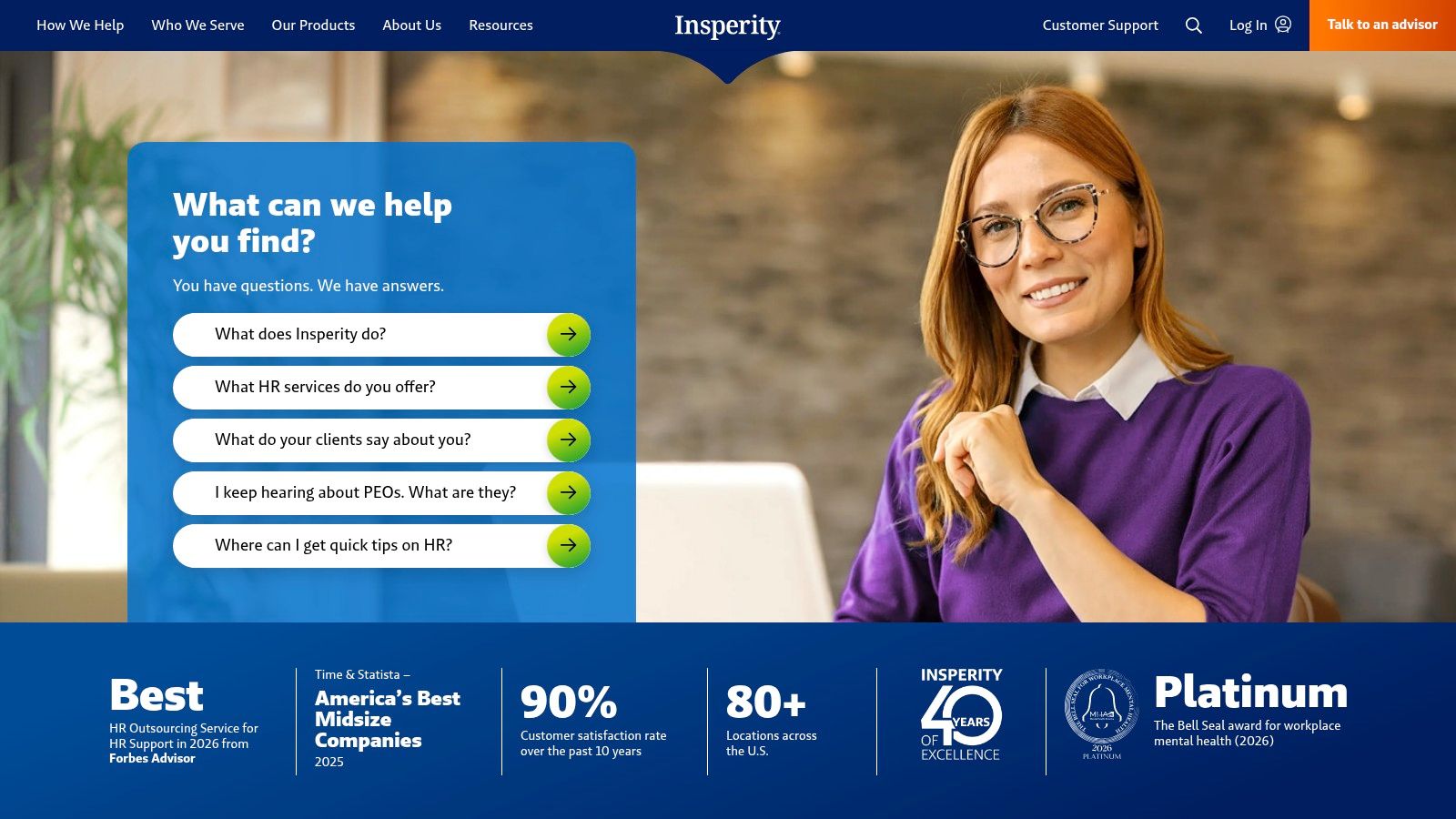
The trade-off is cost clarity. Insperity uses quote-based pricing, and its model may be more expensive than lighter PEO or software-led options. Buyers should request a complete cost breakdown covering administrative fees, benefits, workers' compensation, implementation, and optional services rather than comparing only the headline rate.
Practical rule: Choose Insperity when the value of human support and process discipline outweighs the appeal of a lower-touch, software-first model.
Companies comparing service levels can also find PEO alternatives for business before requesting proposals. Visit Insperity's official website for current service details.
ADP TotalSource makes sense for a growing, distributed SMB that wants PEO administration connected to a broader payroll and HR technology ecosystem. Its co-employment model includes payroll, benefits, risk and safety support, and HR advisory services. ADP also brings national tax and compliance capabilities, including support relevant to employers expanding into new jurisdictions.
That combination is useful when the company's needs extend beyond basic payroll. Recruiting, talent processes, HR administration, payroll, and compliance can sit within a wider ADP environment, which may reduce the need to stitch together separate systems.
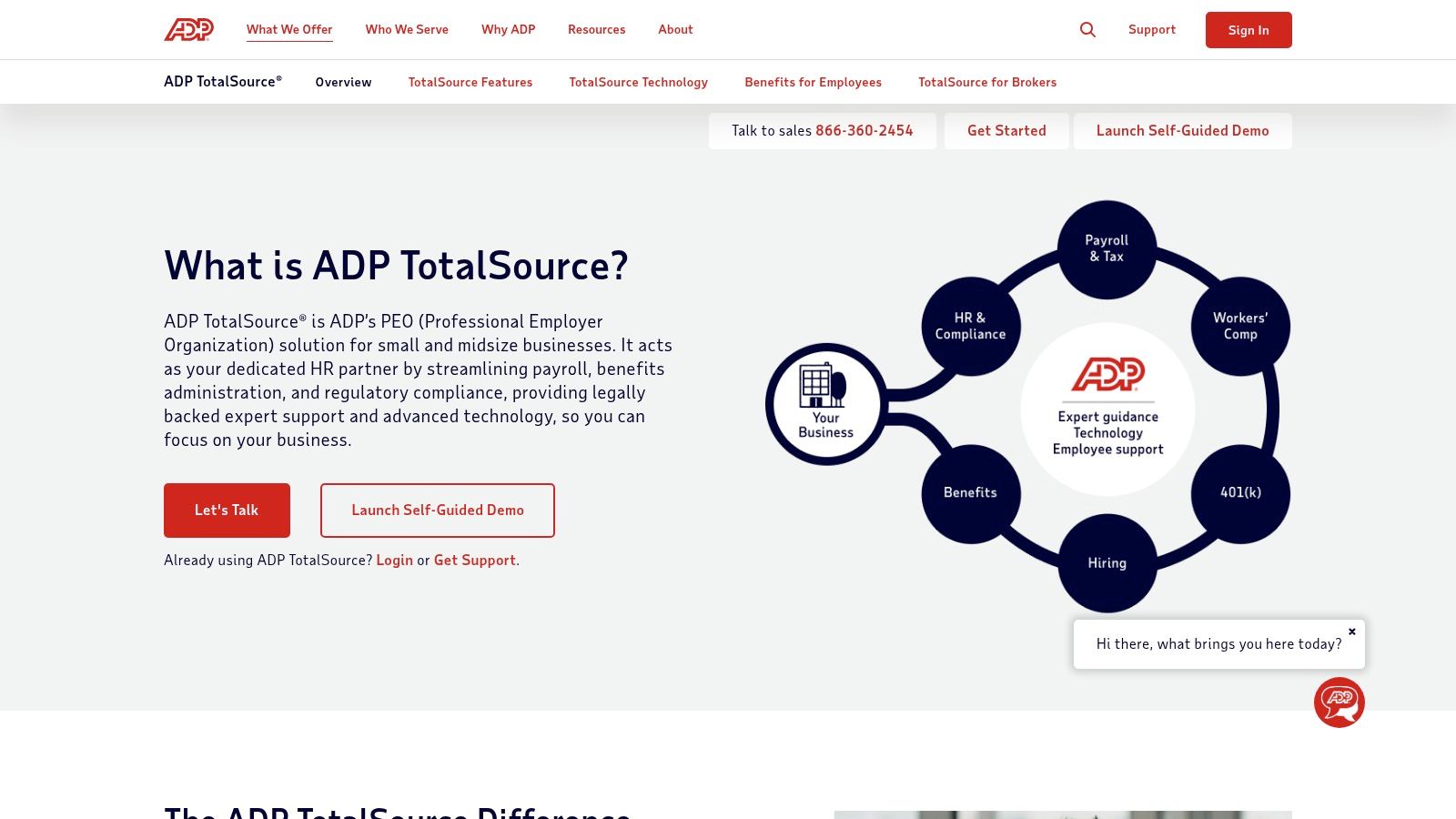
ADP TotalSource is quote-based, so buyers won't get the same upfront cost visibility offered by published-price providers. Implementation and support can also depend heavily on the assigned account team and regional experience. That doesn't make the model unsuitable, but it does mean the sales process should test how escalations work in practice.
Ask who owns tax registrations, how state expansion is handled, which support issues stay with the account team, and when matters move to compliance or legal specialists. A broad platform only helps if the operating handoffs are clear.
Explore ADP TotalSource when platform breadth and national administration are more important than public pricing.
Paychex PEO is useful for companies that want flexibility between payroll administration and a more complete PEO relationship. Its services cover HR, payroll, benefits, risk management, workers' compensation, and retirement services. That range lets an employer evaluate whether it needs full outsourcing immediately or would benefit from expanding service scope over time.
This flexibility can be valuable during a growth phase. A company may begin with payroll and foundational HR support, then add benefits, risk, or broader PEO services as its workforce and geographic footprint become more complex. The important question is whether the transition between service levels is simple under the proposed agreement.
Paychex operates through established entities and programs that support service delivery across states. It also provides client education and onboarding processes, which can help owners who don't have a dedicated HR operations team. Still, plan and benefits variation by market can make comparisons less direct than they appear.
A flexible service menu only creates value when the company understands which responsibilities remain internal at each service level.
Paychex pricing is quote-based, and transparency can vary by package. Request proposals that separate administrative charges from benefits, insurance, payroll taxes, and optional risk services. Also confirm whether moving from payroll-only services to PEO changes implementation requirements, contract terms, or employee communications.
Before comparing proposals, review HR consulting fees for 2026 to separate provider administration from independent advisory support. Visit Paychex PEO for current details.
Justworks is the clearest fit for a small or mid-sized company that prioritizes pricing transparency, simple deployment, and an approachable user experience. Its PEO offering includes published plan tiers, straightforward billing, payroll, benefits administration, HR consulting, and 24/7 support. The company also offers payroll-only and global EOR options, giving buyers alternatives if full co-employment isn't the right long-term model.
For buyers leaving TriNet because they can't evaluate costs without a sales process, Justworks offers a meaningful contrast. Forbes lists TriNet's HR and payroll pricing as starting at $33 per employee per month, while Justworks is listed at $50 per month plus $8 per employee per month. Review the Forbes TriNet pricing analysis for the cited comparison, then validate current quotes and pass-through costs directly with each provider.
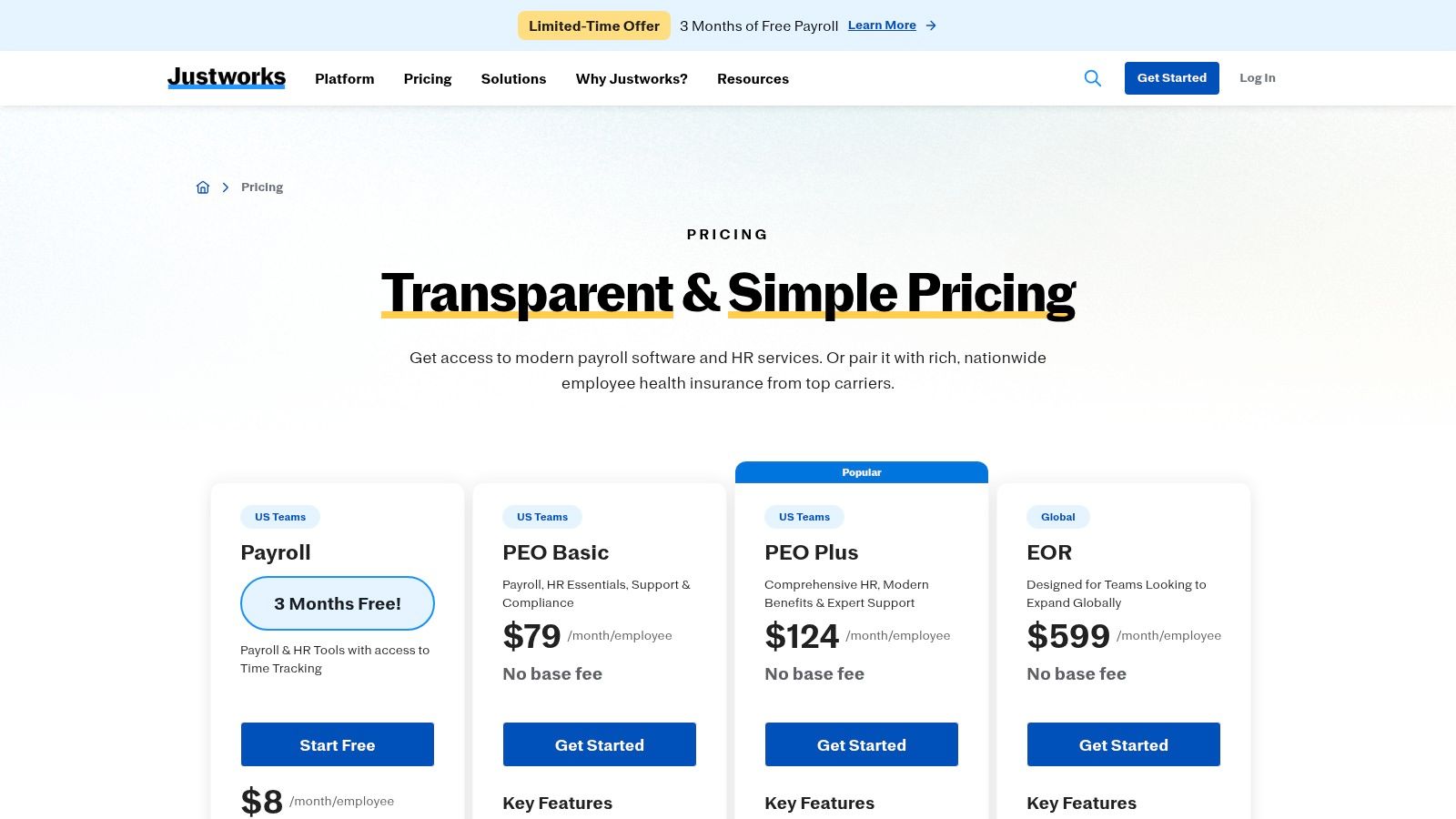
Clear pricing doesn't automatically mean the service is right for a complex employer. Justworks may offer less customization than larger PEOs, particularly for highly regulated industries or organizations with unusual benefits and workforce structures. Teams should also test how support handles investigations, terminations, manager conduct, and state-specific policy questions.
If you're moving away from a managed model, map ownership of state employee handbook requirements before implementation. See Justworks pricing and plan details for current information.
Rippling PEO solves a different problem from a conventional PEO. It targets companies that want payroll and HR administration connected to IT provisioning, applications, devices, and workflow automation. For technology-focused teams, that unified architecture can eliminate duplicate employee records and reduce the number of systems managers use during onboarding and offboarding.
The platform can automate workflows across HR, payroll, and IT. A new hire, for example, may trigger payroll setup, access provisioning, device assignment, and employee onboarding steps from one underlying record. That can improve control, but only if the company has defined the approvals and data ownership that govern each workflow.
Rippling's PEO pricing is quote-based, and costs vary according to selected modules and states. That modularity can be useful, but it makes a proposal harder to compare with a single bundled PEO fee. Ask for a complete map of required modules, implementation charges, support tiers, and costs that change as the workforce expands.
Rippling also offers a published overview of its compliance program, which can help buyers understand the provider's operating approach. Still, automation won't replace leadership judgment in a termination, investigation, documentation dispute, or manager-conduct issue.
Review Rippling PEO to determine whether its automation model matches your internal ownership capacity.
Engage PEO is designed for employers that place a premium on legal-caliber HR guidance and defensible decision-making. Its distinguishing feature is an attorney-led HR consulting model, with each HR Consultant identified as a licensed employment attorney. The broader PEO offering includes payroll, benefits, workers' compensation, risk services, and HR technology.
That structure is particularly relevant for regulated organizations or employers handling sensitive investigations, employee complaints, disciplinary action, and terminations. Routine administration is only part of the risk. The quality of the reasoning behind a decision, and the documentation supporting it, can matter just as much.
Engage PEO is positioned as an IRS-certified PEO and notes ESAC accreditation. Those credentials are relevant to buyers evaluating the provider's compliance and assurance framework, but they shouldn't replace diligence on service delivery. Ask how quickly clients reach an attorney, whether the assigned consultant handles the account consistently, and which matters require separate counsel.
Decision test: If your managers need help deciding what to do, not merely recording what they already decided, Engage's model deserves serious consideration.
Explore Engage PEO and ask for concrete examples of escalation ownership before selecting the provider.
ExtensisHR fits employers that want a boutique, service-centered PEO with a stronger assurance posture. Its full-service offering includes HR, payroll, benefits, compliance, and risk support. The company also highlights CPEO and ESAC credentials, along with SOC 1 Type 2 controls, which can matter to risk-sensitive operators evaluating process reliability and internal controls.
The appeal is less about maximum platform breadth and more about how the provider works with the client. ExtensisHR's PEO Premier program is positioned for higher-touch needs, making it relevant to leadership teams that want a closer operating relationship rather than a largely ticket-driven support model.
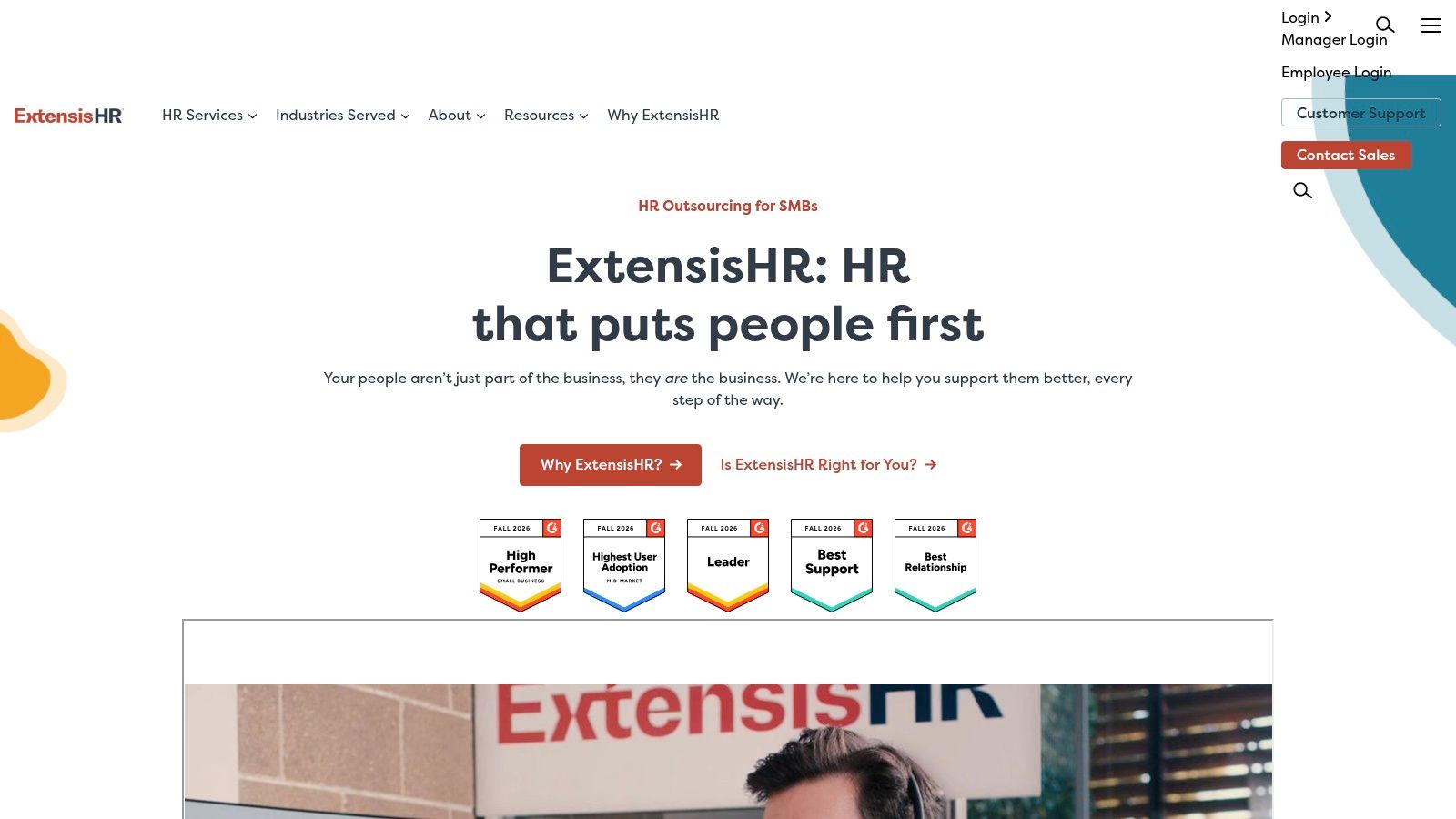
A boutique approach can produce a more personal experience, but it may also mean less standardization than a large national provider. Buyers should verify state coverage, implementation resources, escalation procedures, and the continuity of the assigned service team.
Pricing isn't public, so the evaluation should focus on total operating value. Compare not only payroll and benefits administration, but also the time leadership expects to spend reviewing exceptions, managing documentation, and resolving issues the provider doesn't own.
Review ExtensisHR and request a service map that identifies who owns each recurring and escalated responsibility.
CoAdvantage is a practical option for SMBs seeking broad PEO support with an emphasis on cost control, workplace safety, and foundational compliance. Its services include payroll, benefits administration, HR support, workers' compensation, risk management, safety evaluations, and claims assistance. Dedicated risk teams can be valuable for employers whose exposure is tied to physical work, field operations, or workplace incidents.
The provider's educational resources for clients and brokers may also help smaller businesses build a more consistent HR operating rhythm. That said, companies should distinguish between educational content and hands-on advisory support for high-stakes employment decisions.
CoAdvantage's website and tooling may feel more traditional than newer, automation-heavy platforms. That isn't automatically a disadvantage. A company with simple technology requirements may value a broad service relationship more than a modern interface.
The key question is whether the platform and local support structure can handle the company's actual workflow. Test payroll approvals, benefits changes, workers' compensation claims, state expansion, employee onboarding, and manager questions before committing.
Look at CoAdvantage with a detailed responsibility matrix. It should show what the provider handles, what managers handle, and what remains with executive leadership.
VensureHR is best for organizations that want optionality between PEO, ASO, EOR, and HCM services. That range can matter when a company's needs are changing. An employer may want co-employment and benefits support today, then prefer an ASO arrangement or a different employment structure as its workforce, ownership model, or geographic footprint evolves.
Its broader offering includes nationwide HR, payroll, benefits, loss-control support, and multiple engagement models. That flexibility can reduce the disruption of changing providers, but only if the transition between models is clearly documented and operationally supported.
A broad portfolio can also produce variability by local team, product line, or assigned account group. Ask who owns the relationship when the company changes from PEO to ASO, how benefits are affected, whether payroll tax responsibilities shift, and how employee communications are managed.
Visit Vensure Employer Solutions and ask for a transition plan between each service model you may realistically use.
BBSI is a strong candidate for field-intensive, industrial, and service organizations that value local support, hands-on safety programs, and workers' compensation expertise. Its model combines PEO services with local market teams, risk management, safety support, compliance assistance, and staffing options.
That local presence can make a meaningful operational difference. A safety recommendation or claims issue often requires someone who understands the worksite, the supervisors, and the conditions employees face. A remote support queue may not provide the same practical context.
BBSI's program details and pricing can vary by office and region, so a national comparison alone won't tell you how the relationship will work. Meet the local team that would support the account. Ask who conducts safety evaluations, who manages claims, how quickly leaders receive guidance, and how the provider coordinates staffing with PEO services.
Review BBSI with the specific local office that would serve your employees, not only the national sales presentation.
| Provider | Core services | Best for | Unique selling point | Compliance & advisory strength | Pricing & transparency |
|---|---|---|---|---|---|
| Insperity | Full PEO: HR admin, payroll, benefits, risk & safety | Complex, multi-state SMBs needing process/governance | Established national leader with mature processes | Robust multi-state compliance and governance support | Quote-based; generally premium; not public |
| ADP TotalSource | Co-employment PEO: payroll, tax registrations, benefits, HR tech | Distributed SMBs wanting enterprise-grade tooling & tax coverage | ADP scale with integrated payroll/HR ecosystem | Strong national tax/compliance infrastructure | Custom quotes; pricing opaque |
| Paychex PEO | HR, payroll, benefits, workers' comp, retirement services | SMBs wanting one vendor for payroll + PEO | Payroll heritage with integrated insurance/agency services | Solid onboarding and compliance coverage | Quote-based; varies by market/package |
| Justworks | PEO tiers, payroll, 24/7 support, benefits admin (Plus) | Small–mid teams prioritizing transparency and quick setup | Published pricing and simple, user-friendly platform | Nationwide benefits admin (Plus); lighter enterprise depth | Transparent published plans and tiers |
| Rippling PEO | PEO on unified HRIS: payroll, IT/device provisioning, automations | Tech-forward, multi-state orgs wanting HR + IT automation | Consolidates HR, payroll, and IT to reduce tool sprawl | Automations for onboarding, tax, and compliance tasks | Quote-based; module-dependent pricing |
| Engage PEO | Attorney-led HR advisory + full PEO suite | Regulated or high-risk environments needing legal-caliber guidance | Each HR consultant is a licensed employment attorney | High-caliber, defensible legal guidance embedded in HR | Premium, custom pricing; not public |
| ExtensisHR | Full PEO with CPEO, ESAC, SOC1 Type 2 controls | Mid-market employers wanting boutique service + assurance | Strong assurance credentials and white-glove service | Verified controls and compliance frameworks | Custom pricing; boutique positioning |
| CoAdvantage | Payroll, benefits admin, HR support, risk & safety programs | SMBs seeking economical PEO footprint and safety focus | SMB-oriented programs with emphasis on risk management | Dedicated risk teams, safety evaluations, claims support | Custom pricing; competitive SMB programs |
| VensureHR | PEO, ASO, EOR, HCM options; payroll & loss-control | Growing businesses wanting flexibility across engagement models | Multiple service models under one provider for optionality | Nationwide HR/payroll with variable local delivery quality | Custom pricing; depends on chosen model |
| BBSI | Local market teams, workers' comp, risk management, staffing | Field-intensive, multi-location operations needing in-market support | Strong local presence with hands-on safety and claims help | Industrial-grade risk focus with local expertise | Varies by local office; program specifics require consultation |
The best TriNet alternative depends on the responsibility you want the provider to carry and the responsibility you're prepared to bring back in-house. A national PEO may be the right answer when you need broad payroll, benefits, compliance, and risk infrastructure. A transparent provider such as Justworks may fit better when budget visibility and straightforward administration matter most.
Technology consolidation points toward Rippling, especially when HR, payroll, IT, devices, and application access should share one workflow. Engage PEO is more relevant when attorney-led judgment matters in investigations, terminations, documentation, and manager conduct. ExtensisHR suits employers looking for boutique service and assurance controls, while VensureHR offers flexibility across PEO, ASO, EOR, and HCM models. BBSI is better aligned with companies that need local risk and safety support. Insperity, ADP TotalSource, Paychex PEO, and CoAdvantage each remain credible choices for employers that want broad PEO administration with different balances of scale, flexibility, service depth, and risk support.
The market context supports taking this decision seriously. One independent report values the global HR outsourcing market at $42.0 billion in 2025 and projects it to reach $72.4 billion by 2034, with a 7.2% CAGR. The same report says the SME segment represents 41.7% of the market and is expanding at an 8.9% CAGR, which reflects the growing demand among smaller employers for compliance support, benefits access, and simpler operations. See the HR outsourcing market overview for that market context.
Before you sign, complete a transition review that covers:
A PEO can administer critical processes, but it doesn't eliminate the need for leadership judgment. Multi-state employers with employees in six or more U.S. states spend 3.65 times more time on compliance than teams in five or fewer states, according to neutral market coverage of the implementation and service-model trade-off. Read the TriNet competitor analysis for that comparison.
Market share data also suggests buyers are choosing among scaled platforms rather than a completely fragmented field. Estimated payroll-management shares include ADP HR at 12.28%, Paylocity at 12.20%, and Sage Payroll at 10.58%, with additional shares attributed to ADP Payroll, Paycor, ADP Workforce Now, and Dayforce Ceridian HCM in the cited analysis. Those figures don't identify the best provider for your company, but they do reinforce the importance of evaluating mature multi-state payroll and HCM infrastructure. See the payroll-management competitive landscape for the underlying estimates.
Customer experience also deserves attention. A 2024 benchmark cited 76% of small business owners using PEO services as rating customer experience excellent, while TriNet's 2024 PEO NPS benchmark was reported at 72, with top performers reaching 85. The PEO alternatives review data illustrates why service consistency and compliance support should be evaluated alongside software features.
For leadership teams that need help with high-stakes people decisions, documentation standards, terminations, investigations, manager conduct, or multi-state HR risk, risk management solutions for Florida may also be relevant to the broader operating plan. Paradigm International supports SMB leaders that need structured judgment beyond routine HR administration, particularly when the consequences of a people decision extend into legal, financial, and reputational exposure.
Paradigm International Inc. helps SMB leadership teams navigate high-stakes employee decisions, multi-state HR risk, investigations, terminations, manager conduct, and defensible documentation practices. Visit Paradigm International Inc. to discuss the advisory support your team needs before, during, or after a transition from TriNet.