
An appeal notice often arrives when the team is already managing a termination, payroll questions, and a departing employee's replacement. The deadline may be short, the facts may be disputed, and the employer's file may contain more assumptions than usable evidence. Treat the unemployment benefits appeal as a time-sensitive evidentiary matter, not as routine paperwork.
An unemployment benefits appeal begins with an agency determination about eligibility. Either the claimant or the employer may challenge that determination, depending on the state's procedure and the issue involved. For employers, the trigger is usually a notice stating that benefits were allowed, denied, or otherwise determined after the agency reviewed information from the claimant and the company.
The process is administrative, but it still requires disciplined preparation. A state workforce agency may issue the initial determination, an appeals unit or hearing officer may conduct the first evidentiary review, and a review board or commission may consider a later challenge. The exact structure varies by jurisdiction, so the notice controls the required filing method and next step.
Employers often assume that a weak first presentation can be repaired later. That assumption is dangerous. U.S. Department of Labor-derived figures report a 28.7% reversal rate for lower-authority appeals and 10.7% at higher-authority review for the 2022–2023 period, which shows how sharply the opportunity narrows after the initial appeal stage (U.S. Department of Labor appeals reversal data).
The first appeal may be a live hearing, but it may also involve paper review, pre-hearing reconsideration, or another administrative process. Massachusetts legal services data cited by Experian reported 74% approved without a hearing and 6% approved after a hearing in that dataset (employer guidance on unemployment appeal outcomes). The practical lesson is simple: submit the complete record at the earliest permitted stage. Don't wait for a hearing date before assembling the case.
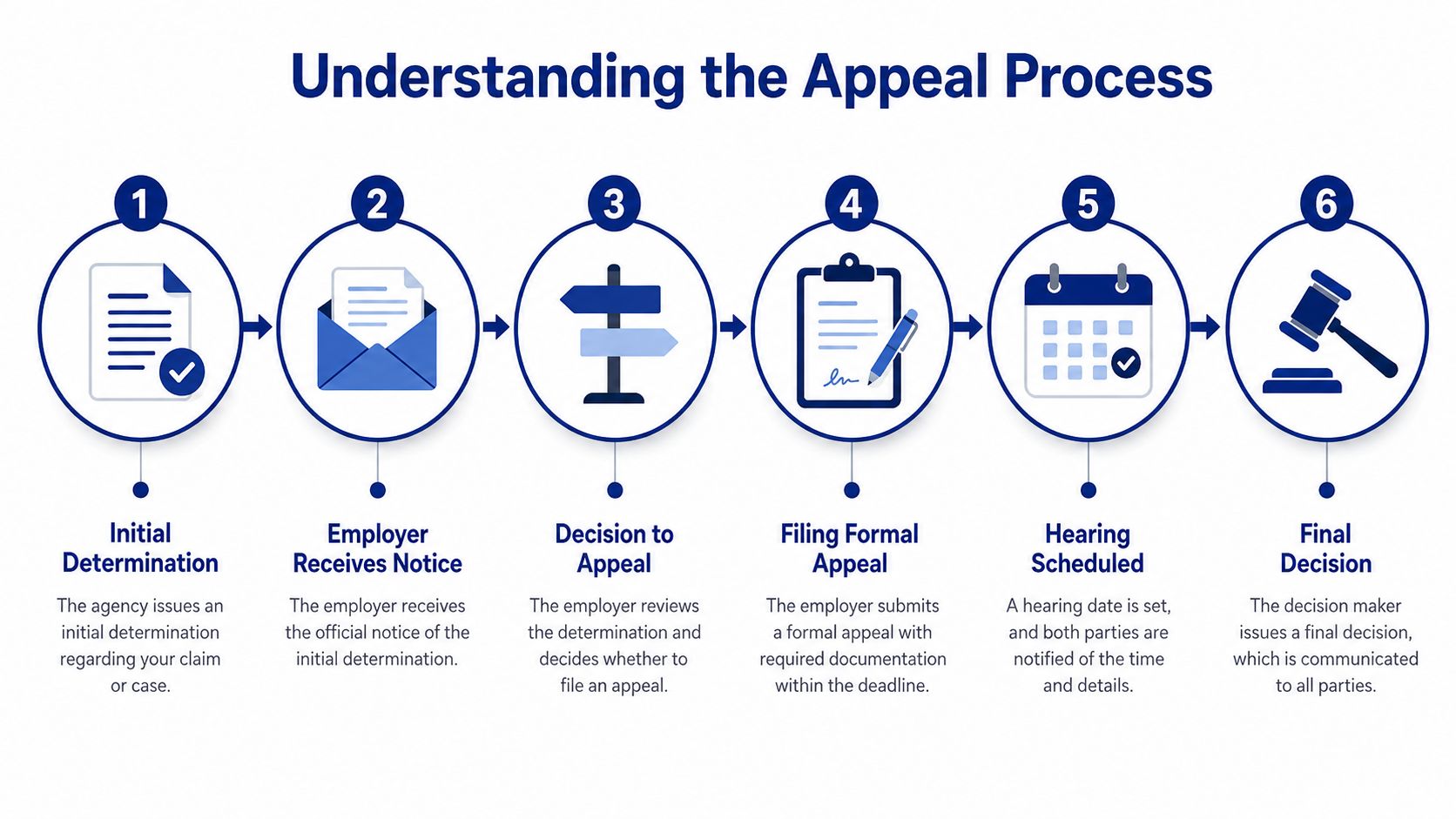
The issue isn't whether management felt justified. The tribunal generally needs a legally relevant explanation for the separation, supported by competent evidence. A company may need to establish the final incident, the applicable policy or expectation, the employee's knowledge, and the reason the conduct met the state's standard for disqualification.
Benefits decisions can also affect employer tax experience and future claims handling. California's unemployment insurance system traces back to the Social Security Act of 1935, its first benefits were paid on January 1, 1938, and its dedicated appeals board was created in 1943 to independently review disputes over benefit determinations and employer tax liabilities (California unemployment appeals information). The system is established and formal, even when the hearing format feels less courtroom-like.
For foundational claim-response procedures, employers can use the Paradigm International Inc. employer resource. The right operating posture is urgency, accuracy, and a complete record.
| State | Deadline (Days) | Trigger Event |
|---|---|---|
| California | 30 | Mailing date |
| Connecticut | 21 | Overpayment appeal deadline |
| New Jersey | 10 or 7 | 10 days from mailing or 7 days from receipt, depending on the applicable rule |
| Texas | 14 | Date the agency mails the ruling |
The table is a planning aid, not a substitute for the agency notice. States calculate appeal periods from different events, and a missed deadline can end a defensible case before anyone reviews the underlying facts. Appeal windows commonly fall between 7 and 30 days, but the applicable trigger and counting method depend on the jurisdiction (U.S. Department of Labor comparison of appeal laws).
California provides a 30-day appeal period from the mailing date. Connecticut allows 21 days for overpayment appeals. New Jersey may require action within 10 days of mailing or 7 days of receipt, depending on the notice and applicable procedure. Texas requires an employer to file an appeal and request a hearing within 14 calendar days of the agency's mailed ruling. A further appeal to the Texas Commission must also be filed in writing within 14 calendar days of the mailed hearing decision (California unemployment appeals guidance; Texas claim and appeal process).
For an SMB operating across states, the operational burden starts when the notice arrives. The date printed on the notice, or legally treated as the mailing date, can control even if the company opens the envelope later. Do not apply one company-wide calendar rule. Log every notice immediately, assign a filing owner, and escalate any uncertainty the same day.
Use the determination notice as the source document. An informal email or manager's recollection cannot establish the filing date reliably. Record:
Set the evidence cutoff before the filing deadline. That buffer gives the employer time to verify the separation reason, correct inconsistent records, obtain witness statements, and resolve portal or transmission problems. The record should be ready before the appeal is submitted, not assembled after a hearing notice arrives.
If the deadline has passed, review the notice, permitted state exceptions, reason for delay, and records supporting a procedural explanation. A late appeal is worth pursuing only when the factual or financial stakes justify the effort and the employer can document a credible basis.
COOs managing distributed teams should align appeal calendars with the employee handbook guide for COOs. The handbook cannot replace an agency notice, but it can assign escalation responsibility and preserve consistent internal procedures.
An employer can have a valid separation decision and still lose the appeal if its records do not prove the sequence. The file must show what happened, which rule or expectation applied, what the employee knew, how the company investigated, and why the final incident justified separation. Build that record before the agency hearing is scheduled.
Start with a chronological file that a hearing officer can understand without oral reconstruction. Organize the separation notice, investigation notes, warnings, attendance records, policy acknowledgment, relevant communications, and witness information in a clear order.
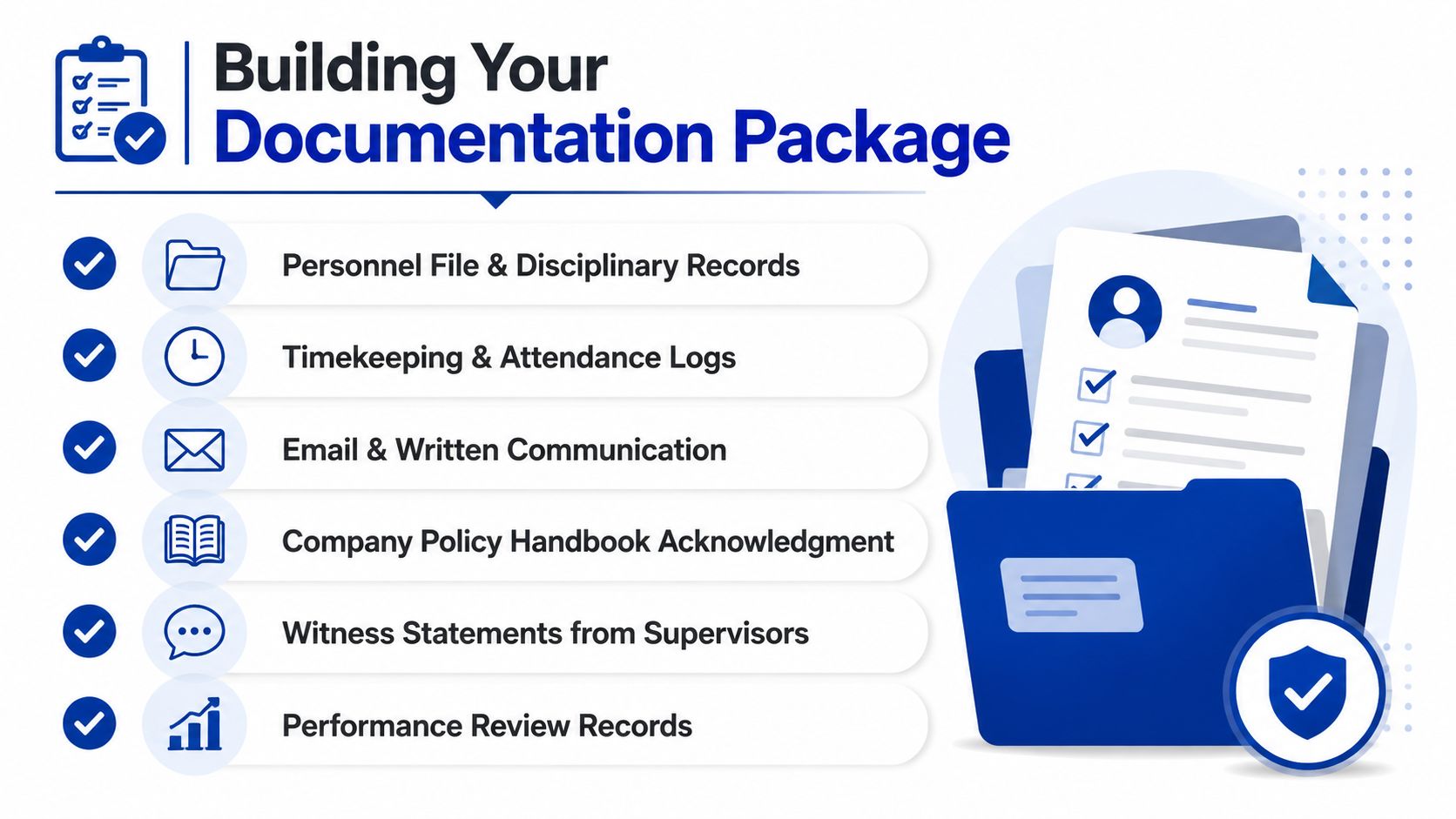
A usable package normally includes:
The package should separate misconduct from inability, poor judgment, or inadequate performance. If the company alleges misconduct, connect each assertion to the employee's conduct and knowledge. A file that collects every complaint can bury the final incident and create an inconsistent narrative.
Illinois hearing decisions rely on a preponderance of legally competent evidence. Written documents generally need live testimony from someone with direct knowledge, or they may be treated as hearsay. A document does not prove itself because it appears on company letterhead.
The supervisor who witnessed the incident should testify about what occurred. An HR representative can explain the investigation and recordkeeping process, but should not speculate about events outside personal knowledge. After-the-fact summaries, vague witness statements, and reconstructed timelines invite credibility challenges.
Evidence standard: When a decision-maker asks, “How do you know that?”, the witness should identify a firsthand observation or a specific business record tied to a person who does.
Use clear exhibit labels and a short index. Remove irrelevant personal information where appropriate, preserve the surrounding context of communications, and follow the agency's submission instructions. The our evidence handling procedures can help establish a repeatable process for preserving records before an appeal arrives.
Strong documents don't rescue a witness who contradicts them. The employer should select witnesses based on personal knowledge, not title. A direct supervisor who saw the final incident is usually more useful than a senior executive who only reviewed the termination afterward.
Witness preparation isn't scripting. It means reviewing the timeline, identifying the limits of personal knowledge, locating the supporting exhibit, and practicing concise answers. The witness should understand the question before answering and should say that they don't know when they don't know.

Hearing officers commonly focus on a few practical questions:
Character judgments create risk. “She was unreliable” is weaker than a dated attendance record tied to a communicated schedule. “He was dishonest” is weaker than a specific statement, the evidence showing it was false, and the decision-maker's documented response.
The witness should never argue with the claimant. If the claimant gives a different account, respond with the company's evidence and the witness's personal knowledge. Don't exaggerate, fill gaps with assumptions, or introduce unrelated performance concerns that weren't part of the stated separation reason.
The company representative should know where each exhibit is located and refer to documents accurately. If opposing evidence is irrelevant or based on secondhand information, raise the concern respectfully when the hearing format permits. The objective is a reliable record, not a theatrical exchange.
A prepared witness makes the documents understandable. An unprepared witness makes the documents look uncertain.
In Texas, agency guidance specifically tells employers to bring firsthand witnesses, supporting documents, and evidence connected to the final misconduct incident or reason for resignation (Texas employer hearing guidance). That is sound operational guidance even when another state uses a different hearing format.
A resignation and a discharge require different documentary packages. They also create different burdens for the employer. Before collecting records, identify the separation theory, the facts that must be established, and the state's allocation of proof. A large file cannot compensate for proving the wrong issue.
For a voluntary quit, the claimant generally must establish that the resignation resulted from qualifying good cause. For a discharge, the employer generally must establish misconduct under the applicable unemployment standard. Those rules vary by state, so SMB operators should confirm the hearing authority's requirement before finalizing the evidence package.
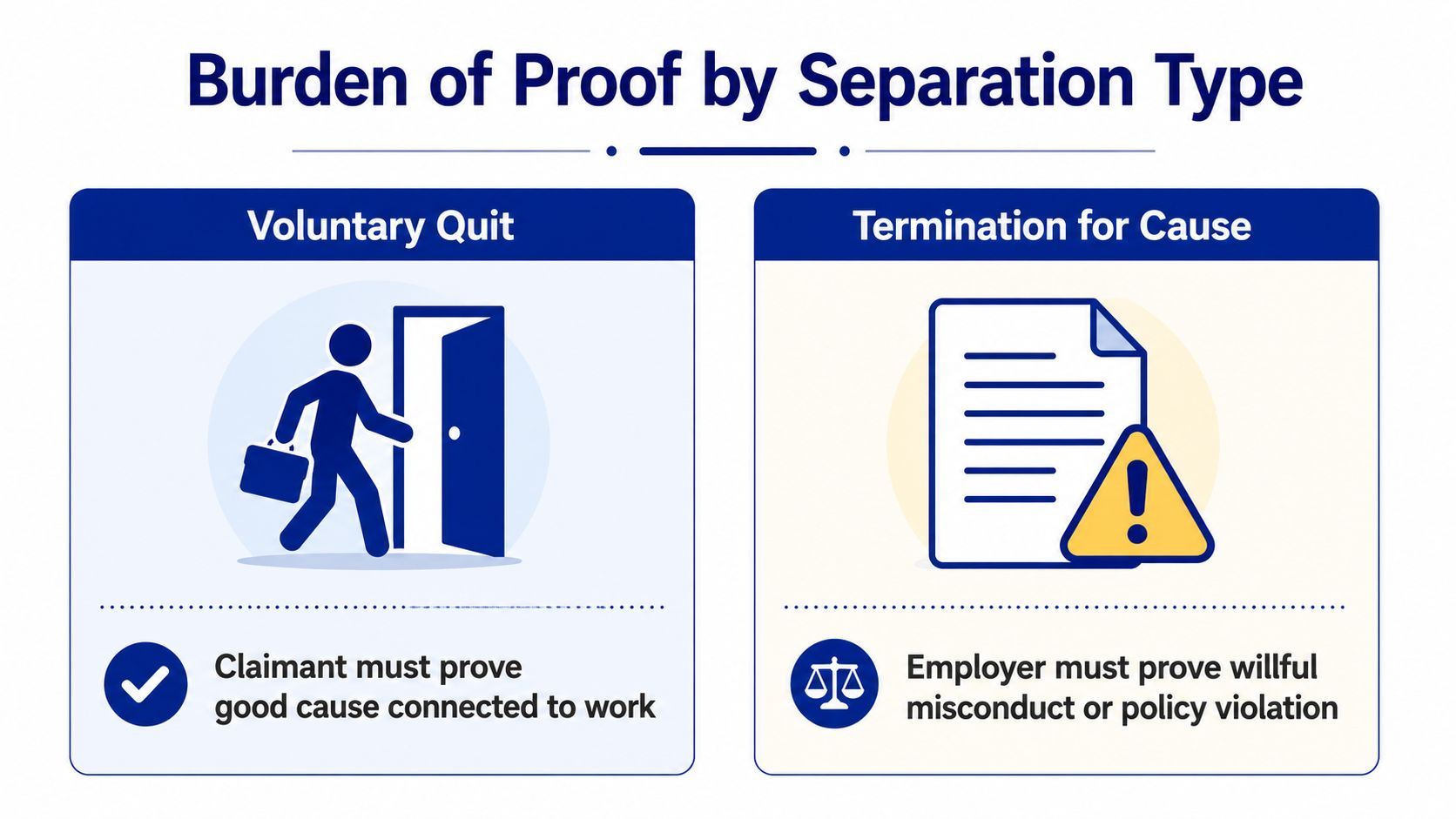
For a resignation, preserve records that answer four questions:
A resignation letter may confirm that the employee left without answering why. The surrounding communications can show whether the departure involved a workplace condition, a personal reason, or another circumstance recognized under state law. Preserve those records when the issue arises, not after the appeal notice arrives.
A discharge case requires the employer to establish the legally relevant misconduct. Begin with the final incident. Then connect it to the applicable policy, instruction, or workplace expectation. Separate intentional or culpable conduct from an honest mistake, inability, or ordinary performance deficiency.
Attendance cases require a tight chronology. Present schedules, time records, call-off messages, prior warnings, and the employee's explanations. Show how the final absence or tardiness fit the stated policy, whether the policy was communicated, and why the company made the decision when it did.
A termination may comply with company policy without meeting the unemployment law's disqualifying-misconduct standard. HR should test that distinction before the separation, then preserve evidence supporting the precise theory presented at the hearing.
The most effective unemployment benefits appeal strategy starts before anyone files a claim. Employers reduce risk when managers document events as they happen, apply policies consistently, and use a separation checklist that forces decision-makers to identify the final incident and supporting evidence.
A practical audit should test whether the company can answer these questions without relying on memory:
Managers need a simple note-taking standard. Each entry should record what occurred, when it occurred, who was present, what the employee said, what policy or expectation applied, and what action followed. Notes should avoid conclusions that the underlying facts don't support.
A separation checklist should require HR or leadership review before the decision is finalized. It should confirm that the company has preserved the personnel file, attendance and timekeeping data, relevant emails, policy acknowledgments, investigation materials, and the final written reason.
Multi-state employers also need a central notice protocol. Assign one inbox or case owner, record every agency notice date, calculate the applicable deadline, and set an earlier internal submission date. Store the appeal confirmation and evidence package in one controlled location so a change in personnel doesn't interrupt the response.
These practices won't eliminate disputes. They do create a consistent record that lets a hearing officer evaluate the facts instead of trying to reconstruct them. For leadership teams that need structured support with terminations, investigations, documentation standards, and multi-state HR risk, Paradigm International Inc. provides advisory guidance designed to help employers make defensible decisions before problems escalate.
Paradigm International Inc. can help your leadership team review separation practices, strengthen evidence preservation, and build deadline controls for multi-state unemployment matters. Visit Paradigm International Inc. to discuss your current HR risk and identify practical improvements before the next unemployment benefits appeal.