
A termination decision is already on your desk. The manager says the employee resigned, but the employee says they were told to leave. Payroll needs a final-pay date, and someone has raised a concern about a recent complaint. The label on the paperwork won't settle the issue. The facts, documents, and applicable state rules will.
Treat voluntary versus involuntary separation as a defensibility decision, not a vocabulary choice. A resignation letter doesn't automatically make a departure voluntary, just as an employer's decision to end a role doesn't by itself establish misconduct. Review what prompted the separation, who made continued employment unavailable, and how the record describes the events.
The classification can shape the employee's unemployment claim, the deadline for final wages, and the evidence your organization may need to show that it acted consistently and for legitimate reasons. It can also affect how a decision looks if the employee later alleges retaliation or discrimination. State rules differ, so a label that seems straightforward under one state's process may not settle the question elsewhere.
Practical rule: Record what happened, not the label that makes the paperwork easier.
Before you speak with the employee, make five decisions:
That sequence keeps the conversation aligned with the evidence. It also gives HR a clear basis to pause when the facts don't support the proposed classification. The sections below apply this approach to the terminology, operational differences, documentation, and state-specific risks leaders should assess before a separation goes live.
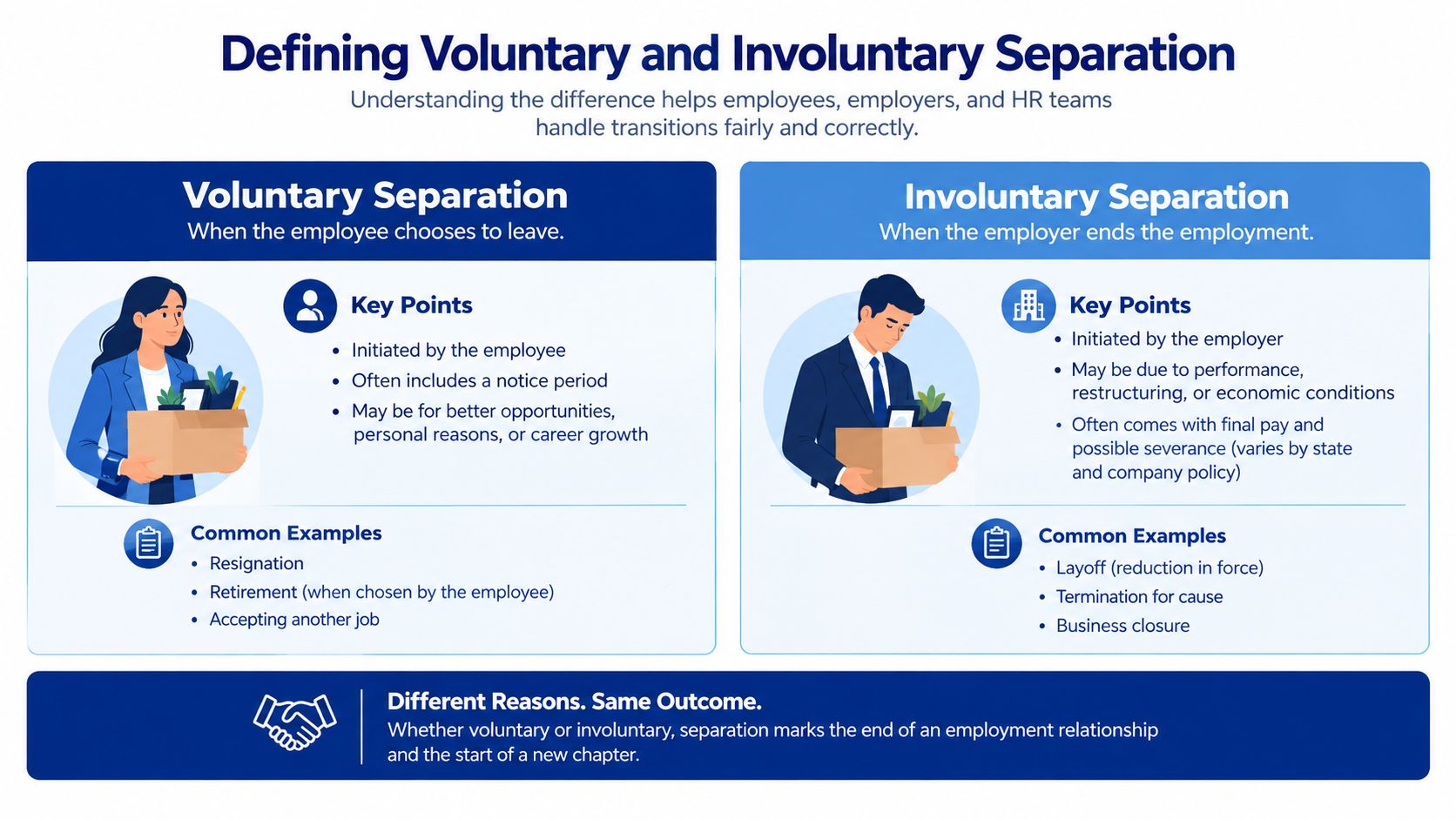
A resignation can be treated as employer-driven if the circumstances support a constructive discharge claim. That makes voluntary versus involuntary more than an HR label: it is a legal classification that can affect unemployment eligibility, final-pay timing, and the records an employer must be ready to defend. Review the facts before recording the separation type.
The U.S. Bureau of Labor Statistics' Job Openings and Labor Turnover Survey (JOLTS) provides a useful starting point. “Quits” are generally employee-initiated separations, while “layoffs and discharges” are employer-initiated. Retirements, deaths, disabilities, and transfers fall under “other separations.” Keep that category distinct rather than forcing every departure into a voluntary-or-involuntary binary. The BLS JOLTS release defines these categories for workforce reporting.
The figures show why workforce totals need context. In July 2025, U.S. employers recorded approximately 3.2 million quits, a 2.0% rate, compared with 1.8 million layoffs and discharges, a 1.1% rate. Quits were about 1.8 times as numerous. Of 5.3 million total separations, quits represented about 60%, while layoffs and discharges accounted for about 34%, with other separations making up the remainder.
The mix changes with labor-market conditions. In November 2021, quits reached a series high of 4.5 million, with a 3.0% rate; layoffs and discharges totaled 1.4 million, with a 0.9% rate. Quits exceeded layoffs and discharges by approximately 3.1 million, according to the BLS report on November 2017 quits. This source describes 2017, not the November 2021 figures, so it does not substantiate that comparison.
For executives, use workforce categories to frame separate reviews. Rising quits may warrant scrutiny of retention, workload, or management practices. Employer-initiated exits call for review of decision criteria, consistency, and supporting records. Neither count establishes why an individual left or whether a particular decision was sound. Examine examples of constructive discharge wins to see how resignation circumstances can lead to an employer-driven classification.
A sound comparison starts with the facts behind the label. Use this table as a screening tool, then confirm the governing state rules and circumstances of the individual case.
| Dimension | Voluntary (Quit, Resign, Retire) | Involuntary (Discharge, Layoff, Termination for Cause) |
|---|---|---|
| Initiator | Employee typically initiates the departure. Retirement is generally tracked separately in BLS JOLTS. | Employer initiates the separation, whether for conduct, performance, or business reasons. |
| Typical trigger | Employee chooses to leave, retires, or submits a resignation. | Employer ends the job due to misconduct, performance concerns, restructuring, or a layoff. |
| Documentation standard | Preserve the employee's stated reason, resignation communication, and agreed final work date. | Record the business rationale, evidence, applicable policy, decision-maker, and consistent treatment. |
| Unemployment posture | A voluntary quit may require the employee to establish legally recognized good cause under the state's rules. | An employee may generally qualify unless disqualifying misconduct applies. State determinations control. |
| Final-pay mechanics | The deadline may depend on state law and notice given by the employee. | Some states require payment sooner after discharge or layoff. |
| WARN exposure | Ordinarily not the central issue for an individual resignation; don't treat a workforce reduction as isolated departures without checking the facts. | A qualifying mass layoff may trigger federal WARN notice and state mini-WARN requirements. |
| Retaliation risk | A resignation soon after a complaint, leave request, or wage dispute warrants careful review of the surrounding events. | Check whether protected activity, leave, or accommodation requests may have influenced the decision. |
| Common employer mistake | Treating a signed letter as conclusive even when the employee says they had no real choice. | Creating or backfilling a rationale after the decision, rather than documenting the basis when made. |
The difficult category is constructive or coerced resignation. An employee may submit a letter and still claim that the employer effectively made continued work unavailable. A severance offer tied to a resignation, pressure from a manager, or a decision to remove the employee from work can all make the circumstances worth examining. The document matters, but it doesn't replace the underlying facts.
BLS categories help describe broad workforce flows, not determine the legal outcome of an individual separation. In a specific case, the state unemployment agency may examine the circumstances and apply its own test. Build your records around what occurred, who initiated the separation, and what the employee was told. Don't use handbook language or a form field as a substitute for that review.
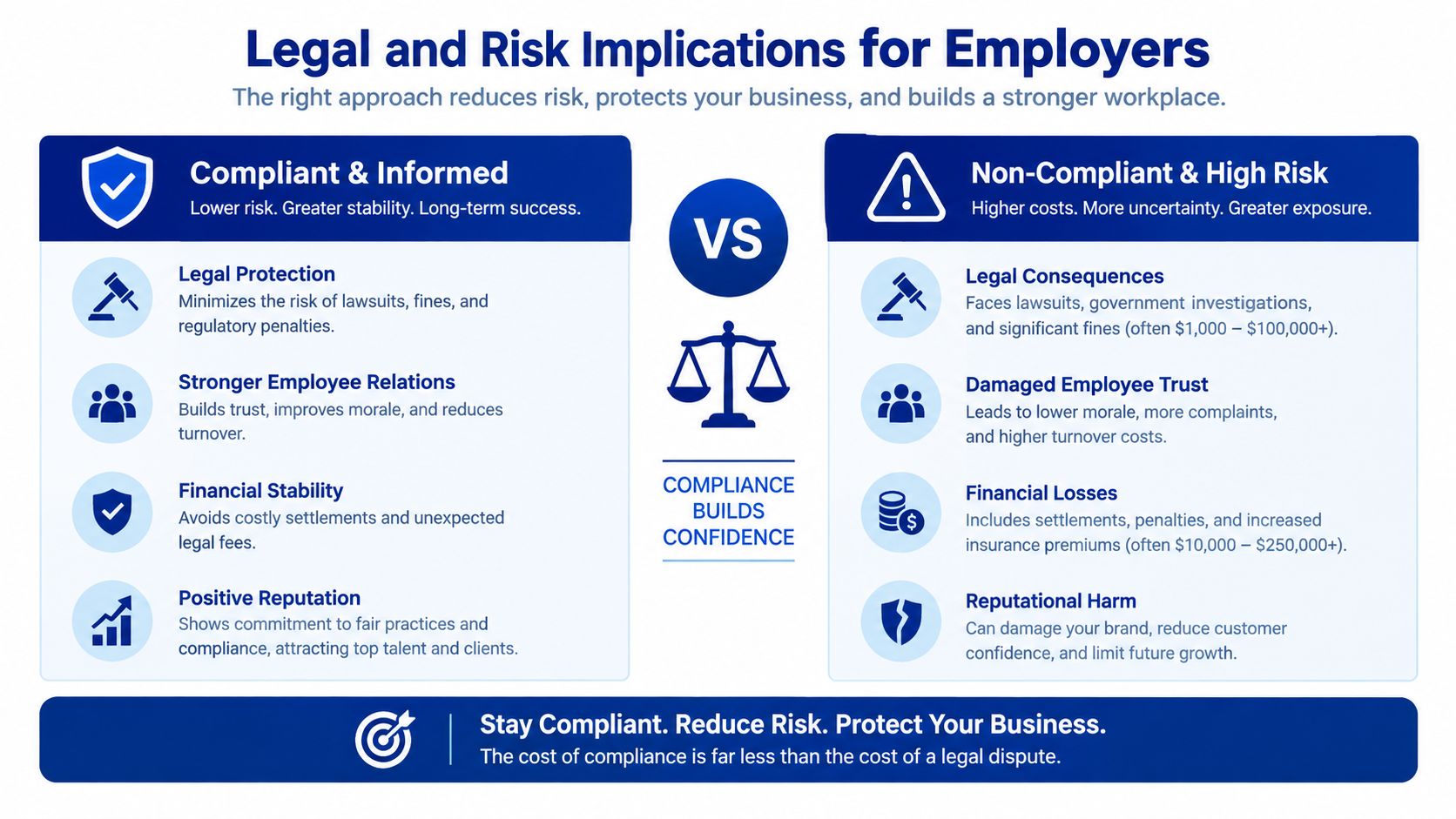
A separation can look voluntary on paper and still be treated as involuntary under the law. Before coding the departure, answer four questions: how the employee left, what prompted the departure, when final wages are due, and whether a layoff requires advance notice. The label is a legal artifact, not merely an HR category. It can affect unemployment eligibility, pay deadlines, notice obligations, and the evidence needed to defend the decision.
Unemployment classification. State agencies distinguish between a quit and an employer-initiated separation. Eligibility and evidentiary standards vary by state. A voluntary quit may require the employee to establish recognized good cause; an involuntary separation may qualify for benefits unless misconduct disqualifies the worker. The National Employment Law Project's discussion of good-cause quits explains why the reason for leaving matters. Don't promise an outcome or treat eligibility as automatic.
Resignation under pressure. A signed resignation does not settle the classification if the employee had no meaningful option to keep working. Texas treats resignation in lieu of discharge as involuntary for final-pay purposes, as described in the Texas Workforce Commission's final-pay guidance. That distinction affects the deadline. Assess the circumstances rather than relying on the form's label.
Final wages. State deadlines can turn on whether the separation was voluntary. Under Texas Labor Code Chapter 61, wages after an involuntary separation are due no later than the sixth calendar day after discharge. After a voluntary resignation, they are generally due on the next regularly scheduled payday. In Oregon, ORS § 652.140 generally requires payment by the end of the next business day after an employer-initiated termination. A resignation with at least 48 hours' notice requires payment on the last day worked, subject to the statute's weekend and holiday rule; shorter notice generally carries a different deadline. The Oregon Bureau of Labor and Industries' paychecks guidance summarizes these requirements. These rules are stated as applicable in 2026. Verify current requirements before acting.
WARN notice. The federal Worker Adjustment and Retraining Notification Act, 29 U.S.C. §§ 2101–2109, generally requires 60 days' advance written notice for a covered mass layoff at a single site affecting at least 50 but fewer than 500 full-time employees, if those employees make up at least 33% of that site's active workforce. The percentage test does not apply when the layoff affects 500 or more full-time employees. Review the U.S. Department of Labor's WARN guidance and check state mini-WARN laws, which may set different coverage or notice requirements.
A resignation record should capture the employee's own account, not just the manager's summary. Save the resignation communication, confirm the last working day, and ask an open-ended question about the reason. If the employee mentions discrimination, harassment, wages, leave, safety, or another concern, preserve that statement and route it through the appropriate review process.

For an employer-initiated termination, build the file as the decision develops. Don't wait until a claim arrives to reconstruct why the employee was dismissed. A clear record helps HR test whether the stated reason is supported and whether managers applied the same expectations to comparable situations. For practical ideas on consistent corrective action, see this restaurant employee discipline guide from AnchOps.
Include the materials a reviewer needs to understand the decision:
If an employee resigns during an investigation, don't coerce a retraction or suggest they must stay. A manager can say: “I've received your resignation. Please confirm your intended last day and whether you're comfortable sharing your reason. The company will continue reviewing the open matter, and we'll document your response accurately. You can send any information you want us to consider.”
Use that script as a neutral starting point, not a substitute for a careful conversation. For a separate contractor matter, HR can review this guide on how to write a contractor termination letter.
A remote employee works in Oregon, reports to a Texas manager, and receives a separation notice prepared at headquarters. Which state's requirements did payroll apply? If the file cannot answer that question, the national checklist has left an exposure unresolved.
Apply the rule where the employee works, verify current law, and document the basis for the classification. Treat that classification as a legal determination with consequences for pay, unemployment eligibility, and workforce-reduction review.
Under Texas Labor Code Chapter 61 and ORS § 652.140, final-pay obligations differ by state and classification. Use the Texas Workforce Commission's guidance and Oregon Bureau of Labor and Industries' paychecks guidance to verify the applicable requirements rather than copying deadlines into a national template.
For remote employees, create a jurisdiction record before approving the separation. Record the employee's Work location, any recent relocation, the law applied, and who resolved uncertainty about coverage. A payroll address alone is an inadequate basis when the employee's actual working location differs. Require HR and payroll to use the same jurisdiction determination.
Keep the remaining review tied to that record. The Notice review should address federal WARN and applicable state mini-WARN coverage, including differences in thresholds and notice obligations. Record Protected activity and Leave status under the applicable requirements without duplicating the investigation file. For the Unemployment process, identify the relevant agency's framework and preserve facts supporting its review. The File record should distinguish an employee-initiated departure from an employer decision, even when the internal system uses a broader separation code.
Maintain state-specific handbook provisions alongside the national process. HR can compare handbook requirements across states to identify policy differences, then assign responsibility for keeping those provisions current.
Standardize ownership and recordkeeping. Keep legal requirements state-specific.
The right choice isn't the one that feels fastest or costs less to administer. It's the one the facts support and the organization can explain under later review. Before deciding, ask whether the record reflects the actual trigger, whether the applicable state requirements have been checked, and whether the employee's recent concerns or protected activity could affect the risk assessment.
Use this decision rule:
Then prepare the operational steps before the conversation: who will deliver the message, what the employee will be told, when access will change, how final wages will be handled, and who will respond to an unemployment inquiry. Give managers a clear script and one point of contact for questions. If the employee later seeks to return, HR can use a consistent process for navigating post-termination rehire questions.
A disciplined process won't eliminate every dispute. It does make the decision easier to explain, keeps the paperwork closer to the facts, and helps leadership see where the organization needs a stronger investigation or state-specific review. For time-sensitive decisions, get qualified advice before the employee meeting, not after the classification has already been recorded.
This article is general information, not legal advice. Employment laws change and vary by state; consult qualified employment counsel about your situation.
Book a Free HR Risk Review. Paradigm International Inc. provides employer-side HR risk advisory, including termination planning, documentation support, investigations, and multi-state compliance coordination. Visit Paradigm International Inc. to discuss a defensible process for your next high-stakes separation.