
A leadership team with 180 employees across four states meets on a Tuesday to approve a site closing and a shift reduction. By Friday the separation list is finished. Nobody in the room has counted full-time employees at the affected site, checked whether earlier separations at that location fall inside the same 90-day window, or read the state statutes that sit on top of the federal rule.
That order of events is how most WARN Act requirements problems begin. The decision gets made first, the paperwork follows, and the counting, timing and state-layer questions get answered by whoever is still available at the end. The federal Worker Adjustment and Retraining Notification Act rewards the reverse sequence. Count first, then decide, then notify.
Signed into law on August 4, 1988 and effective February 4, 1989, the Worker Adjustment and Retraining Notification (WARN) Act is administered by the U.S. Department of Labor and codified at 29 U.S.C. § 2101 et seq., with implementing rules at 20 C.F.R. Part 639. Its purpose is advance information, giving employees, their families and their communities time to look for other work or retraining before the jobs end. The U.S. Department of Labor's WARN overview sets the coverage test at employers with 100 or more employees, subject to specific counting rules.
Two event definitions do most of the work. A plant closing is a permanent or temporary shutdown of a single site, facility or operating unit that causes employment loss for at least 50 full-time employees, excluding part-time employees. A mass layoff is generally an employment loss at one site during a 30-day period affecting at least 50 full-time employees and at least 33% of the active full-time workforce, and the regulation text at 20 C.F.R. § 639.2 confirms that the 33% test drops away when 500 or more full-time employees are affected.
| Requirement | Federal rule | Notes |
|---|---|---|
| Employer coverage | 100 or more employees | Counting rules apply; work through the sequence in the next section |
| Plant closing | Shutdown of a single site causing employment loss for at least 50 full-time employees | Part-time employees are excluded from the count |
| Mass layoff | At least 50 full-time employees at one site in a 30-day period and at least 33% of the active full-time workforce | The 33% test does not apply when 500 or more full-time employees are affected |
| Notice period | At least 60 calendar days of advance written notice | Pay in lieu of notice does not replace the notice period |
| Loss aggregation | Employment losses evaluated over a 90-day period | Related layoffs in the same period may combine |
| Enforcement | Private actions in federal district court | No federal agency brings the claim on an employee's behalf |
The single most expensive misreading of this table is the notice period. The Department of Labor states plainly that WARN does not substitute pay in lieu of the required notice. Writing a check for 60 days does not cure a missing notice letter, and it doesn't reset the clock. Notice is a separate obligation with its own timing, recipients and documentation.
Working rule: Any count that lands within range of a threshold deserves a written calculation and a second reader before the plan is approved.
Use this table as a first screen, not an answer. If the planned action clears a threshold on the screen, the next move is the counting steps below, then the state map, and only then the notice date. Employers that skip straight to drafting letters usually end up redrafting them.
A clean count takes an afternoon and settles most of the argument. Work through these steps in order and write down the answer to each, because the reasoning matters as much as the total if the reduction is ever challenged.
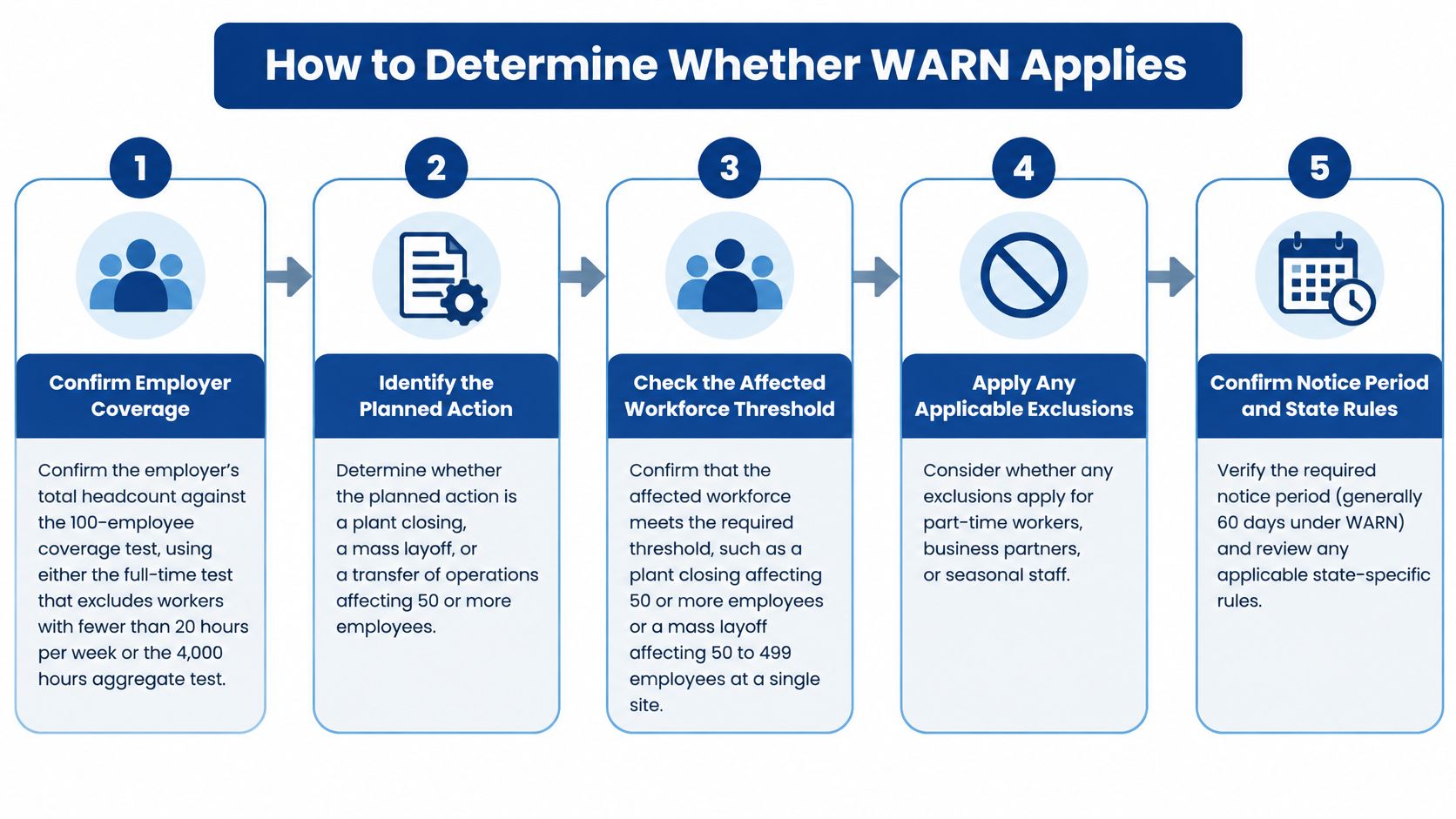
Confirm total headcount against the 100-employee test. There are two routes. The full-time route counts employees but excludes workers employed fewer than six months during the preceding 12 months and employees who work fewer than 20 hours per week. The alternative route counts 100 or more employees including part-time workers whose combined schedules total at least 4,000 hours per week, excluding overtime. Run both, because the answers can differ.
Group employees by site. Both the plant closing and mass layoff triggers are measured at a single site of employment, so a company-wide total tells you almost nothing. A reduction spread evenly across five locations may never touch a threshold at any one of them.
Separate full-time from part-time. Part-time employees don't count toward the plant closing or mass layoff thresholds, which means a payroll headcount of 90 can be a WARN count of 40. Pull the classification from the payroll system rather than from memory.
List every separation, furlough and reduction at that site across a 90-day window. Employment losses are evaluated over a 90-day period, and a temporary layoff or furlough that runs longer than six months can qualify as an employment loss. A quiet round of cuts in the spring can turn an autumn reduction into a covered event.
Compare the full-time loss count against the tests. Fifty full-time employees triggers a plant closing analysis. For a mass layoff, check 50 employees plus 33% of the active full-time workforce, or step past the percentage entirely if 500 or more full-time employees are affected.
The process reads better as a single flow. The path from headcount to notice obligation looks like this:
Flag every reduction planned in the same window and treat them as one decision until counsel confirms they're independent. Staggering two rounds by six weeks rarely breaks the aggregation. A documented business reason for each round, written before the rounds are scheduled, is what makes the independence argument credible.
Record the count, its sources and the date of the decision. Name the payroll report, the roster classification and the person who ran the numbers. A count reconstructed after a complaint is worth far less than one written the week the decision was made.
The common failures are predictable. Part-time staff get counted because the payroll report doesn't separate them. A site gets defined by ZIP code when the operating unit spans two buildings. A furlough gets treated as temporary when the return date keeps sliding past six months.
State dislocated-worker programs often layer their own trigger questions on top of the federal test, and this walkthrough of Mississippi mass layoff notice rules shows how one state frames those questions. The federal count is the starting point, not the whole file.
When the reduction is already moving, the sequencing decisions matter as much as the count. A documented reduction in force procedure keeps the selection criteria, the count and the notice timeline in one place instead of three inboxes.
Coverage and delivery are different problems, and most explainers stop at coverage. The U.S. Department of Labor's WARN page identifies the recipient groups: affected employees or their representatives, the state dislocated-worker unit, and the chief elected official of the relevant local government. Each group needs written notice with its own content and its own delivery record.
| Recipient | Who it is | Delivery and timing |
|---|---|---|
| Affected employees or representatives | Each affected employee; a union where the employee is represented | Written notice by a method designed to ensure receipt, at least 60 calendar days before the loss |
| State dislocated-worker unit | The state agency responsible for dislocated-worker services | Written notice with dated proof of delivery, same timing |
| Chief elected official | The chief elected official of the local government | Written notice with dated proof of delivery, same timing |
Verbal notice doesn't satisfy the requirement. A general announcement at an all-hands doesn't either, and neither does a routine insert in a paycheck. The standard is a reasonable delivery method designed to ensure receipt, and the practical version of that is hand delivery with a signed acknowledgment, certified mail with a return receipt, or a courier with a signature.
Keep the proof. A dated acknowledgment is the only thing that answers the question of when an employee received the letter, and that date drives the 60-day calculation.
Notice must go out at least 60 calendar days before each employment loss takes effect. If an employer relies on an exception, notice still goes out as soon as practicable, with a brief statement of why the full period wasn't given. The shortened letter carries more weight than the standard one, so it needs a reason and a date, not a paragraph of explanation.
The Department of Labor assists employers through the process, but it doesn't issue binding case-specific determinations. Disputes land in federal district court through private actions, which is why the delivery record matters more than the covering email.
Four actions close the gap between coverage and delivery:
Benefits paperwork runs on its own clock during the same period. The COBRA notification requirements that follow a termination are separate from WARN notice, but both calendars start moving the same week.
Owners ask about the exceptions first, usually hoping one applies. The honest answer is that the three federal exceptions are narrow, and the employer carries the burden of proving each one. The reduced-notice provisions at 20 C.F.R. § 639.9 set out the tests.
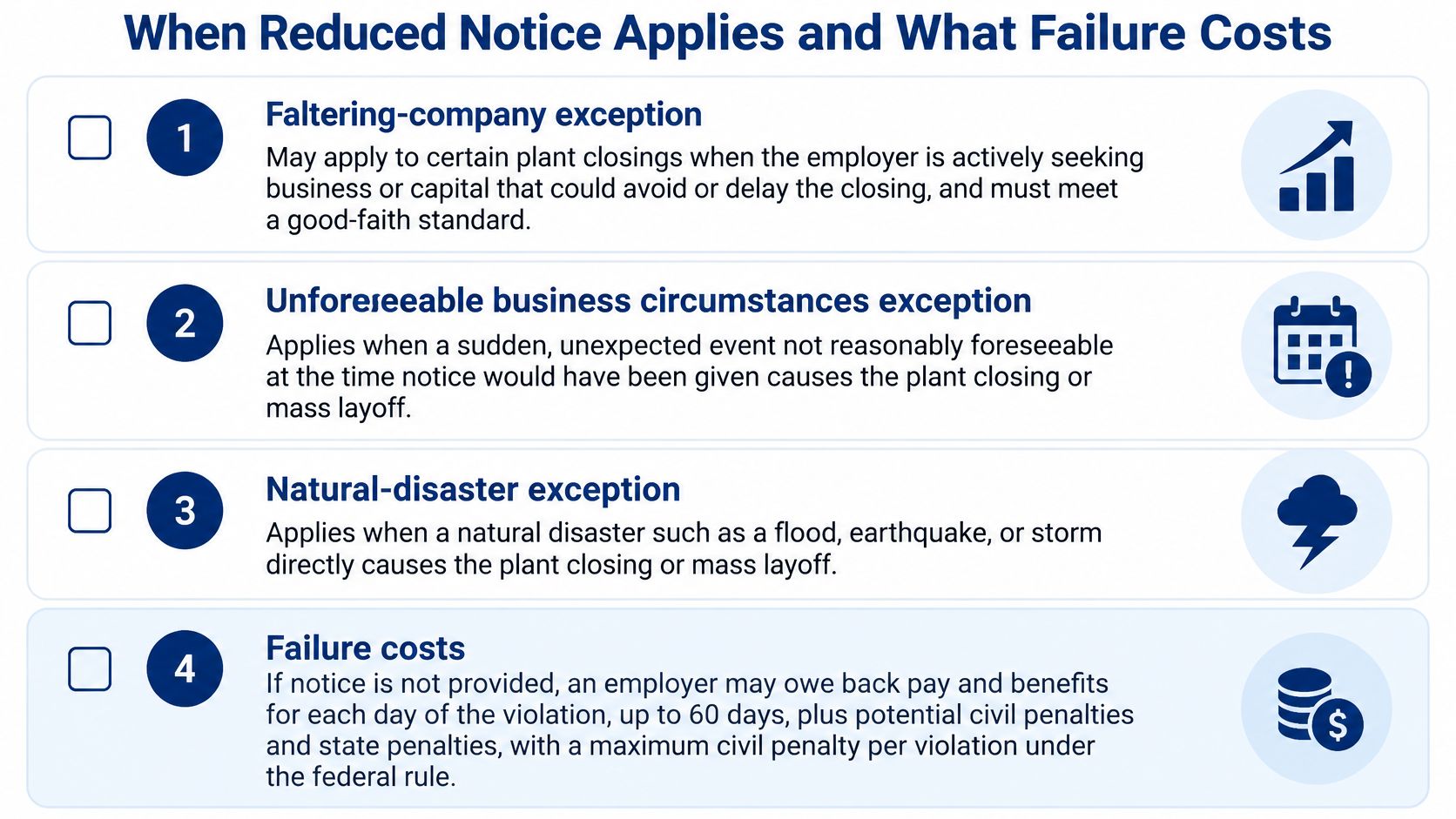
Faltering company. Available for certain plant closings only, and only where the employer was actively pursuing business or capital that would have avoided or delayed the closing. It doesn't cover a general decline in margin.
Unforeseeable business circumstances. Requires a circumstance that wasn't reasonably foreseeable at the point when 60-day notice would otherwise have been due. A sudden, dramatic, unexpected event outside the employer's control is the key indicator. Losing a large customer after a slow sales cycle is painful but usually foreseeable. Losing one because the customer's bank collapsed overnight is closer to the line.
Natural disaster. The employer must show the closing or layoff was a direct result of the disaster, not that the disaster made business harder.
The exception is never a convenience rule. It's a documented claim about causation and timing, and it fails without evidence.
Even when an exception holds, notice must still go out as soon as practicable to affected workers or their representatives and the applicable government entities. The letter must include a brief statement explaining why the full notice period couldn't be provided.
Assemble it while the facts are fresh. Reconstructing causation months later rarely works, and the employer is the party who has to prove the point.
Two categories of closures sit outside the notice obligation entirely. Temporary-facility closures and project completions may be excluded when employees were hired with an understanding that employment was limited to that facility or project. That understanding has to exist in the offer letter or the project document, not in a manager's recollection.
Federal liability can equal back pay and benefits for each affected employee for up to 60 days, reduced by notice already provided or certain voluntary payments, under 29 U.S.C. § 2104. That figure is per employee, which means the exposure scales with the size of the reduction rather than sitting at a fixed penalty. The Department of Labor's layoff guidance also notes that failure to notify a local government can result in a civil penalty of up to $500 per day.
Severance doesn't replace the analysis. A generous package may reduce the back pay figure, but it doesn't convert a missing notice into a compliant one, and it doesn't answer the recipients question or the timing question. Treat severance as a separate decision that sits alongside notice compliance.
When a layoff follows an employee complaint, a leave request or an investigation, the sequence deserves a review before anything is sent. The notice letter is evidence, and wording chosen in a hurry tends to read badly six months later.
Remote work broke the assumption that a site has a building. An employee who lives in one state, reports to a manager in another and appears on a payroll system registered in a third creates a genuine question about which rules count, and the answer needs to be written down rather than assumed.
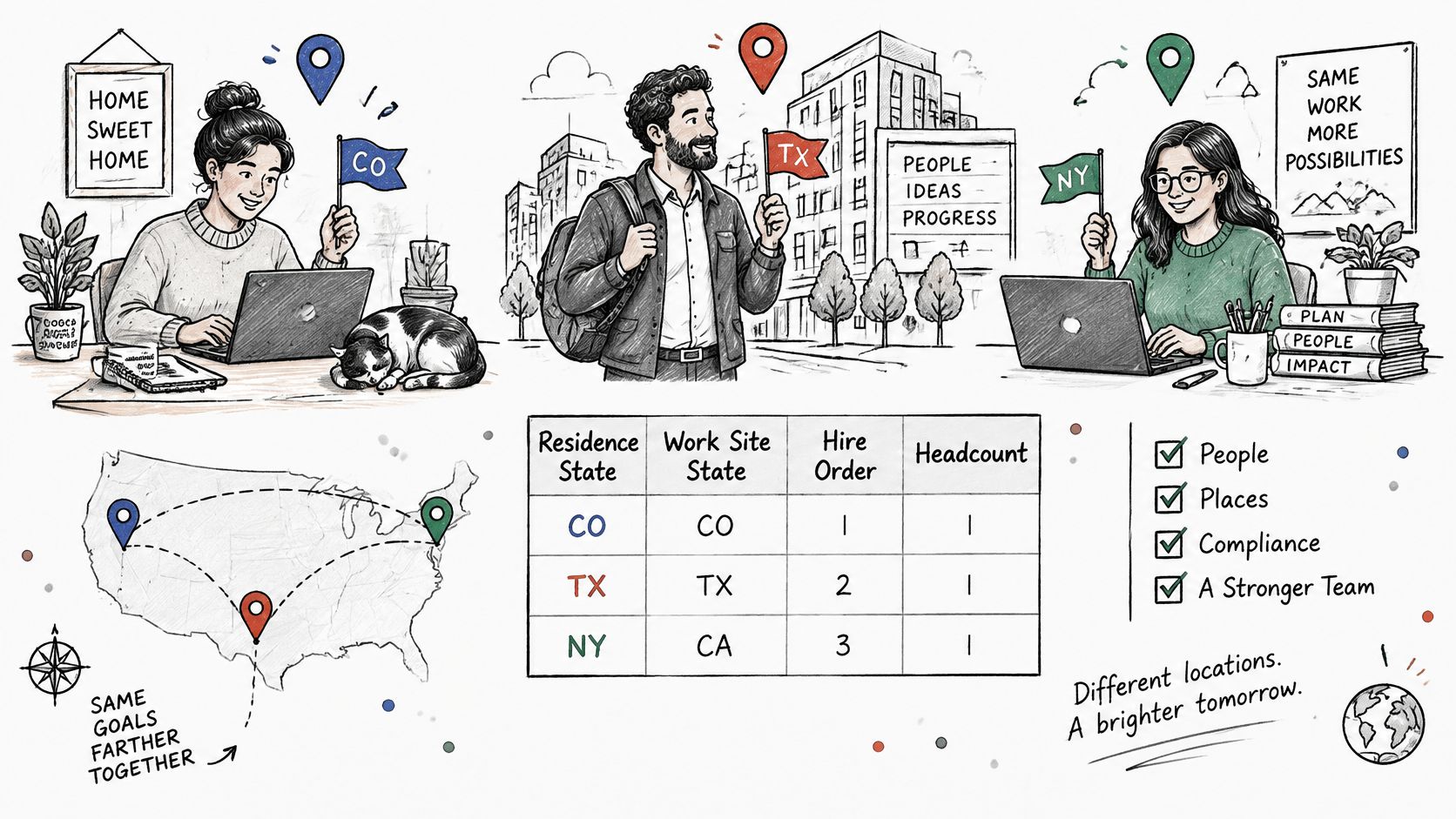
Record four facts for every employee, and keep them current:
When those four disagree, someone has to decide which one governs for a given count. That decision belongs to counsel, and it belongs on paper with a date next to it.
A first hire in a new state can bring that state's rules into play even with no office, no signage and no local manager. Verify that before a reduction is planned, not after the letters are drafted. Since employment law changes, the analysis should also be refreshed whenever a new state is added.
Treat attribution as a documented judgment, not a fixed fact. Two reasonable people can land in different places on a remote employee's site, which is exactly why the reasoning needs a date and an owner.
The state-level question of which law governs a distributed employee is broader than WARN. This guide to which state law applies to remote employees covers the wider set of issues that follow the same fact pattern.
The federal statute is a floor, not a ceiling. Several states run their own plant-closing and mass layoff statutes, often called mini-WARN laws, and those statutes can cover smaller employers, require longer notice, define covered events differently or attach severance obligations. The Department of Labor's guidance on state plant-closing requirements directs employers to check state rules separately for exactly this reason, because thresholds, covered events, notice recipients and timing can all differ.
The table below is a working map for common footprints, not a legal opinion. Every cell marked for verification needs current statute text before a notice date is set.
| State | Coverage threshold | Notice period | Key difference from federal rule |
|---|---|---|---|
| California (Cal-WARN) | Below the federal 100-employee test; confirm current number | 60 days | Lower threshold than the federal 100-employee test; confirm current text |
| Illinois | Below the federal 100-employee test; confirm current number | 60 days | Lower threshold than the federal test; confirm notice recipients |
| New York | 50 or more employees | 90 days | Longer notice period than the federal 60-day rule |
| New Jersey | 100 or more employees | 90 days | Mandatory severance may apply in addition to notice |
| Washington | Confirm current statute after recent amendments | Confirm current statute | Recently amended; confirm current thresholds and timing |
| Ohio | Confirm whether a state statute applies and what it requires | Confirm current statute | State requirements apply to some employers; verify before planning |
| Florida | No general state statute identified | None identified | Confirm before relying on this |
Counting. A state that sets its coverage threshold below 100 employees can pull a company into a notice obligation that the federal test never reaches. A 70-person employer in a state with a lower threshold may owe notice while owing nothing under federal law. Run the state count with the state's own definition of who counts.
Covered events. Some statutes reach relocations and transfers that the federal rule doesn't treat the same way. Others count part-time employees where the federal rule excludes them. The definition of the triggering event drives everything downstream, so read that section of the statute first.
Recipients. A state may require notice to a different agency, an additional local official, or a workforce board the federal rule never mentions. Getting the employee letters right and missing the state recipient produces an incomplete notice even when the letters are perfect.
Timing. A 90-day period can't be met by counting back 60 days and hoping. When a state requires longer notice, the decision date moves earlier, which changes when leadership has to commit to the reduction and when managers can be told.
Severance. Where a state attaches a severance obligation tied to the number of employees or years of service, the cost model changes. That figure belongs in the reduction's financial plan from the start, not as an afterthought once notice is drafted.
Use this table to identify which states need attention, then have employment counsel confirm the current statute text in each one before the notice date is locked. Where the reduction touches several locations, this reference to termination rules by state helps sort which rules follow each employee. A layoff that follows a complaint, a leave request or an investigation raises discrimination and retaliation questions alongside the notice questions, and that combination is worth a review before anyone acts.
Three letters carry the same facts to three different audiences. The wording below is a starting point, and every bracket has to be replaced with real detail before anything is sent.
The employee letter needs the statute, the site, the action type, the expected date and a contact for questions. Nothing else belongs in the first paragraph.
This notice is provided under the federal Worker Adjustment and Retraining Notification Act. Your position at [site address] is expected to end on or about [date]. This notice is given at least 60 calendar days before that date [or, if a shorter period applies: as soon as practicable, for the following reason: ____].
Keep the delivery acknowledgment separate from the letter itself. A signature log stapled to the back of the file copy is easier to produce later than an email thread.
This letter serves a different purpose, so it reads differently. Give the site address and the operating unit, the number of affected employees broken out by job title, the expected date of each employment loss, and the name, phone number and email of the reporting contact. State the action type explicitly so the receiving unit can route the filing correctly.
Add the reason for the action in one sentence. The state unit uses the notice to schedule services, and a vague description slows that down for the employees who need it.
The local official letter mirrors the state letter on site and timing, with the same counts by job title. Include the name of the reporting contact and the date the employee notices were or will be delivered. Local officials often learn about a closure from the news, and a dated letter changes that conversation.
Where a state requires notice to more than one local official, send separate letters to each rather than copying everyone on one document.
Have counsel review the wording for each state where employees work, because state statutes may require content the federal letters don't include. A letter that satisfies the federal rule can still be short of what a state statute demands, and the gap is usually in the details rather than the headline.
Fill the placeholders from the decision record, not from memory. Counts, dates and recipient names should match the file exactly, because any mismatch between the letter and the count is the first thing anyone looks at.
The last pass is a file review, done by one person, against a written checklist. If an item can't be answered from the file, the plan isn't ready.
Two situations justify outside review before anything is sent. The first is a layoff that follows a complaint, a leave request or an investigation, where the notice letter becomes part of a larger record. The second is a count that lands near a threshold at a site in a state with its own statute. Both are cheaper to review on the front end.
The firm works as the HR and compliance function for companies with 25 to 500 employees and people in several states, and its free HR Risk Review is a 30-minute confidential call followed by a short written summary of risks and recommended next steps. Reviewing the annual employment law compliance calendar alongside a planned reduction is a useful way to catch the state rules that change between planning and notice.
This article is general information, not legal advice. Employment laws change and vary by state; consult qualified employment counsel about your situation.
When a reduction is on the table, Book a Free HR Risk Review to walk through the count, the state map and the notice timeline with someone who does this work weekly.
The company supports owners and operators who handle HR on top of their real job, with employer-side advisory on reduction planning, multi-state policy alignment and termination documentation. WARN Act requirements sit at the intersection of counting, timing and state variation, which is exactly where a second set of eyes pays for itself before the letters go out. Visit Paradigm International Inc. to see how the advisory work is structured.