


Navigating tough business decisions is part of every leader's journey, and few decisions are as challenging as restructuring your workforce. When strategic shifts require eliminating roles, understanding the term "reduction in force," or RIF, is essential. It's a formal process that, when handled correctly, protects your organization and treats employees with respect. This guide will clarify what a reduction in force is, why it happens, and how to manage one with confidence and care.
A reduction in force (RIF) is the permanent elimination of a position from an organization. This decision is not based on an employee's performance but is driven by a strategic business need. The key distinction is that the role itself is being removed, and there is no intention to rehire for that same position in the foreseeable future.
Think of it as a structural change to your company's blueprint. If you are updating your business model or adopting new technology, certain job functions may no longer be necessary. A RIF is the formal process of removing those functions to align your organization with its new goals. This makes it fundamentally different from a termination for cause, which addresses individual performance or misconduct.

Understanding this difference is critical for compliance. While both a RIF and a performance-based termination are forms of involuntary termination, their legal foundations and best practices for execution are entirely different. Mismanaging a RIF can lead to significant legal and financial risks.
Business leaders often use terms like "layoff" and "RIF" interchangeably, but they have distinct meanings in HR and legal contexts. Clarity is crucial to avoid compliance issues. Using the correct terminology ensures that your actions align with your intentions and legal obligations.
Here is a simple breakdown of these common employment actions:
| Action | Reason | Focus | Expectation of Recall |
|---|---|---|---|
| Reduction in Force (RIF) | Strategic business need (e.g., restructuring, new technology) | The position | No; the role is permanently eliminated |
| Layoff | Business slowdown, lack of work, or temporary budget issues | The employee | Often a possibility of recall when conditions improve |
| Firing (Termination for Cause) | Poor performance, policy violation, or misconduct | The employee | No; the relationship is severed due to individual issues |
| Furlough | Temporary cost-saving measure without severing employment | The employee | Definite expectation of recall; employee remains on payroll with reduced or no hours |
Mastering these definitions is the first step toward responsible workforce planning. A RIF is a powerful tool for reshaping your business, but its permanent nature demands careful planning and a clear understanding of the rules.
Deciding to conduct a reduction in force is a significant leadership decision. While often associated with cost-cutting, a true RIF is driven by deeper, strategic business needs. The first step in building a defensible plan is to clearly articulate these reasons. A RIF is a proactive move to ensure long-term business health and agility.
The core of a legitimate RIF is a fundamental change in the business, making certain roles or functions unnecessary for achieving strategic goals. This rationale must be objective, well-documented, and entirely separate from any individual employee's performance.
A common driver for a RIF is a major shift in company strategy. As business priorities evolve, the skills and functions needed to support them also change. This means that the roles essential yesterday may not be the ones you need for tomorrow.
For example, a company might decide to discontinue a legacy product to focus all its resources on a new, high-growth platform. As a result, the engineering, sales, and support roles tied to the old product become redundant. The positions are eliminated not because the employees performed poorly, but because the business priority they supported no longer exists.
A defensible reduction in force is directly tied to a non-discriminatory, legitimate business necessity. The focus is always on the elimination of the position, not the person filling it.
Another frequent trigger for a RIF is a major organizational restructure, often following a merger or acquisition. When two companies combine, overlapping roles and redundant departments are almost inevitable. To create a single, efficient organization, leaders must make difficult choices about which positions to eliminate.
Common reasons for a RIF in these scenarios include:
In every case, the decision must be tied to the new organizational blueprint. Documenting this business case is essential if you are considering or navigating a RIF. For guidance on approaching these complex decisions, contact our team of expert advisors.
Executing a reduction in force without a solid grasp of the legal landscape is a significant risk. For any business owner or HR leader, a RIF is not just an operational task—it is a major compliance event. A single misstep can expose your company to costly lawsuits, steep fines, and long-lasting damage to your reputation.
The laws governing RIFs are a complex web of federal and state rules designed to protect employees. Understanding these rules is not optional; it is a core requirement for any business planning to eliminate positions. Proactive and careful planning is the only way to ensure your decisions are both fair and legally defensible.
One of the most important federal laws is the Worker Adjustment and Retraining Notification (WARN) Act. This law typically applies to employers with 100 or more employees and requires a 60-day advance written notice to affected staff before a mass layoff or plant closing. A RIF can easily trigger the WARN Act if it meets certain employee thresholds.
However, the federal law is just the starting point. Many states have their own "mini-WARN" acts, which are often stricter.
For companies operating in multiple states, this patchwork of laws creates a significant compliance challenge. What is compliant in one state could be a violation in another, making a centralized and well-researched approach essential.
Beyond notice requirements, the most significant legal risk in any RIF is discrimination. Even with neutral intentions, your selection process can still result in disparate impact, which occurs when a seemingly fair process disproportionately affects a protected group, such as employees of a certain age, race, or gender.
For instance, eliminating roles based on seniority could unintentionally impact older workers more heavily, potentially leading to an age discrimination claim under the Age Discrimination in Employment Act (ADEA). Similarly, eliminating a department that happens to be mostly female could open the door to a gender discrimination lawsuit. To effectively navigate the significant legal risks and ensure compliance during a RIF, leveraging advanced AI legal software can provide comprehensive assistance.
Disparate impact focuses on the outcome of your decisions, not the intent. This is why objective, job-related criteria and rigorous analysis are non-negotiable.
Mishandling a RIF exposes businesses to legal risks that amplify liabilities. Federal data shows that after a peak in late 2024, employment dropped by 327,000, or 10.9%, by early 2026. Proactive RIF planning preserves reputation and cash flow. To learn more about this trend, you can read the full research on tech industry employment shifts on Statista. You can also learn more about disparate impact in our detailed guide.
Ultimately, avoiding these major legal risks comes down to meticulous planning, objective criteria, and thorough documentation. Navigating these challenges requires expertise, and partnering with an advisor can be a critical step. Reach out to Paradigm to discuss how we can help you build a defensible strategy.
When it comes to a reduction in force, the difference between a smooth transition and a legal and cultural disaster lies in the planning. A well-executed RIF is the result of a methodical, deliberate process—not a series of rushed decisions. Think of it as a strategic project where each step builds a foundation of fairness and legal defensibility.
Following a step-by-step framework is your best defense against costly mistakes. This process ensures every decision is thoughtful and protects your organization from significant legal and reputational risk, starting with a clear business rationale and ending with compassionate communication.
First, every RIF must be grounded in a solid, documented business reason. This justification must be objective and entirely separate from individual employee performance. Are you eliminating redundant roles after a merger, shifting away from a legacy product, or restructuring departments for efficiency? Your business case is the bedrock of your RIF strategy and must be clear enough to withstand legal scrutiny.
With a clear business case, the next step is to create impartial criteria for selecting which positions to eliminate. The focus must always be on the role, not the person in it. These criteria should tie directly back to the future needs of the business as outlined in your justification.
Examples of objective selection criteria include:
Relying on subjective factors like "attitude" or vague performance notes is a direct path to a discrimination claim. Whatever criteria you choose, they must be applied consistently across the entire organization.
Before finalizing any decisions, you must perform a disparate impact analysis. This is a statistical review of your proposed RIF list to check if it unintentionally and disproportionately affects employees in a protected group (based on age, race, gender, etc.). This analysis acts as a crucial pre-flight check, allowing you to spot and correct potential bias before taking action.
The infographic below highlights key legal areas to navigate during RIF planning.
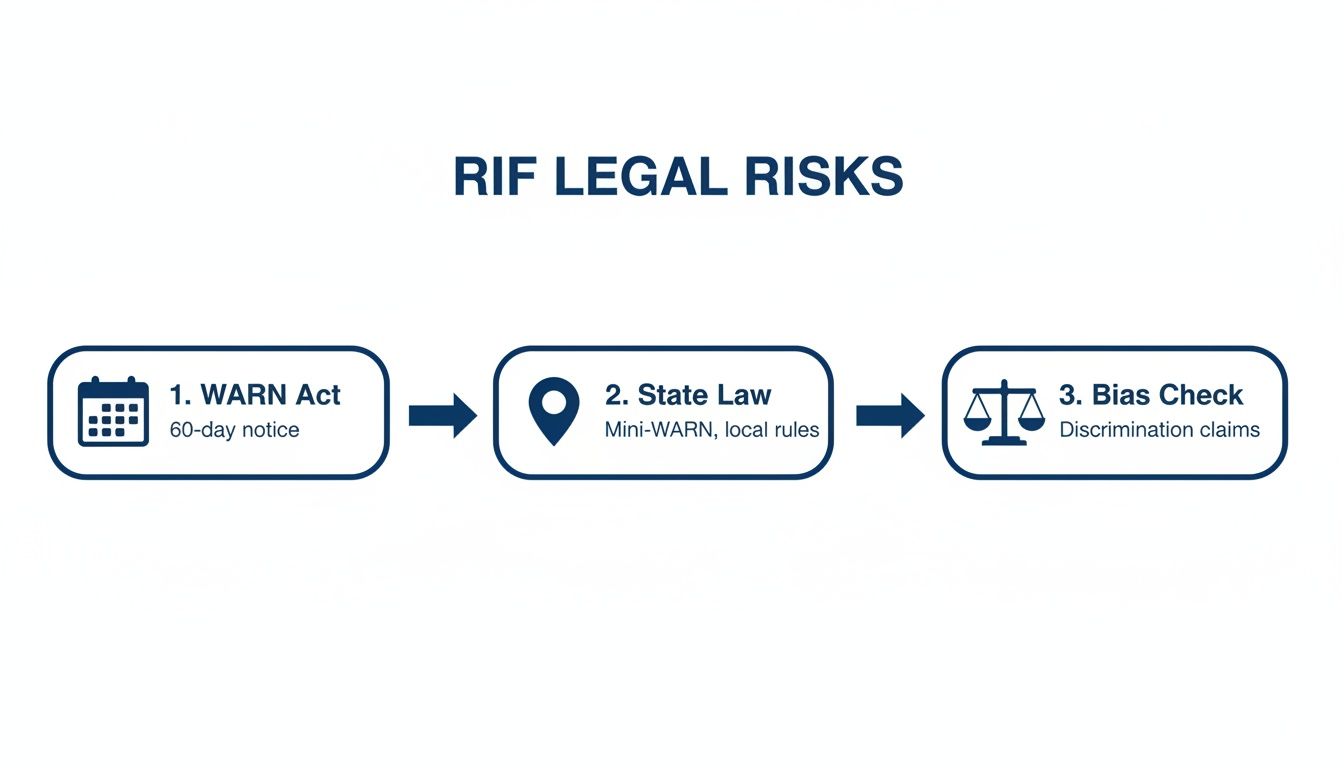
This analysis is your proactive defense against legal claims. If your review uncovers a potential adverse impact on a protected group, you must revisit your selection criteria to ensure fairness before proceeding.
Finally, prepare fair and compliant severance packages. This step requires careful attention to detail, especially for employees aged 40 and over. For this group, any severance agreement must follow the specific rules of the Older Workers Benefit Protection Act (OWBPA), which dictates required language and consideration periods for signing.
A well-structured severance agreement provides a financial cushion for the departing employee in exchange for a release of legal claims against the company. This step provides closure for both parties and is a crucial risk management tool.
Navigating a RIF is a complex process where mistakes can have lasting consequences. For guidance on building a defensible strategy, contact our team of expert advisors.
How you communicate a reduction in force will define its impact on your company culture and brand reputation. The delivery of this difficult news is a defining moment that requires exceptional care, empathy, and clarity. A well-planned communication strategy ensures everyone, whether they are leaving or staying, is treated with dignity and respect.
This is not a single conversation but a series of communications tailored for three distinct audiences: affected employees, your remaining team, and external stakeholders. Each group has different needs and concerns, and your approach must address them directly.

This is the most sensitive part of the process. These conversations must be handled in person or via live video call—never through an impersonal email or text. The news should be delivered by the employee's direct manager, with an HR representative present to answer questions about benefits, severance, and next steps.
Key elements of a compassionate notification meeting include:
A respectful offboarding process is not only the right thing to do—it also significantly reduces legal risk and protects your employer brand. How you treat departing employees sends a powerful message to everyone who remains.
Once notifications are complete, your focus must shift to the employees who are staying. They will likely be feeling a mix of relief, anxiety, and survivor's guilt. Without clear leadership, rumors can spread, and morale can drop. Hold a team-wide meeting to address the RIF head-on.
Be as transparent as possible about the business reasons for the decision and reaffirm the company's future direction. It's crucial to monitor morale—studies show that without effective change management, productivity can dip by over 30%. A structured, supportive approach helps minimize these financial hits and supports responsible scaling. Discover more insights about managing RIF costs and impacts.
Your final audience includes customers, partners, and the public. It is important to control the narrative to protect your brand. Prepare a brief, approved statement to share if you receive inquiries. This message should focus on the strategic nature of the business decision and your commitment to supporting affected employees. This proactive step prevents misinformation and reinforces your company’s integrity.
Communicating a reduction in force effectively is a true test of leadership. If you need guidance on developing a compassionate and defensible communication strategy, contact us for expert support.
A reduction in force should always be a last resort, not the first option. Before making a permanent decision to eliminate roles, it is critical to exhaust all other possibilities. This thoughtful, people-first approach reinforces trust and ensures a RIF is pursued only after all other viable strategies have been considered.
This process involves a deliberate review of operational efficiencies and cost-saving measures that can stabilize the business without reducing headcount. Exploring alternatives is a hallmark of responsible leadership and a commitment to your workforce.
Before eliminating roles, look for savings within your operations. Many businesses find significant savings by re-evaluating spending and resource allocation. For example, some organizations are improving agent productivity with AI-powered support to make current teams more efficient, potentially avoiding the need for a RIF.
Other effective cost-saving strategies include:
Another powerful alternative involves temporarily adjusting work structures. These measures can provide substantial payroll savings while keeping your talented team intact. This allows you to retain valuable institutional knowledge for when business conditions improve.
A RIF is a double-edged sword for many companies. While some firms have cut payrolls by 15-20%, a 25% uptick in lawsuits is often expected in the aftermath. With job seeker conditions tough, as shown by 1.69 million layoffs in late 2025 and tight hiring rates, a thoughtful, alternative-first approach is critical. Read more on recent employment data from the Department of Labor.
Options like temporary furloughs or reduced work schedules offer this flexibility. A furlough keeps employees on the payroll but reduces their hours to zero for a set period, while reduced schedules might involve moving the company to a four-day workweek. Both strategies preserve jobs and protect your team.
Weighing these alternatives carefully is a strategic imperative. If you need help evaluating these options for your unique situation, contact Paradigm to explore your path forward.
While the decision to conduct a reduction in force rests with leadership, executing one correctly is a complex task. This is where an expert HR risk advisor becomes an essential partner. They provide the specialized expertise needed to navigate the legal and human challenges of a RIF, helping you take the critical steps to protect your business.
An experienced advisor provides crucial support in several key areas:
This partnership is a crucial investment in your company's long-term health and stability. When the stakes are this high, expert guidance protects your business from significant financial and reputational damage.
For more information on the value of external expertise, read our guide on HR consulting services for small businesses.
Navigating these tough decisions requires a steady, experienced hand. As you consider the path forward, having expert guidance can provide clarity and confidence. If you would like to learn more about how to manage these challenges effectively, Paradigm can help. Contact us for a consultation to discuss your specific needs.


