
An operating budget is a 12-month plan that forecasts recurring revenue and day-to-day expenses, including payroll, COGS, and OPEX, so leadership can control near-term operations. If you run a multi-state business, it's the document that keeps staffing, compliance, and spending from drifting out of sync.
That matters because owners and HR leaders usually feel budget mistakes in the worst place first, payroll, benefits, and vendor commitments. By the time a cost shows up in the P&L, the hiring decision is already made and the contract is already signed.
A lot of SMB owners call something a budget when what they really have is a wish list. Then payroll grows, state-specific obligations show up, and someone realizes too late that the plan never accounted for the cost of keeping people employed.
An operating budget is the annual control layer that tells leadership what the business expects to earn and what it expects to spend on recurring operations over a defined fiscal year. In public-budget practice, that same idea has long been used to plan annual service delivery over a fixed fiscal year, including the July 1 to June 30 cycle used by many public budgets in the United States, which is a useful reminder that the budget is about managing the year ahead, not fantasizing about the next five. CTAS explains operating budgets.
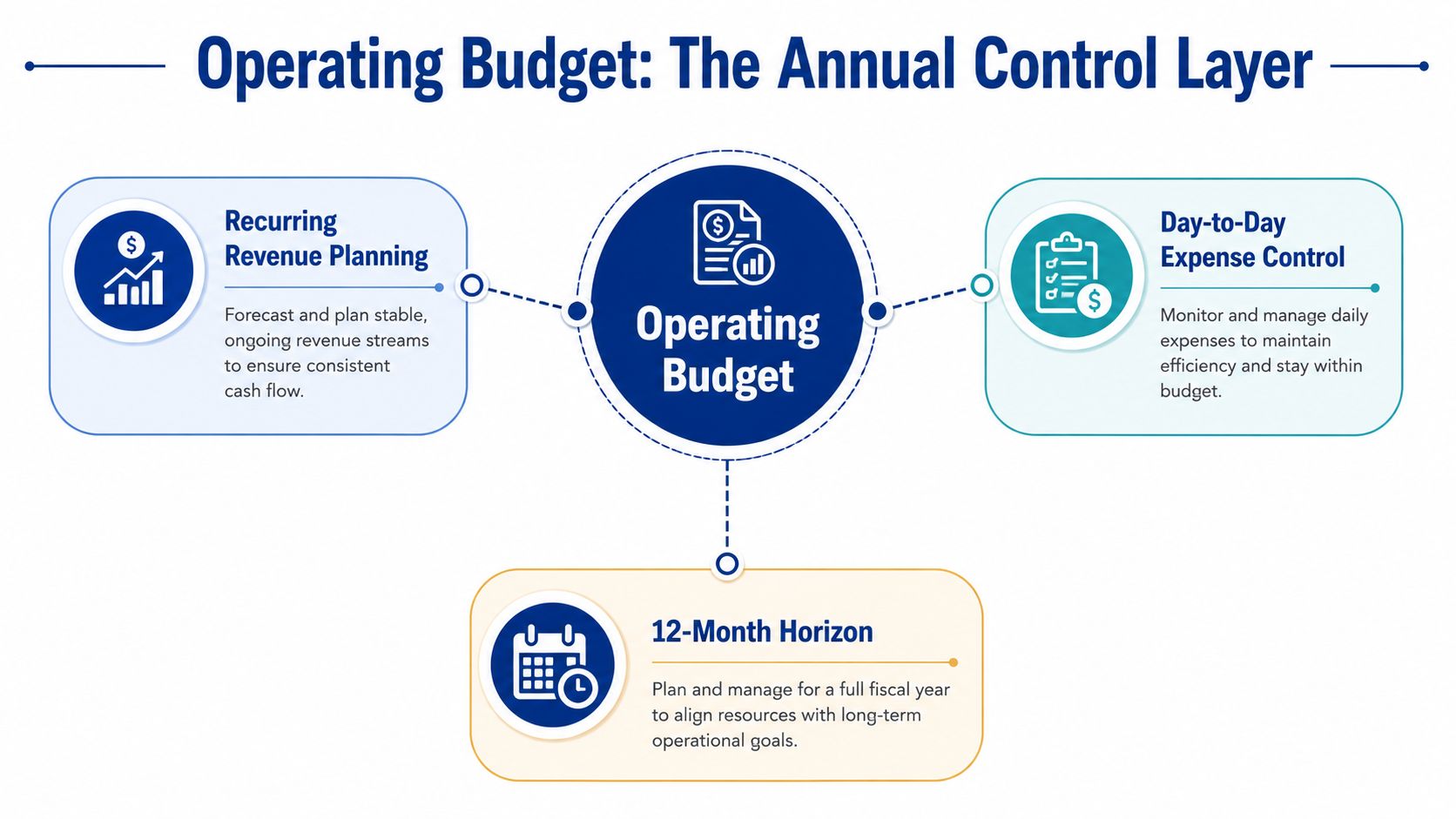
An operating budget is the business's short-term control document. It is usually built for a 12-month fiscal year and focuses on recurring revenue and recurring expenses such as payroll, rent, utilities, supplies, and overhead, while leaving out major capital spending and long-term financing items.
Practical rule: if the expense keeps the lights on this year, it belongs in the operating budget. If it buys an asset or changes the balance sheet, it belongs somewhere else.
That distinction matters for HR and operations leaders because the budget is not just a finance artifact. It becomes the baseline for staffing decisions, vendor approvals, and mid-year corrections when a business gets hit with a wage adjustment, a benefits increase, or a compliance cost that nobody folded into the plan. If you are trying to keep labor assumptions disciplined across states and job classes, the place to start is the pay structure itself, including UK basic salary legal duties that shape how compensation must be handled. A managed payroll service also helps keep the budget tied to real labor costs instead of guesses.
A defensible operating budget should answer four plain questions:
The point is simple. An operating budget is not a prediction of long-term success, and it is not a fundraising model. It is the working plan that lets leadership make sensible decisions before small misses become expensive ones.
A strong operating budget is built from parts you can point to, not broad guesses. If you cannot assign an expense to the right bucket, the budget starts to blur, and it stops working as a management tool.
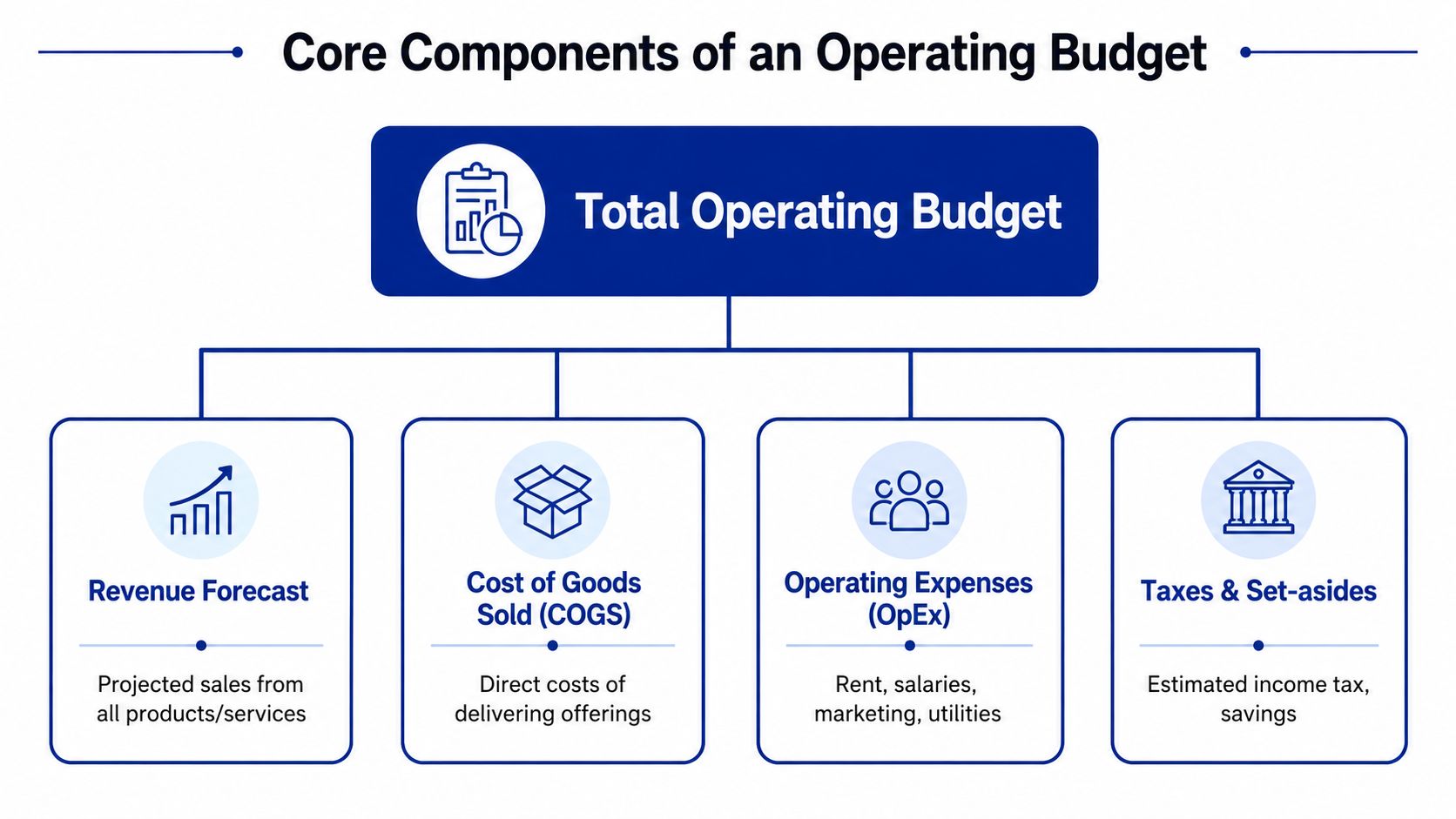
The operating budget is the control layer for recurring operations. It forecasts revenue and recurring costs such as payroll, rent, utilities, supplies, and COGS, while leaving capital purchases and financing items in separate budgets. The basic structure is consistent with Wikipedia's operating budget overview.
Here's the cleanest way to break it down:
The line between payroll and COGS shifts by business model, and that is where sloppy budgeting starts to hurt. If a cost is directly tied to delivery, put it with direct costs. If it supports the business generally, put it in overhead.
For labor-heavy businesses, the UK concept of UK basic salary legal duties is a useful reminder that compensation has to be documented and handled carefully, not sorted out after the fact. That level of clarity is what keeps a budget defensible when employees, contractors, and managers are all paid through different arrangements. A managed payroll service can help keep those labor costs tied to what the business owes, instead of what someone assumed in a spreadsheet.
A budget gets messy when leaders dump the wrong items into it. Loan principal payments, major equipment purchases, office build-outs, and long-term financing decisions should stay outside the operating budget, because they distort variance analysis and hide what the business is really spending to run day to day.
A clean operating budget makes one thing obvious, whether the business is living within its recurring operating model or quietly financing growth through sloppy categorization.
That matters for HR and operations leaders as much as it does for finance. If payroll assumptions are wrong, the whole document is wrong. If a recurring vendor renewal gets buried in the wrong line, the next quarterly review turns into a fight over definitions instead of a decision.
For leaders who need the structural side of compensation and labor planning tied to the budget, the budget should be read together with HR consultant hourly rates in 2026 so the labor model reflects the actual cost of outside support.
Most SMB trouble starts when leaders treat these three documents like they're interchangeable. They're not. Each one answers a different business question, and if you update the wrong one, you'll get the wrong answer back.
| Dimension | Operating Budget | Capital Budget | Cash Flow Forecast |
|---|---|---|---|
| Time horizon | Typically 12 months | Longer-term, tied to asset investment decisions | Near-term timing of money moving in and out |
| Main focus | Recurring revenue and recurring expenses | Major purchases and long-lived assets | Bank balance timing and liquidity |
| Typical uses | Staffing, vendor approvals, operating spend control | Equipment, expansion, technology projects | Payroll timing, tax payments, receivables, payables |
| What it helps leaders decide | Can we afford this level of day-to-day operations? | Should we buy, build, or invest now? | Will we have cash when bills hit? |
The operating budget is the P&L-driven plan for recurring operations. The capital budget is where you put the asset decisions that last beyond the current operating cycle. The cash flow forecast is the timing tool that tells you when cash moves, which matters even when the budget looks fine on paper.
That separation prevents one of the most common planning mistakes, stuffing a major equipment purchase into operating expenses. When that happens, the monthly variance report becomes meaningless because the budget is comparing apples to a one-time machinery buy.
If the decision changes the company's asset base, use the capital budget. If the decision changes whether you can make payroll or cover bills on time, use the cash flow forecast. If the decision changes recurring spend, use the operating budget.
That rule keeps approvals cleaner and prevents confusion in leadership meetings. It also gives owners a faster way to decide which document needs updating when a new expense lands on the table.
The operating budget is where strategy turns into something leaders can enforce. At the department level, it stops being a finance file and becomes the control layer for hiring, vendor commitments, compliance costs, and discretionary spending.
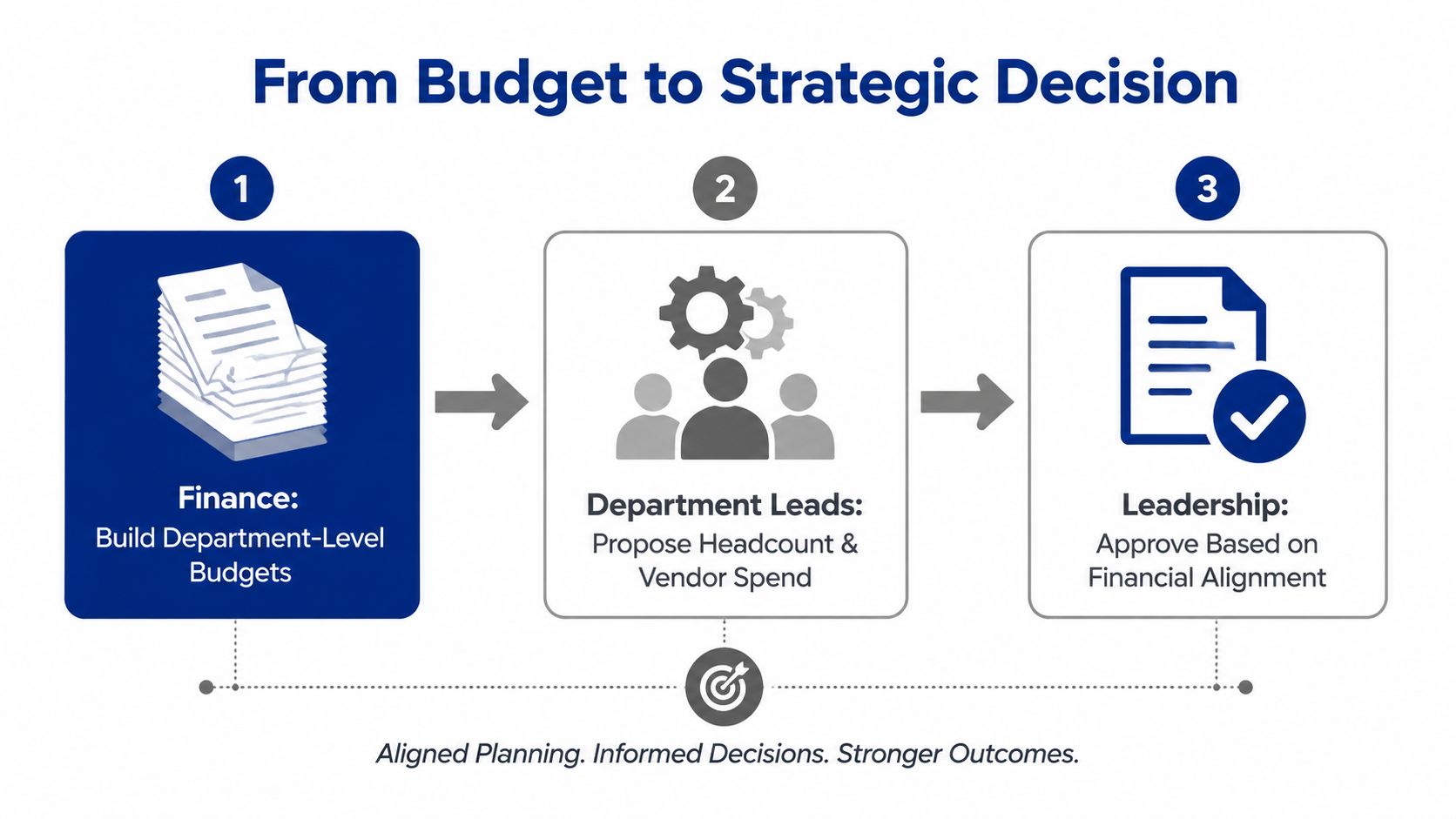
A department-level operating budget forces line-by-line accountability. It shows whether planned hiring, vendor commitments, and operating spend are supported by the numbers, instead of being approved on instinct. As noted earlier, department budgets are built for that kind of visibility.
That is the part too many leaders skip. They approve headcount because a manager says the team is overloaded, then scramble to defend the cost later. A department-level operating budget pushes the team to show the revenue, workload, or compliance need before the spend gets approved.
For multi-state SMBs, weak planning shows up fast. Payroll taxes, paid leave accruals, workers' compensation premiums, and benefits load can vary by jurisdiction, and those costs belong in the operating plan before the hire is signed off. If they show up after the fact, HR gets blamed for a budget that was never built to absorb the full cost.
They do not approve labor in a vacuum. Every new role, contractor arrangement, and vendor contract has to tie back to the operating budget, or the spend is just org-chart noise.
A practical approval process is straightforward:
For service firms that rely on outside expertise, it also helps to compare the budget with calculate video project value when evaluating non-core spend. The point is simple. Every dollar needs a clear operating reason before it gets approved.
That is why the budget matters to staffing decisions. It gives leaders a defensible basis to freeze hiring, reduce a vendor, or delay a request without turning every discussion into a personality contest. It also lets owners compare outside help with the cost of internal labor, including options such as HR consultant hourly rates in 2026, before they commit.
A practical example beats theory every time. Say you run a 30-person services firm in three states, with recurring client work, a mixed payroll, and a steady stack of overhead costs that show up every month whether the pipeline is strong or not.
The budget below is intentionally simple. It shows how revenue, direct costs, overhead, and payroll can be tracked across quarters so leadership can see whether the business is staying within its operating plan.
| Line Item | Q1 | Q2 | Q3 | Q4 |
|---|---|---|---|---|
| Revenue assumptions | Stable client contracts and recurring project work | Same core client mix, modest seasonal lift | Renewals and referral work hold steady | Year-end pipeline converted into recurring work |
| COGS | Delivery labor tied to service fulfillment | Delivery labor and contractor support | Delivery labor holds level | Delivery labor plus holiday coverage |
| OPEX | Rent, software, insurance, professional services | Same recurring overhead | Same recurring overhead | Same recurring overhead plus renewals |
| Payroll and benefits | Salaries, benefits, payroll taxes, contractor spend | Salaries, benefits, payroll taxes, contractor spend | Salaries, benefits, payroll taxes, contractor spend | Salaries, benefits, payroll taxes, contractor spend |
| Contingency reserve | Small cushion for volatility | Unused reserve stays protected | Reserve absorbs pressure | Reserve ends the year intact or partially used |
This is the part that matters for operators. Payroll and overhead belong inside the operating budget because they are recurring, predictable, and controllable. A new office build-out does not belong here, because it is a separate investment decision that needs different treatment.
A budget template for this kind of business should always include:
A budget without a reserve is just a promise to be surprised later.
That example is enough for most owners to sketch a first draft. Once the structure is clear, the next step is not making it prettier, it's making the assumptions honest.
The worst budgeting habit in SMBs is treating the annual budget like a sealed envelope. Once the year starts, leaders assume the plan is done, even when wage pressure, insurance renewals, or regulatory changes make the original assumptions stale.
Most definitions still present operating budgets as a largely annual, static plan, but the U.S. inflation rate remained positive in 2026 and wage growth continued to outpace some categories of overhead, which can make a once-a-year budget obsolete quickly. BambooHR's operating budget glossary captures the core problem. The environment changes, and the budget has to keep up.
A good reforecast starts with actuals versus plan, then updates the second half of the year based on what leadership now knows. That means revisiting revenue assumptions, payroll loading, benefits costs, vendor renewals, and any regulatory costs that have shifted since the budget was approved.
The cadence should be quarterly at minimum. If the business is in a volatile labor market or crosses multiple state lines, out-of-cycle reviews should happen when a major change lands, not when finance finally closes the books.
Use these trigger events to force a fresh look:
A reforecast is not a cosmetic update. It re-baselines the variance so leadership can see what changed and why. If you don't do that, the budget stops being a control system and becomes a historical artifact.
That's also why the best operators treat the budget as a living document. They do not wait for year-end to discover they were underpriced on labor or overcommitted on overhead.
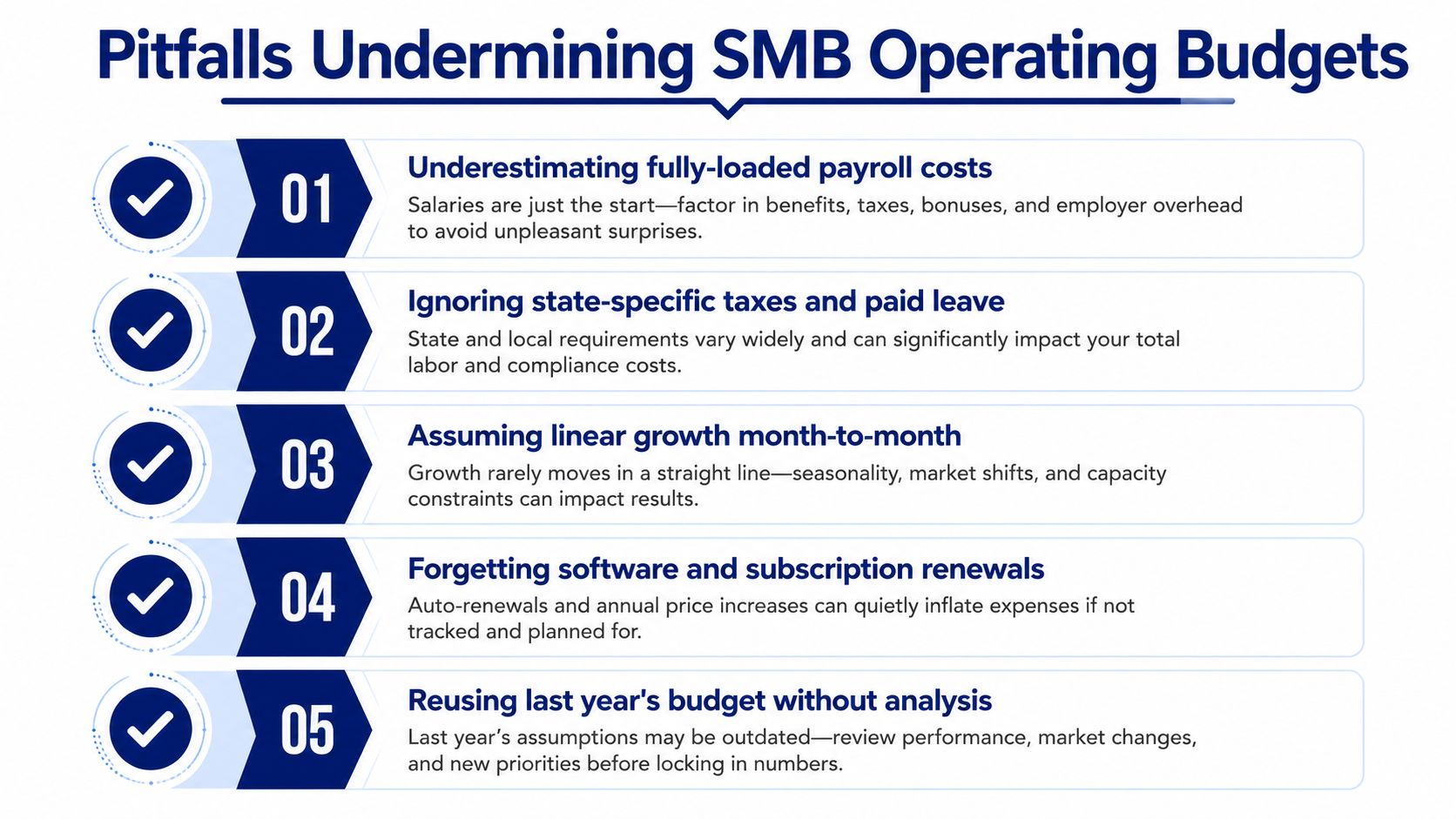
Most bad budgets fail for boring reasons. Leaders rush, assume last year's numbers still fit, or hide costs in the wrong bucket and then act surprised when actuals blow past the plan.
A well-designed operating budget decomposes operations into expected revenue, fixed costs, variable costs, and contingency reserves, which improves forecasting precision and helps leaders model sensitivity to volume changes, wage inflation, or vendor price increases. Ramp's operating budget guide gets at the value of that structure, and it explains why sloppy assumptions create sloppy decisions.
The biggest failure modes are predictable:
A good corrective action exists for each one. Review payroll from the bottom up, map compliance costs by state, separate capital decisions from operating spend, carve out a reserve before approvals start, and rebuild the plan from actuals instead of copying and pasting old assumptions.
The budget also needs to line up with the calendar of renewals and regulatory changes. If insurance, software, leave obligations, or licensing costs reset in a specific month, the budget should show that timing instead of flattening everything across the year.
If the budget doesn't reflect the real timing of labor and compliance costs, it won't protect the business when those costs hit.
That is the risk. A flawed budget creates flawed variance analysis, and flawed variance analysis leads to bad staffing and spending decisions when leadership needs clarity most.
The operating budget is not fancy. It is clear, department-level, and tied to the actual cost of running the business over the year ahead. Build it from prior-year actuals, adjust for staffing and compliance realities, and reforecast it quarterly so it stays usable.
For SMB leaders, especially those managing labor across multiple states, the budget should sit alongside the broader operating model and support defensible HR decisions. A practical way to keep that thinking grounded is to review the operating model itself, like the framework in HR operating model, and make sure finance and people decisions are speaking the same language.
If you want better control over staffing, labor exposure, and the budget decisions that come with growth, talk with a team that works where HR and operations overlap. Paradigm International Inc. helps leaders think through the people-side risks that show up in operating plans, and the right next step is usually a focused conversation before the next budget cycle closes.