
You're usually not missing an SOP because nobody knows the work. You're missing it because the work has lived in one manager's head, and now a termination, complaint, or cross-state handoff has exposed the gap. When that happens, the question what is SOP stand for stops being a vocabulary search and becomes a risk question.
A Standard Operating Procedure is the written, step-by-step instruction set that keeps routine work consistent when people change, teams grow, or a process crosses locations. Britannica traces the term to the mid-20th century, tied to the rise of industrial management, standardization, and quality control as organizations scaled across factories, laboratories, and service environments Britannica's history of standard operating procedures. For a business owner or COO, the point is simple, an SOP is operational control, not paperwork.
A manager fires an employee in one state using one set of steps, while another manager in a different state handles the same issue entirely differently. No one can point to the written process, because there isn't one. By the time HR, counsel, or leadership tries to reconstruct what happened, the company is arguing from memory instead of evidence.
That is the cost of a missing SOP. It is not the extra time spent drafting a document, it is the inconsistency you can't defend later. In regulated or risk-sensitive settings, a documented procedure helps preserve consistency when staff change, teams grow, or work spans multiple locations, which is exactly why SOPs stay central in manufacturing, healthcare, and clinical research Britannica's overview of standard operating procedure.
The plain answer to what is SOP stand for is Standard Operating Procedure. In business terms, it means a written procedure that tells people how to do a recurring task the same way every time. I'd go further and say the best SOPs are not read as instructions, they are used as proof that leadership set a standard and expected managers to follow it.
Practical rule: if a process would look sloppy or inconsistent under oath, it is not controlled enough yet.
That is why the best SMB leaders treat SOPs as a control layer. They reduce dependence on individual judgment, preserve consistency, and give you something concrete when a regulator, investigator, or attorney asks how the process was supposed to work. If you want the shortest usable definition, use this one, an SOP is the written version of how your business avoids improvising when things matter most.
When someone says SOP, they often mean Standard Operating Procedure, but that is not the only meaning in circulation. Dictionary sources list other uses, including Standing Operating Procedure, plus non-business meanings such as a financial-aid usage or a bland offering in general language Cambridge Dictionary entries for SOP. That ambiguity matters because a leader who hears “send me the SOP” might assume policy, while the other person is asking for a step-by-step control document.
In regulated work, precision matters. The International Council for Harmonisation, as cited in the literature, defines SOPs as “detailed, written instructions to achieve uniformity of the performance of a specific function”, which is exactly the point in clinical and controlled environments Wikipedia's summary of standard operating procedure definitions. TechTarget also emphasizes that SOPs should be followed the same way every time to support consistency and compliance with industry regulations and business standards TechTarget's SOP definition.
A manager in HR, finance, or operations should hear SOP and think document control, not generic guidance. In military or emergency settings, the phrase can mean standing operating procedure, which is close in spirit but not the same phrase. In everyday language, “sop” can even mean something handed over to placate someone, which is exactly why teams should stop assuming everyone means the same thing.
If someone on your team says “we need the SOP,” ask which process they mean, who owns it, and where the current version lives.
That small clarification prevents the wrong file from being circulated and the wrong standard from being followed. For SMB leaders, the danger is not just semantic confusion, it is operational drift. If one manager is acting on a policy memo and another is following a procedural control, your recordkeeping will look inconsistent even when everyone thought they were helping.
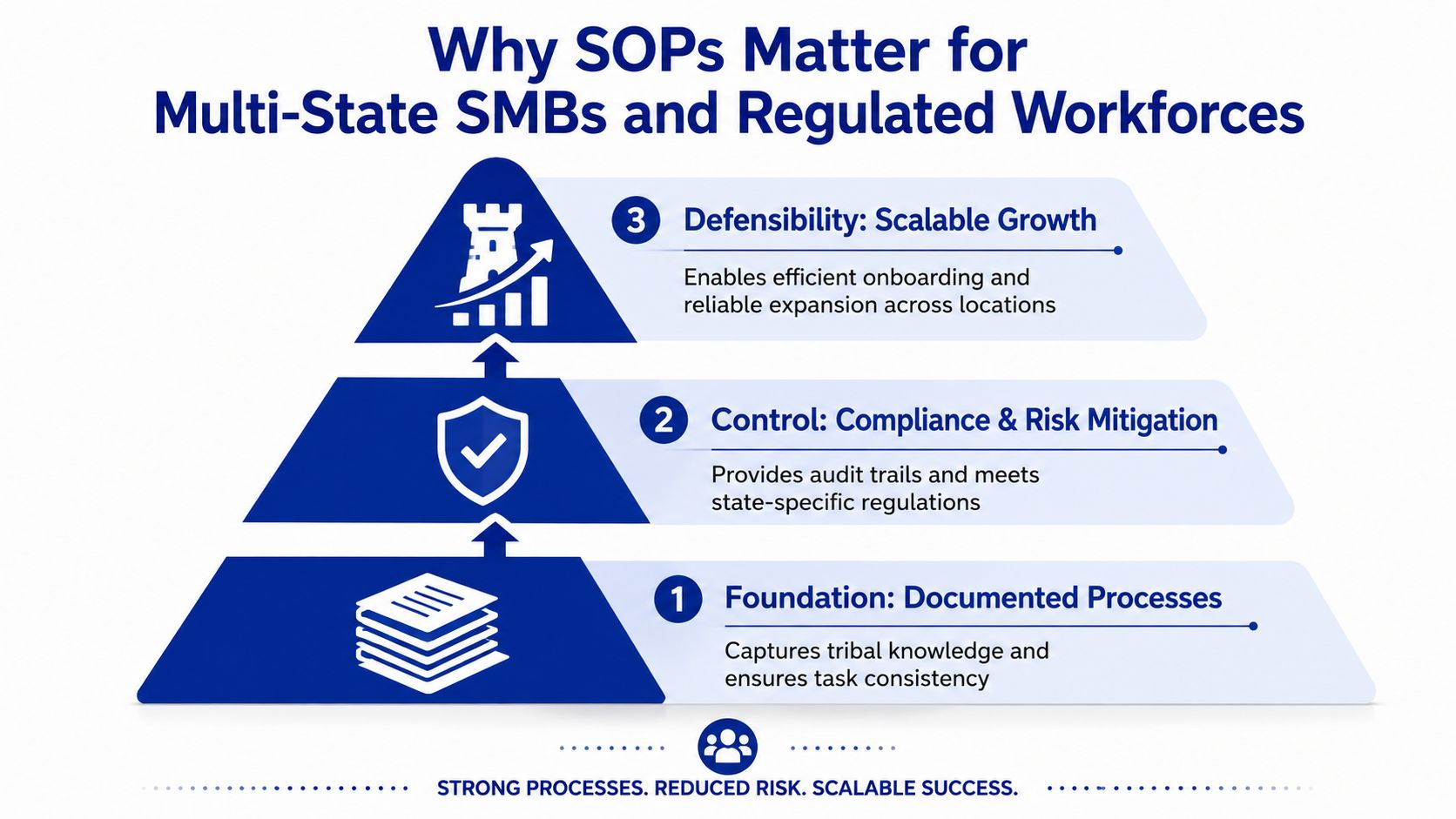
A company that operates in more than one state cannot afford process drift. One manager improvises, another follows an old memo, and a third relies on local habit. The result is a weak record of what the company expects. SOPs stop that slide. They turn daily actions into a defensible operating standard.
Regulated workforces have even less room for inconsistency. In healthcare, manufacturing, clinical research, and any setting where mistakes can affect safety, quality, or compliance, an SOP tells people what should happen, who should do it, and what proof should exist afterward. That is the point. The document is there to control risk, not decorate a shared drive.
A strong SOP gives leadership three things at once. It shows the process, it shows the standard, and it shows that the company expected people to follow that standard. During investigations, terminations, audits, and litigation, that record matters more than a manager's memory or a later explanation.
For SMBs, the value is practical and immediate. New leaders can inherit a process without inventing their own version, and existing leaders can keep work aligned as hiring spreads across locations. SOPs also work best when they sit beside the broader policy framework, not in place of it. A handbook sets the employment rules, while an SOP shows how a specific process gets carried out, and employee handbook requirements by state helps clarify why that distinction matters.
When a multi-state business needs to show consistency, the SOP becomes part of the evidence file. If a termination is challenged, if an investigation is questioned, or if a regulator asks how a decision was handled, the company can point to the written procedure and show whether it was followed. That is how an SOP protects defensibility.
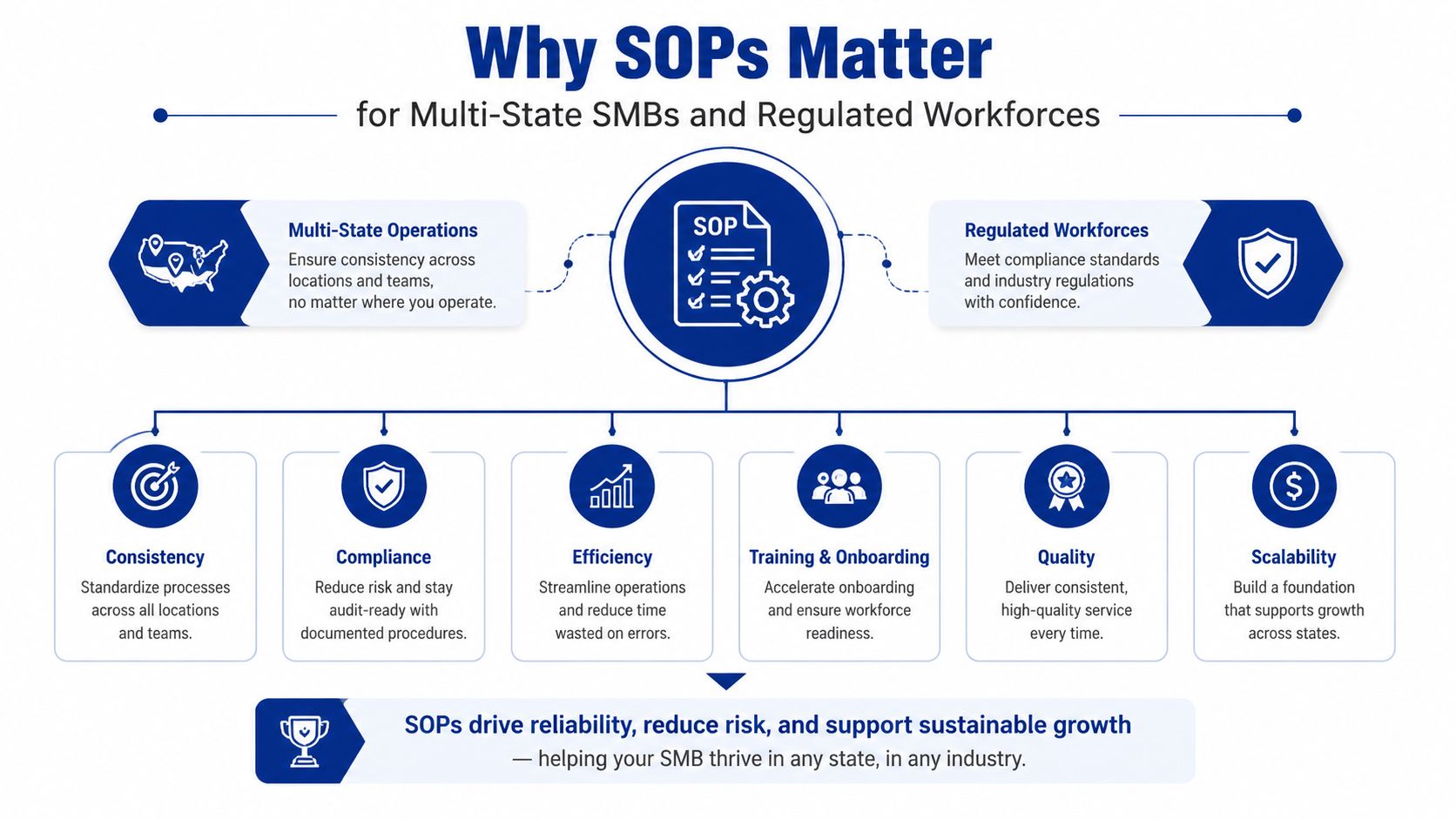
A termination is the first place many leaders feel the lack of structure. One manager gives a warning, another skips documentation, and the final meeting happens without a shared process. When that employee later challenges the decision, the company has no clean record of who reviewed what, which standard applied, or whether the same steps were used across locations.
The same problem shows up in an internal complaint. If the intake, investigation, documentation, and follow-up are left to manager discretion, the process becomes inconsistent fast. A defensible investigation path should show who received the complaint, who handled it, what records were gathered, and how the conclusion was preserved, which is why investigation management should never depend on memory alone.
Termination: A good SOP names who approves the decision, who documents performance or conduct issues, and where the final file is stored. A bad one lets each manager improvise, which makes the company look inconsistent even when the decision itself was justified.
Internal complaint: A good SOP tells HR who receives the report, what gets logged, and how interviews or findings are recorded. A bad one leaves the process open-ended, which creates uneven treatment and weakens the record if the matter escalates.
Resignation review: A good SOP guides the exit checklist, record retention, and any follow-up review of outstanding documentation. A bad one lets important notes disappear, which can become a problem later if counsel asks how a decision was handled.
The point is not to turn HR into a paperwork factory. The point is to make sure a manager's actions can be reconstructed by someone who was not in the room. If the file cannot show what should have happened, your best explanation will still look thin.
An SOP is only useful if it can survive a real dispute. That means it needs more than a title and a paragraph of guidance. A technically complete SOP specifies the purpose, scope, roles, sequence of activities, control points, required records, exception handling, and revision history structure requirements for SOPs.
Purpose tells people why the procedure exists. If the purpose is missing, staff usually treat the document like optional guidance.
Scope sets the boundary. A solid scope says which team, site, or process is covered, so nobody stretches the document beyond what it was written to govern.
Roles make ownership clear. If a manager, HR lead, and approver all touch the process, the SOP should say who does what, not leave that to tribal knowledge.
Sequence of activities keeps the work repeatable. This is the step-by-step core, and it prevents each person from inventing a slightly different version.
Control points identify where a decision, approval, or check must happen. That is what turns a routine task into a controlled process.
Required records tell the team what must be saved. If it was not recorded, it is hard to defend later.
Exception handling covers the odd cases. Good SOPs acknowledge that not every situation fits the happy path.
Revision history shows the document evolved deliberately. If version control is weak, the company can end up defending an outdated process as if it were current.
The best SOPs are boring in the right way. They remove guesswork, leave a record, and make it obvious who was responsible at each step.
That structure is what makes a procedure auditable across people, sites, and jurisdictions. It also keeps the document from becoming a vague checklist that nobody trusts when the stakes rise.
The fastest way to weaken an SOP is to copy a template and call it done. Generic language looks polished, but it usually misses the actual workflow, which means managers keep operating from habit instead of the document. A procedure that does not match reality is not a control, it is theater.
Another common failure is leaving ownership undefined. If nobody owns updates, version control, or distribution, the SOP drifts until the company is relying on an outdated file. That becomes a serious problem during a dispute, because an old termination procedure can read like deliberate inconsistency rather than a simple oversight.
The cleanest antidote is to treat SOP governance the way strong teams treat managing content workflows and standards. Documents need a maintained system, not just a draft folder and good intentions. Once that standard is in place, version control becomes part of the process, not an afterthought.
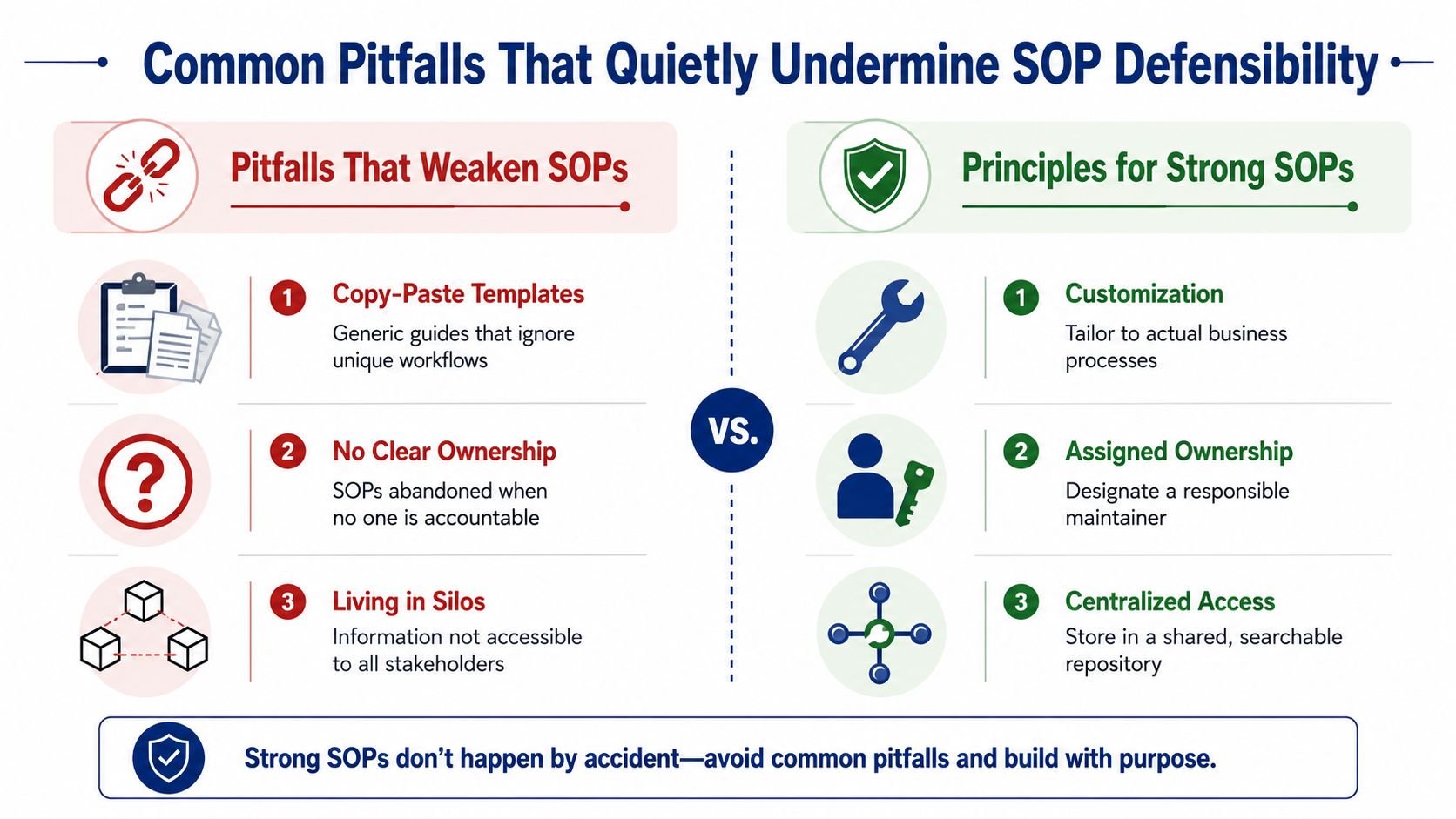
Strong rule: if the SOP cannot be found quickly, or no one can say who last reviewed it, it is not ready for serious use.
A final mistake is treating the SOP as a one-time project. Businesses change, laws change, managers change, and the document has to keep up. If it does not, you end up with a file that creates false confidence, which is often worse than having no file at all.
Start with the procedures that carry the most risk when they go wrong. That usually means terminations, investigations, onboarding, time off, payroll handoffs, or other recurring tasks where a bad call creates legal or operational fallout. You do not need a hundred SOPs, you need the right ones maintained properly.
Ownership should sit with the person closest to the process and the risk. That owner should know when the document gets reviewed, what triggers a revision, and where the current version lives. If your leadership team already uses a broader governance model, hr governance framework is a useful companion concept because it keeps procedures tied to decision rights instead of scattered across inboxes.
The maintenance cycle should be straightforward. Draft the procedure, validate it with the people who do the work, train managers on the version that is current, audit a few real uses, and revise when the process or law changes. That loop matters more than a fancy template because it keeps the SOP alive.
Use review triggers that make sense for your business. A change in state law, a new location, a manager shift, or a repeated process failure should force a review. If nothing has changed, the document still needs a periodic check so old instructions do not linger.
Version control should be visible and boring. One current source of truth is better than scattered copies with different dates. If a manager cannot tell which version applies, the document is already failing at the one job it has.
SOPs are not a paperwork exercise. They are the written controls that let you show how work was supposed to happen, who owned it, and what record should exist when a decision gets challenged. That is the difference between being organized and being defensible.
If you want a useful model for how structured documentation supports accountability across products and processes, look at Digital Product Passport as another example of controlled information living in a governed system. The same principle applies here, keep the process clear, current, and traceable, or it will fail you when you need it most.
International Inc. helps owners, COOs, and HR leaders build defensible people practices before a problem turns into a liability. If your SOPs are thin, outdated, or scattered across states and managers, visit Paradigm International Inc. to start a structured conversation about strengthening the controls behind your HR decisions.