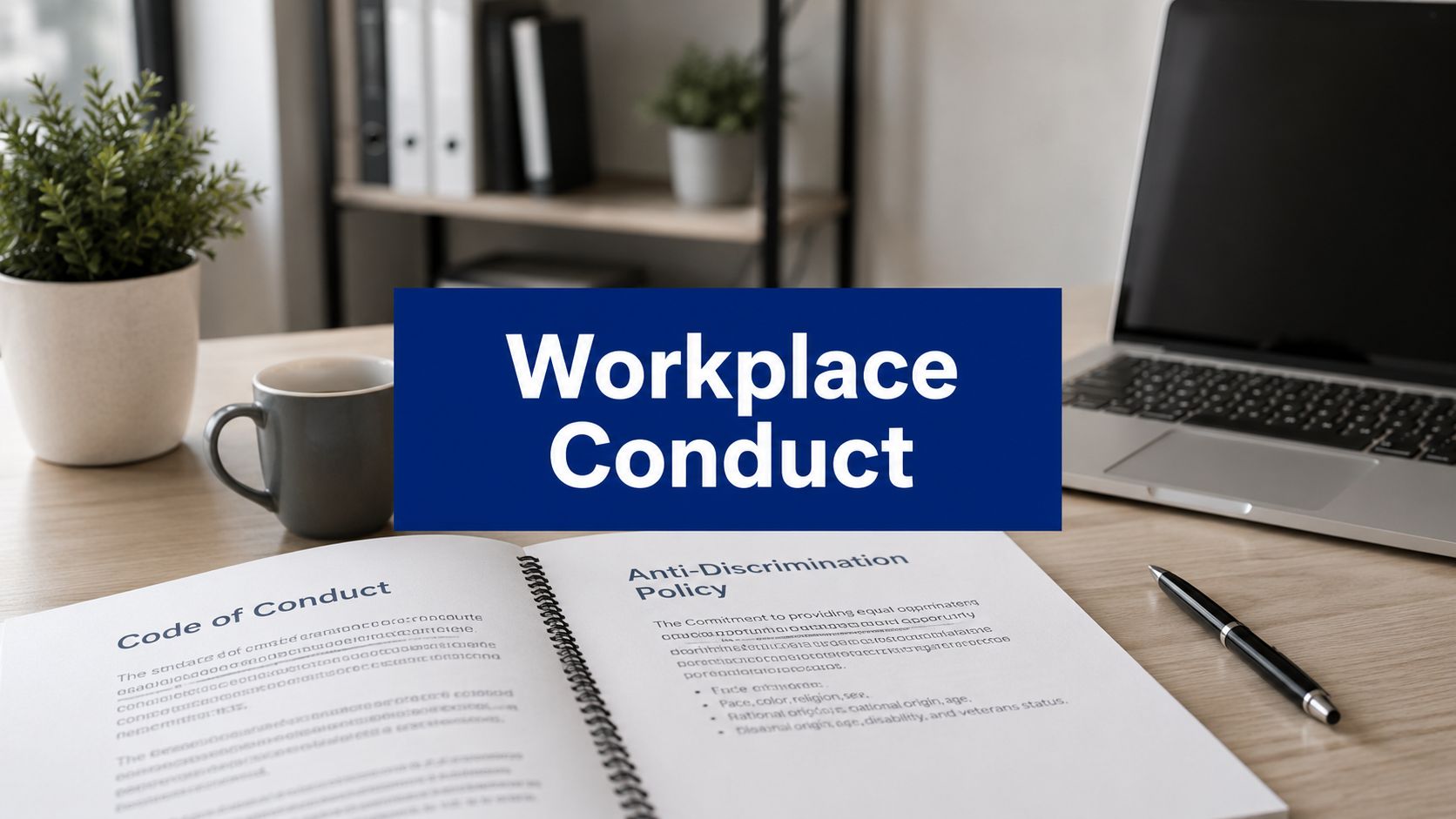
In fiscal year 2023, the U.S. Equal Employment Opportunity Commission recorded 31,354 harassment charges, up more than 47% from fiscal year 2021, while monetary recoveries reached $202.2 million. Those figures make one point clear: a workplace conduct policy isn't a handbook ornament. It's a control mechanism that defines expected behavior, reporting routes, investigation standards, and manager accountability before a complaint becomes a larger business problem. (EEOC harassment guidance)
A policy earns its value through what it helps the company do after a report arrives. The EEOC's enforcement data shows that harassment remains a substantial source of workplace risk. Earlier EEOC materials reported that 31% of private-sector charges received in fiscal year 2015 alleged harassment, including 27,893 harassment charges, and the agency secured $125.5 million for employees alleging harassment through its pre-litigation process. (EEOC Select Task Force report)
That history matters because a thin policy creates operational uncertainty. Employees may not know whom to contact, managers may respond inconsistently, and HR may struggle to show that the company acted promptly and impartially. A policy that says “treat everyone with respect” doesn't establish a usable reporting channel, explain interim measures, define retaliation, or identify who owns the investigation.
Practical rule: Draft the policy for the day a COO must explain the company's response to a serious complaint, not for the day employees click “I acknowledge.”
A defensibility audit trail now matters more than a polished document. Leadership should be able to locate the original report, intake record, evidence-preservation actions, interview notes, findings memo, corrective-action decision, and follow-up record. The policy should match actual practice. If the policy promises multiple reporting avenues but employees only know to contact their direct manager, the inconsistency becomes a credibility problem.
The policy also needs to address conduct that occurs outside the traditional office. Remote work, messaging platforms, customer interactions, business travel, and employer-connected social activity can create reporting and investigation questions that a conventional handbook never answers. The right response isn't to write an impossibly broad document. It's to define the employer connection clearly and give managers a repeatable decision process.
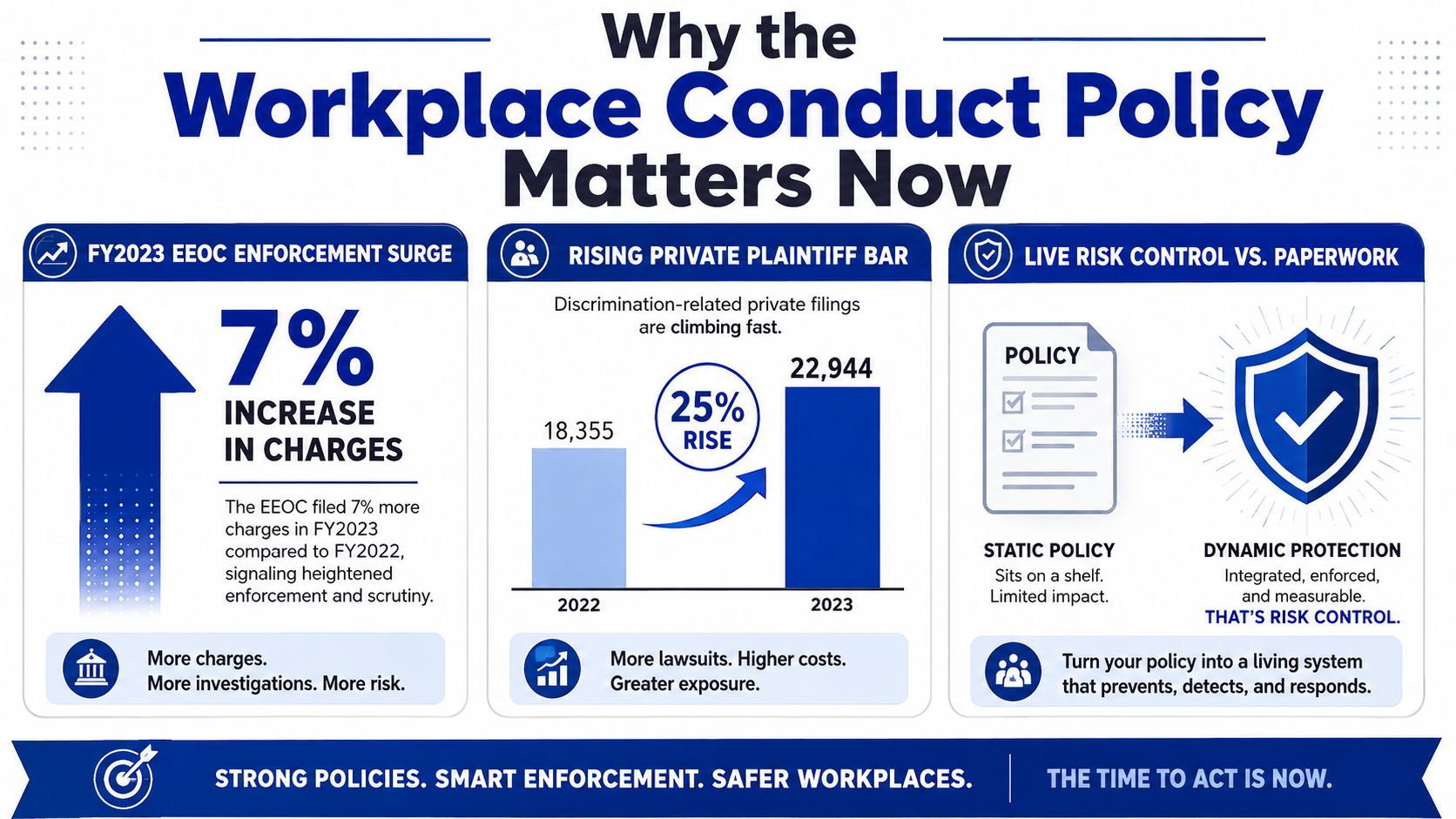
Treat the workplace conduct policy as part of the company's internal control environment. It should tell people what to do, preserve consistent decisions, and produce records that demonstrate responsible action.
A defensible policy needs more than legal vocabulary. Each provision should answer a practical question an employee, manager, investigator, or reviewer could ask.
Scope and coverage. State who the policy covers and where it applies. Include employees, managers, temporary workers, contractors, customers, vendors, business travel, work events, electronic communications, and remote-work settings.
Adaptable language: “This policy applies to workplace-related conduct involving employees and other covered individuals, whether conduct occurs on company premises, remotely, during business travel, at company events, or through work-related systems.”
Purpose statement. Explain the business standard without promising an unrealistic workplace free of every disagreement.
Adaptable language: “The company maintains this policy to promote a professional workplace, provide accessible reporting channels, and support prompt, fair responses to reported concerns.”
Protected-class and non-protected conduct definitions. Identify harassment and discrimination connected to protected characteristics, but also address bullying, threats, abusive conduct, conflicts of interest, dishonesty, and serious incivility where legally appropriate.
Adaptable language: “Prohibited conduct may violate this policy whether or not it meets the legal definition of unlawful harassment or discrimination.”
Prohibited behaviors. Give concrete examples, including slurs, unwanted sexual conduct, threats, intimidation, exclusionary behavior, discriminatory decisions, and misuse of confidential information.
Adaptable language: “Examples include unwanted comments about a protected characteristic, threats, repeated humiliating conduct, and employment decisions based on protected status.”
Reporting channels. Provide several routes, including at least one outside the employee's direct reporting line. The EEOC recommends that an effective anti-harassment policy be widely disseminated, understandable, and supported by multiple reporting avenues. (EEOC promising practices)
Adaptable language: “Employees may report concerns to their manager, Human Resources, a designated executive, or the company's confidential reporting channel.”
Anti-retaliation clause. Protect good-faith reporters, witnesses, participants, and employees who support an internal complaint. Don't write the clause so broadly that it appears to prohibit legitimate performance management.
Adaptable language: “The company prohibits retaliation for raising a good-faith concern, participating in a review, or supporting another employee's report. This protection doesn't prevent legitimate action based on documented performance or conduct.”
Investigation process. Describe intake, triage, evidence preservation, interviews, findings, and corrective action. Avoid guaranteeing a particular result.
Adaptable language: “The company will assess reports promptly, conduct an appropriate impartial review, preserve relevant information, and take corrective action when warranted.”
Confidentiality. Promise discretion, not absolute secrecy.
Adaptable language: “Information will be shared only with people who have a legitimate business or legal need to know, while recognizing that a fair review may require contacting relevant individuals.”
Discipline. Reserve discretion while preserving consistency.
Adaptable language: “Violations may result in corrective action up to and including termination, consistent with the circumstances, applicable law, and comparable company decisions.”
Acknowledgment. Confirm receipt and understanding without implying that acknowledgment waives legal rights.
Adaptable language: “By acknowledging this policy, the employee confirms receipt and understands the reporting and non-retaliation expectations.”
Use a structured systems approach when assigning owners, records, and escalation points. Guidance on systems advice from Your Success Shift can help leadership connect policy language to repeatable operating processes.
| Component | Sample Language Snippet | Common Failure |
|---|---|---|
| Reporting channels | “Employees may report through HR, a manager, an executive, or a designated reporting channel.” | Only naming the direct manager |
| Investigation process | “Reports will be assessed, investigated as appropriate, documented, and resolved with corrective action when warranted.” | No owner, timing, or record standard |
| Anti-retaliation | “Retaliation against reporters, witnesses, or participants is prohibited.” | Protecting only the original complainant |
| Confidentiality | “Information will be limited to those with a legitimate need to know.” | Promising absolute confidentiality |
| Conduct examples | “Examples include threats, discriminatory decisions, unwanted comments, and serious abusive conduct.” | Relying on vague standards |
| Acknowledgment | “Acknowledgment confirms receipt and understanding.” | Treating it as a waiver |
Four omissions repeatedly weaken otherwise polished policies: failing to address off-duty conduct connected to customer-facing roles, ignoring social media boundaries, saying nothing about AI tools, and omitting a retaliation carve-out that protects internal complainants and witnesses. Every clause should be provable through an investigation record, not merely reasonable on the printed page.
A multi-state employer shouldn't maintain a different philosophy in every location. It should maintain a stable core policy, then add jurisdiction-specific requirements where the law demands more.
The variables requiring review include:
A “most protective” drafting strategy gives the core policy language that can operate across the company without weakening employee protections in more demanding jurisdictions. State addenda then address local reporting obligations, required notices, training, leave, wage, privacy, or termination rules. Keep the core document generic enough to remain stable, but don't use generic wording to avoid a required state-specific instruction.
| Variable | How States Differ | Drafting Response |
|---|---|---|
| Protected conduct | State and local laws may cover additional characteristics | Use broad behavior-based language and attach local supplements |
| Off-duty behavior | Some jurisdictions limit employer action involving lawful off-duty conduct | Define the connection to work and route uncertain cases to HR |
| Social media | Privacy, monitoring, and protected activity rules vary | State what the company won't monitor or restrict, then identify legitimate business boundaries |
| Training | Required audiences and timing can differ | Track local training obligations in an implementation matrix |
| Pay transparency | Posting and disclosure rules vary by location | Assign recruiting and compensation owners to review each posting workflow |
| Termination language | At-will disclaimers and exceptions require careful drafting | Use counsel-reviewed core disclaimers and state addenda |
California, New York, and Illinois deserve early review because their employment requirements often create operational work beyond a generic handbook. Don't assume that one nationwide paragraph handles their rules on harassment prevention, leave, wage transparency, privacy, employee rights, or workplace notices. Use a location matrix tied to the employee's work location, reporting line, and work arrangement. Leaders can use this handbook compliance by state resource to organize that review.
The policy should also say which document controls if the core policy conflicts with an addendum. That small drafting choice prevents managers from choosing whichever version they find more convenient.
The policy becomes credible when HR can run the same basic workflow every time. The workflow doesn't need to be elaborate, but it does need an owner, a case record, timing triggers, and a clear separation between fact-finding and discipline.
Intake comes first. Identify who receives reports, how employees can reach that person, and how the case enters the tracking system. Log the report within 24 hours as an internal operating standard, record the date and source, preserve the reporter's original wording, and note any immediate safety or scheduling concern.
Triage should classify the report by response need:
This classification guides the response. It doesn't predetermine the outcome.
Rapid fact-finding answers whether the company needs to separate people, preserve records, or expand the scope. A full investigation determines what happened, which policy provisions may apply, and what corrective response is reasonable. Keep those stages distinct. The investigator gathers and tests facts, while the decision-maker evaluates findings and selects action, with employment counsel involved where privilege or significant exposure warrants it.
The EEOC says harassment complaints should be investigated promptly, thoroughly, and impartially. In federal-sector guidance, the investigation should begin within 10 calendar days after the agency becomes aware of the allegations. (EEOC harassment policy tips) Use that 10-day benchmark as a maximum escalation trigger for starting the review, while applying the faster standard required by safety concerns or state law.
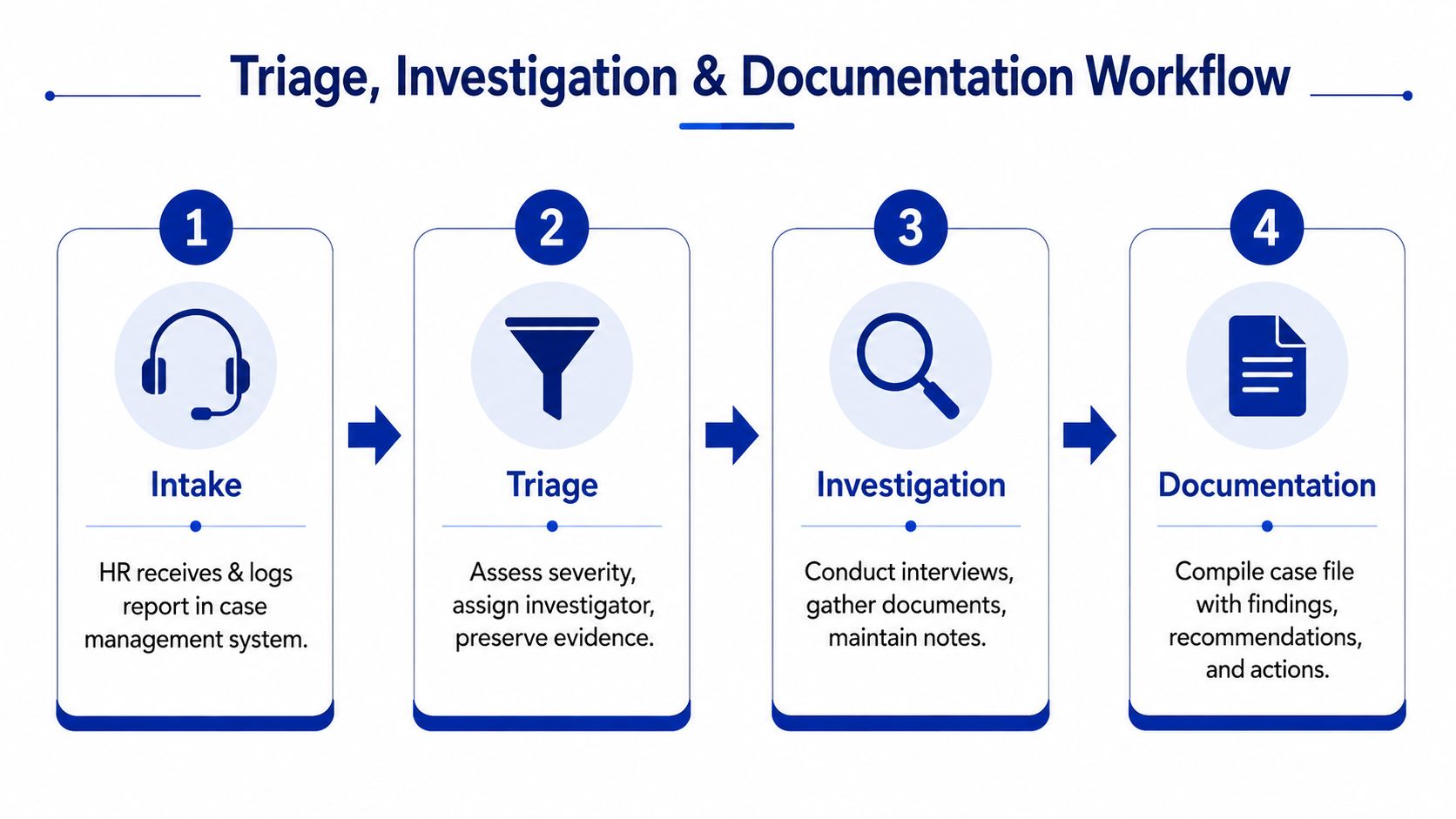
Preserve relevant email, chat messages, access records, schedules, customer communications, and performance documentation as soon as the allegation identifies them. Interview the complainant, respondent, and relevant witnesses using open-ended questions, then test accounts against documents and system records. Record the reason for each delay, the evidence requested, and the investigator's impartiality check.
Use practical documentation language:
Interview note: “The interviewee stated that [conduct or event] occurred on or around [date] in [location or system]. The interviewee identified [witnesses or records]. Follow-up requested: [specific item].”
Findings memo: “Allegation, policy provision, evidence reviewed, credibility considerations, factual findings, and recommended corrective response.”
Keep the recommendation separate from the final decision. A corrective-action matrix can show the allegation, finding, comparable prior decisions, policy or training response, recommendation, final decision-maker, and implementation date. Review SMB HR documentation tips to strengthen the records surrounding this workflow.
Close the case with a written outcome memo, limited communications to the parties, and follow-up for retaliation or recurring conduct. The file should show not only what the company decided, but how it reached that decision.
A remote account manager receives a complaint after several Slack messages are described as dismissive and hostile. She has also started using an AI drafting tool to make customer replies more concise, and her team is debating whether cameras should be on during hybrid meetings. One report now touches civility, AI use, customer communication, and meeting expectations.
A broad policy leaves HR to improvise. A usable policy maps each issue to a rule employees can apply without interpreting legal doctrine.
Chat tone and professionalism
Off-hours conduct connected to work
AI-assisted writing and code
Camera-on expectations
Scenario-based language works because it gives employees a decision point. The 2026 LRN analysis of more than 1,000 codes of conduct across 15 countries found that only 9% explicitly addressed AI or technology ethics, fewer than one-third included scenario-based questions and answers, and 24% of employees said their code was too long or difficult to follow. (LRN Code of Conduct Report 2026)
Keep the policy concise, then place examples in a quick-reference guide, manager card, or training module. For employment-document decisions that follow a serious conduct issue, a contractor termination letter guide can help teams separate factual documentation from unsupported conclusions.
A signed acknowledgment doesn't prove that employees understand the policy or that managers can respond correctly. Rollout should operate as a 30-60-90 day control cycle, with a named owner for each deliverable.
Ship the policy with an executive memo that explains the standard, reporting routes, and non-retaliation commitment. Hold a manager calibration session using the same scenarios employees will see, then track acknowledgments by employee, location, role, and completion status.
Give managers one instruction they can remember: receive the report, thank the employee, avoid promising secrecy, document the concern, and escalate it immediately.
Run role-specific training rather than one generic presentation:
The employee module should use chat, customer, AI, and hybrid-work examples. The manager session should include calibration exercises where leaders compare how they would handle the same report. That exposes inconsistent instincts before they become inconsistent case files.
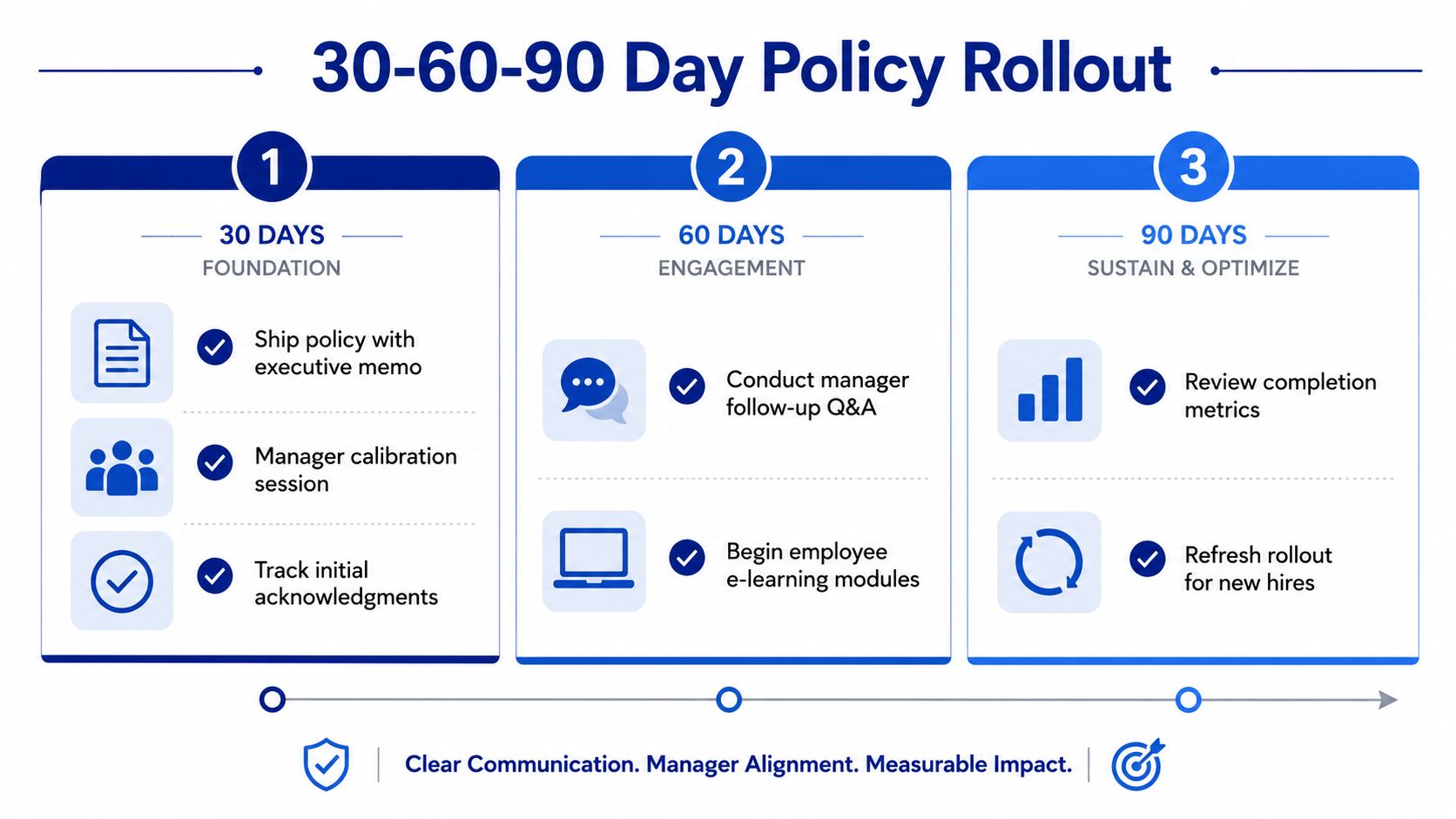
Review completion metrics, unresolved acknowledgments, manager attendance, report volume, escalation timing, and time to resolution. The dashboard owner should be HR or Employee Relations, with quarterly review by the COO or executive leadership team. Don't use report volume alone as a culture score. A rise may reflect greater trust in reporting, while a lack of reports may reflect confusion or fear.
Track whether managers escalated concerns, whether interim measures were documented, and whether corrective decisions matched comparable cases. Feed recurring issues into the next policy revision, manager coaching plan, and scenario library. That closes the loop between written standards and daily management.
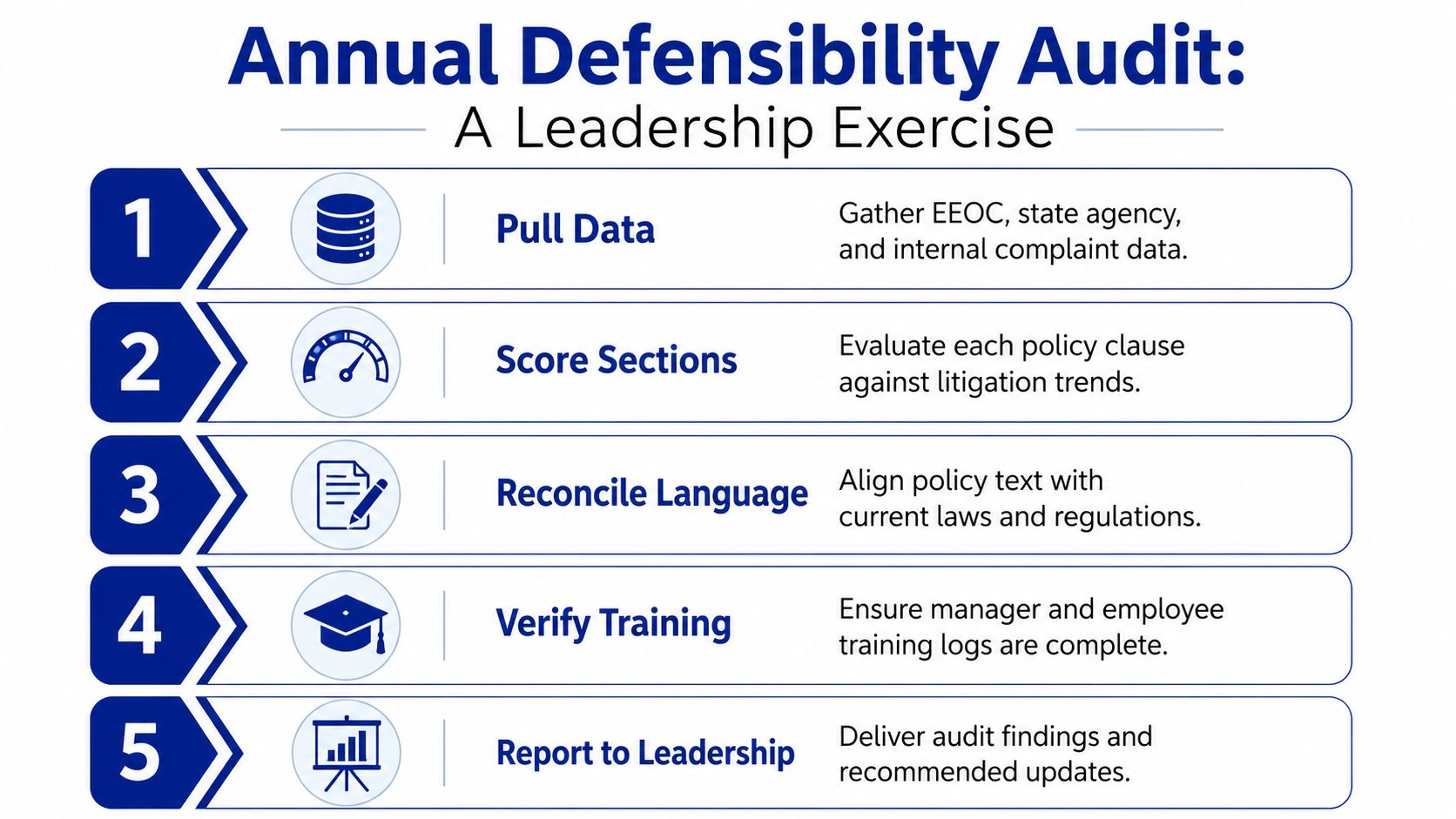
An annual review should produce evidence, not a calendar entry. Assign the exercise to HR or Employee Relations, require executive sponsorship, and give leadership a written record of what changed, why it changed, and which risks remain open.
Pull data. Gather EEOC developments, state agency activity, internal complaint categories, investigation timelines, retaliation concerns, and manager escalation records. Produce a risk summary that identifies recurring allegations and locations.
Score policy sections. Review scope, definitions, reporting, retaliation, investigations, confidentiality, discipline, AI, social media, remote work, and acknowledgment language. Produce a heat map showing which provisions are clear, incomplete, or disconnected from actual practice.
Reconcile language. Compare the core policy and state addenda against current multi-state requirements. Produce a redline, a jurisdiction matrix, and a list of operational owners responsible for implementation.
Test the case flow. Select closed matters from the prior review period and compare intake, triage, evidence preservation, interviews, findings, corrective action, and follow-up against the written workflow. Produce a case-clock review that identifies delays and undocumented decisions.
Verify training and report upward. Confirm employee acknowledgments, manager training, coaching records, new-hire completion, and dashboard reviews. Deliver leadership a short report with completed actions, overdue items, responsible owners, and recommended policy updates.
The most common drift points are predictable. Remote-work clauses stop reflecting how teams communicate, AI language fails to address confidential information and verification, and discipline timelines no longer match operational reality or current enforcement expectations. A policy can also drift when managers create informal exceptions that HR never records.
Bring in employment counsel when the allegation involves senior leadership, potential termination, government contact, overlapping protected activity, credible safety risk, complex privilege questions, or a likely dispute over inconsistent treatment. Counsel shouldn't replace the internal workflow. Counsel should help leadership assess exposure, protect appropriate communications, and make consequential decisions with a complete record.
Log the audit for the board or leadership team through a dated report, approved action register, policy version history, and completion evidence. A workplace conduct policy is defensible when the company can show that it updates the standard, trains people on it, follows the workflow, and corrects gaps instead of hiding them.
International Inc. helps owners, COOs, and HR leaders build defensible employee-relations practices for investigations, manager conduct, documentation, and multi-state compliance. Visit Paradigm International Inc. to discuss how your leadership team can turn a workplace conduct policy into a working control system.