
A complaint lands at 4:45 on a Friday. The office manager, who handles HR along with payroll and vendor invoices, reads it twice and isn't sure whether to call the supervisor, call the owner, or wait until Monday. There's a paragraph in the handbook about harassment, but nothing that says who owns the next step. By the time Monday arrives, three people have discussed it, no one has written anything down, and the company has already made decisions it can't take back. That gap is what a workplace investigation policy is supposed to close.
A workplace investigation policy is the operating system for handling complaints and misconduct reports. It says who receives the report, who owns each decision, what record gets created, and when the matter closes. It is an operating procedure a tired manager can follow at 4:45 on a Friday without inventing the next step.
The legal reason to treat it as a system goes back to two 1998 U.S. Supreme Court decisions, Faragher v. City of Boca Raton and Burlington Industries, Inc. v. Ellerth, with the Faragher opinion published by Justia explaining the prevention and correction standard. An employer may raise an affirmative defense in certain supervisor-harassment claims when it exercised reasonable care to prevent and promptly correct harassment and the employee unreasonably failed to use the available complaint process. The Court did not treat a written policy as automatically sufficient. It pointed to a policy suited to the employment circumstances, backed by a functioning complaint procedure.
That distinction matters because the policy has to work under pressure. A handbook line that merely says harassment is prohibited gives a manager no routing rule, no evidence standard, and no closure step. Owners need a process that names roles, sets targets, protects against retaliation, and leaves a record that can be reviewed later.
A workable policy has seven parts, and each one needs an owner in writing:
Owners rebuilding the surrounding paperwork can browse hiring guides for employers to see how expectations get set at offer and onboarding, before any complaint exists. Clear early language makes the investigation policy easier to enforce later. Treat this as part of the system, not separate paperwork.
The payoff is practical. When a complaint arrives, the owner should be able to identify the scope, assign the investigator, protect the people involved, document the findings, and monitor retaliation after the case closes. That is what turns a policy into a control system instead of handbook language.
Use this table as the operating map, not as handbook decoration. Every row needs a named owner, a time expectation, and a record that can be produced later. If you run the company without an HR director, assign each owner by role now, before a complaint forces the question.
| Element | Owner and deadline | Proof the policy worked |
|---|---|---|
| Scope | Owner or HR lead confirms coverage at adoption and whenever work arrangements change | Coverage includes workplace conduct, remote and hybrid staff, out-of-state staff, and the locations where company work happens |
| Reporting channels | HR and the direct manager publish the routes at handoff and onboarding | Employees can report through more than one route, including one that bypasses the direct manager |
| Timelines | Intake owner acknowledges the complaint promptly and assigns the investigator | The file shows when the complaint arrived, who received it, who was assigned, when interviews occurred, and when closure was communicated |
| Investigator selection | Owner or HR lead checks conflicts before assignment | The investigator has no stake in the outcome. Outside help is used when neutrality matters, including executive or owner allegations |
| Confidentiality | Investigator tells participants what will stay private and what must be shared | The policy avoids absolute secrecy promises and explains the need-to-know limits |
| Documentation | Investigator controls the file from intake through closure | Notes, evidence, findings, and the final report sit in one controlled place, not on personal devices |
| Remedies | Owner approves corrective action after receiving findings | The policy describes a range of actions and who approves each level |
| Anti-retaliation | HR lead or designated watcher checks after closure | The written prohibition is paired with follow-up on schedules, assignments, treatment, and new complaints |
Score the current handbook against each row as written, vague, or missing. Written means a manager could act on it without asking a follow-up question. Vague means the intent is there but the mechanics are absent, as in a line that says investigations will be handled promptly without saying who acts or what gets recorded. Missing means the row is absent.
Treat missing rows as exposure. Vague language still gives a manager something to work with. A missing rule pushes the manager into improvisation, and improvisation produces late reporting, uneven discipline, retaliation claims, and a file that cannot be rebuilt when challenged.
Practical rule: if a manager reading the policy wouldn't know whom to call within the hour, the policy has failed, no matter how well the conduct section is written.
Employees and outside reviewers usually look at scope, reporting channels, and timelines first. Those rows answer three basic questions: was this worker covered, was there a usable route to report, and did the company move. A policy written only for the main office leaves remote and out-of-state workers guessing whether they are protected.
The quiet damage usually comes from the last two rows. Documentation fails when interview notes sit on a personal phone that leaves with the employee. Anti-retaliation fails when the rule appears once and nobody checks the complainant's schedule or treatment after closure.
Do the scoring on one page with the date at the top. Mark the owner beside each weak row. That page becomes the rewrite work plan and shows where exposure sits before a complaint tests the policy.
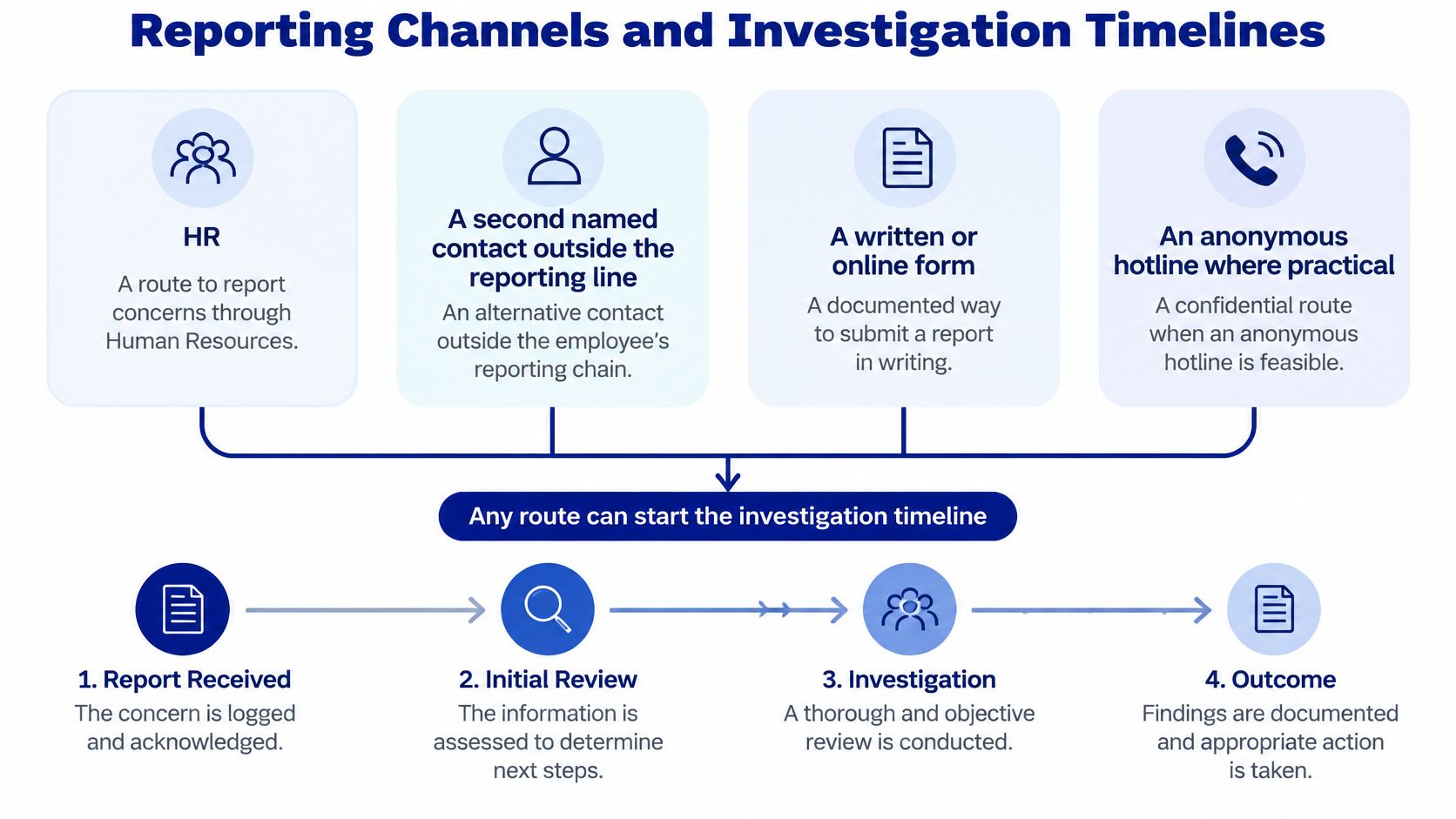
Offer four routes and publish all of them together: HR, a second named contact outside the reporting line, a written or online form, and an anonymous hotline where practical. The second contact matters most in a 40-person company where the owner is also the sales leader and the complaint involves a top performer. Any manager who receives a complaint should be required to pass it to HR within one business day, in writing, without asking the employee to repeat the story to three people first.
The EEOC's promising practices guidance for preventing harassment reports that more than 34% of employment-discrimination charges received between fiscal years 2018 and 2022 included an allegation of harassment, and that total harassment charges rose from 21,270 in FY 2021 to 24,430 in FY 2022. Those are agency charges, not the full count of workplace incidents, because many employees never report internally or externally. An owner with two internal complaints last year shouldn't read that as a clean workplace. It may mean people don't believe the channel works.
Intake is where most small employers lose control of the timeline. The investigation process starts with intake and scope, gathering initial facts, defining the investigation scope, and identifying involved parties and risk areas. The same sequence works for an internal owner:
Those are service levels an owner sets, not statutory deadlines. Their value is that they make delay visible. A case sitting at day 22 with no investigator assigned is a management problem, not an HR problem.
State agencies run their own clocks. California's Civil Rights Department and New York's Division of Human Rights each accept filings on their own timelines, so the intake form should list every state where the company has employees and route the file accordingly. A detailed harassment complaint procedure gives the office manager something to follow step by step instead of reconstructing the process under pressure.
A manager who supervises the parties should never run the investigation. Put that rule in the policy. Independence is a structural fact about reporting lines, friendships and who controls the investigator's next performance review. If any of those ties exist, assign someone else.
The investigator's job is to test competing explanations, not build a case. That means collecting evidence that contradicts the allegation as deliberately as evidence that supports it, applying the same credibility factors to every witness, preserving records before they're deleted, and writing down each step. The UK-based ACAS guide on handling investigations advises using someone not involved in the case, getting information from both sides, and recording how and why evidence was obtained, including requests that were refused. Treat that as useful non-U.S. guidance, then anchor the policy in U.S. requirements. Reports should cover the investigation, findings, recommendations and any corrective action.
| Option | Best fit | Main risk | Documentation needed |
|---|---|---|---|
| Internal HR professional with no conflict | Low-risk issues within one department | Perceived bias if HR reports to the accused | Full file with interview notes |
| Outside investigator | Complaints involving senior leaders or the owner | Higher cost and a slower start | Engagement letter and written report |
| Counsel-directed investigation | Matters likely to lead to termination or litigation | Scope limited by privilege decisions | Counsel-approved plan; confirm with employment counsel |
| Manager who supervises the parties | Not recommended in any case | Conflict and retaliation claims | Not applicable; the policy should prohibit it |
An internal HR professional works when the complaint sits two levels below them and nobody questions their neutrality. An outside investigator earns the cost when the subject is a senior leader, because no internal employee can credibly investigate the person who signs their raise. Counsel-directed work fits matters heading toward termination or litigation, and employment counsel should confirm the plan and privilege boundaries before interviews start. The fourth row belongs in the policy as a prohibition.
Write the scope before the first interview. Keep it short: the allegations, the parties, the time period, and what's excluded. Scope creep turns a focused inquiry into a broad audit of someone's entire career, which wastes time and raises the risk of retaliation claims from people who thought the investigation was about them.
The standard sequence holds across most cases. Interview the complainant, then witnesses, then the subject with a fair chance to respond. Review messages, documents, camera footage and timecards where relevant. Conduct confidential interviews with all relevant parties and review physical and digital evidence. Require a conflict check at assignment, and bar managers from deciding the outcome privately before fact-finding ends. The firm has handled complex, high-risk workplace investigations in Florida since 1994, and its work is built around EEOC, DOL and FLSA requirements.
Cases involving executives, owners or a likely termination should go outside the company. Guidance on investigating a complaint against an executive covers the neutrality problem in detail, and high-risk matters deserve expert help before any action is taken.
A finding of "no policy violation" doesn't end the risk. The complainant goes back to the same supervisor, the witnesses go back to the same team, and everyone watches what happens next. Exclusion from meetings, a suddenly cold manager, a shift change that costs someone their childcare arrangement: employees experience those as punishment for speaking up, whether or not the company intended them that way.
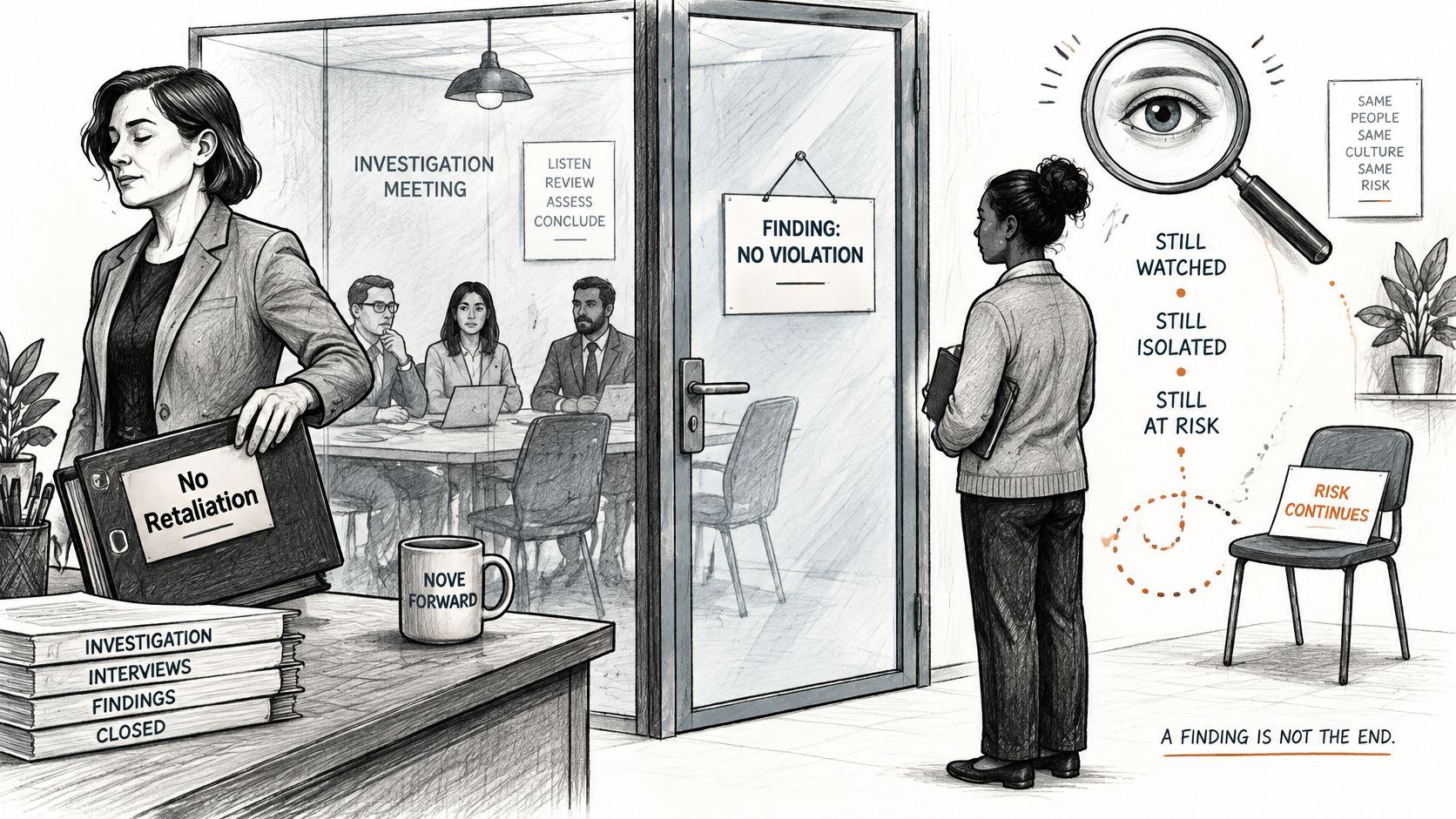
Under Title VII of the Civil Rights Act of 1964 (42 U.S.C. § 2000e et seq.), the EEOC's enforcement guidance on retaliation identifies participation in an internal investigation as protected activity, along with providing information to the employer, filing an agency charge and opposing conduct believed to violate federal discrimination law. Answering an investigator's questions is protected. That's the point most handbooks miss.
Hand every involved manager a short written instruction, not a verbal reminder:
Interim measures need the same scrutiny. Moving the complainant, cutting their duties or changing their schedule can itself be viewed as retaliation, so each proposed step gets a necessity and consistency review before it happens. If the separation is needed, ask who requested it and whether the same step would apply to an employee who never complained.
At intake, give the complainant, the witnesses and the subject a written explanation of the retaliation prohibition, how to report suspected retaliation, and examples of prohibited conduct. Then schedule documented check-ins at 30, 60 and 90 days as a suggested cadence, with one named owner responsible for making the calls and writing the notes.
Escalation triggers should be listed in the policy: schedule changes, performance ratings, pay decisions, transfers, leave decisions and terminations affecting anyone who participated. Any of those goes to the owner and to expert review before it's finalized. Timing alone doesn't establish a violation, but discipline that follows a complaint or a witness interview carries significant risk and needs careful documentation. Readers who want the mechanics of how these claims get built can review how to prove retaliation in the workplace.
Start with the file. The EEOC's guidance on discharge and discipline makes two points worth building into your policy: an employer's records will normally be an important source of evidence in a discharge or discipline charge, and Title VII section 704(a), enacted in 1964, prohibits discharging or disciplining an employee because the employee filed a Title VII charge, participated in a Title VII investigation or opposed discrimination. The file is the evidence for the decision.
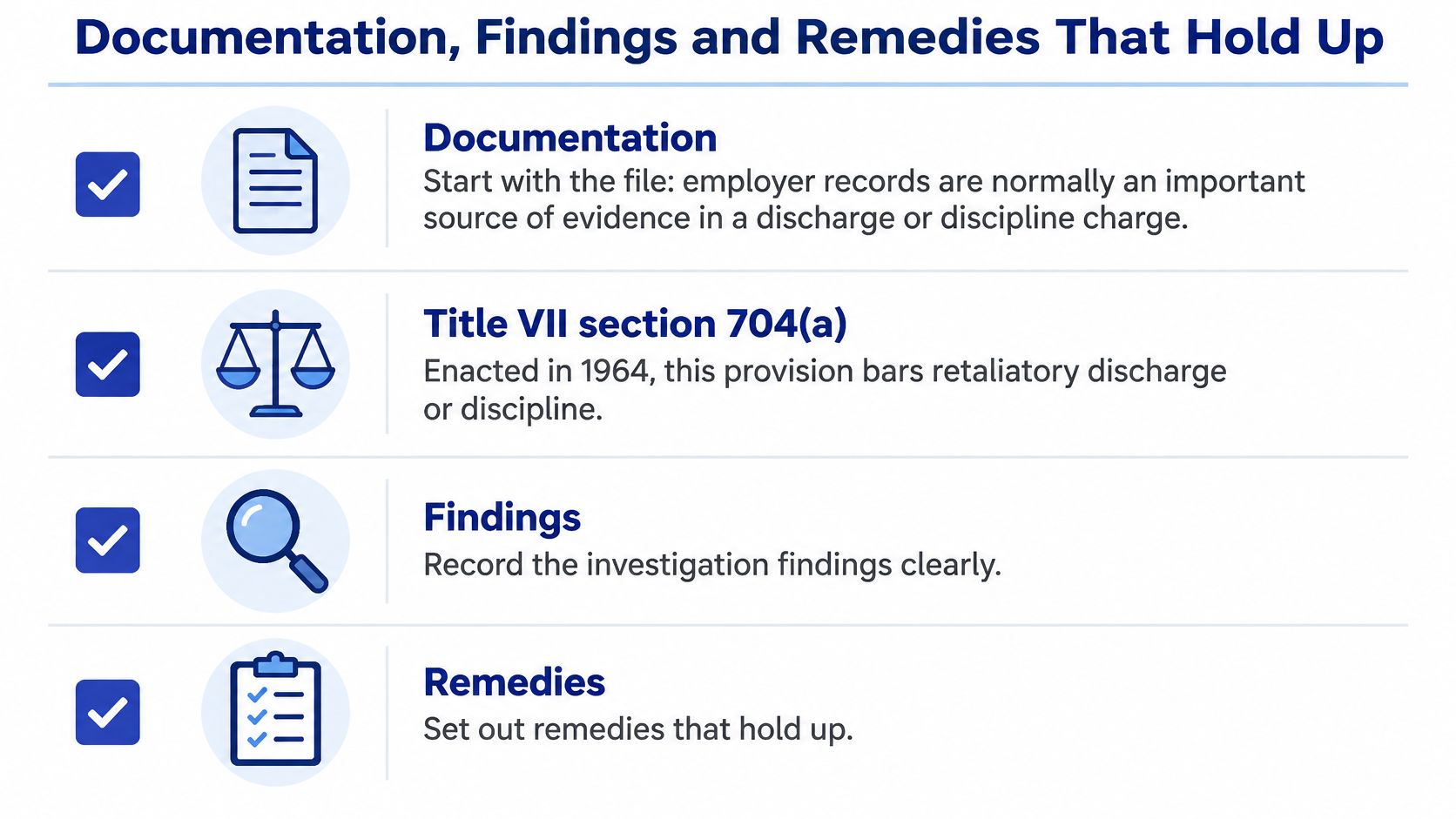
Keep the complaint, the investigation plan, interview notes, relevant messages, findings, the corrective-action rationale and records showing consistent treatment in one controlled location, with access limited to people who have a business need to know. Personal phones, private email and a manager's desk drawer do not qualify as a file. Strong document control standards decide where the record lives, who can open it and how versions are tracked.
Give the file an owner and a closure date. One named person confirms every item is in place before the matter is marked closed, and the record should also capture what happened after that date: the follow-up notes, any later complaints from the same people and the policy updates the case triggered. A file that ends at the finding misses the part a retaliation claim will target.
The decision-maker answers these in writing before approving anything:
Ban vague labels such as "bad attitude" and any explanation written after the fact. A reason invented later reads as a reason invented later.
A manager who cannot answer question four has no business signing the write-up.
Use three findings terms and define them in the policy: substantiated, not substantiated and inconclusive. "Not substantiated" means the evidence did not support the allegation; it says nothing about whether the complainant lied, and the report should say so plainly. Keep evidence separate from assumptions in the report itself, so a reader can see which facts carried the conclusion. The deliverable is a written investigation report with conclusions and next steps, documented so the decision is supported if challenged.
Set remedy levels from coaching to written warning to suspension to termination, and name the approver for each level. Tell the complainant and the subject the outcome in general terms within privacy limits, which usually means confirming that the matter was reviewed and addressed without disclosing another employee's discipline. Then close the loop in the file: record who was notified, on what date, and what changed as a result, whether that is a termination, an updated conduct policy or a documented coaching plan.
Retention rules differ across federal and state law, covering privacy, wage, leave and personnel records. Confirm the applicable retention schedule with qualified advice before destroying any file or taking adverse action after a complaint or leave request.
Run one enterprise standard for conduct, investigations, documentation and retaliation. Then attach short state addenda for the rules that differ. Separate handbooks invite separate standards for the same complaint, and that creates risk fast. Treat the policy like an operating system: the core rules stay stable, named owners handle routing, and each addendum explains what changes by location.
Work location sets the first boundary. A remote hire in another state, or the first employee in a state where the company has never operated, can bring that state's rules into the complaint process immediately. Candidates raise these issues before accepting offers, and navigating remote policies in interviews shows how often location expectations surface during hiring. Put the approved work location in writing at offer, identify the addendum that applies, and make sure managers know which owner routes the complaint.
The areas that most often vary:
Federal leave law overlaps with investigations more often than owners expect. The FMLA (1993, 29 U.S.C. § 2601; 29 C.F.R. Part 825) applies when a leave request is part of the complaint or follows it (DOL FMLA regulations), and Title VII (1964, 42 U.S.C. § 2000e et seq.) governs the discrimination and retaliation side (EEOC Title VII guidance). A termination touching both needs review before it is executed. If the facts involve threats, violence, drugs, alcohol, theft, fraud, misuse of company property, executive misconduct or retaliation after protected leave, bring in outside expertise. Our team handles prompt, impartial and thorough investigations and builds them around EEOC, DOL and FLSA requirements.
Use five implementation steps: list every state where employees work, draft the core policy, write a short addendum for each state with different rules, assign one owner per state, and confirm each addendum with employment counsel. Practical detail on multi-state employment laws helps an owner see where the seams are. Put a review date on every addendum, because state rules change and an undated addendum becomes wrong.
Adopt the policy, circulate it, collect written acknowledgments from every employee, and train managers before the next complaint arrives. Training means walking managers through the routing rule, the intake owner, the deadline for escalation, and the retaliation instructions. Do not reduce it to a PDF blast. Owners who need help with the drafting mechanics can review steps for drafting staff policies before writing the final language.
Include a reporting clause employees can use:
Any employee who believes they have experienced or witnessed conduct that violates this policy may report it to Human Resources, to the named second contact, or through the listed channel. The company will acknowledge each report in writing within two business days. Retaliation against anyone who reports or participates is prohibited.
A short review of the current policy against these tests is a practical next step, and it can be done in one sitting. A confidential investigation consult carries no judgment and no obligation.
This article is general information, not legal advice. Employment laws change and vary by state; consult qualified employment counsel about your situation.
International Inc. is an HR risk and decision advisory firm, not a law firm. It conducts neutral, documented workplace investigations for employers, from intake and scope through interviews, evidence review, and a written report with conclusions and next steps. It also builds the surrounding structure: complaint response protocols, handbook and state addenda, and decision support before a termination or corrective action goes through.