When a serious employee complaint lands on your desk, it’s a moment that truly defines leadership. How you handle it doesn't just resolve the immediate issue; it sends a powerful message about your company's commitment to fairness and integrity. The line between a well-managed process and a chaotic one often comes down to one thing: clear, consistent documentation. A solid workplace investigation report template is the most important tool you have, ensuring every inquiry is handled with the fairness and defensibility your organization needs.
The pressure to act quickly during a workplace issue is intense. However, moving too fast without a clear framework can lead to critical errors that undermine the entire investigation. Think of a structured report not as paperwork, but as the official record that proves you took the matter seriously and followed an impartial process.
This final document is your shield. It clearly lays out the incident, the steps you took, the evidence you gathered, and the rationale behind your conclusions. If your actions are ever questioned—by an attorney, a government agency, or your own team—this report serves as your primary evidence. For example, a thorough report can single-handedly prove you acted promptly on a harassment claim, protecting the company from accusations of negligence.
Trying to create a new process during a stressful investigation is a recipe for missing something crucial. Using a standardized template brings much-needed order to a complex situation. When every investigation follows the same logical flow, you dramatically reduce the risk of overlooking a key witness or a critical piece of evidence.
This is especially true for small and mid-sized businesses where HR leaders wear multiple hats and don't manage investigations daily. A good template forces you to be methodical and organized.
A well-structured report transforms an investigation from a reactive headache into a strategic asset. It not only helps you resolve the problem at hand but strengthens your company's overall risk management by creating an unimpeachable record of your actions.
For another excellent perspective on structuring these critical documents, this resource on a Workplace Investigation Report Template is a great place to start.
Ultimately, your goal is to produce a credible, impartial, and thorough account that can withstand scrutiny. Adopting a template-driven approach is the best way to achieve this, giving your leadership team real confidence in the final decisions you make.
Of course, the report is just one piece of the puzzle. Before you even begin writing, it helps to see the full picture. Our guide on the essential HR steps for workplace investigations walks you through the entire journey from start to finish.
An effective workplace investigation report is far more than a simple summary of events. Think of it as the official, structured story of your entire inquiry—a logical document that needs to stand up to scrutiny. When you build your report around a proven framework, you bring a level of consistency to the process that is absolutely essential for fairness and defensibility.
Without a clear structure, critical details get lost and your conclusions become harder to justify if questioned. This structured approach acts as a roadmap for anyone who reads it, whether that’s your CEO, legal counsel, or an external auditor. It guides them step-by-step from the initial complaint, through the evidence and analysis, all the way to your final recommendations.
The entire process boils down to three core phases: document the facts, analyze the evidence, and protect your organization with a clear, well-supported conclusion.
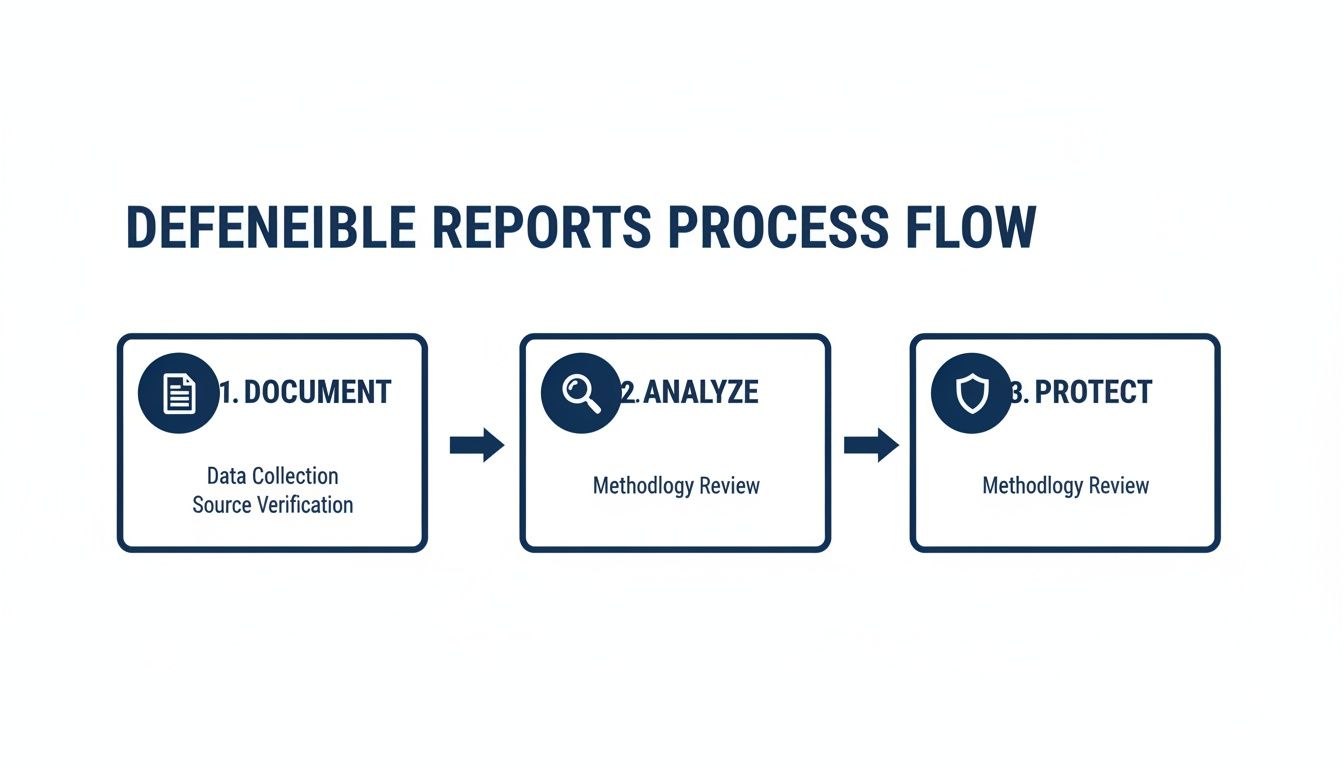
As this shows, a defensible outcome isn't an accident. It comes from a methodical progression where each stage is completed before you move on to the next. Every investigation report should be built on a solid foundation of key components. The table below breaks down the essential sections that ensure your report is clear, compliant, and ready to withstand scrutiny.
By ensuring each of these sections is thoroughly completed, you create a comprehensive and logical record that demonstrates a professional, impartial, and diligent investigation from start to finish.
Every defensible report begins with a clean, concise summary of the essential information. This provides immediate context and sets the stage for the detailed findings that follow. Think of it as the cover sheet for your entire document.
This initial data entry might seem like simple administrative work, but it’s foundational. It creates an official record and immediately shows that the process was organized and tracked from day one—a crucial first step in demonstrating a prompt and professional response.
Right after the basic details, you need a powerful executive summary. This is a brief, high-level overview of the complaint and your ultimate conclusion. It should be just a few sentences long, giving a busy executive everything they need to know without getting bogged down in details.
For instance: "This report details the investigation into an allegation of unprofessional conduct filed by Jane Doe against John Smith on October 26, 2024. The investigation concluded that the allegation was substantiated based on corroborating witness testimony and email evidence."
Immediately after that summary, you must define the scope of the investigation. This is a critical step for managing expectations and keeping the inquiry tightly focused. Be explicit about which specific allegations were investigated.
Defining the scope prevents "investigation creep," where an inquiry spirals into unrelated issues. It ensures your report sticks to the specific allegations you set out to investigate, making your findings more direct and defensible.
This section keeps the report on track and proves you took a disciplined, methodical approach to the issue at hand.
This part of your report outlines the "how" of your investigation. You’re detailing the specific actions you took to gather information, providing a transparent account of your methodology. Anyone reading this section should be able to understand exactly what steps you took to arrive at your conclusions.
This section must include:
Too many businesses rely on loose notes and scattered email threads to document investigations, creating huge risk exposure. This fragmented approach undermines defensibility with inconsistent evidence collection and incomplete records. Using a standardized template is the antidote, ensuring you systematically capture every detail. You can explore how structured frameworks provide this level of protection by reviewing details on defensible documentation.
Each interview is a critical piece of the puzzle, and your report needs to capture the key information from every single one. You should create a separate summary for each person you spoke with—the complainant, the respondent, and all witnesses.
A word of caution: do not simply copy and paste your raw, unedited interview notes into the report. The goal here is to write a concise, objective summary of the relevant information provided by that person.
Present these summaries in a consistent format. Start with the person’s name, title, and the date of the interview. Then, use bullet points or short paragraphs to outline their testimony, focusing only on the facts they presented. This objective presentation is absolutely vital for building a credible report.
This is where the investigation truly comes together. The "Findings of Fact" section is the core of your report, where you shift from gathering information to drawing conclusions. The credibility of your entire report hinges on your ability to remain completely objective here. Every statement must be a logical conclusion directly supported by the evidence you've collected—no personal opinions, guesswork, or emotional language.
Think of it this way: this section isn’t just a recap of what people said. It is your analysis of the evidence to determine what most likely happened. Your main job is to build a clear, evidence-based narrative by meticulously tying every finding back to a specific piece of proof, whether it's a witness statement, an email timestamp, or a security log.
Without that direct link, a "finding" is just an opinion. And an opinionated report is easy to challenge, opening you up to claims of bias or unfairness.

An allegation is a claim waiting to be proven. Your job is to sift through all the evidence to determine which parts of that claim can be backed up as fact. You're not a judge delivering a verdict; you're an investigator piecing together an event from the available information.
Let's say an employee alleges, "John Smith yelled at me in the breakroom." Your factual finding needs to be much more precise and grounded in evidence.
The strong finding is specific, neutral, and directly tied to evidence. It turns an accusation into a documented, verifiable fact. A huge part of this comes down to analyzing interview data effectively, which involves sorting through messy and often conflicting information.
It's rare for everyone involved in an incident to remember things the exact same way. When you encounter conflicting stories, your job is to assess the credibility of each person and determine which version is more plausible based on all the evidence you have.
You should never state that someone is "lying." Instead, you make a credibility assessment based on objective factors and explain why you found one account more believable than another.
Here are a few things to consider when you're dealing with conflicting testimony:
Your report should state: "While Mr. Smith and Ms. Doe provided conflicting accounts of their conversation, Ms. Doe's version is credited as more plausible because it is corroborated by an email she sent to her manager just minutes after the discussion, which documents the key points she later raised in her interview."
This shows you used a reasoned, analytical approach instead of simply summarizing a "he said, she said" situation.
The words you choose in your findings are critical. The wrong phrasing can introduce bias, create legal risk, and undermine the report's impartiality. Here are some of the biggest pitfalls to avoid.
Do Not Make Legal Conclusions
You are an investigator, not a court. Your role is to determine if company policy was violated, not if a law was broken. This is a crucial distinction.
Making a legal conclusion can expose your company to major liability. Leave the legal interpretations to your legal counsel.
Eliminate Inflammatory and Biased Language
Words that are loaded with emotion or judgment have no place here. Stick to neutral, descriptive terms that state the facts.
Avoid: "Jane Doe launched a series of vicious accusations."
Use Instead: "Jane Doe reported three separate incidents of alleged misconduct."
Avoid: "It was an obviously hostile environment."
Use Instead: "Multiple witnesses described the team's communication style as 'unprofessional' and 'disrespectful.'"
Mastering this skill ensures your investigation outcomes are seen as fair and impartial. For more insight into how these principles play out, reviewing different workplace investigation examples can be incredibly helpful.
Even with a perfect workplace investigation report template, the final document is only as strong as the judgment behind it. A good template provides guardrails, but there are several common mistakes that can still derail an investigation and expose your business to unnecessary risk.
These aren't just minor errors; they are fundamental flaws that can undermine the integrity of your findings and make them difficult to defend. Understanding these pitfalls is the first step toward building a more resilient and fair process, which is especially important for leaders who may not have a large internal team for support.
This is perhaps the most frequent and damaging mistake: failing to document every single step of the process. A defensible report needs a complete record of all actions taken, decisions made, and evidence reviewed from the moment a complaint is received.
Missing information creates holes in your narrative that can be easily exploited later. For instance, if you don’t document why a potential witness was not interviewed, someone could later claim you were trying to hide contradictory evidence. Every detail counts.
The moment an investigator’s personal opinions or feelings creep into the report, objectivity is lost. Biased language can instantly discredit your findings, making it look like the outcome was decided from the start. It’s absolutely critical to stick to neutral, fact-based language throughout the entire document.
This mistake often shows up in subtle ways, through word choices that imply judgment. An investigator’s job is to report the facts, not to editorialize.
A report must reflect the decision and reasoning of the investigator—not their personal feelings about the parties involved. Once bias creeps in, even a factually correct conclusion can appear tainted and unfair.
For example, describing a witness as “agitated” is subjective. Instead, document what you actually saw: “The witness spoke quickly and stood up from their chair while recounting the event.” This focuses on observable behavior, not your interpretation of their emotional state.
It’s human nature to want to solve a puzzle quickly, but a common temptation is to form a conclusion early on and then subconsciously look for evidence that proves it right. This is confirmation bias, and it is poison to a fair investigation. A proper investigation remains open-minded until every piece of evidence has been collected and analyzed.
Jumping to conclusions often leads investigators to discount conflicting accounts or fail to pursue every relevant lead. The final report needs to show that you considered all possibilities before reaching a final determination.
In today's workplace, digital evidence—emails, Slack messages, access logs—is often the most compelling proof. It’s incredibly powerful, but it’s also easy to mishandle. Failing to properly secure and document this evidence can render it useless.
Simply printing an email is often not enough. You must preserve the metadata—the sender, recipients, and timestamp—that proves its authenticity. Ensure you have a clear process for collecting and storing digital files so they cannot be altered or deleted.
Knowing the common traps is half the battle. The other half is actively turning those bad habits into strong, defensible practices. It often comes down to small shifts in how you approach documentation and analysis. This table breaks down some of the most frequent errors and shows you the right way to handle them.
By consciously steering clear of these pitfalls, you can ensure your investigation report serves its true purpose: to create a fair, objective, and unshakeable record of the facts.
A technically perfect investigation report can still fail if it destroys employee trust along the way. How you conduct the investigation and communicate its outcome is just as critical as the final document itself. Every action you take sends a powerful message about your company's values.
Handling these sensitive situations with care is about more than just checking a compliance box; it's a defining moment to prove your company’s integrity. When people see their concerns are taken seriously through a fair, transparent process, their confidence in leadership grows. But an investigation that feels secretive or biased can cause lasting damage to morale.

Transparency is the bedrock of trust in any workplace investigation. While complete confidentiality is non-negotiable, transparency is about being clear about the process. Employees involved need to understand the steps you will take, the general timeline, and how a conclusion will be reached. This clarity helps manage anxiety and stops the rumor mill from filling in the blanks.
Procedural fairness is the other side of that coin. It’s about ensuring every person involved has a real opportunity to be heard and that the investigation is conducted without bias. When employees believe the process is fair—regardless of the outcome—they are far more likely to accept the final decision.
Effective communication is a delicate balance between providing necessary information and protecting confidentiality. Here are a few practical strategies to build trust:
The core of maintaining trust is simple: demonstrate that every employee's concerns are taken seriously and handled with integrity. A structured, fair process shows people you are committed to getting it right, not just getting it over with.
Confidentiality isn't just a suggestion; it's a firm rule. Any breach can compromise the investigation, expose the company to legal risk, and destroy employee faith in the process. Remind every person you interview that the details are confidential and that sharing information could lead to disciplinary action.
Just as important is taking a firm stance against retaliation. Make it explicitly clear to everyone involved that any form of retaliation against someone for reporting an issue is strictly prohibited and will result in serious consequences. This is one of the most vital ways you can ethically handle employee complaints and ensure people feel safe coming forward in the future.
Sharing the final outcome is often the toughest part. Your goal is to provide closure while reinforcing that a fair process was followed. You should always follow up separately with the complainant and the respondent.
There’s a significant employee trust deficit when it comes to workplace investigations. Research from the Society for Human Resource Management (SHRM) has shown that while many employees report issues, their confidence in the process can be low. However, a structured and fair investigation process is proven to increase employee trust and psychological safety, reinforcing a positive workplace culture.
Navigating a workplace investigation can feel like walking through a minefield. New questions and potential risks can pop up at every turn. Even with a solid report template, business owners and HR leaders often face tricky situations that demand quick, confident answers. Let's tackle some of the most common questions we hear.
This is a critical compliance question with a nuanced answer. While specific retention periods vary by state and federal law, a safe best practice is to hold onto these files for the entire duration of the involved employees' tenure, plus several additional years after they have left the company.
This approach ensures the records are available through the statute of limitations for any relevant employment claims in your jurisdiction. Because these timelines differ, you should consult with your legal counsel to establish a formal document retention policy that is fully compliant where you operate.
A well-defined retention policy isn't just about checking a compliance box—it's a core part of your risk management strategy. It ensures you have the proof to defend your actions long after an investigation is closed.
Access to the final report must be on a strict, need-to-know basis. Granting access too broadly is a recipe for confidentiality breaches, workplace gossip, and even retaliation or defamation claims. Keep the circle tight.
Typically, the only people who should see the full report are:
It is extremely rare—and usually not advisable—to share the full report with the complainant or the subject of the investigation. Instead, you will inform them of the outcome in a separate, carefully worded communication. Store the report securely in a confidential investigation file, completely separate from general personnel files.
Absolutely—and you should write every single word as if it will. A primary reason for creating such a detailed and objective report is to serve as official evidence if the matter escalates to litigation. It’s your organization's formal record, documenting that you acted promptly, reasonably, and in good faith.
A well-written, impartial report can be your strongest defense, showing a thorough and fair process. On the flip side, a poorly written one—riddled with bias, missing information, or unsupported conclusions—can quickly become a plaintiff's most powerful weapon against you. You must assume every section could one day be scrutinized by opposing counsel.
Understanding these nuances helps shift your investigation process from a reactive chore into a proactive, strategic function. A thoughtfully prepared workplace investigation report template is your starting point, but knowing how to manage the lifecycle of that report is what guarantees long-term defensibility.
At Paradigm International Inc., we act as a decision partner for SMB leadership teams during high-stakes moments. We provide the structured guidance needed to navigate complex investigations, manage employment risk, and maintain defensible HR practices. Learn how we help you move deliberately and avoid preventable exposure.