A wrongful termination suit is a claim that an employee's firing violated employment law. Plaintiffs win about 21% of adjudicated cases, but prevailing awards average $1,646,044, so exposure can be disproportionate to frequency. The underlying public-records dataset reports 1,191 plaintiff wins out of 5,543 adjudicated opinions, alongside defendant wins and many mixed or dismissed outcomes.
That's the situation many leaders face after an employee raises a safety concern, requests leave, reports discrimination, or asks for an accommodation. The termination may have looked justified when management approved it, but the employee's attorney will examine the timeline, the decision-makers, prior performance records, policy enforcement, and every message written before the exit meeting. A defensible decision depends on more than the final reason given. It depends on whether the full sequence supports that reason.
A manager approves termination for repeated attendance problems after weeks of informal conversations about reliability. The business needs dependable coverage, and the manager believes attendance is the only issue. Two weeks earlier, however, the employee reported a safety concern. The employee then requested protected medical leave. The personnel file contains little written evidence showing that attendance concerns existed before those protected events.
That sequence gives the employee a retaliation theory even if the attendance problem was real. Counsel will ask when the concern first arose, who knew about the complaint and leave request, what the manager said afterward, and whether the company applied its attendance rules consistently. A decision approved in less than an hour can lead to extended review of emails, text messages, calendar entries, performance discussions, leave communications, and internal complaints.
The exposure often comes from the record surrounding the termination. Missing warnings, sudden policy enforcement, or explanations that change after the employee leaves can make an ordinary business decision appear retaliatory.
A wrongful termination suit examines the stated reason and the events surrounding the discharge, not merely the employer's authority to end the relationship. At-will employment permits many lawful terminations, but it does not protect a decision based on discrimination, retaliation, or a state-law exception to at-will employment.
Timing is usually the first pressure point. A termination soon after a complaint or leave request does not establish unlawful motive by itself. It does invite closer scrutiny when the file also contains hostile comments, missing discipline, inconsistent explanations, or different treatment of comparable employees.
Practical rule: Treat the weeks before termination as part of the termination decision. The record begins before the final meeting.
Leaders should treat a demand letter as an early litigation event, not only as a settlement tactic. Some disputes resolve before a complaint is filed. Others require document production, manager interviews, and witness preparation. In the same public-records dataset described earlier, defendant wins accounted for 43% of rulings, while mixed results, dismissals, remands, and settlements made up the remainder. The practical lesson is that employment cases often end through outcomes more varied than a simple employee or employer victory.
Start with a chronology:
The strongest file shows that the concern predated the protected activity, was handled consistently, and led to a decision supported by records created at the time. If the termination followed a complaint, review specialized post-complaint termination help before sending a response or altering the personnel record.
A wrongful termination suit can follow several legal theories, but three categories appear repeatedly in employer reviews: discrimination, retaliation, and contract or public-policy claims. The same termination may support more than one theory, particularly when an employee belongs to a protected group and recently made a complaint.
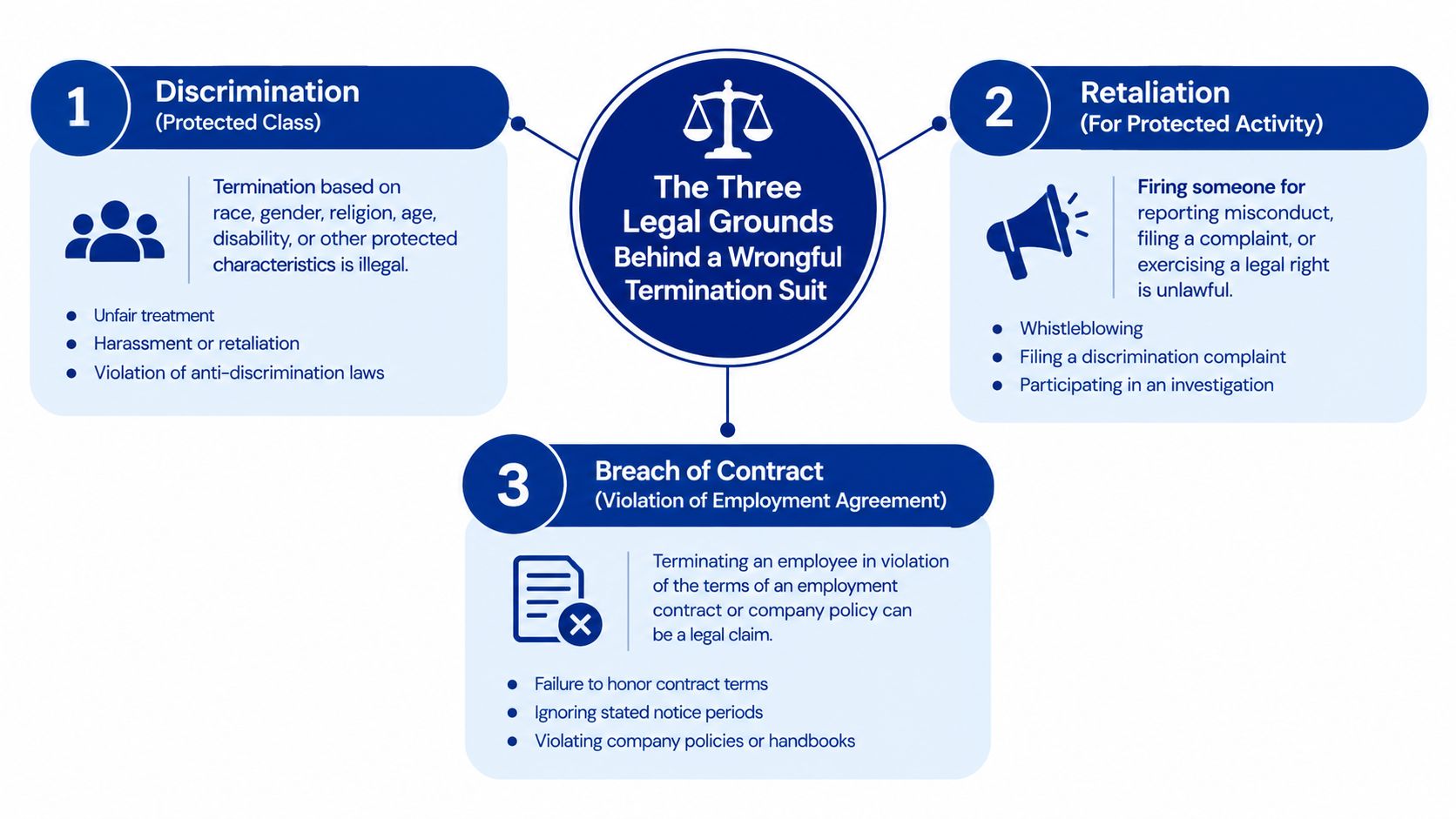
A discrimination theory alleges that the employer terminated the employee because of a legally protected characteristic. The relevant categories and standards vary by applicable federal and state law, but the practical question is usually whether the employee's protected status influenced the decision.
For example, an employee receives ordinary performance feedback for months. After disclosing a disability or requesting an accommodation, the manager describes the employee as a “problem” and recommends termination without documenting a comparable performance issue. The employer may still have a legitimate concern, but the timing, language, and treatment of similar employees can create a fact dispute.
A strong review compares the employee's treatment with that of similarly situated workers. It also examines whether the stated reason appeared before the protected characteristic became known, whether the reason changed, and whether the employer followed its own process.
Retaliation claims arise when an employee alleges an adverse action followed protected activity. Protected activity can include reporting discrimination or harassment, raising certain wage or safety concerns, requesting an accommodation, or seeking protected leave, depending on the law involved.
Consider an employee who reports harassment and then receives a negative evaluation from a manager who previously praised the employee's work. If termination follows soon after, the employer will need more than a conclusory statement that “performance declined.” It should be able to show what changed, who observed it, when it was documented, and whether the same standards applied to others.
Retaliation claims often turn on sequence and knowledge. The employer doesn't need to avoid every termination after a complaint, but it does need a credible, well-supported explanation for why the decision was necessary at that time.
At-will employment doesn't eliminate every possible claim. Employment agreements, offer letters, handbooks, incentive plans, collective bargaining agreements, and employer promises may create contractual obligations. State law can also recognize public-policy exceptions where the termination allegedly violates an important legal or public interest.
A long-run employment-law review reported that by 1985, 37 U.S. states had recognized the public-policy exception, 31 states had recognized the implied-contract exception, and 5 states had recognized the covenant of good faith and fair dealing exception, according to this review of employment-law development. Those figures explain why a general at-will assumption isn't enough for a multi-state employer.
The question isn't only whether the company could end employment. It's whether the company can prove that it ended employment for a lawful reason, using a process consistent with its obligations.
The legal trigger often sits in the timeline before the firing. An employee raises a complaint, requests leave, asks for an accommodation, participates in an investigation, or reports a workplace concern. Management then begins discussing performance, attendance, attitude, or restructuring. If termination follows, the employee may describe the sequence as retaliation or pretext.
That narrative gains strength when the employer's records are incomplete. A manager may remember performance problems that were never recorded, while the employee can produce emails showing positive feedback immediately before the complaint. A business may have changed direction, yet the decision file may not explain when that change occurred or why the employee was selected.
A useful review starts with dates and participants rather than labels. Put the following events in sequence:
This exercise often exposes gaps that a conventional termination review misses. It may show that the manager first recommended termination for attendance, later referred to attitude, and finally used restructuring in the separation letter. Multiple reasons aren't automatically unlawful, but unexplained changes make the decision harder to defend.
The historical development of at-will exceptions matters because states don't apply identical theories to the same facts. A termination that appears permissible under a broad at-will assumption may still raise questions about implied promises, public policy, contractual notice, or fair dealing in another jurisdiction.
Global operations face an even wider variation. In Nigeria, recent appellate developments reported for 2026 indicate that contractual notice pay isn't necessarily the ceiling for wrongful termination claims where a claimant proves denied hearing, stigma, retaliation, constructive dismissal, or other unfair labor practices, as described in the Nigeria employment-law developments guide. A contract allowing termination without cause therefore doesn't guarantee that the employer's exposure ends with notice pay.
For England and Wales, statutory minimum notice is one week after employment from one month to under two years, followed by one additional week for each full year from two to twelve years, capped at 12 weeks after twelve or more years, as explained by Citizens Advice. A contract can require more, and a reasonable notice period may be implied where no contractual clause exists, so the greater applicable requirement must be assessed, as outlined by Lewis Silkin.
For multi-state leaders: One termination checklist can create consistency, but it cannot replace jurisdiction-specific review.
The first response should protect the record and prevent avoidable statements. Leaders should not ask managers to “clean up” files, rewrite notes, or coordinate a single version of events. Those actions can make an ordinary dispute look like an effort to manufacture evidence.
Preserve relevant records immediately. Identify email accounts, messaging platforms, personnel files, performance systems, calendars, complaint records, leave communications, and documents held by decision-makers.
Issue a litigation hold with counsel. A hold should explain what must be preserved, who is covered, and which systems or devices may contain relevant information. Employees should acknowledge the instruction and understand that routine deletion or document destruction must stop.
Freeze personnel-file changes. Don't backdate warnings, add new explanations, or revise old evaluations. If a factual correction is necessary, record it transparently with the correction date and reason.
Engage employment counsel before responding. Counsel can help separate a demand letter from a filed claim, identify deadlines, evaluate privilege, and establish a communication plan. The employee should receive a professional response, not an improvised admission or accusation.
Create a decision chronology. Collect the original complaint, prior feedback, policy records, investigation materials, approval messages, and termination documents. Preserve original versions instead of relying only on exported summaries.
Audit consistency. Compare the employee's treatment with relevant comparators, including discipline, attendance enforcement, investigation standards, severance practices, and reasons for selecting employees during restructuring.
Do not contact former employees to pressure them about statements. Don't instruct managers to discuss the claim casually, and don't let a supervisor continue communicating directly with the claimant without guidance. A business can defend a difficult decision, but it becomes harder when leaders create new evidence after the dispute begins.
Civil wrongful termination claims generally place the burden on the employee to show that the termination was unlawful by a preponderance of the evidence. In many discrimination and retaliation cases, the employee first establishes a prima facie case, the employer states a legitimate nondiscriminatory reason, and the employee then attempts to show that reason was pretextual, as summarized in this employment-law burden-of-proof guide. The employer's immediate task is therefore to preserve the facts that support its legitimate reason, not to create a better reason later.
Good documentation records the decision as it developed. Vulnerable documentation reconstructs the decision after the employee complains. That distinction often matters more than the length of the personnel file.
A defensible record should show the specific concern, the source of the information, the policy or expectation involved, the employee's response, the investigation performed, and the action selected. It should also show whether the company applied the same standard to comparable employees.
| Defensive practice | Vulnerable practice |
|---|---|
| Performance concerns are recorded when they occur, with dates and examples. | The file contains no warnings, then suddenly describes long-standing poor performance. |
| The termination reason matches the prior decision record and exit communication. | Managers use different explanations in emails, meetings, and the separation letter. |
| Investigators identify witnesses, review evidence, and document findings. | Leadership relies on a brief conclusion without showing what was reviewed. |
| Comparable employees are considered before discipline is approved. | The company says the decision was consistent but can't identify comparable cases. |
| Corrections are dated and explained. | Personnel records are edited after a claim arrives without an audit trail. |
A complaint that precedes termination creates two related but distinct questions. First, did the employer respond appropriately to the complaint? Second, was the termination based on a legitimate reason unrelated to protected activity? Combining those questions can cause the same manager who is the subject of the complaint to control the termination decision.
Use an investigator with appropriate independence and define the scope before interviews begin. Preserve interview notes, identify documents reviewed, record credibility issues carefully, and avoid promising absolute confidentiality. If the investigation reveals misconduct, the employer should document how that finding affected the employment decision and whether the same outcome would apply without the protected complaint.
Operational discipline matters too. Consistent naming, version control, access restrictions, and chronology make the record easier to review. Leaders looking to improve the administrative side of this process may find practical law firm case management tips useful when organizing documents, deadlines, communications, and matter ownership.
The riskiest pattern is often a clean performance history followed by a protected complaint and then sudden termination supported by vague language. The employer may have a genuine concern, but the absence of earlier documentation gives the employee room to argue that the reason was invented to disguise retaliation.
Documentation isn't a substitute for fair decision-making. It must reflect real events, not a paper exercise. A detailed false record is more dangerous than a concise, accurate one because it creates additional credibility problems when witnesses or messages contradict it.
Prevention begins before a manager recommends termination. Managers should know how to escalate complaints, leave requests, accommodation issues, and investigations before they make performance or restructuring decisions. Training should use realistic scenarios, including an employee who raises a concern and then becomes subject to discipline.
A standardized process helps leadership ask the same core questions every time:
A single national template can improve discipline, but it shouldn't pretend that all states have identical rules. High-risk decisions deserve state-specific legal review, particularly when they involve recent complaints, leave, accommodation, alleged misconduct, senior employees, or a disputed investigation.
The cost of structured review is visible before a claim arrives. Leadership spends time clarifying facts, checking consistency, and correcting process gaps. The alternative is often a reactive review under pressure, with preserved evidence, witness memories, and explanations already working against the company.
Paradigm International Inc. provides HR risk and decision advisory for leadership teams handling terminations, investigations, manager conduct, documentation, and multi-state compliance. Its approach is suited to employers that need a structured decision partner rather than reactive HR administration, particularly when a termination carries legal, financial, or reputational consequences.
Paradigm International can help owners, COOs, HR directors, and executive teams review the decision history, complaint timeline, documentation, comparators, and communication plan before a high-risk termination proceeds. Visit Paradigm International Inc. to learn how a structured advisory process can support more defensible employment decisions.