
The seven steps typically move from verbal warning and written warning through suspension, final warning, role modification, and termination. Serious misconduct may require a different sequence, including immediate removal from the workplace or termination after a focused investigation.
A recurring attendance, conduct, or performance problem often starts with informal coaching. The manager explains the concern, offers direction, and expects improvement, but the same issue appears again. At that point, continuing with informal feedback can leave both the employee and the employer unclear about the seriousness of the problem.
Progressive discipline creates notice, an opportunity to improve, and a consistent record. It isn't a rigid checklist that forces every case through identical actions. Investigations, protected activity, serious misconduct, state requirements, union obligations, and company policy can change the appropriate response. For teams evaluating their broader operating model, HRSD for enterprise service delivery can provide useful context for connecting employee processes with structured service delivery.
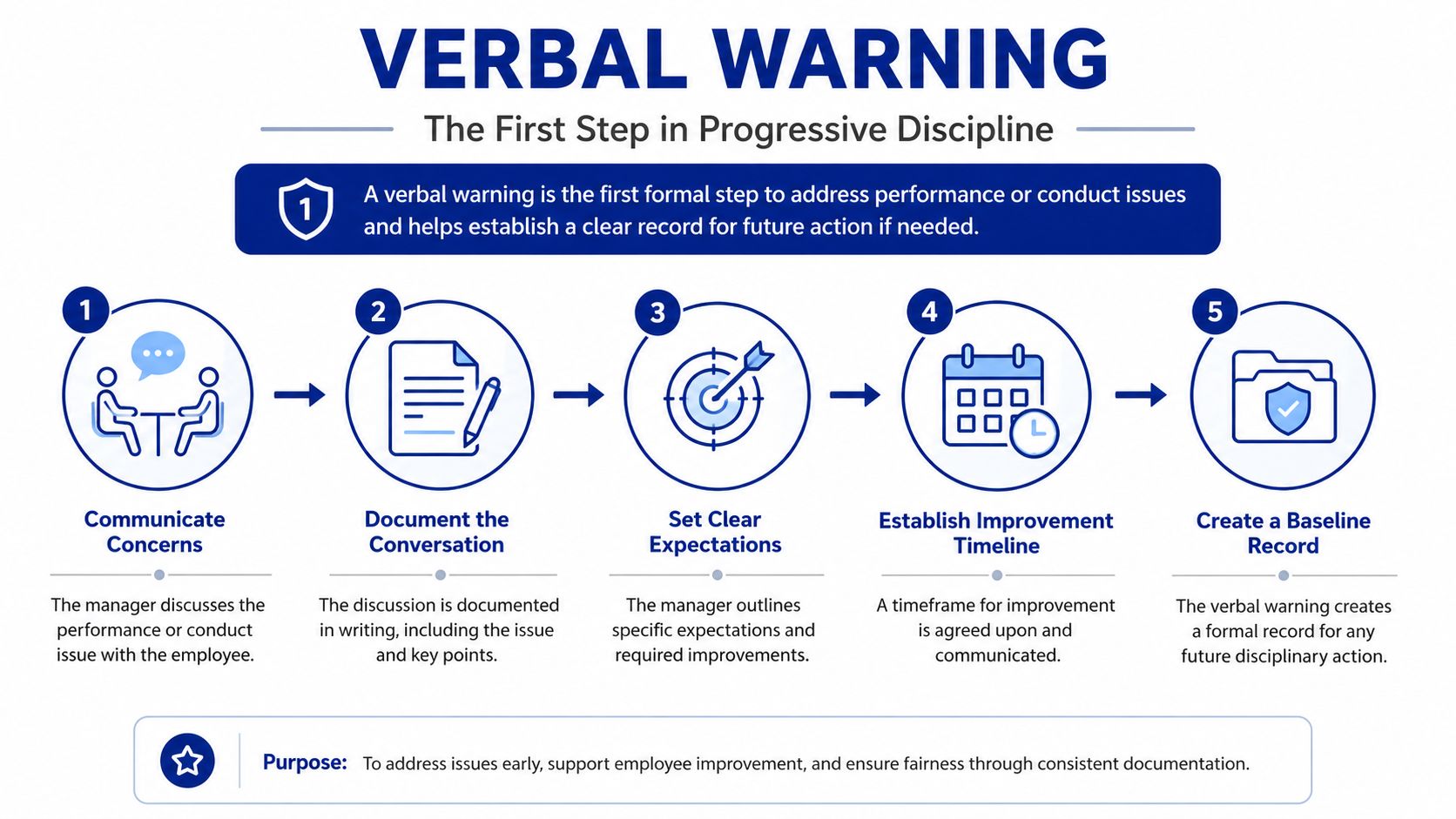
A verbal warning is usually the first formal step after informal coaching. The manager addresses the specific performance or conduct gap, explains the applicable expectation, and tells the employee what must change. The conversation may be verbal, but the record should not be.
A short written note created after the meeting should identify the date, issue discussed, employee response, expected improvement, and potential consequence of continued problems. That contemporaneous record helps show that the employee received notice and an opportunity to correct course. Progressive discipline is historically connected to labor relations and just-cause standards, including reasonable rules, notice, investigation, fairness, proof, equal treatment, and appropriate discipline, as described in the seven-part just-cause framework.
Consider a punctuality problem. If an employee repeatedly arrives late, the manager should reference the attendance expectation, describe the observed pattern without exaggeration, and explain how the employee must notify the company about future delays. The same approach works for missed quality standards or unprofessional communication in team meetings.
Practical rule: A verbal warning should feel corrective, not casual. The employee should leave knowing what happened, why it matters, and what successful improvement looks like.
Document the conversation promptly while details remain fresh. Ask the employee to acknowledge receipt, but treat acknowledgment as evidence that the document was delivered, not necessarily agreement. If the employee refuses to sign, record the refusal and retain the manager's notes. Multi-state employers should also confirm that the handbook and attendance language match the applicable local requirements, using resources such as employee handbook requirements by state.
A written warning turns a documented conversation into a formal corrective action. It should explain the issue, identify prior communication, state the relevant policy or performance standard, and describe the change required. The document should also explain what may happen if the employee doesn't improve.
The strongest warning uses observable facts rather than conclusions about attitude or character. Instead of saying an employee is unreliable, identify the missed deadlines, incomplete work, or attendance events that support the concern. An employee who previously received a verbal warning for missed deadlines should see that earlier discussion referenced, along with the required standard for future work.
A written warning can address several practical questions:
The most widely cited operational model uses escalating actions such as verbal counseling, written warning, suspension without pay, and termination. A classic HR publication on progressive discipline describes the approach as structured and stepwise, while the practical value comes from showing that penalties increased only after earlier correction attempts failed.
For a first written warning, an HR review is a sensible control. Gallaudet's progressive discipline procedure requires supervisor consultation with Human Resources before a first written warning and HR approval before a final written warning. That type of review can catch inconsistent wording, missing facts, or an overlooked accommodation or protected-activity issue.

Suspension removes an employee from work for a defined period while employment continues. It can be disciplinary, investigative, or both in practice, so the employer must state the purpose clearly. A disciplinary suspension communicates that the concern is serious, while an investigative leave should remain neutral until the facts are established.
This step may be appropriate after repeated warnings, a significant safety violation, or conduct that creates an immediate workplace concern. For example, an employee who violates a safety protocol may be removed from work, required to complete retraining, and given written expectations before returning. An employee whose inappropriate comment raises harassment concerns may need to remain away from the workplace while the organization determines what occurred.
The written notice should answer the questions an employee and later reviewer will have:
Don't announce the underlying allegation to the broader team. A professional message that the employee is temporarily unavailable protects confidentiality without creating unnecessary speculation.
A suspension can also provide time to gather facts, review records, and separate an emotionally charged incident from the final decision. It shouldn't be used as an automatic punishment whenever a manager feels frustrated. The employer still needs a fair process, consistent treatment, and a documented business rationale.

A final written warning tells the employee that employment is at serious risk. It generally follows earlier corrective action that didn't produce sustained improvement, although the employer may use it earlier when the circumstances justify a compressed response. The document should make the next consequence unmistakable without promising an outcome that the facts don't support.
Start by reviewing the entire record. Confirm that earlier warnings addressed comparable conduct, that the employee understood the expectations, and that the organization followed its own process. A final warning built on vague prior notes is weak, even if the current incident is well documented.
A useful final warning explains:
A final warning isn't a substitute for investigation. If the employee raises a new factual explanation, the manager should pause and evaluate it rather than treating the warning as predetermined. The same applies if the employee identifies a possible accommodation request, protected complaint, leave issue, or inconsistent treatment by another manager.
A final warning should close the ambiguity, not close the employee's opportunity to be heard.
Have HR review the document before delivery, especially when termination is a realistic possibility. The meeting should occur privately, with a witness when appropriate, and the employee should receive a copy or acknowledgment process consistent with company policy. Record the employee's response after the meeting, including any facts that require follow-up.
Termination isn't the only possible response when an employee isn't succeeding in a particular role. A demotion may reduce title, pay, or responsibility. A role modification may move the employee to different duties, a different department, or a less client-facing position while preserving employment.
This option works best when the employee has demonstrated value but isn't a good fit for the current assignment. A manager who struggles with team leadership might return to an individual contributor role, allowing the organization to retain technical capability while addressing leadership risk. An employee whose communication problems affect client relationships might move to back-office work, provided the decision is based on legitimate business needs and applied consistently.
Role changes carry their own risks. A poorly explained demotion can look retaliatory, discriminatory, or like an attempt to force a resignation. A pay reduction can also create practical concerns involving contracts, wage rules, incentive plans, or internal equity.
Document the decision with the same care used for a warning:
Don't describe the change as temporary unless the company intends to review it. Don't describe it as permanent if the organization may restore responsibilities after demonstrated improvement. Clear language protects the employee from false expectations and helps managers apply the arrangement consistently.
The best role modification is a documented business decision, not a disguised punishment. It should solve a real organizational problem while giving the employee a credible path to perform successfully.
Investigative suspension is different from disciplinary suspension. The first separates an employee from the workplace while the company gathers facts. The second is a consequence for conduct or performance that the employer has already evaluated.
Administrative leave can be appropriate when an allegation involves harassment, theft, financial misconduct, serious safety concerns, or possible interference with witnesses or evidence. Removing the employee may protect the integrity of the inquiry, but the employer should avoid language that implies guilt before the review is complete.
A sound notice should state that:
The employer should gather relevant documents, interview the complainant and witnesses, and give the accused employee a meaningful opportunity to respond. A rushed inquiry can produce a decision that appears predetermined. A well-organized process creates a clearer basis for deciding whether to reinstate, discipline, modify the role, or terminate.
For complex matters, investigation management that holds up in court requires more than collecting statements. The investigator should preserve records, separate facts from assumptions, and document why the final action matches the findings.
Communicate the outcome promptly once the review is complete. The organization can explain the result and next steps without disclosing confidential personnel details to the broader workplace.
Termination for cause ends employment because documented performance or conduct failures justify separation. The cause may involve repeated failure to improve, a serious policy violation, job abandonment, or misconduct established through investigation. It should never be a label added after the decision. The employer needs to identify the legitimate reason before taking action and confirm that the record supports it.
Progressive discipline often strengthens the decision by showing notice, correction opportunities, proportionality, and consistent escalation. Those principles align with the just-cause tests described in labor relations guidance on disciplinary decisions, although no single sequence automatically guarantees legal protection.
Immediate termination may be defensible when misconduct is serious enough to justify bypassing earlier steps. The Cornell Legal Information Institute's explanation of progressive discipline recognizes that employers may skip or compress steps for serious misconduct when the action rests on legitimate business reasons and the decision is documented. The employer should still investigate, compare similar cases, and check for protected activity or discriminatory treatment.
Before the meeting, complete a final review:
For owners and operators, SMB employer termination rules should be reviewed alongside company policy and state-specific requirements. Tell the employee the decision and next steps without debating every historical detail. Inform the broader team only that the employee has left and explain how responsibilities will be handled.
| Item | Implementation complexity | Resource requirements | Expected outcomes | Ideal use cases | Key advantages |
|---|---|---|---|---|---|
| Verbal Warning | Low, one-on-one conversation with brief follow-up note | Minimal, manager time and short written record | Notice of issue and opportunity to correct; baseline documentation | First-time or minor performance/conduct issues (e.g., punctuality) | Low-impact, quick, preserves goodwill |
| Written Warning | Moderate, formal document and meeting | Manager + HR review, signed acknowledgment | Stronger documented notice with measurable improvement timeline | Repeated issues after verbal warning or measurable performance gaps | Clear record, reduces disputes, legally defensible |
| Suspension or Temporary Leave | Moderate, policy compliance and written notice required | HR involvement, pay decision considerations, documentation | Temporary removal from workplace; time to investigate or de-escalate | Safety breaches, ongoing misconduct, cooling-off after escalation | Addresses serious problems without immediate termination |
| Final Written Warning | High, thorough review and formal issuance | Extensive documentation, HR/legal review, witness for delivery | Final opportunity to improve; explicit consequence of termination if unchanged | Failure to improve after prior steps; recurring serious misconduct | Unambiguous notice, strong defensibility before termination |
| Demotion or Role Modification | Moderate, role redesign and compensation adjustment | HR/legal for pay/wage compliance, documented new expectations | Employee retained in altered role; realigns duties to capabilities | Skill or fit mismatch, preserve institutional knowledge, training investment | Retains talent, less disruptive and often less costly than firing |
| Investigative Suspension / Administrative Leave | High, neutral framing and strict procedural controls | HR + legal oversight, investigation resources, often paid leave costs | Fact-finding without presumption of guilt; protects evidence and staff | Allegations of harassment, theft, fraud, or serious safety incidents | Enables impartial investigation, prevents interference or risk |
| Termination for Cause | High, final decision with legal and HR sign-off | Significant, complete documentation, legal review, exit logistics | Employment ends based on documented cause; reduces future liability if done properly | Serious misconduct, repeated failures after progressive discipline | Strong legal defensibility, enforces standards, final resolution |
The seven steps of progressive discipline are best understood as a defensible decision path, not an automatic ladder. The framework helps managers provide notice, document facts, offer a reasonable opportunity to improve, and apply consequences proportionately. It doesn't require an employer to use every step in every case.
A recurring attendance issue may begin with coaching and move through warnings. A serious safety or misconduct allegation may require an investigation before any disciplinary conclusion. A role modification may be more practical than termination when the employee can succeed in different duties. The correct response depends on the facts, the policy, the employee's history, and the risks surrounding the decision.
Before issuing high-risk discipline, use a deliberate review:
Written discipline is a risk-control system, not an HR courtesy. Poor records can increase exposure to wrongful termination, discrimination, retaliation, and implied-contract claims, while contemporaneous records help demonstrate a good-faith effort to correct behavior. Guidance on the consequences of failing to document disciplinary action reinforces the importance of retaining policies, standards, witness accounts, warning memoranda, and evidence of specific violations.
Consistency also affects whether employees trust the process enough to raise concerns. Recent workplace misconduct research from HR Acuity's 2025 workplace harassment and misconduct report connects reporting, resolution, and perceived fairness, which makes employee voice part of the control system rather than an administrative afterthought. Managers should invite a response, protect confidentiality, and explain expectations without humiliating the employee.
This principle applies beyond disciplinary events. Leaders handling tip pooling policies for restaurants face the same need for clear rules, consistent application, and documentation that matches actual operations.
Owners and HR leaders managing multi-state or regulated workplaces can learn more about advisory support from Paradigm International. A structured review before a high-stakes decision can help leadership teams move deliberately, preserve employee voice, and build records that are accurate rather than reconstructed later.
Paradigm International Inc. advises SMB leadership teams on terminations, investigations, manager conduct, documentation standards, and multi-state compliance considerations. Visit Paradigm International Inc. to discuss how a more consistent progressive discipline process can make future employment decisions deliberate and defensible.