
You review the monthly exits report. A few people resigned, one employee was terminated, and two long-tenured roles were left open because the business decided not to refill them. On paper, it all looks like employee loss. In practice, those departures mean different things for staffing, cost, compliance, and risk.
That is where many leadership teams get tripped up. They use attrition and turnover as if they mean the same thing, then make decisions based on a blurred picture of what is happening. For an SMB, particularly one operating across states or inside a regulated environment, that confusion can lead to weak hiring plans, poor documentation, and avoidable legal exposure.
Your monthly departure report is a lagging indicator. Ten exits can point to a planned reduction in force, a failed manager, a compensation problem, or a restructuring that was never documented cleanly. Those situations create very different staffing, legal, and operating risks.
The first mistake leadership teams make is treating all exits as one number. That total is easy to report and hard to use. The useful question is operational. What happened to the work after the employee left? If the answer is unclear, the exit data is not decision-ready.
That matters more in multi-state and regulated businesses. A role that is left open can trigger workload, wage and hour, control, and recordkeeping issues if the duties are redistributed without review. A role that is backfilled can signal persistent turnover, weak manager practices, or a hiring model that keeps recreating the same risk.
I advise clients to read exit data in three buckets: churn, planned role reduction, and mixed cases that need executive review. Mixed cases cause the most trouble because they often hide informal decisions. Someone leaves, the team absorbs the work, and six months later leadership still has no clear position record, no updated job description, and no defensible explanation for how exempt and nonexempt duties shifted.
Good exit analysis also depends on what employees said before they left. Stay conversations, manager notes, and guidance on effective exit interview practices often show whether the business is dealing with conduct, burnout, poor supervision, unclear role design, or a job that no longer fits the operating model.
Classification is the control point.
Without it, attrition versus turnover turns into a vocabulary argument. With it, leadership can decide whether to hire, redesign, document, train, or investigate.
| Workforce change | What it usually means | Leadership question | Primary risk |
|---|---|---|---|
| Turnover | Someone left and the role will be filled | Why did this person leave, and why do we still need the role? | Repeated hiring, disruption, weak retention |
| Attrition | Someone left and the role will not be filled | Is the role eliminated, or are duties just being shifted informally? | Knowledge loss, overloading staff, poor restructuring records |
| Mixed pattern | Some roles replaced, others removed | Which exits reflect business design versus avoidable churn? | Misreading workforce health |
The difference comes down to one operational question. Will the company replace the employee who left?

If the answer is yes, you are looking at turnover. If the answer is no, you are looking at attrition.
That sounds straightforward, but it changes how you interpret most workforce signals.
Turnover measures employees who leave and are replaced, whether the separation was voluntary or involuntary. It captures motion through the organization. Someone exits, recruiting starts, and the role remains part of the operating model.
A straightforward formula applies: (Total Departures ÷ Average Headcount) × 100. That formula is widely used for both metrics, but the classification depends on replacement intent. Lattice’s explanation of turnover and attrition also notes that healthy organizations typically target rates below 10%, while industry benchmarks vary widely, including 10% in energy and 60% in retail.
Turnover points leadership toward questions like these:
Attrition measures employees who leave and are not replaced. The role disappears, at least in its previous form. This happens through retirement, restructuring, consolidation, or a deliberate decision not to backfill.
That makes attrition less about churn and more about net workforce reduction. In some organizations, that is a healthy sign of redesign. In others, it is a silent warning that critical work is being redistributed without enough planning.
Consider it like shelving in a warehouse. Turnover means one box leaves and another takes its place. Attrition means the shelf space is removed from inventory entirely. If that removal is intentional, operations adapt. If it is not, gaps show up later in service, compliance, or team capacity.
Executives want one workforce number they can glance at and move on. That is understandable, but it creates blind spots.
Key takeaway: Turnover tells you whether the organization keeps having to refill seats. Attrition tells you whether the organization is shrinking or reshaping those seats.
That distinction drives different business decisions. Turnover calls for retention work, hiring discipline, and manager accountability. Attrition calls for succession planning, workload analysis, and proof that a role was eliminated rather than informally left vacant.
The math is not difficult. The challenge is using the right inputs and reading the result correctly.
For either metric, you need a reasonable average employee count over the period you are measuring. Many SMBs track month by month, then use that period average as the denominator.
Once you have average headcount, classify each departure before you calculate anything. Do not start with “how many left.” Start with “which of these roles are being replaced.”
Use this order:
| Metric | Variable | Example Data | Calculation | Result |
|---|---|---|---|---|
| Turnover | Employees left and were replaced | 20 departures, 100 employees | (20 ÷ 100) × 100 | 20% |
| Attrition | Employees left and were not replaced | 5 departures, 200 employees | (5 ÷ 200) × 100 | 2.5% |
| Turnover | Average headcount method | 10 departures, average headcount 91 | (10 ÷ 91) × 100 | 11% |
| Voluntary turnover subset | Voluntary departures only | 8 voluntary departures, average headcount 91 | (8 ÷ 91) × 100 | 8.8% |
| Turnover | Average of changing headcount | 20 departures, average headcount 175 | (20 ÷ 175) × 100 | about 11.4% |
The replacement decision is what makes the result meaningful. TalentHR’s examples on attrition vs turnover show that a company with 100 employees and 20 people who leave and are replaced has 20% turnover, while a company with 200 employees and 5 departures that are not replaced has 2.5% attrition.
A percentage by itself can mislead leadership.
If turnover is elevated, the first question is not whether the number looks high in a vacuum. The first question is whether the exits are concentrated in one part of the business. A broad pattern may signal compensation or market pressure. A narrow pattern points to a management or job-design issue.
If attrition is elevated, look at what work disappeared with the role. If the work ended, the number may reflect a strategic shift. If the work is being done by other employees without formal redesign, then attrition is masking strain.
A good dashboard separates signal from noise. At a minimum, review these views consistently:
Practical tip: Decide in advance how your business determines whether a role counts as replaced or eliminated. If leaders decide that informally after the fact, your reporting will drift and your documentation will weaken.
Broad benchmarks can help leadership avoid overreacting. Industry variation is considerable, and what looks severe in one sector may be common in another.
Still, the benchmark should never override local facts. A “normal” turnover rate means little if one manager is driving exits in a critical function. A “low” attrition rate can still be dangerous if the organization is losing institutional knowledge in hard-to-replace roles.
A departure metric is not the issue. The issue is what the metric reveals about how the business is functioning.
High turnover creates immediate operational pressure. Open seats need coverage, recruiters move quickly, managers pull people away from their own work to interview and train, and customers or patients feel the inconsistency first.
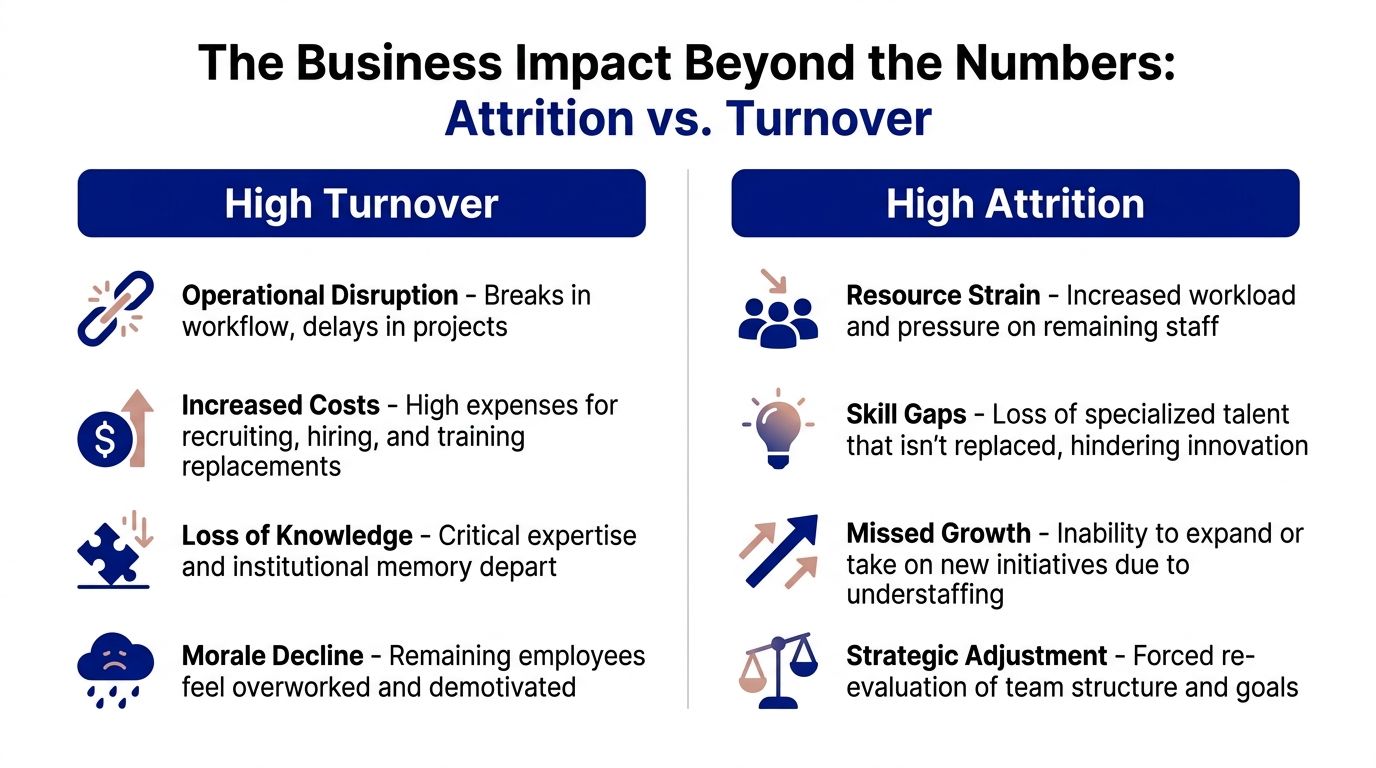
Attrition can feel less urgent because no replacement search starts. That is why leadership teams underestimate it. The cost shows up later through capability gaps, delayed growth, and overloaded teams.
Turnover is a symptom, not the root problem. It may reflect weak selection, poor supervision, burnout, misaligned pay practices, or a work environment that people do not want to stay in.
Its impact is direct. EWS explains turnover’s business effect using the standard formula (Number of separations ÷ Average number of employees) × 100, and notes that 42% of turnover is preventable. The same source cites Deloitte’s finding that data-driven firms addressing the issue see 82% higher 3-year profits.
When turnover rises, the business pays twice. It pays to lose the employee, and then it pays again to replace them under pressure.
Leaders should not read turnover as a recruiting challenge. It is a management systems problem. If people keep leaving and the role keeps reopening, the organization is learning the same lesson repeatedly at a high cost.
Attrition tells a different story. It may be strategic, particularly when leadership is consolidating roles, adjusting service lines, or allowing natural departures to reshape the organization over time.
The risk is that attrition can look efficient while weakening execution. A role disappears from the chart, but the work usually remains. Someone else inherits tasks, client relationships, reporting obligations, or regulated duties.
That is where attrition becomes dangerous. If the transfer of work is informal, undocumented, or unrealistic, the business can create hidden pressure that later shows up as service problems, burnout, or another wave of turnover.
Turnover and attrition both involve exits, but they create different operational consequences.
| Pattern | What leadership sees first | What often follows |
|---|---|---|
| High turnover | Hiring volume, vacancies, repeated onboarding | Lower morale, inconsistent service, repeated training burden |
| High attrition | Lower payroll, fewer backfills, leaner chart | Loss of know-how, reduced capacity, narrowed growth options |
A useful diagnostic question is whether leadership is trying to solve a people problem or a design problem.
Numbers alone do not tell you whether a departure helped or hurt the business. Leadership has to connect the data to role criticality, manager effectiveness, customer impact, and compliance obligations.
That is why I advise executives to review exits in three layers:
A low headline exit number can hide a serious workforce issue if the wrong people are leaving, or if critical work is being spread across already stretched teams.
Good leadership does not chase the lowest possible exit rate. It makes deliberate choices about which departures to absorb, which roles to refill, and when a staffing change improves the business.

The question is “Which option best supports the organization’s future state with the least avoidable risk?”
Strategic attrition works when leadership already knows the role is no longer necessary in its current form. That can happen after automation, process redesign, service-line changes, or consolidation of overlapping responsibilities.
This route lowers short-term disruption because there is no active replacement cycle. ExtensisHR’s discussion of attrition vs turnover notes that turnover costs average $4,700 per hire, while strategic attrition can provide a lower-cost path to right-sizing.
That does not mean attrition is the better choice. It works when leaders can answer hard questions:
If those questions do not have clean answers, attrition becomes wishful thinking rather than strategy.
Intentional turnover is a tougher leadership move, but the right one. This means the business decides the role remains necessary, yet the current fit is not sustainable or aligned with future needs.
This can apply when performance has not improved despite support, when a role needs stronger technical depth, or when an evolving business requires different leadership capability. Replacing the person can strengthen execution, accountability, and culture.
The risk here is speed. Leaders move to replace without fixing the conditions that caused the problem. If the manager, scope, workload, or expectations remain broken, the organization rotates new people through the same failure point.
Use four tests before choosing strategic attrition or intentional turnover.
Ask whether the position is still essential in the business model. If yes, attrition is usually the wrong answer. If no, replacement may be unnecessary.
Map where the work will go. If the answer is vague, you do not have an attrition plan.
Some roles carry more institutional, client-facing, or regulatory weight than others. A departure in those roles requires more caution, even when elimination seems efficient.
Leaders need records that show why the role was retained, replaced, redesigned, or removed. Weak documentation turns ordinary workforce planning into avoidable exposure later.
Strategic attrition is a design decision. Intentional turnover is a talent decision. Problems start when leadership treats one like the other.
Several patterns create trouble quickly:
Executives do not need more HR jargon here. They need disciplined choices. Attrition vs turnover becomes useful when leadership applies it to organizational design, not just reporting.
A controller marks an exit as attrition to freeze headcount. Two weeks later, a hiring manager opens a requisition for the same work in another state. That gap between what the company recorded and what it did is where compliance trouble starts.

For multi-state employers, attrition versus turnover is not a reporting preference. It affects how the business handles hiring, separation records, unemployment responses, benefits administration, and state-specific employment obligations. In regulated environments, it also affects whether the company can show that required duties remained covered after the departure.
Turnover usually means the role continues. Once leadership replaces the employee, the company may trigger new posting, onboarding, pay transparency, tax registration, notice, and policy obligations based on where the replacement will work.
Attrition creates a different compliance record. If the role is eliminated, the employer may need to defend that decision in an unemployment claim, explain benefit treatment, assess threshold effects, or document why the work can be absorbed without creating wage and hour or supervision problems.
The legal issue is rarely the label by itself. The issue is whether the company can prove the label matched the business decision.
Most exposure begins as an operating problem, then becomes a legal one. HR codes the exit as eliminated. Finance removes the position from budget. Operations redistributes the work. A manager later asks recruiting to fill a similar role in a different state because service levels dropped.
That sequence creates avoidable risk in several areas:
Healthcare groups, financial services firms, and professional practices carry obligations that outlast the person in the seat. A title can disappear on the org chart while the underlying duty still has to be performed by a licensed, supervised, or trained worker.
That is why attrition decisions in regulated businesses require a role-duty review, not just a headcount decision. If the employee handled patient documentation, privacy controls, client trust activity, supervisory review, or required staffing coverage, leadership needs a documented plan for who owns that work next.
Distributed teams add another layer. State law, local practice, manager discretion, and remote work arrangements can pull in different directions unless the company uses one standard. For a structured view of compliance for multi-state remote workers, see a structured view of compliance for multi-state remote workers.
If your records cannot show whether the role ended or continued, you do not have a defensible workforce decision.
Start with the approval record. Document the reason for classifying the exit as attrition or turnover when the decision is made, not after someone questions it. If the role is eliminated, record who approved it, which duties end, which duties transfer, and whether the change affects reporting lines, exempt status, workloads, or required coverage.
Then test the paper trail against actual behavior. The org chart, budget, payroll coding, separation notes, job postings, and manager communications should all match. If they do not, fix the classification or fix the operating decision.
Agencies, auditors, and plaintiff counsel look for contradictions. Multi-state employers should assume every inconsistency will be read as evidence that leadership made the decision first and tried to justify it later.
A monthly exit report should help leadership make staffing decisions that hold up under scrutiny. If it only counts departures, it is too weak to guide hiring, coverage, or compliance risk.
Start with operating discipline. Every departure needs an owner, a classification, and a business decision attached to it. Record whether the role will be backfilled, when that decision will be reviewed, and what business risk sits with the vacancy in the meantime. In regulated or multi-state environments, that step matters because a delayed replacement can create payroll control gaps, licensing coverage problems, missed supervisory review, or service failures that do not show up in the headcount report until later.
Use a short review standard that managers can follow and leadership can audit:
One exit can be situational. A pattern usually points to a controllable problem.
That is why workforce stability review belongs in the same operating cadence as budget, hiring, and risk review. Compare exit patterns with overtime, service issues, employee complaints, leave trends, audit findings, and manager span of control. That gives leadership a better basis for action than exit counts alone.
Retention also needs executive ownership. Teams that want to reduce avoidable loss should treat preventing employee turnover as an operating issue, with clear accountability for manager behavior, workload design, pay decisions, and hiring quality.
The goal is intentional exits, accurate classification, and staffing decisions the business can defend later.
Handled well, attrition and turnover metrics become an early warning system. They show where the business is accepting risk, where managers need intervention, and where a staffing decision may create a compliance problem before anyone labels it one.