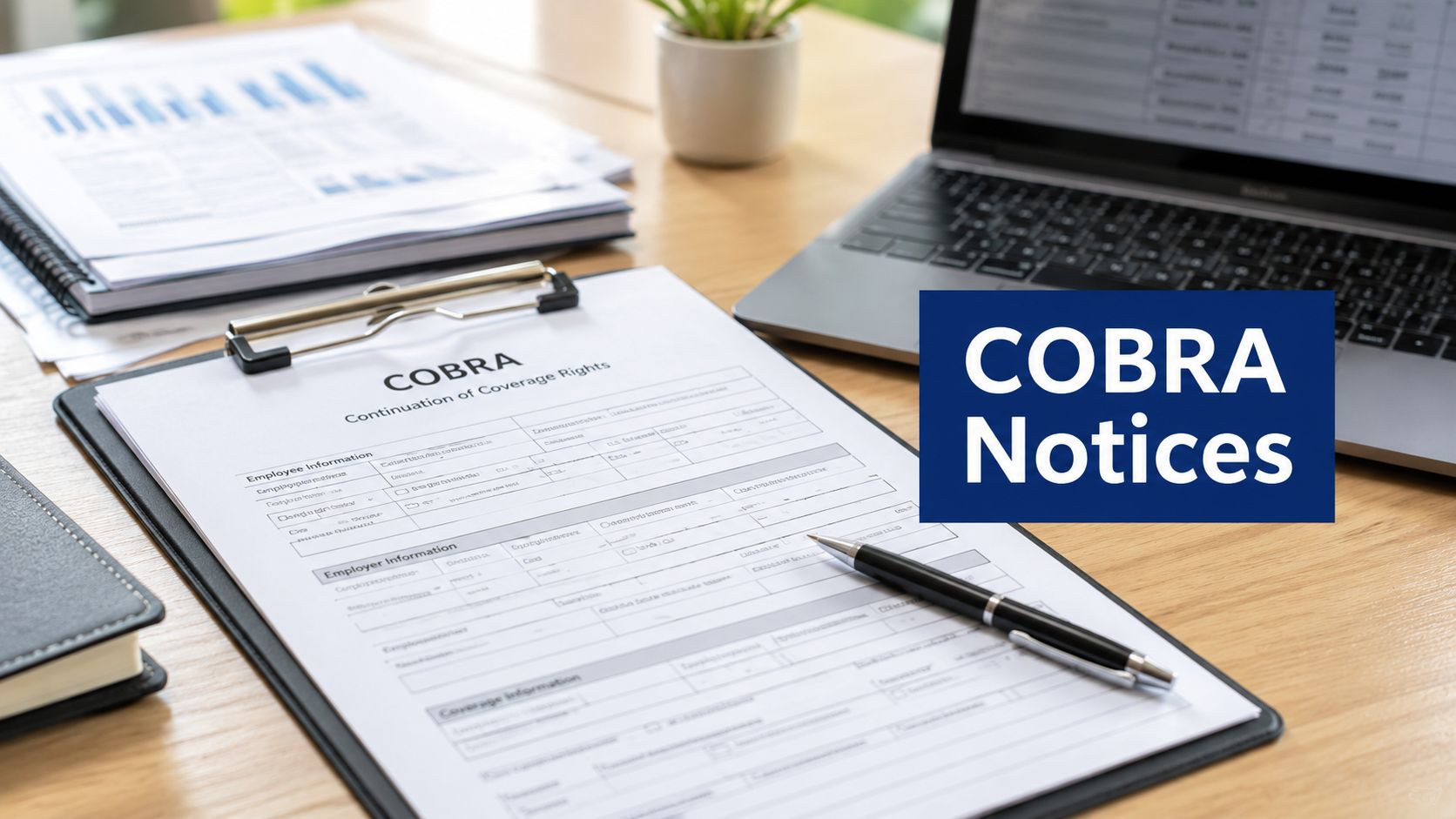
COBRA requires a 90-day general notice, a 30-day employer notice to the plan administrator after a qualifying event, and a 14-day election notice after that notice is received. If the employer is also the plan administrator, the election notice deadline becomes 44 days from the qualifying event.
That's the clean answer, but most businesses run into trouble because COBRA isn't a single notice. It's a chain of written steps, and each step depends on who triggered the event, who administers the plan, and whether state mini-COBRA rules add another layer. If you're managing benefits, terminations, or HR for a growing company, the question isn't whether COBRA applies, it's whether your process can prove every notice went out on time and to the right people.
COBRA notification requirements are the written notice duties that make continuation coverage work in practice. They're not just a courtesy to departing employees. They're the mechanism that tells covered people what rights they have, when they can act, and who must respond when coverage changes.
For a business owner, the important point is that COBRA is a process, not a single document. The process starts before anyone leaves, continues when a qualifying event happens, and can involve the employee, spouse, dependents, the employer, and the plan administrator. That's why weak file handling or informal handoffs create avoidable risk, especially when a company has managers in more than one state.
A lot of small and midsize employers treat COBRA like an exit paperwork issue. That's too narrow. The federal framework expects a documented sequence, and the sequence changes based on the event and who holds each responsibility.
The operational trade-off is simple. A loose process may feel faster, but it makes it harder to prove compliance later. A structured process takes more discipline upfront, but it gives you a clearer defense if a former employee says they were never notified.
Practical rule: If you can't show who sent each notice, when it went out, and who received it, your COBRA process is incomplete even if the forms were prepared correctly.
Multi-state employers feel this pressure most. A company with locations in different jurisdictions may have one set of federal obligations and another set of state continuation rules layered on top. That means the compliance answer isn't just “Did HR send something?” It's “Did the right notice go to the right person under the right rule at the right time?”
For a practical next step, many teams start by aligning COBRA workflows with their broader termination documentation. A good place to compare that approach is the employee termination checklist, because COBRA failures often begin with a missed internal handoff rather than a bad notice form.
The federal notice chain works like a relay. One party starts the process, another party passes the baton, and the final notice goes to the person whose coverage changed. If one handoff is late, the whole chain is exposed.
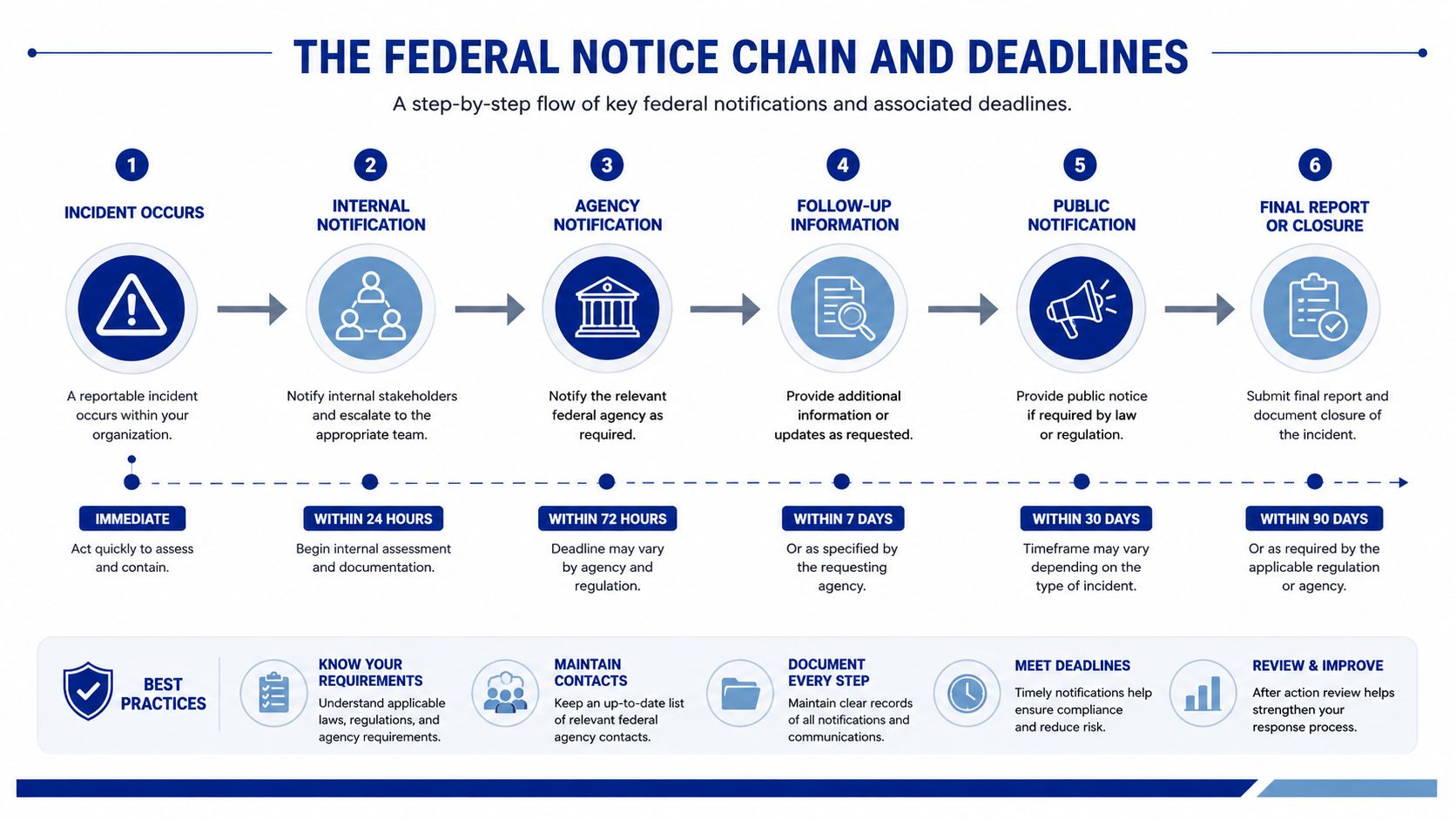
The first notice is the general notice. It must be furnished to each covered employee and spouse within 90 days after coverage under the group health plan begins, and it has to explain the plan, the types of qualified beneficiaries, qualifying events, and the employer's duty to report certain events, including death, termination, or reduction in hours. That timing comes from the Department of Labor's model notice guidance and COBRA notice materials, which also make clear that the notice is tied to the start of coverage, not the end of employment. DOL COBRA model notice guidance
The second step starts when a qualifying event happens, such as termination or reduction in hours. The employer then has 30 days to notify the group health plan administrator. CMS states that same 30-day rule for termination or reduction in hours, so this is not a soft internal goal. It is a fixed deadline that drives the rest of the chain. CMS COBRA Q&A
The third notice is the election notice. The plan administrator has 14 days after receiving notice of the qualifying event to send it to the affected person. If the employer also serves as the plan administrator, the combined outside limit is 44 days from the qualifying event. That timeline is also reflected in federal COBRA notice summaries used by plan administrators and insurers. Federal COBRA notice summary
| Notice Type | Deadline | Who Sends | Who Receives |
|---|---|---|---|
| General notice | Within 90 days after coverage begins | Plan sponsor or plan administrator | Covered employee and spouse |
| Employer notice of qualifying event | Within 30 days after the event | Employer | Group health plan administrator |
| Election notice | Within 14 days after the administrator receives the event notice | Plan administrator | Affected qualified beneficiary |
| Election notice when employer is the administrator | Within 44 days after the event | Employer and plan administrator | Affected qualified beneficiary |
For a business, the issue is not the calendar alone. It's whether HR, payroll, and benefits administration share a documented process that records the event date, the handoff date, and the mailing date. Without that record, you may know what happened internally, but you may not be able to prove it later.
If you want to map those federal deadlines against continuation coverage itself, the COBRA continuation rules article is a useful companion.
Responsibility under COBRA is split, and that split creates the most common confusion. Employers are usually the first movers after a termination or hours reduction, but beneficiaries can also have reporting duties when the qualifying event is something personal, like divorce or a child aging out.
The employer's role is clear in the federal chain. Once a qualifying event such as termination or reduction in hours occurs, the employer must notify the plan administrator within 30 days. That part is straightforward because it sits inside the company's own control. The harder part is making sure the event gets reported to the right person fast enough.
Beneficiary-triggered events are the hidden risk. The Department of Labor says the plan can require the employee or qualified beneficiary to report certain events, including divorce or a child aging out of coverage, and the notice window must be at least 60 days from the latest trigger date. That means COBRA is not a termination-only workflow. It can rely on action from the spouse or dependent, and many SMBs never build that into their process. DOL worker guide to COBRA
The initial general notice also reaches beyond the employee. It must go to the covered employee and spouse within 90 days after coverage begins. That detail gets missed often because many onboarding files are built around the employee record alone. If the spouse never receives the notice, the company has a documentation gap before any qualifying event even happens.
Practical rule: The person who triggers the event is not always the person who receives the notice, and that's exactly where compliance breakdowns start.
A good way to pressure-test your process is to separate the event source from the notice recipient. A termination may start with management, move through HR, and end with the plan administrator. A divorce, by contrast, may depend on the beneficiary's own notice to the plan. Those are different control points, so they need different file paths.
If you're reviewing how your company tracks who owes what, the data owner responsibilities guide is a useful way to think about accountability across departments. For the HR side, that same discipline should be reflected in your employee termination checklist, because the notice chain usually fails when ownership is vague.
Federal COBRA is only part of the picture. In states with mini-COBRA laws, the rules can extend continuation coverage to employers that are too small for federal COBRA or add notice steps that federal rules don't require. For multi-state operators, that means one standard benefits workflow may not be enough.
Mini-COBRA laws matter because they can cover smaller employers, while federal COBRA generally applies to group health plans with 20 or more employees. That difference changes the compliance question for a lot of SMBs. A company that thinks it is exempt at the federal level may still owe continuation rights under state law, depending on where it operates.
The safest comparison is not “federal versus state” in the abstract. It's “which locations have local continuation coverage rules, and do those rules change the timing or the recipient list?” Some states also require additional notice content, which means a federal template alone may leave out material language. A template that works in one state can be incomplete in another.
For California employers, that issue is especially important because state continuation requirements can overlap with local employment practices. The California employer health insurance guide is a useful reference point if your workforce spans that state and you need to separate federal COBRA from state-level obligations.
The best approach is to build a state-by-state matrix and treat it as part of your benefits file. That matrix should show which locations are subject to federal COBRA, which rely on mini-COBRA, and which notice templates apply. Without that mapping, HR teams tend to assume one workflow fits all, and that's where avoidable errors creep in.
A simple decision rule helps:
A structured compliance checklist also helps here, especially if your team already uses a SaaS compliance checklist for other employment tasks. The same thinking applies here, because COBRA is easier to manage when state variation is tracked before the event happens, not after.
A defensible COBRA process starts with records, not reminders. The companies that handle this well do not rely on memory or a single HR inbox. They create a file trail that shows who knew what, when they knew it, and what was sent next.
Your COBRA file should hold the exact notice version sent, the date it was sent, the delivery method, the recipient name, and the address used. If you can't reconstruct those details later, the file is not audit-ready. That's true even if the notice itself was correct.
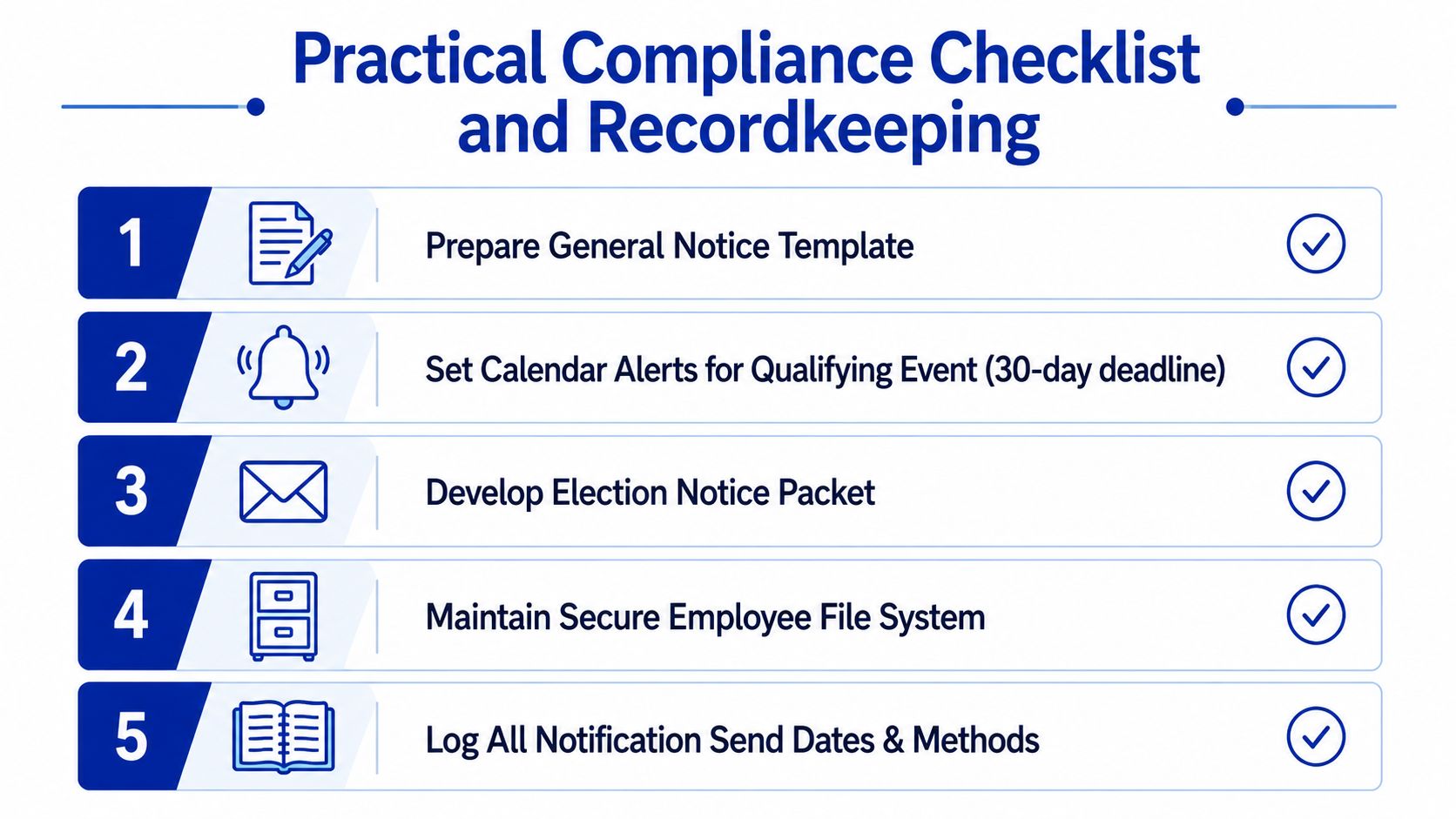
A practical checklist looks like this:
Practical rule: A good COBRA file answers three questions without extra explanation, what was sent, when it was sent, and how you can prove it.
Using a template is smart. Using one without customization is where employers get into trouble. The notice needs to reflect the correct event, the correct people, and the correct plan details. A template that skips those variables can create the appearance of compliance while leaving out the information the recipient needs.
One operational trade-off comes up here. Automated systems reduce manual errors, but they still need accurate input. Manual processes are flexible, but they're much easier to break during busy termination periods. Most smaller teams need both structure and review, not one or the other.
Paradigm International Inc. is one advisory option for companies that want a documented HR process around terminations, notice timing, and multi-state exposure. The firm's role is to help leadership teams build defensible practices around employment risk, not to replace legal counsel.
For a broader recordkeeping lens, the employment records retention requirements resource pairs well with COBRA file design, because the same documentation habits support both benefits compliance and general HR defense.
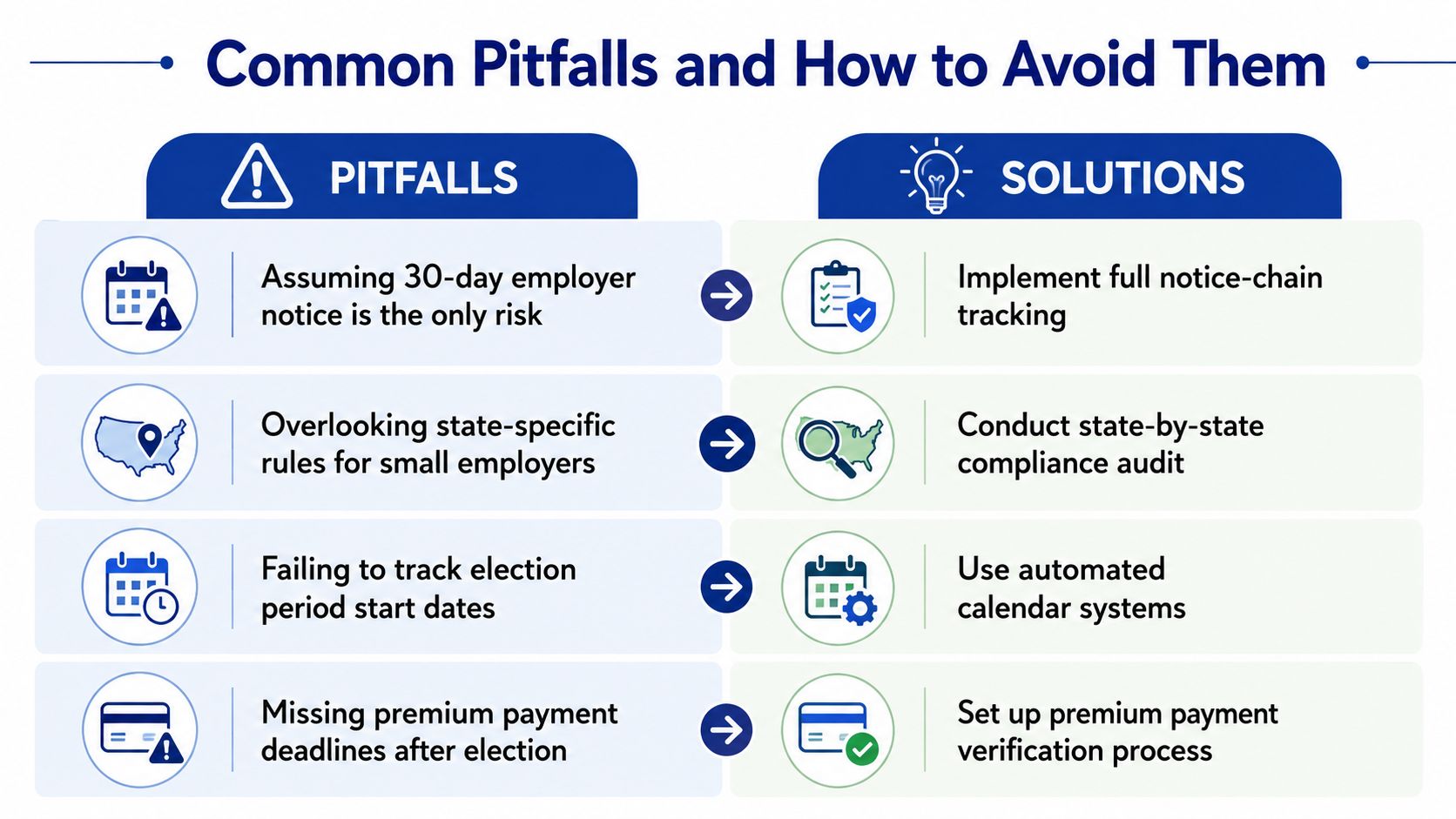
The biggest COBRA mistake is assuming the 30-day employer notice is the whole story. It isn't. That deadline matters, but most real exposure comes from everything around it, especially who got notified, whether the initial notice went to the spouse, and whether the company can prove what it sent.
The first pitfall is ignoring beneficiary-triggered events. Divorce, death, and a child aging out can all change the coverage picture, but these events often depend on notice from the employee or qualified beneficiary. If your process only watches terminations, you've already left a gap.
The second pitfall is treating the general notice like a boilerplate onboarding add-on. The notice must reach the covered employee and spouse, and it has to do so within 90 days after coverage begins. If your onboarding process only tracks the employee record, you may never have proof that both people received it.
The third pitfall is assuming the election notice can be informal or verbal. It can't. An exit conversation is not a written election notice, and it doesn't start the beneficiary with the information they need to make a timely decision. A spoken explanation may help in the moment, but it does not replace the formal notice chain.
The fourth pitfall is weak documentation. If a former employee says they never got the notice, your company needs more than a memory of mailing it. That is where date-stamped logs, copies of the sent notice, and a reliable delivery method become essential.
The employers that avoid COBRA problems are usually not the ones that know the rules best. They're the ones that built a repeatable process before the event happened.
A better system separates notice creation from notice approval and notice delivery. That way, one person can't accidentally skip a step under pressure. It also helps to tie COBRA workflows to payroll or HRIS event flags so that terminations and hours reductions cannot sit unnoticed in an inbox.
For state-heavy employers, the fix is a location review. You need to know which employees are in federal COBRA territory and which are subject to state continuation rules. A single federal template cannot safely cover every site if the state law adds different obligations.
COBRA compliance is easier to manage when you treat it as a documented chain instead of a one-time notice. The key deadlines are fixed, the spouse and beneficiary issues are easy to miss, and state mini-COBRA rules can add another layer for multi-state employers. If your process can't show the notice trail from start to finish, it needs tightening.
The right next move is to review your onboarding packet, termination workflow, and state coverage map together. That's the fastest way to spot where notice timing, recordkeeping, or recipient tracking is weak. If you need a structured advisory partner for that review, International Inc. works with SMB leadership teams on employment risk, documentation standards, and multi-state compliance planning.
If you want help tightening your COBRA process, Paradigm International Inc. can help you build a clearer, more defensible workflow around notice timing, documentation, and state-specific exposure. Visit Paradigm International Inc. to discuss how their advisory team supports business owners who need practical compliance structure without adding unnecessary complexity.