
Designing an organizational structure is more than just drawing boxes on a chart. It is the strategic process of aligning roles, responsibilities, and reporting lines to achieve your business goals. Think of it as the blueprint for how work gets done, how decisions are made, and how your company operates efficiently. A thoughtfully designed structure provides the clarity your team needs and a solid foundation for manageable growth.
For any growing business, designing your organizational structure is a critical leadership responsibility. This is not just an HR exercise; it is a strategic tool for managing complexity, ensuring accountability, and fostering a productive work environment. When a structure is poorly defined or outdated, it can lead to role confusion, duplicated work, and internal friction that slows progress.

As the skeleton of your business operations, this framework directly impacts your ability to scale effectively. It is the mechanism that turns your long-term vision into day-to-day execution.
The consequences of neglecting your organizational design often remain hidden until they become significant problems. Without clear reporting lines and well-defined responsibilities, employees may not know who to turn to for decisions. The result can be delays, missed opportunities, and widespread frustration.
This ambiguity creates several tangible risks:
An intentional organizational structure is not just about efficiency; it is a fundamental component of risk management. It establishes the guardrails that protect your company from inconsistent decision-making and preventable legal exposure as you grow.
This guide provides practical, actionable steps to build a structure that delivers clarity, defensibility, and a strong foundation for your company's future. The goal is to move past theory and give you the tools to create a design that works for your business, not against it.
If you are facing these challenges and need expert guidance on creating a scalable structure, you can contact our advisory team.
Designing your company's structure without a clear business strategy is like building a house without a blueprint. An effective organizational structure is a direct reflection of your company's mission and strategic goals. It should be designed to support how your business creates value and serves its customers.
Before you start defining roles and reporting lines, it is essential to identify the core activities that drive revenue and customer satisfaction. The purpose of your organizational structure is to ensure that every role and team directly supports this value chain.
First, map out the primary activities your company performs to deliver its product or service. These are the non-negotiable functions that are essential to your operations, such as sales, marketing, operations, product development, and customer support. If these activities stopped, the business would quickly stall.
Next, identify the supporting functions that enable these core activities. This includes departments like HR, IT, finance, and legal. This distinction helps clarify how to allocate resources and structure reporting lines so your revenue-generating functions have the support they need to succeed.
An organization's structure should be designed around its strategy, not the other way around. If your strategy is to be a leader in customer service, your structure must empower your support teams with the authority and resources they need to resolve issues quickly.
To achieve this alignment, it helps to have a solid grasp of strategic workforce planning. This discipline connects your high-level business goals to your daily talent decisions.
Once you have a clear picture of your core functions, you can select a foundational model for your structure. While most companies use a hybrid approach, nearly all designs are based on a few classic models. Each has its own advantages and is better suited for different strategies and growth stages. Connecting these choices to your broader people strategy is key, and you can get more context on how to build an HR strategy for growth.
To help you decide, here is a breakdown of the most common models used by small and mid-sized businesses.
Ultimately, the best model is the one that removes friction and speeds up the execution of your unique strategy.
With these models in mind, it is time to assess your current setup. How does your existing structure help or hinder your strategic goals? Look for common pain points, such as decision-making bottlenecks, communication gaps between teams, or roles with unclear ownership.
This requires asking some direct questions. If your strategy depends on rapid innovation, does your structure trap ideas within siloed departments? Answering these questions honestly will highlight the gaps between your current structure and your future needs. The HR consulting industry is projected to reach $39.4 billion in the U.S. by 2025, a clear sign that more businesses are seeking expert help to align their organizational design with their strategy.
Once your business strategy is clear, the next step is to translate that vision into well-defined roles. Ambiguity is a significant source of inefficiency and operational risk. When people lack clarity on their responsibilities, it can lead to duplicated efforts, missed deadlines, and frustration.
This is where you move from abstract concepts to concrete details. It involves meticulously defining responsibilities, reporting lines, and levels of authority. By documenting these elements, you create a single source of truth that empowers your team and protects your business.
A job title is not a job description, and neither is sufficient on its own. True role clarity comes from defining accountabilities—the specific outcomes each position is expected to deliver. This shifts the focus from a list of tasks to ownership of results.
For example, a role that "manages social media" is vague. A better accountability would be to "generate 20% of qualified leads through organic social channels." This clarifies the purpose of the work and sets a clear standard for success.
Defining roles with clarity is a foundational element of a high-performance culture. When employees know exactly what they own and how their work contributes to the bigger picture, they are more engaged, autonomous, and effective.
This process ensures that every critical business outcome has a clear owner, preventing important tasks from falling through the cracks.
A well-crafted job description is more than a compliance document; it is a practical management tool. It should serve as the foundation for recruiting, onboarding, performance management, and career pathing. A strong job description moves beyond a generic list of duties to provide genuine clarity.
To make them truly effective, focus on these key components:
For more detailed guidance, explore our guide on how to write a compliant job description that also drives performance.
One of the most critical aspects of designing reporting lines is the span of control. This refers to the number of direct reports a manager can effectively lead. An overloaded manager cannot provide the coaching, feedback, and support their team needs to thrive.
While there is no single magic number, here are some general guidelines:
Overloading your managers can lead to poor performance management, higher employee turnover, and communication breakdowns. Thoughtfully designing the span of control is essential for building a sustainable leadership structure and mitigating employment risk. Once roles are defined, exploring various hiring services can help you find the right talent.
Designing a new organizational structure is a significant accomplishment, but the implementation is just as important. A brilliant design on paper can fail if the rollout is managed poorly. The implementation phase is where your strategy meets the human side of your business, and success depends on managing this transition with clarity and empathy.
This is a change management challenge. Your role is to guide your team through a period of uncertainty, build trust in the new direction, and ensure everyone understands not just what is changing, but why. A poorly managed rollout can create confusion, lower morale, and undermine the benefits of the new structure.
The first step in a successful rollout is to anchor the change in a compelling narrative. People are more likely to support a new structure if they understand the business reasons behind it. Your communication must be transparent, consistent, and focused on the future.
Equip your leadership and management teams with key talking points so they can act as ambassadors for the change. Your employees will look to their direct managers for guidance, so a confident and well-informed leadership team is your greatest asset.
The biggest mistake leaders make during a structural change is under-communicating. You cannot over-communicate during this period. Repetition and consistency across all channels build the confidence your team needs to navigate the transition.
Be prepared to address tough questions about how these changes will affect individual roles and teams. Acknowledging the uncertainty and providing a clear timeline for implementation will help reduce anxiety and build buy-in.
Once your communication plan is in motion, the next priority is to update your underlying HR infrastructure. Outdated documents and systems can create friction with your new structure, leading to confusion and risk. This step makes the new organization operational.
Your update checklist should include:
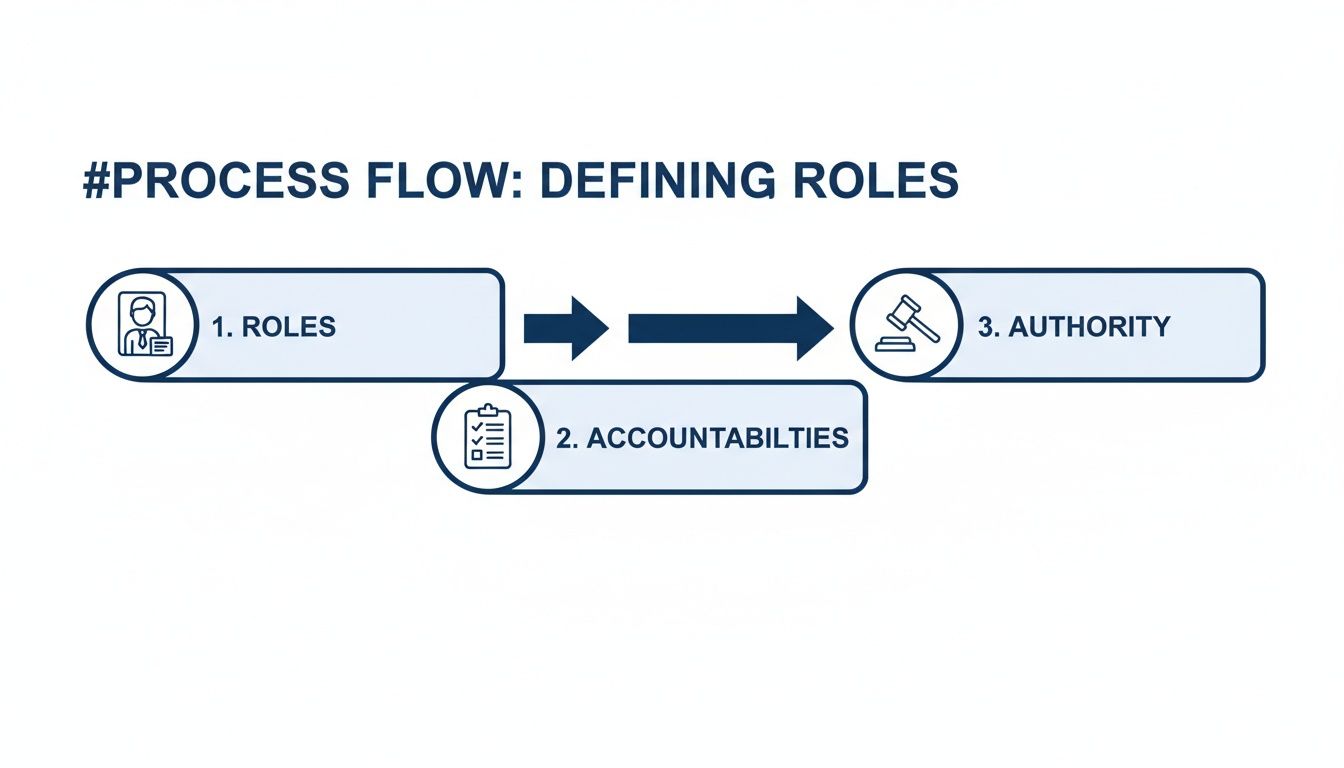 Following a clear process ensures every position is defined by its role, accountabilities, and authority, which is key to preventing ambiguity.
Even with careful planning, there will be a transition period. Some challenges are inevitable as people adjust to new processes and reporting lines. As a leader, your job is to remain visible, accessible, and supportive throughout this time.
Create opportunities for employees to ask questions and voice concerns, such as town halls or small group sessions. Actively listen to feedback and be willing to make minor adjustments where necessary. For businesses managing complex transitions, learning about the steps to implement effective HR outsourcing can provide valuable support.
An organizational structure should not be a static document. It is a living framework that must adapt as your company grows, your strategy shifts, and your market changes. A design that works for a team of 30 can become a bottleneck for a team of 100, creating friction that slows down the entire business.
The goal is to establish a deliberate process for making structural changes, whether that means creating a new department or shifting reporting lines. When done thoughtfully, these adjustments keep your organization aligned and agile.
How do you know when your organizational design is no longer effective? The warning signs are usually clear if you know what to look for. These issues often appear as persistent operational headaches that never seem to be resolved.
Common red flags include:
A well-designed structure should clear the path for your teams to do their best work. When it starts feeling like an obstacle course, it is time for a review. Your structure should accelerate progress, not hinder it.
To stay ahead of these issues, you need a process for periodically reviewing and adapting your structure. This does not have to be a complex exercise. For most small and mid-sized businesses, a simple governance framework is sufficient to ensure changes are strategic.
Establish clear guidelines for key structural decisions, such as when to create a new role or who can approve changes to reporting lines. This shifts the focus from reactive adjustments to deliberate choices aligned with your long-term goals. This proactive approach is also a key part of effective HR risk management strategies.
A formal review of your organizational structure should be on your leadership team’s calendar at least once a year. It is also wise to trigger a review anytime your business undergoes a significant strategic shift, such as launching a new product line or entering a new market.
Your review process can be straightforward, focusing on a few core questions:
By regularly asking these questions, you can make incremental adjustments that keep your organizational design healthy and effective. This continuous improvement mindset prevents the need for disruptive, large-scale reorganizations.
Designing your organizational structure is not a one-time project. If you are navigating these complexities and want to ensure your organization is structured for long-term success, we are here to help. You can connect with us to discuss your needs.
Ultimately, designing your organizational structure is a core leadership function with a direct impact on your company's ability to scale. A well-defined framework gives your team the clarity it needs to execute effectively, while strong governance protects the business from preventable risks. By shifting from an informal approach to a deliberate design, you create a foundation that can support sustainable growth.

This process is about building a clear, resilient, and adaptable organization that can handle complexity without sacrificing speed or employee morale. When done right, it empowers your managers, clarifies career paths for your employees, and solidifies your defenses against operational and legal challenges.
A well-designed organizational structure doesn't just manage the present; it prepares your business for the future. It is a strategic investment in clarity, accountability, and long-term stability.
The principles covered in this guide are practical tools for building a stronger, more organized, and legally defensible business. Implementing them thoughtfully will help you move past common growing pains and build a company that is truly built to last.
If you are navigating these challenges and want to ensure your organization is structured for long-term success, our team is here to help. You can contact us to discuss your specific needs and learn how we can support your growth.
Getting your organizational design right is a high-stakes decision for any leader. It is a process that naturally brings up tough questions, and the answers often determine whether you are building a scalable business or creating future challenges. Below are answers to some of the most common questions we encounter.
You should formally review your organizational structure at least once a year or anytime you are making a major strategic pivot. This includes entering a new market, launching a new product, or experiencing a rapid increase in headcount, such as a 25-30% jump.
However, you should also continuously watch for warning signs. If communication is breaking down, decision-making is slowing, or turnover is rising in a specific department, it may be time for a review. These are clear signals that your current structure may no longer be serving your business needs.
The most common mistake is designing the company around specific people instead of the functions required to execute the business strategy. It can be tempting to create a role tailored to a high-performing employee, but this approach creates long-term fragility. When that person leaves or is promoted, the structure can falter.
A stronger approach is to define the roles and accountabilities required to execute your business strategy first. Only then should you find the right people to fill those roles. This function-first approach creates clarity, ensures continuity, and builds a resilient organization.
Expanding across state lines introduces significant operational complexity. You will likely need a centralized HR or legal function to maintain consistent and defensible policies for payroll, employee leave, and termination procedures.
You must strike a careful balance between local operational autonomy and centralized oversight. Allowing local managers to make independent decisions that may violate state-specific employment laws can expose the entire company to serious legal and financial risk.
Span of control refers to the number of direct reports a manager can successfully lead. The right number depends on the complexity of the work, the experience of the team, and the manager’s capacity.
Here are some general guidelines:
The goal is to avoid overloading your leaders. When a manager’s span is too wide, performance management suffers, employee engagement declines, and operational risk increases.
Designing a sound organizational structure is a fundamental leadership duty that directly impacts your ability to grow safely and sustainably. At Paradigm International Inc., we serve as a decision partner for SMB leaders navigating high-stakes people decisions and complex employment challenges.
If you would like to learn more about building a defensible and scalable framework for your business, contact our team.