A multi-state SMB leader can open an internal email expecting a routine compliance reminder and instead find a much harder question: should the company continue preparing an EEO-1 report that the EEOC may eliminate? Finance needs a budget, HR needs a data owner, and operations needs a clear answer for managers across jurisdictions. Waiting for perfect certainty isn't a compliance strategy.
The EEO-1 2026 Update creates a narrow but important leadership task. Preserve the records and controls you can defend now, avoid unnecessary filing spend, and keep the organization ready for a rule that hasn't yet been finalized.
A multi-state employer can have payroll, HR, and operations working from different records when the EEO-1 rules shift. The EEOC describes Component 1 as a mandatory annual collection of workforce demographic data by job category, sex, and race or ethnicity. Its current statistics page still presents that obligation as active (EEOC EEO-1 employer information report statistics). Leadership therefore faces a practical decision: preserve enough reporting discipline to defend the company, without committing resources blindly.
The issue intensified after the EEOC moved toward ending mandatory EEO-1 reporting in 2026. The agency issued a proposed rule on July 21, 2026, with a public-comment deadline set for August 24, 2026, that would rescind annual race-and-sex reporting for covered employers under Title VII (EEOC proposed rescission of annual race-and-sex reporting requirements). The proposal changes planning assumptions. It does not erase an obligation that may still apply.
A professional services firm with employees in several states may already be reconciling payroll records, job classifications, establishment information, and demographic data. Stopping that work immediately could leave incomplete records and inconsistent methodology if the proposal changes, stalls, or fails to become final. Continuing without review could also waste staff time and filing resources.
Practical rule: Treat the current filing obligation as unsettled, not nonexistent.
The history shows why this deserves executive attention. Forbes reported that the EEOC has required this demographic reporting process since 1966, placing the system in operation for about 60 years (Forbes analysis of the EEOC proposal and reporting history). A possible end to future reporting cycles would change how employers maintain workforce demographic records, not merely how they use an online portal.
Multi-state SMB leadership should maintain a minimum defensible posture: preserve source data, document assumptions, assign ownership, and monitor rulemaking. For practical background, review this understanding the EEO-1 reporting framework.
The EEOC's action is a proposed rescission, not an immediate cancellation. It would remove annual race-and-sex reporting requirements for covered employers, but the agency must complete notice-and-comment rulemaking before that requirement can end, according to this analysis of the EEOC vote and proposed rescission.
For leadership teams, the decision is practical. A proposed rule shows the agency's direction, but it does not authorize employers to disregard an obligation that remains in force. The public-comment deadline of August 24, 2026 marks a procedural milestone, not a final rule or effective date. The EEOC proposed rescission notice sets out that process.
Maintain the reporting infrastructure until the legal status changes. The EEOC's public materials continue to post updates for the 2025 EEO-1 Component 1 collection, indicating that the filing system remains active while the proposal is unresolved (EEOC EEO data collections).
Adopt a minimum defensible readiness posture:
The EEO-1 process has been part of the federal compliance framework since 1966, according to Forbes' reporting on the proposal and its history (Forbes reporting on EEO-1's regulatory continuity). Employers that built recurring controls around the process may hold years of comparable classifications, workforce snapshots, and submission records.
Keep the underlying data and decision logic even if future annual reporting ends. Those records can support internal pay-equity reviews, agency inquiries, workforce-trend analysis, and counsel's evaluation of employment claims. Do not preserve every old task indefinitely. Preserve the data lineage and documented assumptions that would be difficult to recreate later.
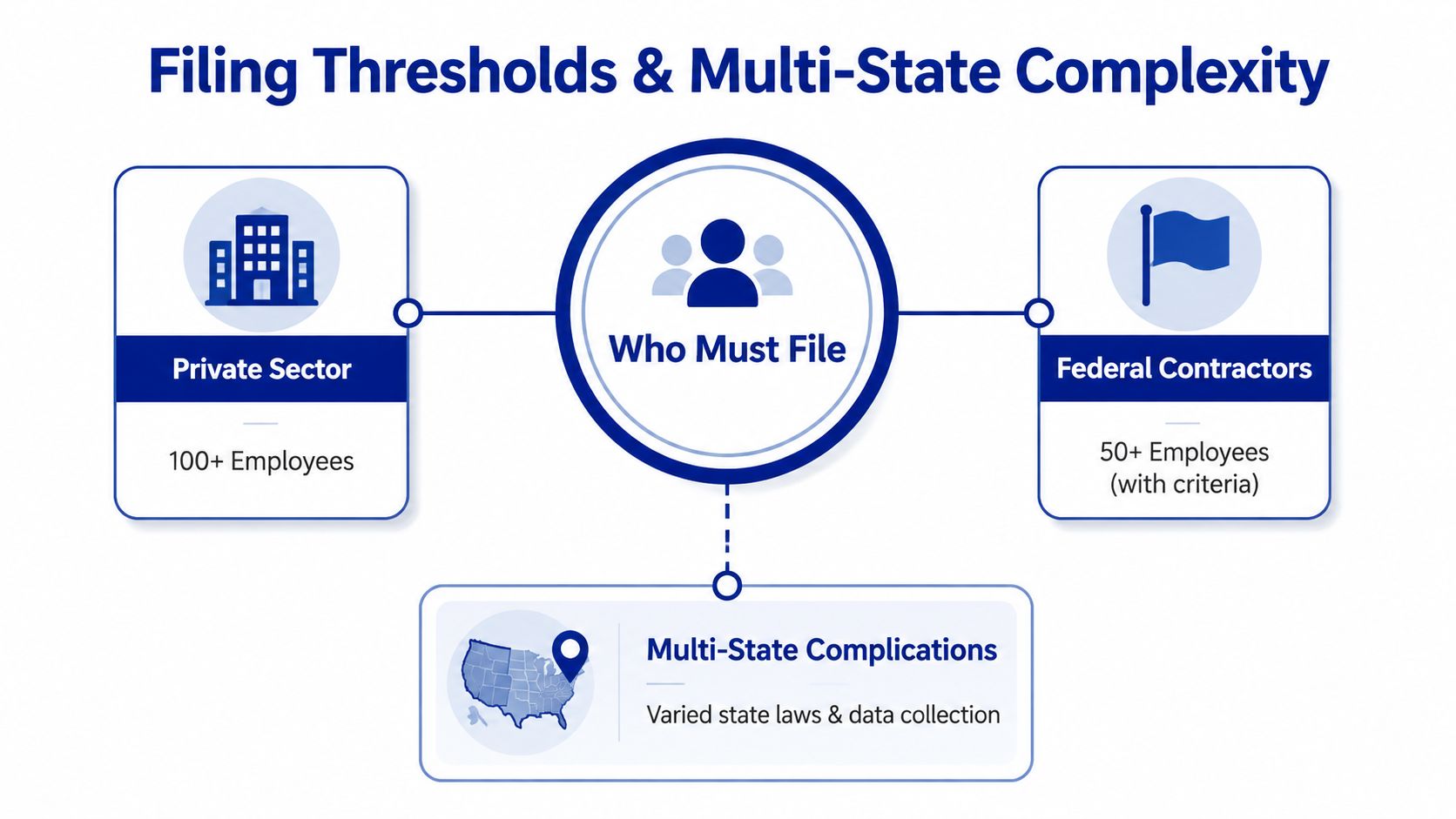
The distinction between a proposal and a final rule controls how employers should approach their current filing obligations. Under the current framework, the EEO-1 Component 1 collection applies to private-sector employers with 100 or more employees. It also applies to federal contractors with 50 or more employees that meet certain criteria. Employers should confirm their status against the applicable instructions rather than assume that regulatory change has ended their responsibilities. (EEO-1 Component 1 instruction booklet)
For a multi-state SMB, the threshold is only the first decision. Leadership must establish which legal entities and establishments are covered, how employees are assigned to locations, and which workforce snapshot will support the analysis. A payroll export alone will not resolve those questions.
The workforce snapshot must come from an employer-selected pay period between October 1 and December 31 of the reporting year. That timing can expose gaps when payroll, HRIS, and recruiting systems use different dates or employment statuses.
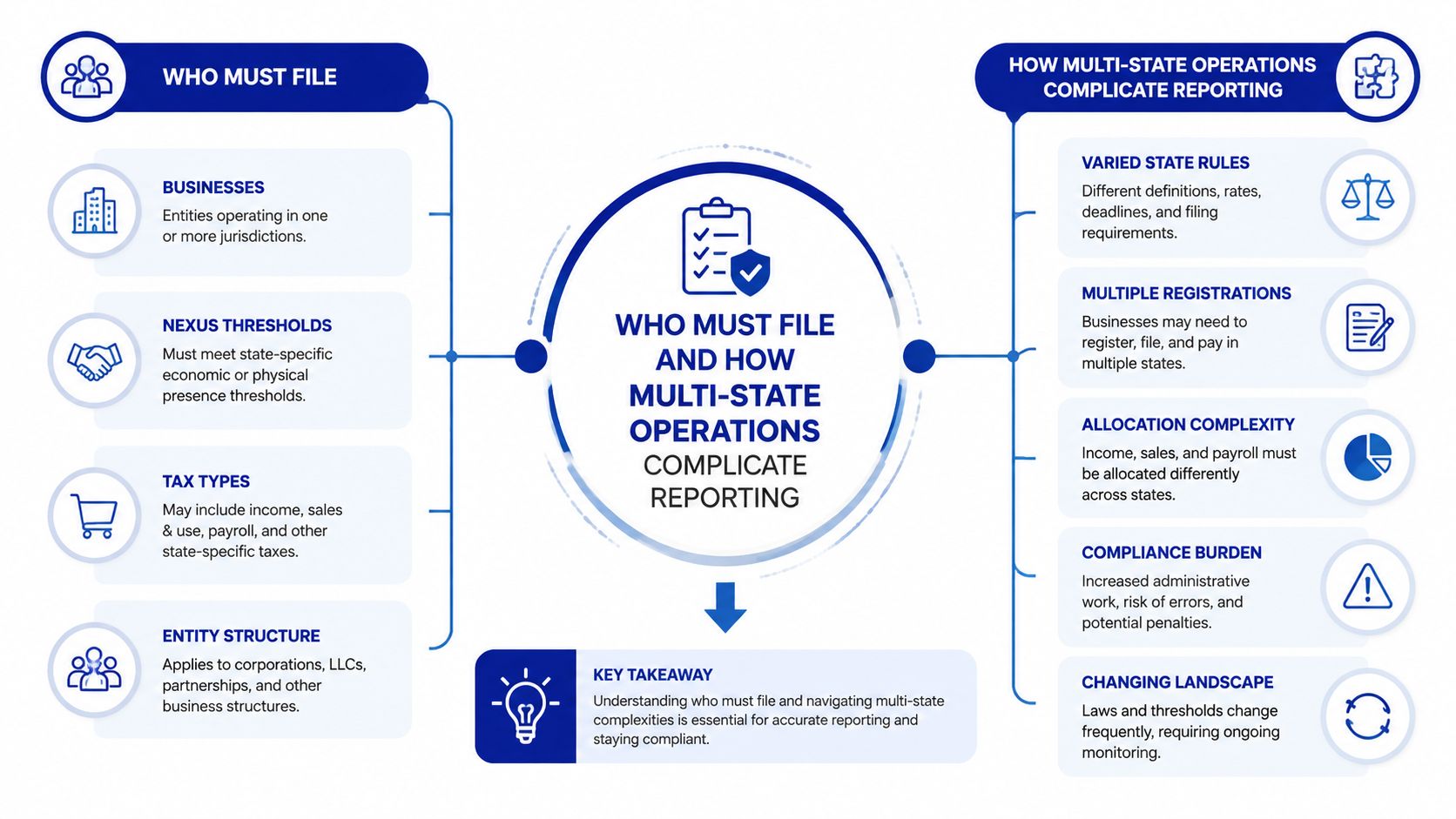
One company may use a shared payroll platform, separate state-level HR records, and inconsistent job titles. Remote employees create additional questions about establishment assignments and work location. Without a common data dictionary, reported totals may look reasonable while remaining difficult to explain.
Common failure points include:
The practical risk is an inaccurate workforce picture that increases exposure during investigations, bid reviews, or disclosure disputes. Leadership should document its method and record exceptions. A structured review of cross-jurisdiction compliance risks can help connect employment data controls across states without turning uncertainty about future rules into unnecessary filing work.
Start with source systems, not the form. Identify the roster for the selected pay period, record the date, map each role to its job category, and reconcile the result to payroll totals. Retain source exports, mapping decisions, the exception log, and approval record.
Assign one owner to monitor EEOC updates, coordinate HR and finance, and preserve the decisions behind the analysis. Reserve internal capacity for data review, but do not authorize unnecessary filing work before requirements are clear. Tell executives and managers that the company is maintaining readiness, not treating the reporting obligation as ended.
Data principle: If another qualified person cannot reproduce the total from the records you kept, the process is not auditable.
A multi-state employer can submit an accurate EEO-1 report and still face exposure later. That risk is especially serious for federal contractors. In early 2026, court developments moved toward public release of years of contractor EEO-1 data. Reporting indicated that bellwether objectors' data could be released first, followed by non-bellwether contractor data (Ninth Circuit FOIA ruling update on EEO-1 disclosure).
Separate coverage warned contractors to prepare for publication of historical EEO-1 reports from 2016 to 2020. The operational point is direct: information submitted for compliance may later matter in public-record disputes, reputation concerns, contract scrutiny, or litigation. Historical reporting deserves the same control discipline as a current filing.

An HR coordinator may prepare the report, an executive may approve it, and the organization may move on after submission. That workflow leaves a control gap when the reported workforce data is later compared with hiring, promotion, termination, compensation, or contracting records.
The risk extends beyond an honest administrative mistake. Inconsistent classifications, unexplained changes from earlier submissions, or unsupported demographic totals can prompt questions the original preparer never expected. Counsel may need to explain the selected snapshot date, job-category mapping, establishment allocation, and approval path.
Retain enough evidence for another qualified reviewer to reconstruct the submission without relying on memory or informal explanations.
The deadline itself is not a final rule or an effective date. Leadership still must decide what records to preserve if requirements change, the portal opens, or a third party challenges the company's data.
A minimum defensible posture includes:
A proposed rescission may reduce future filing work, but it does not erase historical records or eliminate downstream uses of data already collected. Instead of preserving every old process indefinitely, leadership should focus on retaining the data lineage and decision logic that would be difficult to recreate later. Treat EEO-1 materials as sensitive workforce records with a defined retention and review strategy.
A small HR team can establish a defensible readiness posture with four controls: assigned ownership, reconciled data, documented decisions, and a clear escalation path. That standard protects the company while federal reporting requirements remain unresolved.
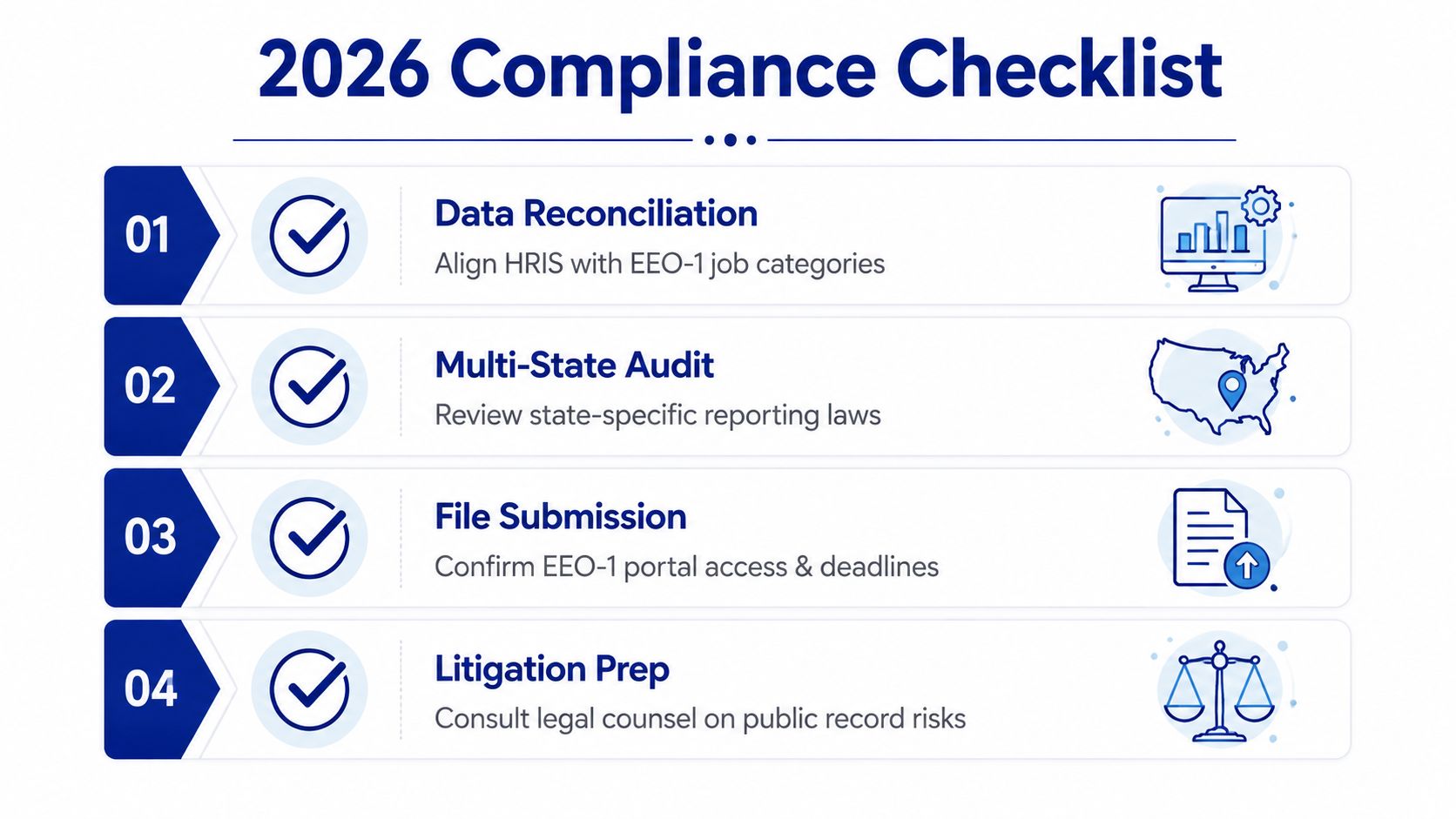
Pull employee data from the HRIS and payroll systems, then compare the totals. Assign one filing owner to control the working file, and prohibit reliance on an unverified spreadsheet assembled from email attachments.
Confirm:
The objective is traceability. A reviewer should be able to follow each number from the source system to the final report without guessing.
Use an employer-selected pay period between October 1 and December 31 of the reporting year, consistent with the applicable Component 1 instructions. Record the selected period and require HR, payroll, and finance to use the same reference point.
Compare the current mapping approach with prior-cycle methodology. Consistency does not require repeating an error, but an unexplained change makes internal review harder and can invite questions from investigators, contracting personnel, or counsel. Document the reason for every material methodology change.
Maintain a controlled folder containing source exports, calculation files, approval notes, portal-credential ownership, and the latest agency communications. The company is maintaining readiness while the rule remains unresolved.
Set a modest readiness budget and identify the people who would complete the work. Release additional filing resources only if the obligation remains active or the company receives a clear filing directive. Keep the folder access-controlled because these materials contain sensitive workforce information.
Federal uncertainty does not remove state employment obligations. Review employee handbook requirements by state alongside EEO-1 data practices, particularly where demographic information, record retention, privacy, or workplace notices may be handled differently.
Create a short leadership memo that answers four questions:
This memo preserves institutional memory if the HR coordinator leaves or the rule changes. Leadership should be able to identify the current data owner, the unresolved judgment calls, and the action that would activate further review.
A multi-state employer needs a readiness posture that remains useful through regulatory change. The strongest response is a durable control system that supports compliance, internal analysis, and legal review even if federal reporting requirements shift.
Name one executive owner and one operational lead. The executive owner approves risk tolerance and budget. The operational lead coordinates HRIS, payroll, finance, legal, and state-level compliance inputs.
Use a simple decision calendar:
A defensible process should remain functional regardless of whether the company files, delays preparation, or retires the federal workflow entirely. Keep the employee data dictionary current. Document how new states, acquisitions, remote employees, and reorganizations affect establishment and job-category records.
Federal reporting changes would not eliminate other demands for reliable workforce information. State agencies, contractors, customers, and internal leadership may still require consistent records. A clean audit trail also supports employment-risk decisions involving investigations, manager conduct reviews, terminations, and employee complaints.
Legal counsel should define retention, disclosure, and litigation-response practices. Finance should distinguish a limited readiness allocation from an open-ended filing project. HR should own data quality, while executives should decide whether to accept or escalate risk.
For ongoing updates on employment compliance developments and operational risk, leadership teams can browse ForwardThis updates as one monitoring resource.
The playbook should scale with the organization. A company entering a new state needs a repeatable intake process covering location, employee status, job structure, and local requirements. Assigning those responsibilities now gives leadership a defensible record of its decisions, regardless of how the federal workflow develops.
The EEO-1 2026 Update illustrates a broader reality for multi-state SMBs: regulatory uncertainty doesn't pause operational risk. Employers still need reliable records, consistent decisions, and a clear explanation of how workforce information was collected and reviewed.
Proactive HR risk management helps leadership teams respond deliberately when requirements shift, employees raise concerns, or public disclosure creates new exposure. [International Inc.] works with owners, COOs, and executive teams on defensible HR practices, multi-state compliance decisions, investigations, documentation standards, and other high-stakes people matters.
If your organization needs to determine its minimum readiness posture, Paradigm International Inc. can help assess the data, ownership, documentation, and multi-state controls that support a defensible response while the EEO-1 rules remain unsettled. Contact the team to discuss a practical plan customized to your workforce structure and regulatory exposure.